

Road Ends in Illinois by Kathy Alexander.
For the most part, Illinois Route 66 glides smoothly and easily through the state along a southwest-to-northeast alignment between Chicago, Illinois, and St. Louis, Missouri. The Illinois section of historic Route 66 has a relatively level alignment and has never offered motorists the thrilling or terrifying switchbacks, dips, and cuts encountered along the southwestern portions of the Mother Road. Unlike many other segments of Route 66, Illinois Route 66 runs through a densely populated, highly developed State. By the mid-1920s, Illinois already had a considerable infrastructure, including a modern road network.
When officially commissioned in 1926, Illinois Route 66 took over State Route 4, a pre-existing, heavily-used, fully paved or “slabbed” two-lane road between Chicago and St. Louis. Thus, while the national span of Route 66 would not be wholly paved until 1938, the Prairie State could boast from the very start that its segment of the Mother Road was mud-free and “slab all the way.” Due to population and development pressures, Illinois Route 66 received constant repairs, upgrades, widening, resurfacing, and rerouting. A distinguishing feature of the history of Illinois Route 66 was the speed of its evolution. From its earliest years, engineers worked to bypass as many rural towns as possible to ensure a speedy, unobstructed flow of ever-increasing traffic between Chicago and St. Louis. Thus, from its birth, Illinois Route 66 was already moving away from its traditional main-street course toward the model of its interstate successor, and toward its demise.
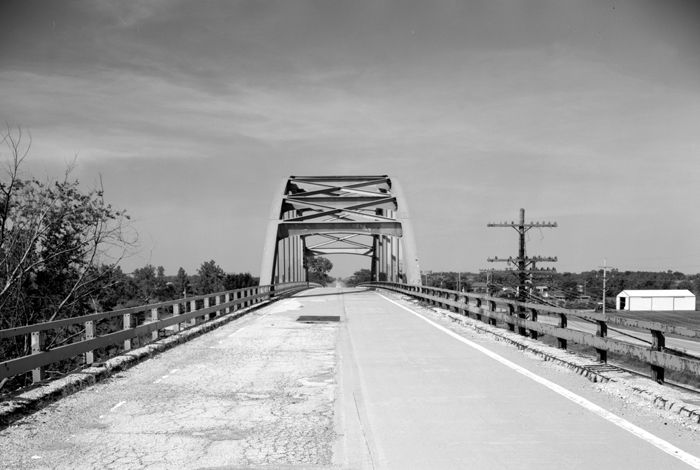
Bridge in Braceville, Illinois, by the Historic American Buildings Survey.
The change process accelerated with the designation of Route 66 as a strategic defense highway during World War II. While traffic to and from the great ordnance factories outside Chicago was critical to feeding the nation’s hungry war machine, it also devastated the Route 66 roadbed, which had not been built to sustain the constant flow of the heavy load-bearing munitions trucks. Even as the war raged, the road received significant upgrades, with many features pointing toward the four-lane limited-access interstate system of the 1950s. The role of the Federal Government, especially its far-reaching Federal Defense Highway Act of 1941, was critical in funding these efforts.
The story of the road’s evolution left its mark on people’s lives. Every change in the Mother Road type and route meant something good or bad for the people along the road. A significant rerouting could bring welcomed business and travelers to the new corridor but also painfully wound the areas left behind. The modern upgrade to a four-lane, limited-access road was a boon to motorists but could spell disaster for the bypassed roadside establishment.
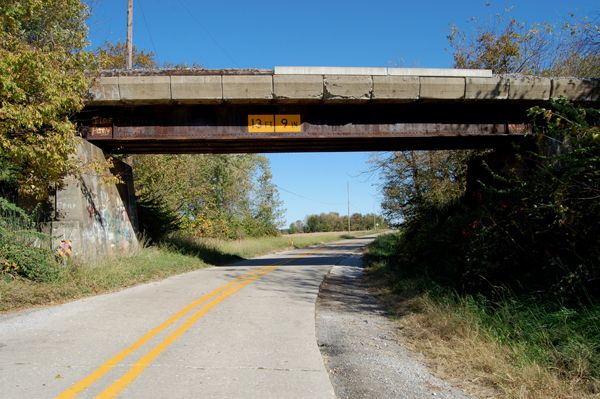
An old concrete segment and bridge North of Nilwood, Illinois. Photo by Kathy Alexander.
The Road Segments
Route 66 in Illinois is a very tenacious road. Although decommissioned in 1977, the Prairie State’s portion of the Mother Road endures, often under new designations, and all but about 13 miles of the final alignment remains traversable. The six road segments below are listed in the National Register of Historic Places. Individually and collectively, they offer the traveler insights into the engineering achievement and evolution of the road in Illinois. Regarding their historical significance, the segments of Route 66 Carpenter Park, Illinois Route 4/North of Auburn, and Route 66 from Girard to Nilwood evoke the engineering and transportation developments of the 1920s and 30s. The segments of Alternate Route 66 — Wilmington to Joliet, Cayuga to Chenoa, and Litchfield to Mount Olive — are significant as wartime and postwar upgrades from 1942 to 1955. Road segments are listed geographically from East to West.
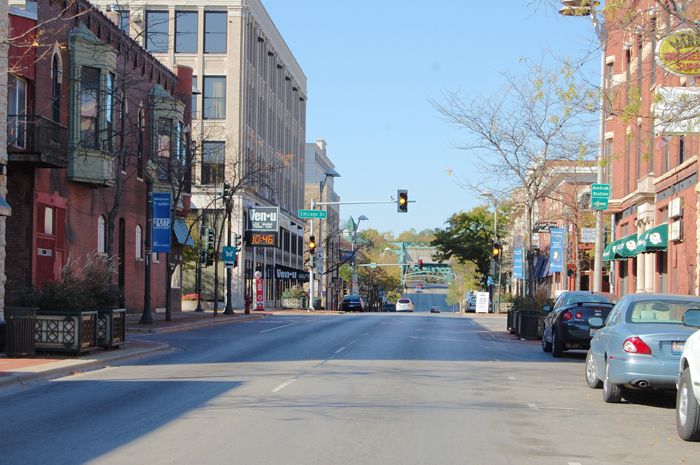
Route 66 in Joliet, Illinois, by Kathy Alexander.
Alternate Route 66, Joliet to Wilmington (1942-1967) – This road segment, stretching from Welco Corners to Gardner, was part of the original alignment until Joliet was bypassed. The main alignment was moved to pass through Plainfield, with the original pavement dubbed Alternate Route 66, which later became Illinois Route 53. The impacts of World War II and the Federal Government are central to this segment’s story. Due to the punishing wartime traffic to and from the nearby Kankakee and Elmwood ordnance plants, the original two-lane highway was replaced by a limited-access, four-lane, divided highway constructed between 1942 and 1945. It was authorized and funded by the Federal Defense Highway Act of 1941. To withstand the wear and tear of wartime traffic, updated construction methods were employed, including a unique gravel-and-stone sub-base atop the older roadbed and a divided, 24-foot-wide roadbed with a 10-inch-thick Portland cement slab.
According to Dwight Cannon, 2024 President of the Route 66 Association of Illinois, “some of the Plainfield alignment is now under I-55, but sections remain, among them what is now labeled as IL 129. IL 129 is not marked as Historic 66, even though it served as US 66 for far longer than the Joliet alignment. If driving on Historic 66, one can see a road paralleling Historic 66 on the other side of the tracks between the Braidwood and Gardner areas – that is the Plainfield alignment, which dead-ends near Gardner where a bridge once existed but has since been eliminated. An original section North of Elwood, currently marked as Chicago Road and then Mississippi Road, was the actual alignment heading into Elwood until it was bypassed by the straighter section that bypassed Elwood.”
This segment remained a significant transportation artery until the coming of Interstate I-55 in 1956. Aside from a new macadam overlay, much of the road’s original 1945 character remains. Travelers should look for the 1942 Union Pacific Overpass near the northern end of the segment’s boundary and four remaining box concrete culverts. To travel this section, begin at Patterson Road in Joliet and travel South on Highway 53 toward Wilmington. The course ends at the junction of Highway 53 (Alternate Route 66) and Illinois Route 102 (Water Street) in downtown Wilmington.
Alternate 66 was officially “retired” in 1967, with the road becoming IL 53. At that time, US 66 and I-55 shared the same roadbed, and US 66 was retired in Illinois in 1977.
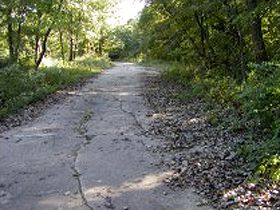
Old Route 66 in Carpenter Park, Springfield, Illinois.
Route 66 by Carpenter Park, Springfield (1922-1936) – (Marked with No Trespassing signs as of this Nov. 2024 update.) This short, surviving segment of abandoned roadbed, extending for about one-quarter mile on the North bank of the Sangamon River in North Springfield, offers the traveler the sensation of visiting not only a road but an archeological site, for it has not seen automobile traffic since 1936. The two-lane, 16-foot-wide road reflects the prevailing engineering and design methods of its 1922 construction. It is also a good example of how existing paved roads were merely redesignated Illinois Route 66 at the Mother Road’s inauguration in 1926.
In 1922, this 16-foot-wide roadway was paved with cement and gravel, with expansion joints placed every 30 yards. Its original four-foot gravel shoulders and four-inch curbs still flanked parts of the road. This segment’s life as Route 66 was short, for almost immediately, engineers began work on a new, wider (four-lane) alignment a few yards to the East, which was completed in 1936. The Carpenter Park segment remains intact mainly because it has not carried traffic since 1936, although it is missing its Old Iron Bridge over the Sangamon River.
With the road’s decommissioning in 1936, the bridge was dismantled, leaving only the concrete abutments. This segment is now a part of Carpenter Park on the far North side of Springfield, Illinois. Visitors are welcome to walk on this stretch of Route 66, surrounded by a forest preserve of native hardwood. The entire segment is contained within the park’s boundaries. The 322-acre park is also an Illinois Nature Preserve, owned by the city of Springfield and overseen by the Illinois Department of Natural Resources.
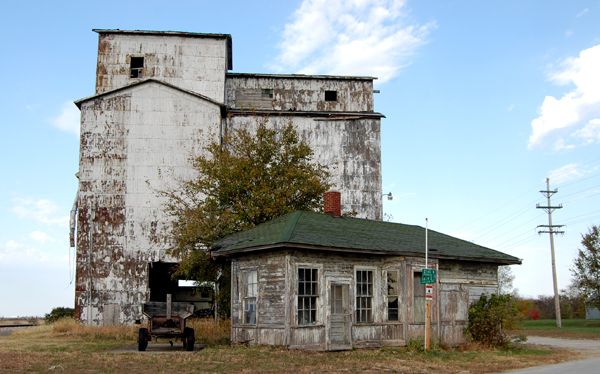
Cayuga, Illinois.
Route 66, Cayuga to Chenoa (1943-44; 1954-55) – This segment’s original 1920s state-of-the-art pavement boasted a width of 18 feet and a Portland cement slab six inches deep. Like the Alternate Route 66 between Wilmington and Joliet, this 18.2-mile segment stretching from Cayuga to Chenoa proved woefully inadequate to carry the burden of Route 66’s World War II mission. The excessive weight and volume of wartime traffic wreaked havoc on the narrow roadbed, necessitating a serious upgrade. A 1943-44 wartime makeover included two lanes of 24-foot-wide, ten-inch-thick concrete. The sections were generally striped for 11-foot driving lanes (an extension of two feet over the older pavement). The southbound lanes, constructed directly over the older roadbed, were completed in 1944, and the northbound lanes in 1954-55, creating a four-lane highway with a center median. Today, the northbound lanes have a new macadam overlay, but the southbound lanes retain their original concrete surface for the most part. The segment retains six historic bridges. To travel this segment from Odell, go South on Odell Road toward Pontiac and Cayuga. From Cayuga, take Pontiac Road into Pontiac. Follow the gradual curve right, then curve left onto Division Street. Cross North Creek, then curve right onto Lincoln and left onto Ladd Street. Cross the junction with Howard. At Reynolds, turn right on Highway 116. Turn left onto Bypass 66 and follow the Frontage Road through to Chenoa.
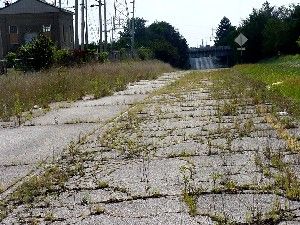
Old Route 66 West of Mt. Olive, Illinois, by Kathy Alexander
Route 66, Litchfield to Mount Olive (1943-1955) – As with Alternate Route 66 from Wilmington to Joliet and Route 66 from Cayuga to Chenoa, the Mother Road’s stretch from Litchfield to Mount Olive was transformed as a result of World War II. By 1942, the original alignment in this area had significantly deteriorated under the stress of wartime traffic. Authorized by the Federal Defense Highway Act of 1941, the approach to constructing this segment shows both the pressures of wartime conditions and the long-term postwar vision (already present in 1941) of transforming Illinois Route 66 into a modern, limited-access freeway between Chicago and St. Louis. The new two-lane road, with a pavement of Portland cement, 24 feet wide and 10 inches thick, was set down just to the West of the older route, which had been constructed in 1930-31. The older, deteriorated pavement was kept in service until the new alignment was complete. When the new Route 66 southbound lanes were completed in 1943, the older alignment was designated Old Route 66 and remained open to local traffic. Construction of the northbound lanes had to wait until after the war. Still, when completed in 1954-55, they formed, along with the 1943-44 southbound lanes, a state-of-the-art four-lane highway with a center median — a veritable precursor to the Interstate freeway.
This segment received a Cost-Share Grant from the National Park Service Route 66 Corridor Preservation Program in 2002. To travel this section from I-55, take the 13th Street exit into Litchfield. Head South on “Old US 66 1940-1977.” This road will meet up with “1930-1940 Historic 66 at North 10th Ave. Continue South on Route 6. Cross St. James Road, turn left on Old Route 66 St. into Mount Olive. Follow Old Route 66 Street across the Junction of Highway 138 and out of town.
This segment received a Cost-Share Grant from the National Park Service Route 66 Corridor Preservation Program in 2002. To travel this section from I-55, take the 13th Street exit into Litchfield. Head South on “Old US 66 1940-1977.” This road will meet up with “1930-1940 Historic 66 at North 10th Ave. Continue South on Route 6. Cross St. James Road, turn left on Old Route 66 St. into Mount Olive. Follow Old Route 66 Street across the Junction of Highway 138 and out of town.
Pre-1930 Segment of Route 66 – Chatham to Staunton – One of the oldest and most scenic segments of Route 66 in Illinois, with portions of this path predating the Mother Road as it follows the old Pontiac Trail. Named for Ottawa Chief Pontiac, this road was the main pathway between Chicago, Illinois, and St. Louis, Missouri, in the early 1900s. That pre-1930s two-lane alignment meanders through Chatham and Auburn — where you can see a piece of brick alignment — before moving on to Thayer, Virden, Girard, Nilwood, Carlinville, Gillespie, Benld, Sawyerville, and Staunton. South of Staunton, the road rejoins with the later alignment.
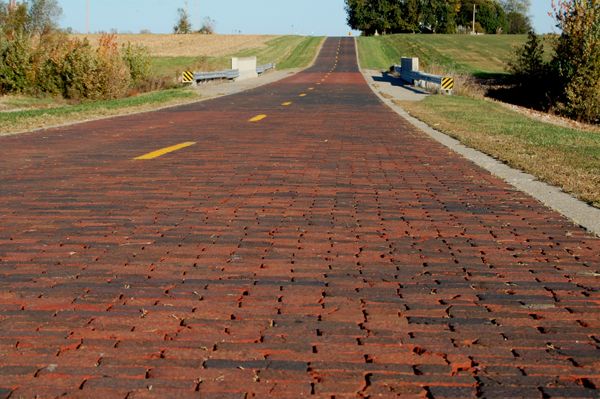
Brick Road Route 66 North of Auburn, Illinois, by Kathy Alexander.
Illinois Route 4, North of Auburn (1921-1932) – A bypassed portion of old Route 4 North of Auburn, Illinois, is listed in the National Register of Historic Places. This segment comprises a 1932 1.53-mile-long brick road and a 1921 Portland cement road. Both are well-preserved examples of Route 66’s early years in Illinois, illustrating early highway-era construction methods. These sections were part of Route 66 until 1930, when the realignment South of Springfield rerouted traffic to the less-populated eastern side through Litchfield to speed up flow by avoiding as many towns as possible.
The concrete section consists of a 1,277-foot-long, 16-foot-wide Portland cement section dating from 1921. After Route 66 was realigned in 1930, this section briefly reverted to its State Route 4 designation before being abandoned in a 1932 relocation of the State road.
To reach the concrete 1,277-foot section, travel South on Highway 4 from Chatham to Alpha Road and turn West. The segment is located on Alpha Road between Highway 4 and Curran Road. The Auburn Brick Road is between Chatham and Auburn on Snell and Curran Roads. Heading South from Chatham on Highway 4, turn West on Snell Road, which will curve South and turn into Curran Road before rejoining Highway 4.
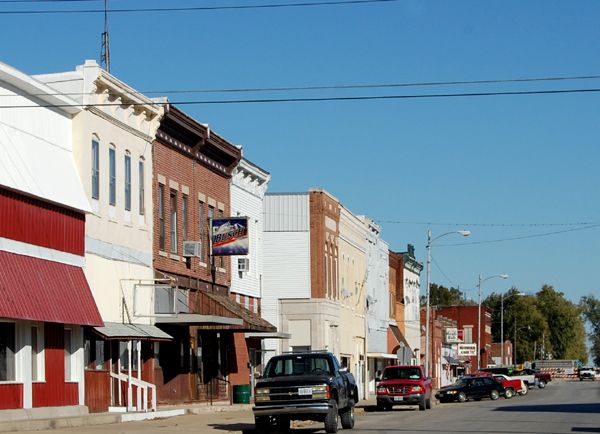
Route 66 in Girard, Illinois, by Kathy Alexander.
Route 66, Girard to Nilwood (1919-1931) – Underscoring the fast-paced evolution of Route 66 in Illinois, this segment was designated as a part of the Mother Road in 1926. Still, it was quickly replaced in 1930 with a major realignment to the East. Constructed in 1920 as part of old State Route 4, this short-lived section of Illinois Route 66 is typical of the engineering and construction methods of the post-World War I era. This was a time of genuine transition in road construction, often combining horse and mule with World War I state-of-the-art trucks and machinery. The road’s cross-section included two eight-foot-wide lanes with 4-7 foot-wide gravel shoulders. The Portland cement slab was generally six inches thick. Although cracked in places, its current concrete pavement is original. The road segment retains five original concrete box culverts and a 1920 single-span concrete bridge.
An interesting piece of pavement can be seen just South of Nilwood, Illinois, where turkey tracks were imprinted in the original concrete when it was poured. After more than 80 years, they can still be seen today. To travel this section, head South on Highway 4 toward Girard, turn right on Madison St., and left on 6th St. Continue South on 6th St. across Highway 4. Turn right on Wylder, then left past the railroad underpass. Turn right on Morean Road. Turn left on Pine and right on Morean St. in Nilwood, which will reconnect with Highway 4. Stay ahead across. The road segment ends at 4.0 miles at the intersection with Illinois Route 4 at the West end of Moraine Street. The National Register nomination form can be found here.
Compiled and edited by Kathy Alexander/Legends of America, updated August 2026.
Source: National Park Service

Travel West

Route 66

Travel East