
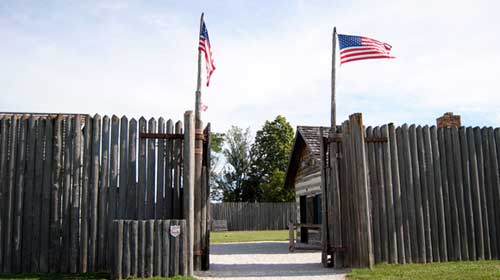
Fort Dodge, Iowa, photo by Kathy Alexander.
The area where Fort Dodge would be built had long been home to the Sioux, Winnebago, and Sac and Fox tribes before Iowa became a part of the Louisiana Purchase in 1803. Until Lewis and Clark came through in 1805, only American Indian tribes and French fur traders knew the region. After the Lewis and Clark expedition, however, many others began to come to the land to settle, establish relations with Indian tribes, and survey the land for the U.S. Government.
One of the first in-depth explorations of what would become the Fort Dodge area was made in 1835 by three companies of the 1st U.S. Dragoons led by Lieutenant Colonel Stephen Kearny. To identify future sites for military posts, the men traveled up the Des Moines River through southern Minnesota before heading South to the Fort Dodge area. When they came upon Lizard Creek, they noted how the site would be suitable for a potential fort along the Des Moines River.
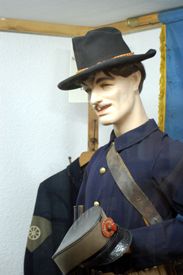
Fort Dodge Museum exhibit by Kathy Alexander.
Fifteen years later, another body of United States soldiers followed the same route under the command of Brevet Major Lewis Armistead, who was ordered to establish a fort at the mouth of Lizard Creek. They built the post there mainly because the Indians had annoyed the early settlers and because they feared they might do worse.
A few years later, a stage line followed the same path the soldiers had taken, becoming known among early settlers as the “Dragoons’ Trail.”
Armistead, who had scouted the area earlier, chose the site the Dragoons had recommended 15 years earlier. Overlooking the junction of the Des Moines River and Lizard Creek, the site offered good water, timber, and stone for building. Armistead led the construction of the post and brought in a steam sawmill to speed up the work. Armistead’s soldiers were soon joined by more troops dispatched from Fort Snelling, Minnesota, to help build the military post. By hiring additional civilian laborers, they completed 12 buildings by November 1850. The post was first named Fort Clarke in honor of the commanding officer of the 6th Infantry. However, they soon learned another fort in Texas shared the name, so the following spring it was renamed Fort Dodge in honor of Colonel Henry Dodge, the U.S. Senator of Wisconsin Territory (which included Iowa at the time) and the founder of the Dragoons.
They also constructed nine more buildings the next spring. The post’s population included three commissioned officers, 10 non-commissioned officers, about 75 enlisted men, and 40 civilians, many of whom were soldiers’ family members.
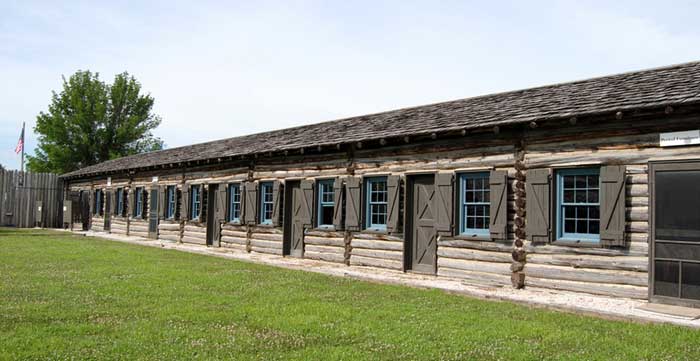
Fort Dodge, Iowa Barracks by Kathy Alexander.
During the fort’s life, the soldiers’ day-to-day life was pretty routine and never involved combat. In fact, when they weren’t drilling or tending to the post, they were primarily involved in keeping trespassers off the Sioux lands, finding bootleggers, and pursuing military deserters. At that time, deserters from the post were frequent, as the lure of the California Gold Rush was strong. For entertainment, the soldiers primarily hunted, drank, and gambled.
Just three years after its establishment, the post was decommissioned, and the soldiers were ordered to Minnesota to establish Fort Ridgely. The next year, William Williams, the post’s sutler, acquired the buildings and the military post and soon would plat the City of Fort Dodge. However, it would be years before the “town” was officially established.
The post was originally located on 1st Avenue North. Today, the reconstructed Fort Museum and Frontier Village are located on the Southwest edge of Fort Dodge. They are a full-scale recreation of a 19th-century military outpost on the prairie and also feature a reconstructed village from the same period.
Buildings and corresponding collections include a family cabin, church, one-room schoolhouse, cabinet shop, land office, general store, drug store, jail, print shop, blacksmith shop, livery stable, pottery building, and tinsmith shop. Other collections include prehistoric, military, Native American, Civil War, period furniture, and early Fort Dodge artifacts.
The only remaining cabin from the fort that established Fort Dodge is dedicated to Lewis A. Armistead, a Confederate general killed at Pickett’s Charge during the Battle of Gettysburg. Before joining the Confederacy, Armistead served as Quartermaster at Fort Dodge. Another special exhibit building tells the story of the Cardiff Giant, one of the most famous 19th-century hoaxes, carved from gypsum mined near Fort Dodge.
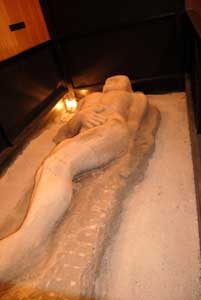
A replica of the Cardiff Giant is on display at the Fort Museum & Frontier Village in Fort Dodge, Iowa. Photo by Kathy Alexander.
The Fort Museum hosts a “Frontier Days” event annually on its grounds. It features a parade, a beauty pageant, historical reenactments, a buck-skinner camp, and live entertainment.
More Information:
Fort Dodge Museum and Frontier Village
1 Museum Rd., Fort Dodge, IA 50501
515-573-4231
©Kathy Alexander/Legends of America, updated September 2026.
Also See:
Forts & Presidios Across America
The Cardiff Giant – A Sucker Born Every Minute
Sources:
Fort Museum and Frontier Village Handout
Pratt, H.M., Fort Dodge and Webster County, Iowa, Pioneer Publishing Co., 1913
Wikipedia