
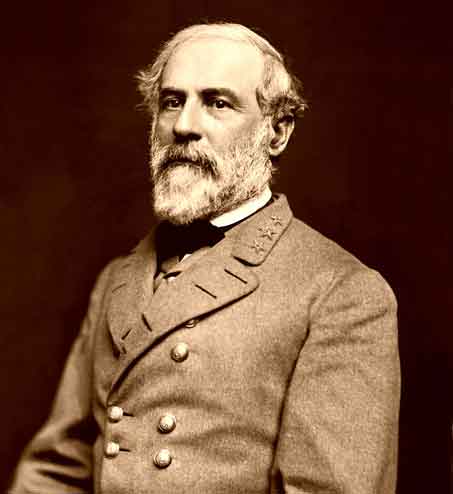
Robert E. Lee.
Robert Edward Lee was a Confederate general best known for his service to the Confederate States of America during the Civil War. Appointed the overall commander of the Confederate States Army, he led the Army of Northern Virginia, the Confederacy’s most powerful army, from 1862 until its surrender in 1865.
Lee was born on a plantation in Westmoreland County, Virginia, on January 19, 1807, the fifth child of American Revolution hero Henry “Light-Horse Harry” Lee and his second wife, Anne Hill Carter Lee. He attended the Alexandria Academy before entering West Point in 1825. He graduated second in his class in 1829, with no demerits against his name. He was then commissioned as a brevet 2nd Lieutenant in the Corps of Engineers.
On June 30, 1831, he married Mary Ann Randolph Custis, and the couple would eventually have seven children. All three of their sons would grow up to serve in the Confederate army during the Civil War.
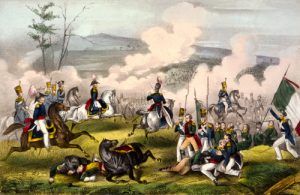
Mexican-American War.
Lee served in the Corps of Engineers in various capacities until the Mexican-American War began in 1846. He was promoted to Colonel during the two-year conflict for his gallantry and distinguished conduct in vital scouting missions.
Afterward, he served as the superintendent of West Point for three years before becoming a Lieutenant Colonel in the 2nd U.S. Cavalry and working in Texas. He served here from 1857 to 1861. When talk of secession began, Lee first denounced it as a “revolution,” and Union Army commander Winfield Scott wanted to promote Lee to a top command post. Lee said he was willing as long as his native state of Virginia stayed in the Union. Though Lee was from the South, he was attached firmly to the Union and the Constitution and entertained no particular sympathy for slavery.
When Virginia withdrew from the Union, Lee resigned his commission rather than help suppress the insurrection. He resigned two days after the Chief of Command of U.S. forces under General Winfield Scott offered him the position. He then proceeded to Richmond to become Commander-in-Chief of Virginia’s military and naval forces. When these forces joined Confederate service, he was appointed a Brigadier General in the Confederate States of America.
General Lee took the initiative and acted at once whenever he had a plan. Cutting off supplies and reinforcements at Seven Pines was a successful Confederate venture. He also halted Union General George B. McClellan’s threat to Richmond during the Seven Days’ Battle (June 26-July 2, 1862). His next assignment ended in defeat when he led his men to a loss at the Battle of Cheat Mountain (September 12-15, 1861) in present-day West Virginia. He began organizing the coastal defenses, but was hampered by the lack of an effective Confederate Navy. He returned to Richmond, Virginia, in March 1862 to become a military advisor to Confederate President Jefferson Davis.
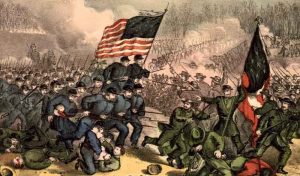
Second Battle of Bull Run, by Currier & Ives.
In the spring of 1862, commanding the Army of Northern Virginia, he led his men in the battles of the Peninsula Campaign. By August, he had defeated the Union Army at the Second Battle of Bull Run in Manassas, Virginia, then invaded Maryland and fought in the Battle of Antietam. In May 1863, Lee and General Stonewall Jackson made news with their dramatic victory over a more significant force at Chancellorsville, Virginia.
Lee continued to lead his troops in several battles throughout the war. He was promoted to General-in-Chief of the Confederate forces on January 31, 1865. But for the South, it was too late, as its army was devastated by casualties, disease, and desertion. When the Union attack on Petersburg, Virginia, was successful on April 2, 1865, Lee abandoned Richmond and retreated West. A week later, his forces were surrounded, and he surrendered them to Ulysses S. Grant on April 9, 1865, at the Appomattox Court House.
After the war, Lee moved to a friend’s plantation in Cartersville, Union forces. In October 1865, he became the president of Washington College (later renamed Washington and Lee University) in Lexington, Virginia, a job he retained until his death. In late September 1870, he suffered a stroke, and on October 12, he died. He was buried beneath the Lee Chapel at the University, where his body remains today.
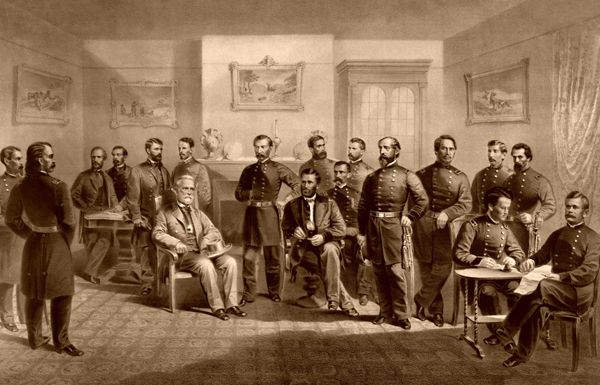
Confederate General Robert E. Lee surrenders to Union General Ulysses S. Grant by Major and Knapp.
During the Civil War, the most celebrated general of the South became even more respected after his surrender for his character, devotion to duty, and brilliant battle successes. Several monuments attest to this fact today, and his birthday is commemorated as a holiday in five southern states.
I tremble for my country when I hear of confidence expressed in me. I know too well my weakness that our only hope is in God.
— Robert E. Lee
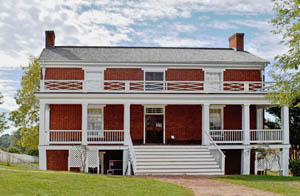
Lee surrendered to Grant in the McLean House in Appomattox, Virginia, by Kathy Alexander.
©Kathy Alexander/Legends of America, updated October 2026.
Also See:
American Wars and Military Photo Print Galleries
See Sources.