
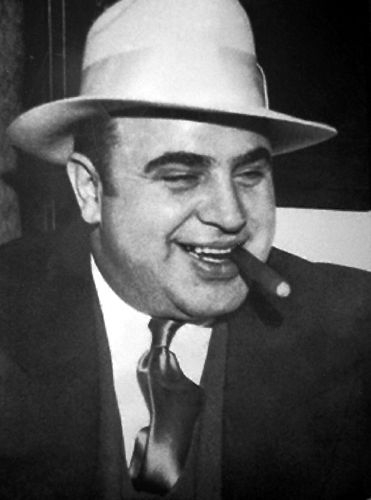
Al Capone.
An American gangster, Al Capone, led a crime syndicate dedicated to smuggling, bootlegging liquor, and other illegal activities during the Prohibition Era.
Born in Brooklyn, New York, on January 17, 1899, to Italian immigrants, Capone dropped out of school after the sixth grade and began associating with a notorious street gang. He was quickly accepted into the group led by Johnny Torrio and became friends with another gang member, Lucky Luciano. In about 1920, at Johnny Torrio’s invitation, Capone joined him in Chicago, Illinois, where he had become an influential lieutenant with his uncle, Giacomo “Big Jim” Colosimo, a major crime boss and pimp. The mob group was also involved in legitimate businesses and cultivated influence with receptive public officials, labor unions, and employee associations. However, by 1920, Torrio and Colosimo clashed because Colismo resisted getting into the lucrative alcohol distribution business during Prohibition.
Torrio killed his uncle and took over the operation, making Capone his right-hand man. Heavily involved in illegal brewing, distilling, and distributing beer and liquor, viewed as “growth industries,” Torrio took full advantage of the opportunities.
In 1925, Capone became boss when Torrio, seriously wounded in an assassination attempt, surrendered control and retired to Brooklyn. Capone had built a fearsome reputation in the period’s ruthless gang rivalries, struggling to acquire and retain “racketeering rights” in several areas of Chicago. That reputation grew as rival gangs were eliminated or neutralized, and the suburb of Cicero became, in effect, a fiefdom of the Capone mob, which came to be known as the Chicago Outfit.
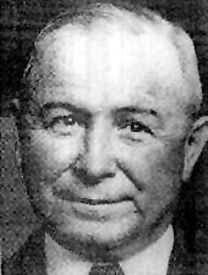
Johnny Torrio.
Perhaps the St. Valentine’s Day Massacre on February 14, 1929, might be regarded as the culminating violence of the Chicago gang era, as seven members or associates of the “Bugs” Moran mob were machine-gunned down against a garage wall by rivals posing as police. The massacre was generally ascribed to the Chicago Outfit, although Capone was in Florida then.
The FBI’s investigative jurisdiction during the 1920s and early 1930s was more limited than it is today, and gang warfare and the period’s depredations were not within the Bureau’s investigative authority. Instead, their crimes fell under the jurisdiction of the Bureau of Alcohol, Tobacco, and Firearms.
The FBI, however, got involved when Al Capone was reluctant to appear before a Federal Grand Jury on March 12, 1929, in response to a subpoena. On March 11, his lawyers formally filed for postponement of his appearance, submitting a physician’s affidavit dated March 5, which attested that Capone, in Miami, Florida, had been suffering from bronchial pneumonia, had been confined to bed, and that it would be dangerous to his health to travel to Chicago. His appearance date before the grand jury was reset for March 20.
The FBI obtained statements from the U.S. Attorney’s Office stating that Capone had attended race tracks in the Miami area, had traveled to the Bahamas, and had been interviewed at the office of the Dade County Solicitor, where he appeared to be in good health.
Capone appeared before the Federal Grand Jury in Chicago on March 20, 1929, and completed his testimony on March 27. As he left the courtroom, agents arrested him for Contempt of Court, an offense punishable by up to 1 year in prison and a $1,000 fine. He posted a $5,000 bond and was released.
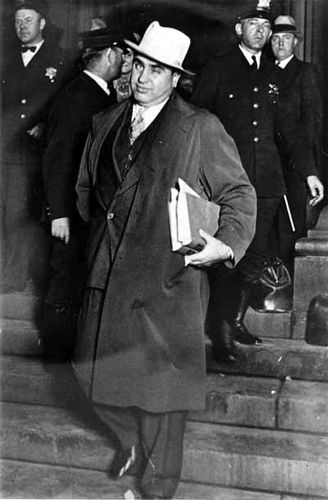
Al Capone.
On May 17, 1929, Capone and his bodyguard were arrested in Philadelphia, Pennsylvania, for carrying concealed deadly weapons. Within 16 hours, they were sentenced to one year each. Capone served his time and was released in nine months for good behavior on March 17, 1930.
On February 28, 1931, Capone was found guilty in Federal Court on the Contempt of Court charge and was sentenced to six months in Cook County Jail in Chicago, Illinois. His appeal on that charge was subsequently dismissed.
Meanwhile, the U.S. Treasury Department had been developing evidence of tax evasion charges. In addition to Al Capone, his brother Ralph “Bottles” Capone, Jake “Greasy Thumb” Guzik, Frank Nitti, and other mobsters were subject to tax evasion charges.
On June 16, 1931, Al Capone pleaded guilty to tax evasion and Prohibition charges. He then boasted to the press that he had struck a deal for a 2 ½ sentence, but the presiding judge informed him he, the judge, was not bound by any deal. Capone then changed his plea to not guilty.
On October 17, 1931, Capone was convicted after trial, and on November 24, he was sentenced to eleven years in federal prison, fined $50,000, and charged $7,692 for court costs, in addition to $215,000 plus interest due on back taxes. The six-month Contempt of Court sentence was to be served concurrently. While awaiting the appeal results, Capone was confined to the Cook County Jail. Upon denial of appeals, he entered the U.S. Penitentiary in Atlanta, Georgia, and was later sent to Alcatraz in California.
On January 6, 1939, Capone was released from Alcatraz and transferred to Terminal Island, a Federal Correctional Institution in California. Finally, on November 16, 1939, he was released after serving seven years, six months, and 15 days and paying all fines and back taxes. However, his isolation from his associates and the repeal of Prohibition in January 1933 significantly diminished his power.
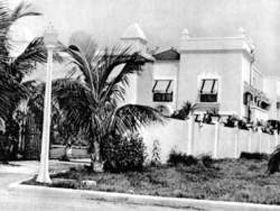
Al Capone’s house in Florida.
He also suffered from paresis derived from syphilis, which had significantly deteriorated during his confinement. Immediately upon his release, he entered a Baltimore hospital for brain treatment and then went to his Florida home, an estate on Palm Island near Miami.
He never publicly returned to Chicago and had become mentally incapable of returning to gangland politics. By 1946, his physician and a Baltimore psychiatrist, after examination, both concluded Al Capone had been reduced to the mentality of a 12-year-old child. He continued to reside on Palm Island with his wife and immediate family in a secluded atmosphere until his death due to a stroke and pneumonia on January 25, 1947. Al Capone was first buried in Mount Olivet Cemetery in Chicago, but was later moved to Mount Carmel Cemetery.
©Kathy Alexander/Legends of America, updated February 2026.
Also See:
Gangsters, Mobsters & Outlaws of the 20th Century
Prohibition in the United States
Speakeasies of the Prohibition Era
Sources: