
Excerpted from The Oregon Trail: The Missouri River to the Pacific Ocean, 1939.
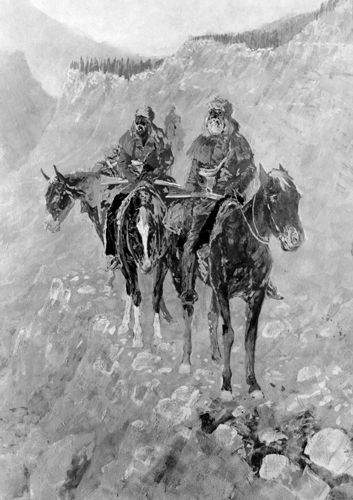
Explorers, Frederic Remington, 1904.
All explorers, pioneers, and fur traders who headed to the American West belonged to a restless breed. When, after a hard winter in a hut along the Missouri River, Meriwether Lewis wrote that the moment of departure for the untrodden wilderness was among the happiest of his life, he was voicing the feelings of all who followed him westward.
Time and again, the traders and mountain men vowed that they were through with hardships and going back to the security of the settled East, but the first person who asked them to return to the mountains was sure to start them west again. Even briefly, those who returned to the East spread unrest and stirred up the adventurous blood dormant in most of the descendants of the first pioneers.
In the early 19th century, a significant portion of the United States’ population was in a particularly disturbed state of mind. The perfect Union envisioned by the Constitution had not abolished taxes or created idyllic communities; the new factories, belching forth smoke and cinders, provided many new comforts but did not pay wages that enabled the hands to buy them in quantities; farmers were receiving lower prices for their products because of competition from the newly settled lands; the blow dealt to the spiritual authority of the churches by the American Revolution had robbed many of their feeling of spiritual security, and the ideas let loose by the French Revolution, widely aired by those who had fled to America to escape the reactionary regimes of the post-Revolutionary period, added to the mental ferment.

Sacagawea guided Lewis and Clark on their expedition of 1804-06.
The journals of Lewis and Clark, as well as those of other explorers, along with the diaries and letters of travelers and journalists, drew public attention to the Far West. European philosophers, poets, and novelists had long been romanticizing the American wilderness and, to some extent, the pioneers. James Fenimore Cooper, however, was the first American to idealize the frontiersmen. Washington Irving began the literary exploitation of the Far West. The romantic attitude gradually spread downward from the literate to the illiterate, and restless migrants who had never read a book began to see themselves as participants in the heroic drama and to act and pose accordingly.
One of the first to advocate emigration to the Oregon region was Hall J. Kelley, a teacher in a school near Boston, Massachusetts, who began writing letters and memoranda to newspapers on the subject in 1818, basing his statements mainly on his interpretations of Lewis and Clark’s reports. In time, he organized emigrant meetings, addressed memorials to Congress for aid, and eventually founded an Oregon Emigration Association to travel west in 1832. His first appeals were commercial and agricultural, but as the clergy, fearful of losing more parishioners and factory owners, who were determined not to have their cheap labor market diminished, began to attack him and his propaganda, his writings became somewhat socialist.
Kelley is interested in the well-to-do Nathaniel Wyeth in the scheme. Wyeth indicated the state of mind of the average emigrant when he wrote: “I cannot divest myself of the opinion that I shall compete better with my fellow men in new and untried paths than in those which require only patience and attention.” But Wyeth discovered Kelley’s impracticality early and determined to lead his expedition as a fur trader rather than a settler. His plans were like those John Jacob Astor had made earlier; a ship would carry supplies for the Indian trade to the Columbia River, and Wyeth would travel overland to meet it. In late October 1832, Wyeth reached Fort Vancouver, Washington, after encountering numerous difficulties due to his inexperience. Upon his arrival, he found that his ship was still at sea. Dr. McLoughlin, liking the young man, took him into the Hudson’s Bay mess with his usual hospitality but, at the same time, warned him frankly that he would do all he could to oppose his business venture. Wyeth did not learn for many months that his ship had been wrecked and that it was useless for him to remain in Oregon.
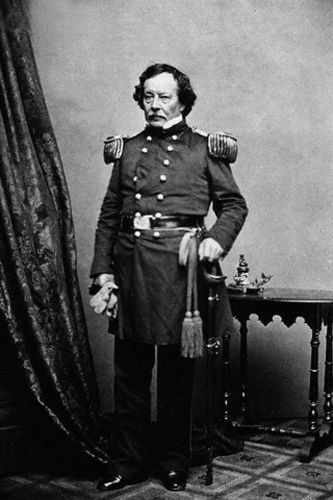
Benjamin Louis Eulalie de Bonneville.
In 1832, Captain Benjamin de Bonneville also arrived in Oregon, ostensibly as a fur trader but actually as a United States secret intelligence officer. The Adventures of Captain Bonneville, written by Washington Irving from Bonneville’s notes, was read by many people, who, in 1837, the year the book was published, were sharing the results of the disastrous financial crash caused by mad speculation in public utilities and unsound public and private financing. To them, the West began to seem like a place of refuge, offering unlimited land without mortgages.
The Hudson’s Bay Company ruled that an employee reaching the end of his term of service must return to the point of enlistment for discharge. Several French Canadians employed in the Department of the Columbia asked McLoughlin for permission to settle near Fort Vancouver when their time was up; they liked the country and had married local Indian women. Ignoring the company regulations, the doctor sent them down the Willamette and aided them with tools and supplies; he did this partly out of kindness and partly, perhaps, because he had an idea that settlement south of the river by loyal Canadians might enable him to hold the country. As the settlement expanded and the number of mixed-race children increased, he became anxious to provide education and religious training. He repeatedly asked headquarters to obtain a clergyman for the post, but none was sent despite promises.
In 1831, four members of the Flathead tribe journeyed to St. Louis, Missouri, to seek instruction in the white man’s religion, having heard from a roving band of Canadian Iroquois about the superior efficacy of the “medicine” of the “black robes” (priests). Their action aroused such interest in religious circles that in 1833, the General Conference of the Methodist Episcopal Church appointed the efficient Jason Lee “Missionary to the Flatheads.” Lee rapidly organized a small party of assistants and, learning that Nathaniel Wyeth was returning to Oregon to make another attempt to compete with the Hudson’s Bay Company, obtained permission to travel overland with the Boston merchant. In July 1834, the party reached the Snake River in present-day Idaho, where Wyeth established a small post named Fort Hall. The party then proceeded to Fort Vancouver, arriving on September 16. McLoughlin greeted them warmly, despite his knowledge of Wyeth’s intentions, and soon advised Lee that it was dangerous to establish a mission among the Flatheads and that he had a congregation ready for his ministrations along the Willamette River.
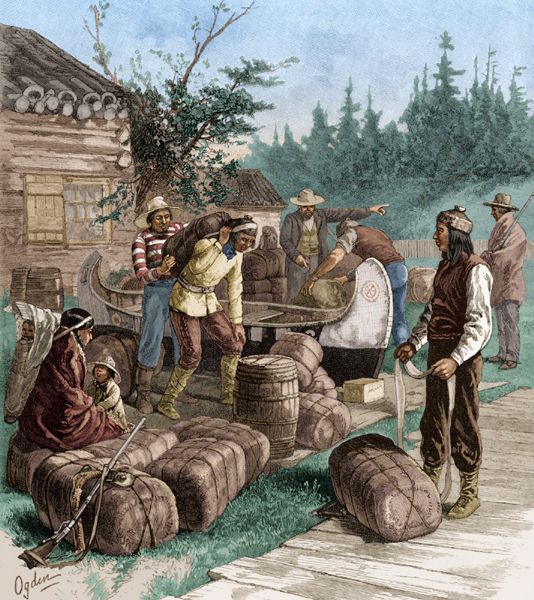
Hudson’s Bay Company Trading Post.
In giving this advice, McLoughlin spoke as a Hudson’s Bay man, eager to keep the Americans well south of the Columbia River. Lee accepted the advice and almost immediately set out to build his mission. Despite Dr. McLoughlin’s disapproval, Wyeth built a post close to Fort Vancouver, but he was no match for his entrenched rival, and after a very discouraging struggle, he left the field.
Another arrival at Fort Vancouver in 1834 was Hall Kelley, who had traveled from Boston by way of California. During his first visit, Wyeth had informed Dr. McLoughlin of Kelley’s activities, and the doctor, ordinarily kind and courteous, had developed an intense hatred of the man trying to stimulate what was, in his opinion, an invasion of a country he had developed. When Kelley arrived, penniless, almost alone, and preceded by a report that he had stolen horses in California, the doctor permitted him to live at the post but treated him as a pariah. Kelley lingered miserably until 1836, his hatred of McLoughlin increasing daily. When Kelley returned to Boston, his anger found an outlet in a bitter pamphlet in which he accused the doctor of tyranny and of activities unfriendly to the American cause. This pamphlet was brought to the attention of the Secretary of State, who arranged for Captain William A. Slacum to investigate the situation on the Columbia River. Slacum’s report, which was not free from bias, aroused many feelings in the United States.
In the meantime, more missionaries had arrived along the Columbia River. The Flathead plea had moved other religious people besides the Methodists; in 1834, an interdenominational board appointed the Reverend Samuel Parker and Dr. Marcus Whitman to study the needs. In 1835, the two men traveled with fur traders to the annual rendezvous in the Green River Valley of western Wyoming. When they reached the valley, Dr. Whitman had seen enough Indians to be convinced that he needed to go no further before reporting to the board that the natives needed religious attention. Parker traveled with only a few Indians, arriving at Fort Vancouver on October 16, immaculately dressed and wearing a plug hat, as was his wont. Though somewhat worried by the advent, Dr. McLoughlin was courteous as usual, but this missionary was not to be diverted to the Willamette Valley. After reviewing mission sites, he left Vancouver for Boston via the Pacific.
Not long after Parker departed for reinforcements, the Hudson’s Bay Company answered the doctor’s six-year-old prayer for a clergyman; the Reverend Herbert Beaver arrived from London with his wife and, within a short time, managed to set the post by its heels. Neither the clergyman nor his wife had anything but scorn for the Indians. They disapproved of the Hudson’s Bay contract marriages, going so far in their dislike of interracial marriage as to snub the doctor’s wife, who was a half-breed and married by contract. The severely critical letters the clergyman wrote to London made the situation increasingly tense. It culminated in 1838 when Dr. McLoughlin lost his temper and publicly caned Mr. Beaver. The act was unfortunate for Dr. McLoughlin because the Beavers, after their return to England, helped to work up opposition to McLoughlin’s activities. Up to this time, headquarters had accorded the doctor great respect. He had extended his posts to the north and East, raised enough foodstuffs to give him a surplus for exportation, and traded in the Sandwich Islands.
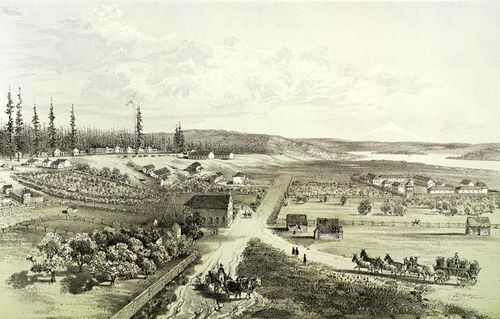
Fort Vancouver, Washington.
When Mr. Beaver delayed his appearance, Dr. Marcus Whitman and the Reverend Henry Spalding arrived at Fort Vancouver with their wives—the first white women to make the overland trip. Dr. McLoughlin treated the party hospitably and, when they insisted on going at once to found missions near Walla Walla and on the Clearwater River, gave them what assistance he could by permitting them to replenish their exhausted supplies from his stores. He warned them of the danger of isolating themselves inland near the treacherous Cayuse Indians.
In the meantime, Jason Lee had called for reinforcements. In the summer of 1837, two ships arrived with supplies and more missionaries, bringing the total in the Willamette Valley to 60.
Dr. McLoughlin watched their arrival with mixed feelings; the Protestant missionaries had made slight progress, their religion having little appeal to the natives. Indian converts had been few, and the French Canadians, who were Roman Catholics, had held aloof. The doctor began to hear rumors that the Americans were shifting their attention to real estate and politics and were considering establishing a provisional government. As the failure to win over the Indians became increasingly apparent, the missionary group became concerned about presenting other results to their financial backers. In 1838, Jason Lee was determined to visit the East and present a memorial to Congress, requesting that Oregon be admitted to the Union.
In the same year, McLoughlin took his first vacation away from the Columbia River since arriving there in 1824. He went to London to present his plans to extend Hudson’s Bay activities to his chiefs. With Russian consent, he obtained permission to trade in Russian America, now known as Alaska. He was authorized to establish settlements south of Puget Sound to reinforce Britain’s claim to the territory now known as the State of Washington.
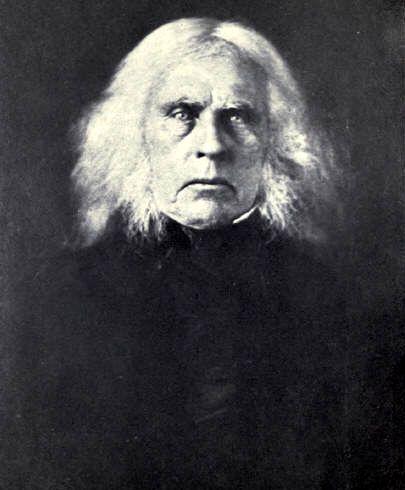
Dr. John McLoughlin.
In May 1840, not long after McLoughlin’s return to his post, Jason Lee reappeared, by way of the sea, at the head of a party of 52 persons. When the doctor asked why they had come, Lee assured him they were to work on the mission. Not long after this, however, it became apparent that many were more interested in settlement than in missionary work. Long afterward, the McLoughlin was to learn that Lee, on his trip east, had traveled widely on lecture tours, mixing his discussion of Indian needs with large doses of propaganda about Oregon’s desirability as a place of settlement. No professional imperialist could have been more enthusiastic than Lee about the justness of seizing Oregon for the United States. Lee’s speeches and the journal of his travels, published in 1838, did much to spread the fever for Oregon. The ethical propriety of Lee’s imperialistic activities has been a topic of debate for decades. He had accepted much help from Dr. McLoughlin in establishing his mission, knowing that McLoughlin would have opposed him if his announced purpose had been commercial or imperialistic. To Lee, McLoughlin was merely a symbol representing Britain, which the average American believed should be outwitted by fair means or foul.
Less easily condoned was the act of the Reverend Mr. Waller, who deliberately pre-empted land by the Falls of the Willamette River that McLoughlin had taken possession of in 1830, and where he had blasted out a millrace. McLoughlin gave notice of the claim when Waller began construction, but permitted the Methodist as a tenant to erect a small building, even providing him with some lumber. Later, Waller and others ignored the doctor’s claim entirely and did all in their power to take from him the spot to which he had planned to retire.
In 1841, Sir George Simpson, the Governor-in-Chief of the Hudson’s Bay Company, arrived at Fort Vancouver on an inspection trip. McLoughlin had been permitted far more freedom than most Chief Factors, but he knew he had betrayed company policy in allowing the missionaries to establish themselves so firmly. Though Sir George was noncommittal, it was clear that he was not satisfied.
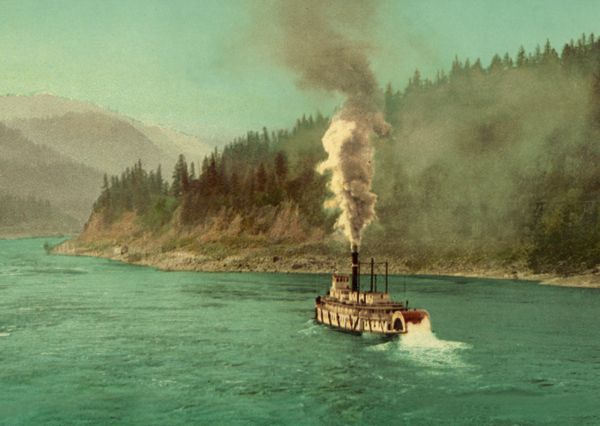
Columbia River below the Cascades.
The Hudson’s Bay Company was well aware of a growing sentiment in the United States for the seizure of Oregon. Americans claimed the disputed title to all the West Coast country up to the Russian boundary. The American claim rested in part on the fact that Robert Gray had visited the mouth of the Columbia River in 1792 and upon the explorations by the Americans Lewis and Clark. The British, however, could demonstrate that they had been developing the country, establishing settlements, and implementing civil rule for British subjects in the territory. The weakness of the American claim was apparent, and the missionary-imperialists in the critical years were frank, in the United States if not in Oregon, in stressing the need to rush settlers into attaining a predominant number for the United States. Conservative government members had resisted the shouts of people supporting military penetration of the Oregon country, much as they had resisted pleas for forts near the Rocky Mountains to protect the fur traders. Settlements, however, were rapidly increasing between the Mississippi River and Indian country, particularly since the 1837 depression had exacerbated the widespread unrest.
In May 1841, a group assembled in Independence, Missouri, to migrate to California. They had been collected mainly by John Bidwell, who had heard stories of the country from a traveling Frenchman. Most of the would-be emigrants became discouraged and withdrew from the party, which became so small that the remainder joined some trappers, including Thomas Fitzpatrick, on their way to Green River and a party of Roman Catholic priests, including Father Pierre DeSmet, who were journeying to the Flathead country at last to answer the call for “black robes.” When the priests left them at Soda Springs, Idaho, the party, now consisting of 64 people, was split. Half of them, fearing to attempt the uncertain California route, followed the better-known trail to Whitman’s Mission at Walla Walla and then proceeded down the Columbia River.
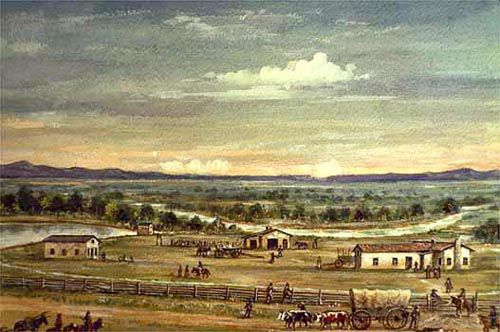
Whitman Mission.
In 1842, the real march on Oregon began. This year, the imperialists, led by Senator Thomas H. Benton of Missouri, had succeeded in having an official trail-exploration expedition sent as far west as the Wind River Valley in present-day Wyoming, led by Benton’s new son-in-law, John C. Fremont. Fremont’s report, issued early in 1843, roused broad enthusiasm. In 1843, he again went out and spent most of the following two years exploring foreign land in Oregon and the Mexican possessions in the United States. His reports of these expeditions became the chief guidebook of later emigrants.
When Fremont made his first trip, a party of about 100 people set out for Oregon under the leadership of Dr. Elijah White, a member of the Willamette Valley Mission. Previously, White had quarreled with Jason Lee and left the area. Still, upon his return, he claimed the title of “Indian subagent for Oregon.” Dr. McLoughlin’s agent at Fort Hall sent a guide to lead them to the Willamette Valley. This party did not pass Fort Vancouver, but McLoughlin later helped many of its members by extending them credit at the company commissary. In the following year, nearly half of the members of the White party moved to California; however, their arrival had prompted the Americans in the Willamette Valley to form a loose civil government for themselves. The British subjects in the valley first joined the movement but withdrew when they discovered the movement’s nationalist character.
In 1842, Dr. Elijah White brought orders to Dr. Marcus Whitman that part of his mission was to be closed because the board was tired of the workers’ dissension and disappointed in the number of conversions. Whitman and his colleagues were determined to disregard the instructions. In the fall of this year, Whitman suddenly decided to rush east, regardless of the weather. After a quick trip across the mountains, he went straight to Washington to present his ideas to government officials, asking for the construction of forts to protect emigrants along the Oregon Trail. He then visited New York, where he met Horace Greeley, who filled him with enthusiasm for the disputed territory. Finally, he went to Boston to consult with his board. Almost immediately, he started west again, lecturing as he went, to join the travelers at Independence and turn them toward Oregon.
In the meantime, nearly 1,000 people assembled at Independence, Missouri, and prepared to head west. In November and December 1843, approximately 875 people arrived in Oregon. Like those who preceded them, the Hudson’s Bay Chief Factor of the Columbia, Dr. John McLoughlin, assisted them in various ways.
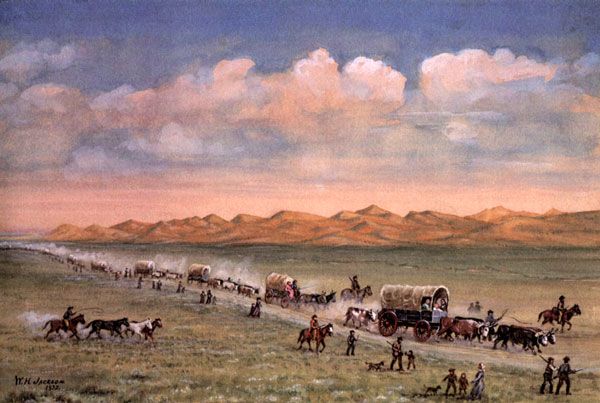
Oregon Trail pioneers pass through the sandhills, as depicted in a painting by William Henry Jackson.
The following year, the settlers reorganized and strengthened their provisional government, welcoming 1,400 more arrivals. Still, Dr. McLoughlin extended credit to the straitened newcomers, promising repayment in wheat and other commodities to be produced on the new lands. He may have hoped to redeem himself in the eyes of his superiors by making Fort Vancouver the territory’s export center.
The provisional government was fully established in 1845, and more than 3,000 immigrants arrived. In the same year, the Hudson’s Bay Company forced the resignation of Dr. John McLoughlin. After winding up his affairs, he moved south to regain the land he had claimed 15 years before and expected some repayment from the many newcomers he had helped. Many settlers had not paid their debts to the Hudson’s Bay Company, and McLoughlin’s later years were embittered by having to use his life savings to reimburse the company. Though he soon became a citizen of the United States, his land claim was not recognized until five years after his death.
The acquisition of vast western lands swelled the migration to all parts of the West. By 1848, the Oregon Trail was deeply rutted. That year, the discovery of gold in California drove many gold seekers deeper into the prairies, carrying most of them at least to a point west of South Pass, Wyoming.
Although much sympathy was extended to the western-bound emigrants, few actually asked for it. They were taking part in one of the great mass movements of history, and they knew it, as is shown by the diaries they kept under challenging conditions, by the letters they wrote to the hometown newspapers and friends, and by the efforts they made to leave their names on various rocks along the way. To many, the journey was an exhilarating picnic, with gossip, chatter, love-making, sightseeing, and adventure providing them with something to boast about for the rest of their lives. The majority remained undismayed, even if the hardships were more significant than anticipated. Cholera epidemics along the trail in 1849, 1850, and 1852 took a heavy toll, as epidemics did in cities.
On the whole, the emigrants had such good health on the trail that hordes of sick and anemic individuals journeyed to the Missouri River to travel with the parties for at least a time. Had the emigrants stayed at home, the average annual death rate would have been 500 in every 20,000; probably, the death rate on the trail from natural causes was lower than at home. Most deaths not resulting from epidemics were due to rashness or carelessness. Loaded guns in the hands of amateur frontiersmen were a leading cause of accidents.
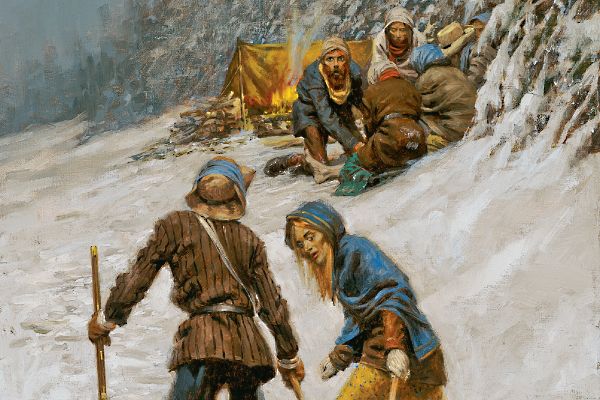
The Donner Party by Andy Thomas.
Every party had some members who were sure they could find shorter and better routes than experienced guides; the tragic experience of the Donner party occurred because the members acted on advice in a letter written by a man they had never heard of.
As Army posts were established along the way, the officers grew increasingly annoyed by the travelers’ foolhardiness. Finally, to save themselves the labor of rushing about rescuing the foolish, they forcibly organized the trains under military rules and passed them along under escort.
While many emigrants feared the Indians and were always alert, others could not be made to take reasonable precautions against surprise. The Indians stole when they could and caused occasional deaths during raids. Still, they were not serious menaces until the 1860s, when they realized that the invaders were driving away and killing off the buffalo and other animals on which the natives depended for food and clothing. By this time, the Indians had become thoroughly disillusioned with any hopes that the whites would keep the land treaties. The whites took the best lands through these agreements and gave the Indians the worst. In addition, comparatively little of the promised compensations in money and goods ever reached the natives. Even the Army officers sent to quell uprisings when the Indians became desperate reported, with a stern sense of justice, that they had cause for their frantic last stands. For many years, the forces sent against the Indians were inadequate; however, when the Government at length undertook to complete the job of expropriation, the results were swift and final.
The settlers’ determination to carry their prized possessions caused great hardship. Many cherished chests and spinets on the West Coast were carried overland at the price of semistarvation.
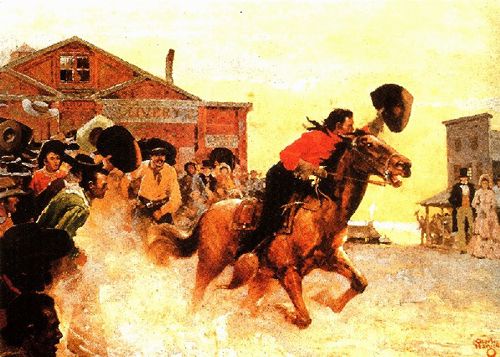
First Ride of the Pony Express.
By 1850, immigrants were clamoring for faster mail service and better transportation, but it was not until 1859 that an overland stage reached as far west as Colorado. The Pony Express, which provided California with its first fast mail service, was inaugurated in 1860. Although it lasted only 16 months and ultimately failed to meet its promoters’ expectations, it provided the country with one of the most exciting series of relay races in history. In 1861, a telegraph line connected the Pacific Coast with the East.
After much talk about building a railroad to the Far West, the Federal government accepted the responsibility. A Congressional act permitted the Central Pacific to build eastward from Sacramento, California, and the Union Pacific to build westward from Council Bluffs, Iowa, until their lines should meet, with a bait of princely land grants to stimulate rivalry between the two companies for distance covered. The most formidable engineering difficulties were encountered at the western end. Still, the construction of the Union Pacific was a far more dramatic enterprise, as it was carried out at a time when many of the Indian tribes of the plains were actively and fiercely hostile. On May 10, 1869, at Promontory, Utah, a golden spike was driven into a cross-tie of California laurel, celebrating the junction of the rails pushed from the East and the West and the completion of an iron span across the continent.
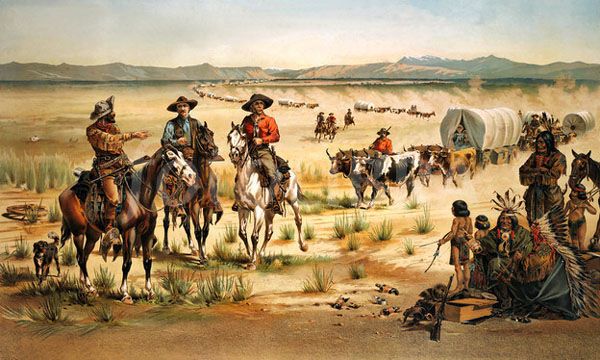
A wagon train and Indians.
Wagons continued to follow the Oregon Trail until late in the 1880s, but the days of pioneer travel were over, and the physical frontier was almost gone. Many who went west remained only a short time, then returned to settle in the Middle West or resettle in their native states east of the Mississippi River. Few immigrants found the quick wealth and happiness they had sought, and the migrations steadily declined over the years.
Excerpted from The Oregon Trail, the Missouri River to the Pacific Ocean; compiled and written by the Federal Writers’ Project of the Works Progress Administration, 1939.
Compiled and edited by Kathy Alexander/Legends of America, updated June 2026.
Also See:
Danger and Hardship on the Oregon Trail
Disease and Death on the Overland Trails
Crossing the Great Plains in Ox-Wagons
Oregon Trail – Pathway to the West
Source: The Oregon Trail: the Missouri River to the Pacific Ocean, 1939.