
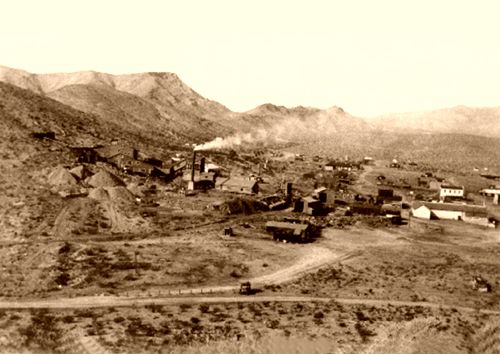
Goodsprings, Nevada, 1924
“Things are quiet here; if people keep on moving away, this ain’t going to be nothing but a damned ghost town.”
— Sam McClanahan, from Ghost Towns of the West by Lambert Florin, 1970.
The natural springs and the area that surrounds what is now Goodsprings, Nevada, were first used by the Ancient Puebloans and then the Paiute Indians. White settlers first documented the springs in 1830, when a caravan traveling along the Old Spanish Trail reached the area. Mining began in the area in 1856, when Mormons established a lead mine at nearby Potosi, the oldest lode mine in Nevada.
Though a small oasis in the desert, no settlement formed until Joseph Good discovered silver near the springs in 1861. Good, primarily a cattleman, established a small store, but a town did not form until more silver and lead deposits were discovered around 1868. First called Goods Springs, the name later evolved to Goodsprings.
By 1882, gold had also been discovered, and the Goodsprings, or Yellow Pine Mining District, was established. Later, more gold was found, with the Keystone Mine, about 5 miles west of Goodsprings, proving the most profitable. In 1893, a post office opened at the Keystone Mine, and the area supported about 200 people, a few stores, and numerous small mines dotting the landscape.
In 1893, the first post office was established at the Keystone Mine, which the miners took over two years later in a wage dispute. The miners held the mine for three months until they had made enough money to pay both their wages and the wages of local Indians who had been cutting wood for the mine.
In 1897, the Keystone Mine post office closed. Meanwhile, Joseph Good sold his store to a man named Samuel Yount, who established a new post office in Goodsprings in 1899. He served as the postmaster from that date until 1914.
In 1901, the Yellow Pine Mining Company formed, consolidating ownership of most of the area’s mines and building a mill. But getting the ore out of the area was difficult, as it had to be hauled by wagon to distant shipping points. However, when the San Pedro, Los Angeles & Salt Lake Railroad built a line through nearby Jean in 1905, moving the ore became much easier. The township was officially platted in 1904, and gradually its tents and shacks were replaced by more substantial buildings. With the railroad’s arrival in Jean, the Yellow Pine Mine began increasing production and built a narrow-gauge line from the remnants of the railroad that had served the Quartette Mine in Searchlight. Though the spur to Goodsprings would take several years to build, when it was complete in 1911, it hauled tons of ore from Yellow Pine’s 100-ton mill to Jean. With transportation problems eased, the town really began to grow.
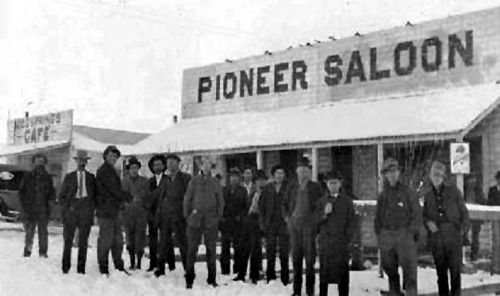
Vintage Pioneer Saloon, Goodsprings, Nevada
George Arthur Fayle, an ore hauler from Calico, California, moved to nearby Goodsprings Junction (later changed to Jean for his wife) in 1904. With financial help from his uncle, Samuel Yount, who owned the mercantile store in Goodsprings, Fayle established a tent store for miners and ore-hauling businesses.
Later, he bought an interest in his uncle’s store in Goodsprings, and they renamed it the Yount and Fayle Store. In 1912, Fayle moved his family to Goodsprings and began to expand the business. In 1913, he built the still-operating Pioneer Saloon.
That same year, a permanent school building was erected, and it still stands. Now on the National Register of Historic Places, it is the oldest school in Clark County that was built and remains in use as a school.

Fayle Hotel, Goodsprings, Nevada
The community prospered, reaching its peak population of about 1,000 people in 1915. The following year, George Fayle built the Fayle Hotel, the area’s most luxurious hotel, with 20 guest rooms, electric lights, hot and cold running water, steam heat, and a restaurant that boasted fine dining. Advertised as the “finest hotel in the West,” it opened with a grand ball on May 13, 1916. The hotel and restaurant were initially so successful that Las Vegas residents would travel to Goodsprings to enjoy the hospitality. However, Fayle’s uncle, Samuel Yount, objected to building the hotel, predicting it could not survive. Unfortunately, Yount’s prediction proved correct and ended their partnership. The hotel, located about 100 yards west of the Pioneer Saloon, eventually failed financially, and in 1966, the building burned to the ground.
Two years later, on May 20, 1918, Frank A. Doherty established the Goodsprings Gazette. The four-page weekly newspaper continued after the founder’s death less than a year later, operated by his wife, Florence, and delivered to its 350-400 subscribers until 1921.
George Fayle also built the Fayle Department Store and, convinced the town would keep succeeding, actively promoted the settlement. Though all his ventures, other than the Pioneer Saloon, would eventually fail as the town began to decline, Fayle would not be around to suffer the humiliation. On December 9, 1918, he succumbed to the Flu epidemic, which was sweeping the United States and Western Europe, and was buried in the Goodsprings cemetery, where he is still the largest headstone.
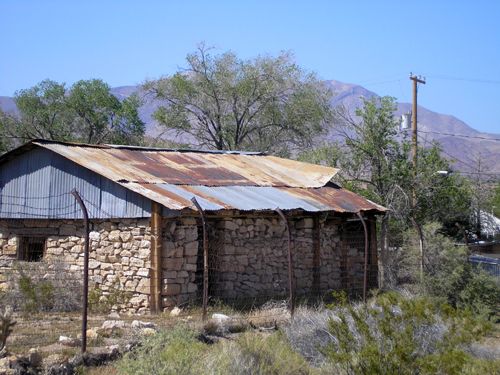
The oldest building in Goodsprings, Nevada
By the time Fayle died, Goodsprings was home to about 800 people, with several businesses, including a number of stores, several restaurants, nine saloons, a post office, a school, the grand hotel, a hospital, and a weekly newspaper. The town was much larger than Las Vegas; residents traveled to Goodsprings for shopping and entertainment.
The town continued to thrive through the end of World War I, when lead and zinc were badly needed for the war efforts. However, when the war ended in 1918, production decreased, mines shut down, and the town declined. By 1920, only about 400 people called the town home. Goodsprings once again saw a spurt of activity during World War II but never grew to its former size. In 1930, the narrow-gauge railroad to Jean ceased operations, and four years later, in 1934, the tracks were removed. By then, most of the mines sat silent, and Goodsprings was becoming a ghost town with fewer than 100 residents.
However, during its heyday, the Yellow Pine Mining District earned over $30 million from lead, gold, copper, and zinc, providing 1/3 of Clark County’s total metal production and making it one of the most lucrative mining districts in Southern Nevada.
In January 1942, Goodsprings became the local site of another bit of excitement when actress Carole Lombard, her mother, 15 Army fliers, and the crew of a TWA Skysleeper, returning from Indiana to California, crashed into the snow-packed Potosi Range. All 22 people on board were killed.
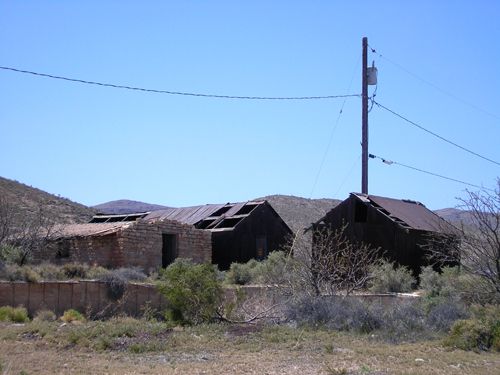
Goodsprings, Nevada ruins
At the foot of the range, Lombard’s husband, actor Clark Gable, stayed at the Fayle Hotel and consoled himself in the Pioneer Saloon while awaiting news of his wife’s fate and holding out faint hope for her survival.
Today, several residents still live in Goodsprings, some in restored buildings and others in mobile homes or newer structures. The community still boasts the operating Pioneer Saloon and the Goodsprings General Store next door. The Pioneer Saloon sports its original long cherry wood bar that was brought down from Rhyolite, Nevada, which had already become a ghost town when the saloon was built. The old pot-belly stove in the saloon, said to date back to Civil War times, is still used. Both the saloon and the general store are sheathed in pressed metal, which resembles bricks.
In the Memorial Room of the saloon, the walls are covered with old newspapers and photographs of the town’s history, including the fatal airline crash that took Carole Lombard’s life.
Across the highway, you can see a couple of rusting tin buildings, an old stone structure, a large foundation, and the ruins of the Yellow Pine Mill. To the West, several more buildings continue to stand, including the first permanent building in Goodsprings, the A.G. Campbell cabin, which dates back to 1886. Also standing is the 1913 school, which continues to serve students today, along with the post office, an 1890s wooden cabin, a church, and numerous old homes and buildings in various states of disrepair.
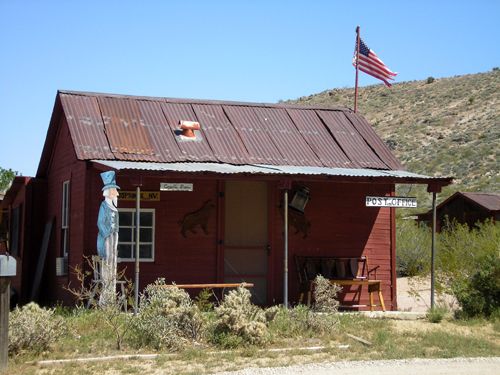
Goodsprings, Nevada Post Office
East of Goodsprings, on State Road NV-161, the town’s cemetery lies on the North side of the highway.
Today, Goodsprings’ 200 residents, many of whom commute to Las Vegas, enjoy a quiet lifestyle in this once-thriving desert town.
To reach Goodsprings from Las Vegas, travel southward on I-15 to the Jean-Goodsprings exit, then turn West on Nevada Highway 161 for seven miles.
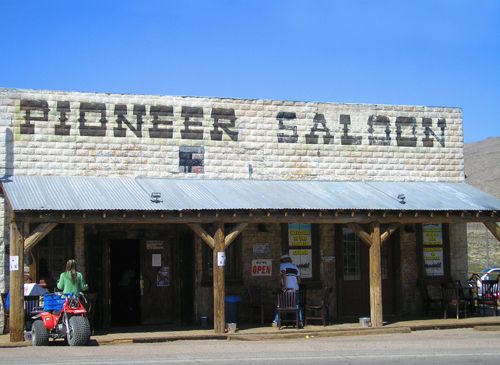
The Pioneer Saloon continues to serve customers today
©Kathy Alexander/Legends of America, updated October 2026.
Also See:
Las Vegas, Nevada – Sin City USA
Ghost Towns & Mining Camps of Nevada
Nevada Ghost Towns Photo Print Gallery
See Sources.