
By James Cox, 1903.
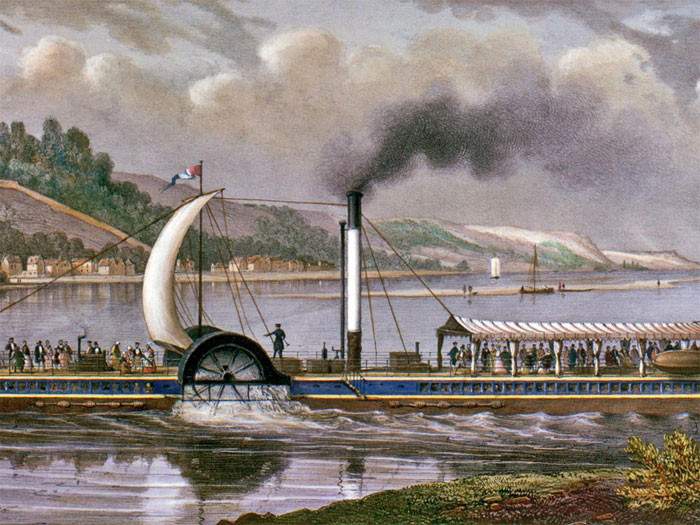
Steamship.
During the last quarter of the century, the steam railroad has put out of joint the nose of the steamboat, threatening travel and motive power so much that it warrants a prediction that, long before another quarter of a century has passed, electricity will take the place of steam almost entirely. However, every citizen of the United States should feel that the country’s prosperity is due, in very large measure, to its magnificent waterways and to the enterprise of the men who equipped and operated river fleets, with varying degrees of profit.
The true river man is not so conspicuous as he was in the days when St. Louis, Missouri; Cincinnati, Ohio; Memphis, Tennessee, and other important railroad centers of today were exclusively river towns. The river man was a king then. The captain walked the streets with as much dignity as he did on his own deck, and landmen pointed him out as a man of dignity and repute. The mate was a great man in the estimation of all who knew him, and of a good many who did not. Ruling his crew with a rod of iron, and accustomed to being obeyed with considerable and commendable promptness, he adopted a tone of voice in general conversation considerably louder than average, and everyone grew accustomed to making way for him.
The levee in a river town, before the railroads came snorting and puffing across country and interfering with the monopoly so long enjoyed by the steamboat, was a scene of continuous turmoil and activity. Sometimes, now, one sees on a levee a great deal of hurrying and noise. But today’s busiest scenes sink into insignificance compared with those that are rapidly becoming little more than an indistinct memory. The immense cargoes of freight of every description would be ranged along the river front, and little flags could be seen in every direction.
These flags may not have provided direct evidence of the schoolmaster’s efforts or the overall quality of education. Instead, they reminded us that a significant majority of river workers were largely illiterate, able to read only a little and write even less. Asking a colored roustabout, 20 or 30 years ago, to fetch a specific cargo marked with the name of a boat or consignee would often elicit a characteristic old-time plantation grin, along with a sarcastic remark about the lack of educational opportunities when they should have been learning the “three Rs,” but were not. However, identifying a cargo by flag was relatively straightforward. In fact, identification rarely failed, as the flags could be varied in color, shape, and size to provide both distinction and variety.
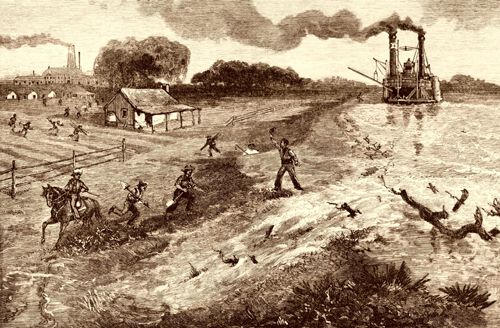
Mississippi River Levees.
Those who remember the busy levee scene, with the flag adornment referred to, will agree that there was something picturesque as well as noisy about the old river days, and will be inclined to regret, and almost deplore, the fact that things are not, from a river man’s standpoint, what they were.
In no country in the world has railroad building been carried on with so much enterprise as in our native land. Before spending large sums to build tracks and purchase railroad equipment, it was important to take advantage of the exceptional transportation and navigation opportunities provided by the country’s vast waterways. Since railroads were built primarily in the East before expanding to the West, most readers understand the significance of our Middle and Western waterways. These waterways played a crucial role in facilitating various business transactions until relatively recently.
The Eastern rivers are less magnificent in extent and volume than those of the West, though many are picturesque and extremely attractive. The Hudson River has often been spoken of as the “Thames of America,” not because the two rivers are similar in length, but because they are situated upon the two greatest cities of modern times. The simile results rather from the immense number of costly family residences and summer resorts built along the banks of both rivers.
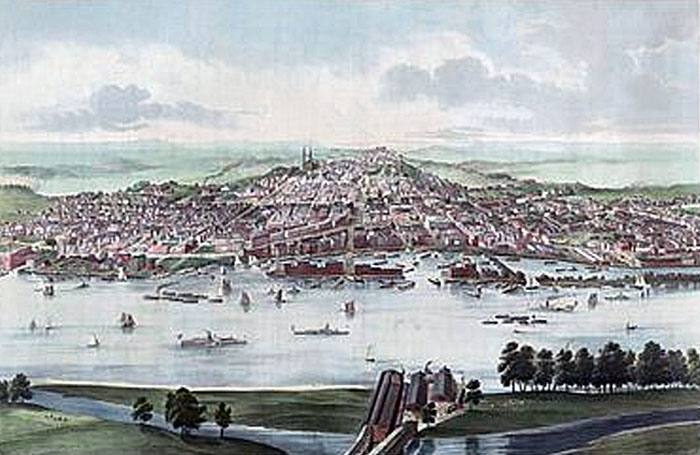
Hudson River at Albany, New York.
In another chapter we say something of a trip down the picturesque Hudson River, whose banks are lined with historic landmarks and points of pressing interest. We give an illustration of a pleasure boat on the Hudson, which reminds one of many delightful river trips taken at various periods, and also of the events of national importance that centered around the river, which is crowded, year after year, with pleasure-seekers from the overcrowded metropolis at its mouth.
The Mississippi River is the largest and grandest in North America. A few miles above St. Louis it is joined by the Missouri River, and if the distance from the source of the latter to the Gulf of Mexico be calculated, the longest river in the world is found. At a considerable distance from the source of the Father of Waters are the Falls of St. Anthony, discovered more than 200 years ago by enterprising pioneers, who thought they had discovered the headwaters of the great river. The scenery of the river at the falls and beyond them is very beautiful, and in many cases so beautiful as to be beyond verbal description. In many other parts of the river the scenery is grand, though occasionally there are long stretches of flat country which are inclined to become monotonous and barren of poetic thought.
Of the entire river, Mr. L.U. Reavis writes enthusiastically:
“The more we consider the subject,” says this author, “the more we are compelled to admit that the Mississippi is a wonderful river, and that no man can compute its importance to the American people. What the Nile is to Egypt, what the great Euphrates was to ancient Assyria, what the Danube is to Europe, what the Ganges is to India, what the Amazon is to Brazil — all this, and even more than this, the Mississippi River is to the North American Continent. In an earlier age men would have worshiped the Mississippi, but in this age we can do better; we can improve it. All our efforts should be directed to this. We should continually bear in mind that no other improvement, ancient or modern, relating to the interests of commerce has ever commanded the attention of men equal in importance to that of the Mississippi River, to control its waters and afford ample and free navigation from St. Paul to the Gulf of Mexico.”
During the last few years, the agitation in favor of river improvement has assumed very definite shape, and from time to time large appropriations have been made by Congress for the purpose of keeping the river navigable at all periods of the year. As long ago as 1873, the Chairman of the Senate Committee on Transportation Routes censured the Government for neglecting to improve the big rivers thoroughly. A quarter of a century has nearly elapsed since then, and, in the opinion of many competent river men, there is still room for much improvement, not only in the river, but in the method of arranging and carrying out the improvements.
Kansas City Skyline from the Missouri River by the Corps of Engineers.
The Missouri River, a major tributary of the Mississippi, has often been described as one of the most treacherous and aggressive rivers in the universe. It seems driven by a spirit of unrest and a desire for change, so much so that the center of the riverbed frequently shifts right or left so rapidly that it wipes out prosperous farms and homes. Sometimes this erratic procedure threatens the very existence of cities and bridges, and tens of thousands of dollars have been spent from time to time on day-and-night work to check the stream’s aggression and compel it to confine itself to its proper limits.
The Mississippi River carries clear water from the lakes to its junction with the Missouri River. This clear water reflects the lush greenery along the banks, giving it a green appearance. In contrast, the Missouri River is muddy and turbulent. Even at low water, it carries a significant amount of sand and sediment, and during high water, it can bring along trees and other debris. Throughout the year, the Missouri River water remains murky.
At the confluence of the two rivers, the difference in water color is very noticeable. Interestingly, the waters do not completely mix for several miles downstream. Under normal conditions, the water on the western side of the current appears much darker than that on the eastern side, even 20 miles from what is typically referred to as the mouth of the Missouri River.
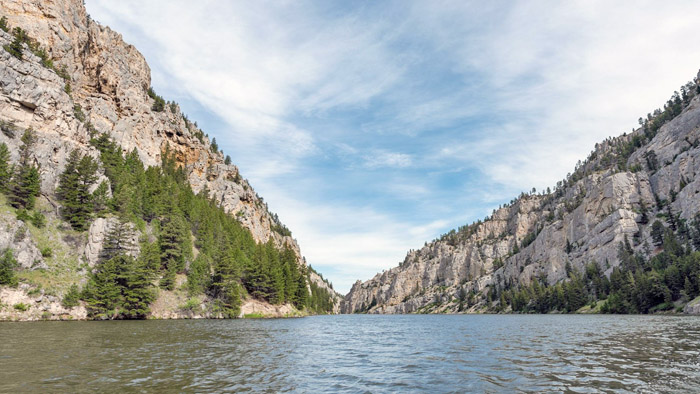
Gates of the Rocky Mountains, National Park Service.
The Muddy Missouri rises in the Rocky Mountains. It is really formed by the junction of three rivers–the Jefferson, the Gallatin, and the Madison. By a strange incongruity, the headwaters of the Missouri are within a mile of those of the Columbia River. However, the two rivers run in opposite directions: the Columbia River enters the Pacific Ocean, and the Missouri River reaches the Gulf of Mexico via the Mississippi River. At a distance of 441 miles from the extreme point of the navigation of the head branches of the Missouri, are what are denominated as the “Gates of the Rocky Mountains,” which present an exceedingly grand and picturesque appearance. For about six miles, the rocks rise perpendicularly from the river’s margin to a height of 1,200 feet. The river itself is compressed to a breadth of 150 yards, and for the first three miles there is but one spot, and that only of a few yards, where a man can stand between the water and the perpendicular ascent of the mountain.
At a distance of 110 miles below this point, and 551 miles from the source, are the “Great Falls,” in Montana, nearly 2,600 miles from the egress of the Missouri into the Mississippi River. There, the river descends through a succession of rapids and falls, dropping 351 feet over 16.5 miles. The lower and greater falls have a perpendicular pitch of 98 feet; the second is 19, the third 47, and the fourth 26 feet. Between and below these falls are continuous rapids with a descent of 3 to 18 feet. The falls, next to those of Niagara, are the grandest on the continent.
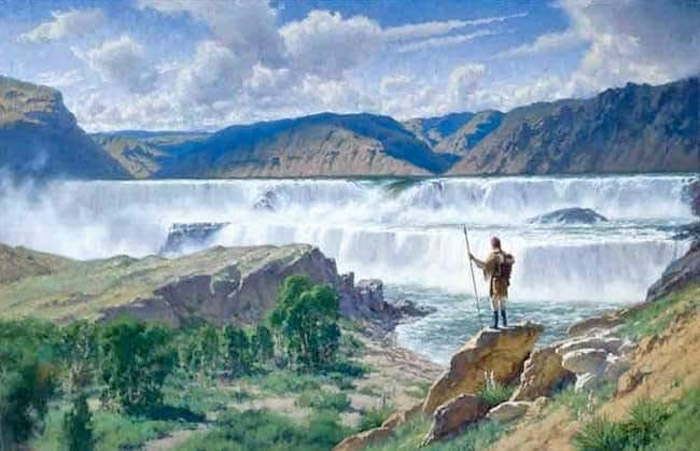
Meriwether Lewis at the Great Falls, Montana by Charles Fritz.
Below the “Great Falls” there is no substantial obstruction to navigation, except that during the midsummer and fall months, after the July rise, there is frequently insufficient water for steamboating. This results from the fact that, although the Missouri River drains a large area of country and receives many tributaries, some of which are navigable for many hundreds of miles, it passes for a great portion of its course through dry, open country, where evaporation is very rapid. The channel is rendered intricate by the great number of islands and sandbars, and in many cases it is made exceptionally hazardous by reason of countless snags.
Volumes have been written concerning the adventures of pioneers and gold hunters, who went up the Missouri in advance of railroads and even civilization, to trade with the Indians or to search for yellow metal in the great hills in the unexplored country, where so much in the way of easily acquired wealth is looked for. Some of the wealthiest men in the West today vividly recall the dangers they encountered on the voyage up this river, and the enemies they had to meet or avoid. Sometimes hostile Indians would attack a boat amid-stream from both sides of the river. When an attempt was made to bring gold or costly merchandise down the river, daring attacks were often made by white robbers, whose ferocity and murderous designs were quite as conspicuous as those of the aboriginal tribes. Many a murder was committed, and the seeds were sown for countless mysteries and unexplained disappearances.
The Ohio River is another of the Mississippi’s great tributaries. In years gone by, this waterway was enormously important. The Mississippi River itself runs through Minnesota, Wisconsin, Illinois, Iowa, Missouri, Arkansas, Kentucky, Tennessee, Mississippi, and Louisiana. The Ohio River taps and drains a much older country than many of these States, and hence its importance in the days when Cincinnati, Ohio, was the great gateway of the West and a manufacturing city of first importance.
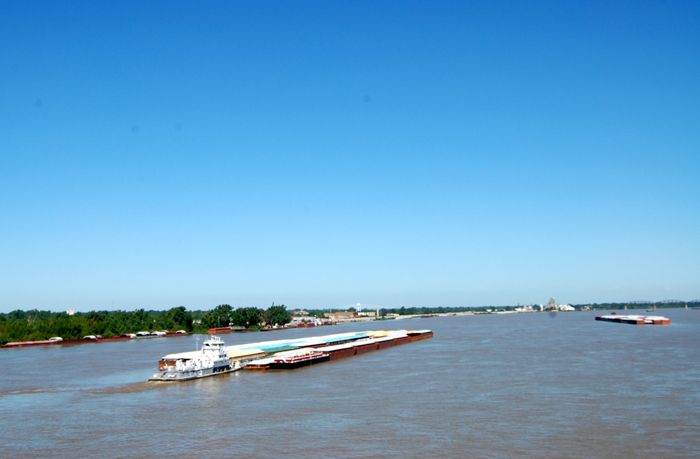
The Ohio River at Cairo, Illinois, is still busy today, according to Kathy Alexander.
The Ohio River is a great river for more than 1,000 miles and connects Pittsburgh, Pennsylvania, with Cairo, Illinois, running through important towns such as Louisville, Kentucky, and Cincinnati, Ohio. On this river, some of the most interesting events in river history have been enacted. Many a tragedy and many a comedy are included in its annals, and even today, although paralleled, crossed and recrossed by railroads, it is a most important highway of commerce.
The Tennessee River is a tributary of the Ohio River, which it enters so near the Mississippi that it has a very close connection with that great river. Entering the Ohio River at Paducah, Kentucky, the Tennessee is one of the largest and most important rivers East of the Mississippi River. It is formed by the union of two rivers which rise in the Allegheny Mountains and unite at Kingston, Tennessee. The river then runs Southwest through Alabama, and turning northward, passes through portions of Tennessee and Kentucky. In length the Tennessee exceeds 1,200 miles, and, except very dangerous places here and there, it is strictly a navigable river.
Running as it does through a country not yet thoroughly supplied with railroad accommodation, the Tennessee River forms an important connection between several small shipping points that would otherwise be cut off from commercial intercourse with large centers. Hence the transportation facilities are good and, in many respects, remind one of old days when river traffic was general. Boats run almost all the year around up this river as far as Alabama points, and not only is a large and lucrative freight business transacted, but pleasure and health-seekers are also carried in large numbers.
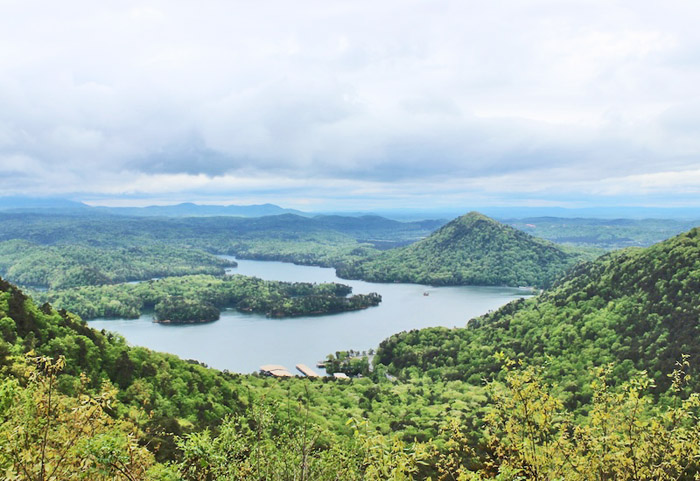
Tennessee River.
River life in the old days was not prosaic. All of us have heard of the great races on the Mississippi River between magnificent steamers, and of the excitement on deck as the first one and then the other gained a slight advantage. Stories, more or less reliable, have been told again and again of the immense sums of money speculators made and lost by backing their own boats against all comers. Tricks and jokes also prevailed and continue to this day. The passenger on a Tennessee River boat is almost sure to be told how a very popular first mate escaped arrest by disguising himself as a cook. The story is amusing enough to bear repetition, and bereft of corroborative detail, evidently designed to lend artistic verisimilitude to the narrative, it is as follows:
The boat was detained at a landing at a small Kentucky town where the laws against gambling were supposed to be very strict. Some of the boat’s officers were determined to kill time by staking a few dollars at poker, faro, or something worse, and they inquired where a game could be found. These results satisfied the gamblers, and the crowd made its way to the appointed spot, bringing with them the very stout, good-natured, but not very speculative first mate. The game was played in a small room at the rear of an almost equally small restaurant. Everything went well for a while, and those who were winning thought they had everything the heart could desire. All at once, one of the colored helpers rushed in with a notification that the place was being raided.
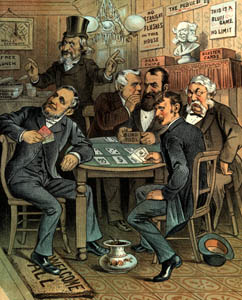
Gambling by Bernhard Gillam, 1884.
It was every man for himself. As usual in situations like this, one or two individuals hid under the table, but authorities quickly found and arrested them. Two others leaped out of the window and landed in the arms of two deputies who were waiting to take them into custody. The mate, caught for the first time in his life in a gambling establishment, devised a clever escape plan. Snatching up his hat and coat, he walked into the kitchen, where he found a good-natured woman stirring batter to prepare a meal. With impressive presence of mind, the mate picked up an apron, tied it around himself, and told the lady to take a few minutes to rest, as she seemed exhausted. He then grabbed her wooden spoon and continued stirring the batter as if he had been doing it his entire life.
Meanwhile, every other member of the party had been caught and taken to the little frame building that served as jail and police-court combined. Various conjectures were exchanged as to the fate of the mate, whose ignorance of the events incidental to gambling raids was expected to prove very inconvenient to him in a variety of ways. All anxiety on this score, however, was thrown away. The old man acted his part so well that, when the raiders saw him laboriously at work with the wooden spoon, they concluded he was a member of the establishment. As a result, they left him alone, and when the raid was over he replaced his hat and coat with the indifference and nonchalance of an experienced actor, and went quietly back to the boat.
Here he informed friends of the incarcerated individuals of the fix they were in, and advised them to go to their release, preferring himself to keep as far as possible from the representatives of the law. Liberty was obtained by paying considerable sums in fines and costs. Although the event took place some years ago, the way the inexperienced gambler escaped remains a source of merriment. At the same time, it remains a constant source of merriment among officers and passengers that more hardened and experienced friends were caught.
It was while enjoying a delightful and distinctly sensational trip on the Columbia River that the passengers were enlightened as to a comparatively old trick, which was executed with the utmost promptness and despatch by a young second mate. This young man was never known to have any money. Generous in the extreme, and heartily full of fun, he managed to get rid of his salary as promptly as it was paid him, and his impecuniosity was a standing joke among members of the crew and regular passengers. On one occasion, the boat met with an accident and was tied up in a small town for four or five days. The hero of the story, with several other light-hearted individuals, naturally went ashore for pleasure. They had what is generally called a good time, but the little funds they started with were soon exhausted.
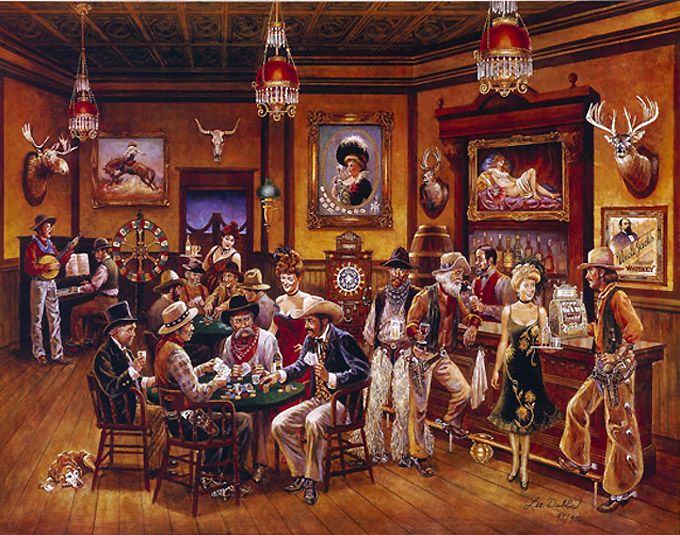
Saloon.
Two or three councils of war were held on how to obtain a supply of liquid refreshments, of a character not included in the temperance man’s bill of fare. Finally, the second mate undertook to secure the needful without spending any money. He borrowed a heavy overcoat from one of the party, then hunted up two large wine bottles. He filled one with water and corked it securely. He took the other empty and, with both in his pockets, entered the saloon. Producing the empty bottle, he asked the barkeeper how much he would charge to fill it, and, on hearing the amount, told him to go ahead.
As soon as the bottle was filled and returned to the second mate, he slipped it into his pocket and, matter-of-factly, began arranging to settle the debt at a convenient time. The saloon-man naturally resented any discussion of this character, and told his customer to either pay for the liquor or return it right away. Assuming an air of injured innocence, our friend took out the bottle of water, handed it to the barkeeper, who said he “guessed he’d have to take it back.” The unsuspecting purveyor of liquor that both cheers and inebriates grumbled considerably, emptied the bottle of water into the demijohn of whisky, handed back the bottle to the apparently disconsolate seeker after credit, and told him to “get out.”
Naturally, no second order was necessary. Five minutes later, the entire party could have been seen sharing the contents of the bottle which had not been emptied, but which they lost no time in emptying. The trick answered its purpose admirably. When, about two weeks later, the man who had played it was again in the town, he called at the saloon to pay for the whisky. He was treated very kindly, but hints were freely given as to the necessity of a keeper accompanying him on his travels. In other words, the barkeeper was quite convinced that he had been hoodwinked as stated. This feature of the joke was, in the opinion of its perpetrators, the most amusing feature of all, and it need hardly be said that very little effort was made to disabuse the unbelieving but somewhat over-credulous barkeeper.
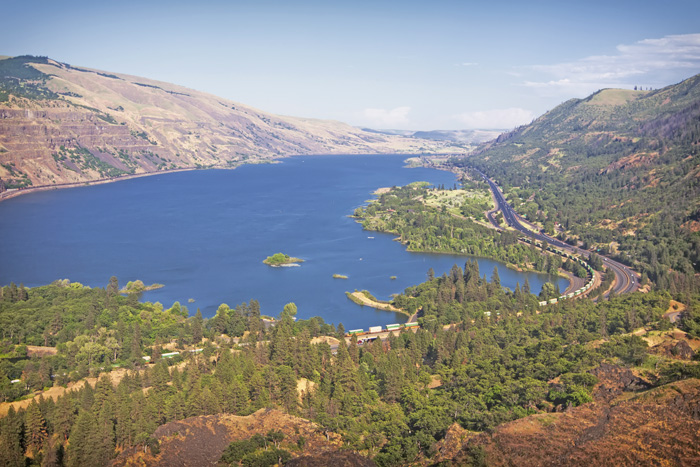
Columbia River, Oregon.
The Columbia River, in Oregon, is one of the most interesting and remarkable on the continent. Rising, as it does, quite near the source of the Missouri River, it runs, by a very circuitous route, to the Pacific Ocean, being in places very narrow, and in others abnormally wide. The Dalles of the Columbia River are known the world over. They are situated some 60 or 70 miles West of the city of Portland, and are within easy distance of the American Mount Blanc. They extend from Dalles Station, a small town on the Union Pacific Railroad, to Celilo, another station about 15 miles farther East. Between these two points the bed of the Columbia is greatly reduced in width, and its boundaries are two huge walls of rock, which rise almost perpendicularly from the water level. The width of the chasm, through which the water rushes wildly, varies considerably, but at no point in the western section does it exceed 130 feet; on either side of the Dalles, the river itself ranged from about 2,000 to much more than 2,500 feet.
As the volume of water is enormous at this point, especially after rain and much snowmelt, the water often rises 50 feet in a few hours in the narrow channel of the Dalles. Sometimes the rise exceeds 70 feet, and an effect most extraordinary in character results. From many points along the riverbanks, Mount Hood can be seen towering up into the clouds. The bluffs themselves are marvels of formation, very difficult to explain or account for. When the water is low, almost vertical cliffs are exposed. The bluffs vary in height to a remarkable extent, and the lower the water, the more grotesque the figures along them appear. When the water is very low, a cascade, or waterfall, appears every few feet, creating a continuous uproar and froth that is very attractive to the sightseer but very objectionable for navigation.
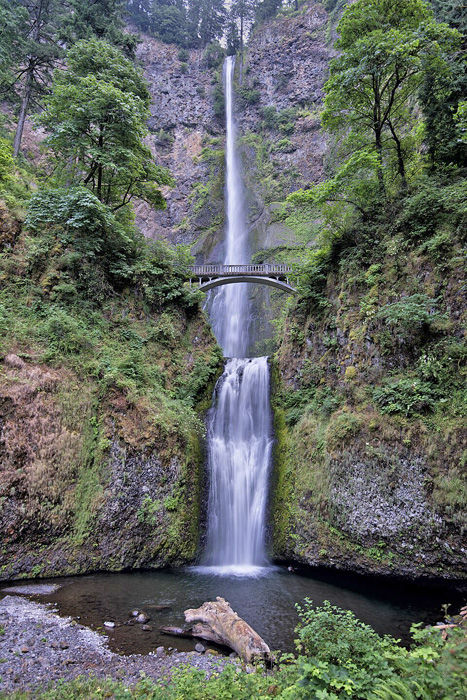
Multnomah Falls, Oregon, near Portland.
When the water is high, these cascades are lost sight of, and the rocks which form them are covered with one raging torrent, which seems inclined to dash everything to one side in its headlong course towards the Pacific Ocean. Logging is a most important use to which the Columbia River is put. When immense masses of timber come thundering down the Dalles, at a speed sometimes as great as 50 miles an hour, all preconceived notions of order and safety are set at naught. One timber shoot, more than 3,000 feet long, is so steep that the logs rush down in scarcely 20 seconds. The Dalles may generally be described as a marvelous trough, and the name is a French word that well signifies this feature.
Farther down the river, and near the city of Portland, there are some very delightful falls, not exceptionally large or high, but very delightful in character, and full of contradictions and peculiarities. Steamboating on the Columbia River, in its navigable sections, is exceedingly pleasant and instructive. The river is the largest in America which empties into the Pacific Ocean. For more than 140 miles it is navigable by steamers of the largest kind, while other vessels can reach much higher, and nearer the picturesque source. On some sections, glaciers of great magnitude can be seen, and many points are also the subject of legend and tradition. According to one of these traditions, the Indians who formerly lived on the banks of the river were as brave as the ancient Spartans and Greeks. However, if this is approximately correct, the law and argument of descent must be entirely erroneous, for the Indians of this section today rank among the meanest and most objectionable of the entire country.
An artistic illustration is given of the “whaleback” steamer, used principally on our Northern lakes. The whaleback varies from a somewhat clumsy-looking craft, resembling in appearance very much the back of a whale, to the much more attractive and navigable craft shown in the illustration. These whalebacks play a vital role in inland navigation. It seems able to withstand bad weather and rough water readily. Unlike most vessels, which are safe under these conditions, it requires very little water to be safely navigated, and it can carry heavy loads in six or eight feet of water.
The revival of the steamboat trade on our great rivers, and the recovering from the railroads of at least a portion of the trade stolen away, is a pet hobby among river men generally, and especially among those whose parents taught them from the cradle up the true importance of the magnificent internal waterways bountifully provided for our native land by an all-wise Providence. It is seriously proposed to attempt this revival with the aid of whaleback steamers. If the project is carried out, the success that will attend the effort is likely to pleasantly surprise even the most enthusiastic among those who are now advocating it.
Compiled & edited by Kathy Alexander/Legends of America, November 2026.
Source: Cox, James; My Native Land, Blair Publishing Co., Philadelphia, PA, 1903