
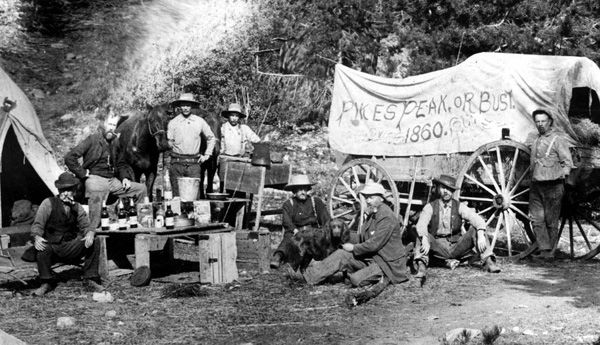
Pikes Peak or Bust.
By Daniel R. Seligman.
The discovery of gold in the Rocky Mountains in 1858 led to the Pike’s Peak Gold Rush. Gold seekers swarmed into the mining camps and boom towns in today’s Colorado, recalling the California Gold Rush a decade earlier. The comforts of civilization were few, and manufactured goods were in short supply. And — one step beyond bare necessities in the 19th century — the mining settlements lacked religion and women (not necessarily in that order).
An idealistic young minister felt called to bring God to the rough and lawless Colorado mining camps. With the enthusiastic support of his pretty 19-year-old wife, he embarked on a wagon train from St. Joseph, Missouri, in the late summer or early autumn of 1858. One night on the trail, the young minister disappeared. At the same time, a woman reputedly of loose morals was also absent. A search party failed to find either of them, and the obvious conclusion was that they had run off together.

Pike’s Peakers Crossing the Plains by Albert Bierstadt, 1859.
The incident provoked some serious soul-searching in the abandoned wife. When the wagon train reached Indian Row in the settlement of Auraria, today part of Denver, she experienced a dramatic moral about-face. She would no longer be a God-fearing woman, her name would henceforth be Addie LaMont, and she would open the first brothel in the area. True to her word, she became a spectacularly successful madam in the overwhelmingly male environment. In short order, she moved her business from a shack on Indian Row to an upscale house on Arapahoe Street, where she operated Denver’s premier whorehouse.
However, her promising career ended in tragedy. A decade or so later, a friend visiting Kansas came upon a human skeleton in the prairie with a bullet hole in the back of the skull. Found with the skeleton were the remains of a Bible with an inscription by Addie to her husband, which the friend had presented to her upon his return. The evidence was clear: her minister husband had not been unfaithful but rather the likely victim of an Indian attack. The brutal realization provoked another bout of soul-searching and another moral about-face. She began to drink heavily and allowed her business to fail. She moved on to Georgetown, another mining settlement, sank into destitution, and ultimately died of starvation.
At least, that is the legend as described by Zamonski and Keller and more or less repeated by the authors DeArment, Collins, Dallas, and Secrest. Unfortunately, Zamonski and Keller (hereafter Z&K) did not cite any references, and one suspects that, like many legends of the American West, the story contains some truth and a good deal of exaggeration.
We examine the available evidence to uncover the real story of Ada/Addie Lamont.
Religious Activity
On the heels of the gold rush, the religious leaders of the day became interested in the spiritual welfare of the Rocky Mountain miners, and Methodist and Presbyterian preachers, among others, made the trek to the gold fields. Methodists W.H. Goode and Jacob Adriance arrived in Denver on June 28, 1859. Presbyterian A.T. Rankin showed up in July of the following year. The dates are sufficiently close to those in Z&K’s account to make an early visit by an enthusiastic young minister entirely plausible. Indeed, Secrest suggests that the legend’s date of 1858 is at least a year too early, owing to an established lack of white women in the area at that time, bringing the dates even closer.
There is some question about Ada’s age. The United States Census of 1880 and the Colorado State Census of 1885 both have her born about 1835, making her a more mature 24 in 1859 rather than a blushing bride of 19.
Charley Harrison
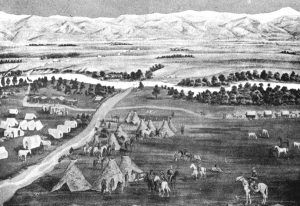
Early Denver, Colorado, 1859.
Charley Harrison was a western gambler with a murky background who showed up in Denver about 1859. He had the air of a southern gentleman of the times and displayed a prickly sense of honor. Harrison was responsible for at least two shootings before he arrived in Denver, where he bought into the Criterion Saloon and ran it jointly with one Ed Jump. Z&K and DeArment suggest a love affair with Denver’s premier madam and a brief but important role in her life in Denver.
In July of 1860, not long after his arrival, Harrison shot and killed one “Professor” Charles Stark, a black blacksmith. The source of the trouble seems to have been Stark’s attempt to be too familiar, offending Harrison’s southern sensibilities, but Stark then came at him with a Bowie knife, prompting Harrison to shoot and kill him. Harrison was denounced in the local press, but there were no legal repercussions.
In another incident, Harrison shot and killed James Hill, a local rancher, in a confused episode that may or may not have been self-defense and that led to a hung jury in the subsequent trial.
In a third incident, Harrison joined a posse in the pursuit of the murderer of another local rancher. He was instrumental in obtaining a confession, which, presented at a jury trial, led to a legal hanging.
Ada LaMont as Madam

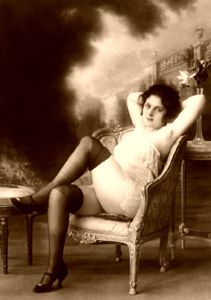
Soiled doves in Denver, Colorado.
The evidence of Ada LaMont’s tenure as a madam in Denver is somewhat sparse.
According to Z&K, the First Division of the Utah Army, on the way to New Mexico, was caught in a major downpour in the vicinity of Denver in the middle of July 1860. Six soldiers, wet, bedraggled, and drunk, “stomped into Ada LaMont’s house” and began to treat the girls roughly and make general nuisances of themselves. They were diplomatically turned away by Charley Harrison and three companions who made a timely appearance and, conveniently, were also armed. However, the newspaper The Western Mountaineer (7/19/1860) treats the same incident, placing it in “a house in Highland,” referring to “four or five men” turning away the soldiers, and making no explicit mention either of Ada LaMont or Charley Harrison. There may be some confusion here between Arapahoe Avenue in Highland and Arapahoe Street in Denver. Highland and Denver were separate settlements prior to December 1859.
A few days later, James Gordon, a young civil engineer, unable to hold his liquor, “wound up at Ada LaMont’s house” and proceeded to shoot the bartender, Frank O’Neil, according to Z&K. The Western Mountaineer (7/26/1860) places the same incident “in a house of ill-fame,” The Rocky Mountain News (Weekly) (7/25/1860) in “a house of ill-fame on Arapahoe street,” and Smiley’s History of Denver in “a house of evil repute on Arapahoe street.” None of the three explicitly mentions Ada LaMont.
The following December, Charley Harrison’s trial for shooting James Hill ended in a hung jury, with the suspicion, according to Z&K, that “Ada LaMont had distributed five thousand dollars” to ensure the result.
Colorado Territory entered the Union in February of 1861. News of the firing on Fort Sumter the following April led to trouble in Denver, more or less evenly divided between Union and Confederate sympathizers. In August of 1861, tensions between southern sympathizers and the newly recruited Company B of the First Colorado Volunteers boiled over. Committed to the southern cause, Harrison took an active role in a confrontation. Z&K report a “fight in the bagnio owned by Ada LaMont” that escalated into a brawl at Harrison’s Criterion Saloon. The contemporary local newspapers report a far more subdued event and make no mention of Ada LaMont’s bagnio (The Rocky Mountain News (Daily) (April 23, 1861); The Daily Colorado Republican and Rocky Mountain Herald (April 23- 24, 1861)).
The Mountain-Ear (9/3/2009) offers a retrospective look at the incident and seems to confirm both the level of violence and the involvement of Ada LaMont’s establishment. But its sources are unstated.
Arrested, tried, and found guilty of obstructing the government, Charley was fined and banished from the city. Leaving Denver, he joined the Army of the Confederacy as a captain. In a distinguished military career, he served the Confederacy in several battles and was promoted to lieutenant colonel, then to full colonel. On May 16, 1863, he was killed in a skirmish with (pro-Union) Osage Indians in SW Kansas.
Madam or Prostitute?
The evidence, scant as it is, suggests that Ada LaMont probably ran a high-class Denver bordello on Arapahoe Street in the early 1860s. If so, there are indications that her fortunes suffered a downturn later in the decade, conceivably resulting from a moral trauma. During this latter period, she also seems to have spent some time in Georgetown. The available facts, as reported in the local newspapers, are as follows:
– In April 1867, “Ad. Lamont” was fined $11 for drunkenness in Denver in police court. (The Rocky Mountain News (Daily) (4/22/1867))
– The following October, “a house of ill-fame, kept by one Ada Lamont” in Georgetown was pulled down, and she was sent out of town. (The Daily Colorado Tribune (10/2/1867))
– In January of 1869, she witnessed the shooting of one George Maguire in Georgetown. Accounts differ as to whether the shooting took place at “Ada LaMont’s place” or that of one Moll Greer. (The Rocky Mountain News (Daily) (1/26/1869); Georgetown Courier (2/17/1906))
– The following May, Many Kirwin was charged in Denver with “keeping a house of ill-fame, and Ada Lamont with being an inmate of the same,” and each was fined $25. (The Rocky Mountain News (Daily) (5/24/1869))
– In January of 1870, “Ad. Lamont, a woman of the town” was arrested for drunkenness in Denver and “assessed the usual fine.” (The Rocky Mountain News (Weekly) (1/26/1870))
– The following June, “Ad Lamont” was fined $13 for “breach of the peace” in Denver. (The Rocky Mountain News (Daily) (6/17/1870))
– In August of 1871, one Charles Madden was living with “two soiled doves, named respectively Ad. Lamont and Nellie Murphy… in a brush tent, or sort of summer house” in Denver. (The Rocky Mountain News (Daily) (8/30/1871))
Beginning in 1867, her activities in Denver suggest a working prostitute and perhaps an alcoholic rather than a “respectable” madam. In Georgetown, the picture is a little more ambiguous and suggests that she had not entirely given up on the managerial side of her profession.
Sojourn in Georgetown
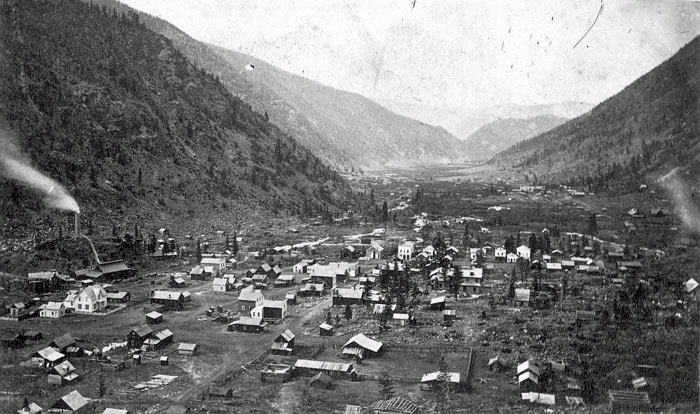
Georgetown, Colorado, 1867.
Although she was run out of Georgetown in October of 1867, she had returned by the early 1870s and thereafter lived a relatively quiet life, much of it at the county’s expense, if one of her obituaries is to be believed. The 1880 US census lists a 45-year-old Adda Lamont living in Georgetown with a 16-year-old boarder named Tillie Jones, a Swedish immigrant. The 1885 Colorado state census lists a 50-year-old Ad Lamont as proprietress of a boarding house in Georgetown with 18 boarders. Both male and female names are included in the census record, suggesting an actual boarding house and not a front for a brothel.
For the next twenty years, the newspapers are relatively quiet on the subject of Ada LaMont, save for a couple of human-interest stories, likely implying an uneventful life. The Leadville Daily/Evening Chronicle (9/19/1887) lists “Lamont, Addie” among a group of excursionists on a recreational train ride in the Rocky Mountains. The Georgetown Courier (4/22/1905) reports an encounter with a wildcat that entered “Ada LaMont’s cabin at Silver Dale” and parked itself under her bed.
According to The Idaho Springs Mining Gazette (9/13/1906), “Addie LaMont” was found dead in her home on September 11, 1906. There are some obvious inaccuracies in the obituary, including a claim that she had joined Barnum’s circus and won acclaim as a bareback rider. (Barnum didn’t get into the circus business until the early 1870s when Ada LaMont was living in Colorado.)
An obituary in the Grand Junction Daily Sentinel (9/15/1906) entitled “Famous Beauty” reads as follows:
Georgetown, Colo., September 15. – Last evening [sic], Addie LaMont was found dead in her cabin at Silver Dale. She was more than 70 years old and had probably the most remarkable career of any early settler in the state.
In the early sixties, she was a reigning belle among the sporting class in Denver and, at the time, remarkable for her beauty. In 1863, she and her paramour were arrested for stealing a box of cigars from a house standing on the bank of Cherry Creek, where the Larimer Street bridge now crosses.
She came to Georgetown about 36 years ago, since which time she has lived a secluded life, being, for the greater part of the time, a charge of the county.
Her death was no doubt due to heart failure.
Three years later, an article in the Georgetown Courier (9/18/1909) entitled “Looking Backward” remembers her with the honorific Pioneer:
September 11… Pioneer Ada Lamont found dead. 1906.
Contrary to the grim fate recounted in the legend, Ada LaMont lived out a quiet life in Georgetown and even achieved a measure of local respect.
Evaluation of the Legend
Like most legends, the story of Ada LaMont contains some truth, some unproven parts, and some fiction.
There was indeed a woman who called herself Ada or Addie LaMont, who was prominent in Denver’s demimonde in the early days of the gold rush. She likely spent some years as a madam but worked as a prostitute as well. Her origin as a Christian missionary, the violent fate of her husband, her two moral turning points, and her affair with Charley Harrison, while entirely consistent with the facts, remain unproven. Finally, her ultimate descent into penury and death by starvation is verifiably in error. Ada LaMont’s story has a much happier ending.
©Daniel R. Seligman, for Legends Of America, submitted February 2026.
Also See:
Ghost Towns & Mining Camps of Colorado
Brothel Museum, Cripple Creek, Colorado
Leading Madames of the Old West
Painted Ladies of the Old West

Author Daniel Seligman.
About the author:
Daniel is a retired computer engineer from Massachusetts with a lifelong interest in the American West. He teaches seminars on western gunslingers and has authored a number of articles on western history in various publications, including:
Baldy Green, the Ill-fated Jehu, Wild West History Association Journal, September 2025, 54-59
The Rise and Fall of Rough Elliott, Wild West History Association Journal, June 2025, 40-26
Stagecoach Brawl, Legends of America, September 2024
Getting Away with Murder, Legends of America, March 2024
These Two Highwaymen Battled for the Title of World’s Best Stagecoach Robber, Wild West, Autumn 2023, 50-55
How to Rob a Stagecoach, Wild West, Autumn 2023, 20-21
Mary Jane Simpson – The Lady and the Mule, Legends of America, January 3, 2023
Charles Waggoner – Colorado Robin Hood, Legends of America, November 14, 2022
Scouts of the Prairie: A Glorious Disaster, Legends of America, November 7, 2022
Going for Gold: How the Confederacy Hatched an Audacious Plan to Finance Their War, America’s Civil War, July 28, 2022
Tracking the White Apache, Wild West, October 2021, 44-49
King of the Tulares, Wild West, April 2021, 58-63
Annie Oakley’s Gaffe…Or Was It?, Wild West History Association Journal, September 2019, 69-73
Rough and Ready, Wild West, October 2019, 44-49
Bound and Determined, Wild West, August 2018, 46-51
This Scout Lived with the Enemy, Wild West, August 2018, 22-23
Western Stagecoach Robberies: A Statistical Analysis, Wild West History Association Journal, December 2017, 23-27
Evolution of a Mountain Man, Wild West, October 2017, 58-63,
The Greatest of Confidence Men, True West, June 2015, 40-41
The Flawed Gentleman Bandit, True West, December 2013, 32-35
Frank Butler, Much Maligned Husband, True West, March 2013, 44
References:
Books
- Robert K. DeArment, Knights of the Green Cloth: The Saga of the Frontier Gamblers, 1982: Chapter 2, 39-67
- Isaac Haight Beardsley, Echoes from Peak and Plain; or, Tales of Life, War, Travel, and Colorado Methodism, 1891, Part IV, Chapter II, Methodist Beginnings: 224-239
- Jan MacKell Collins, Brothels, Bordellos & Bad Girls, Prostitution in Colorado 1860-1930, 2018: 53
- Sandra Dallas, Cherry Creek Gothic: Victorian Architecture in Denver, 1971: 227-228
- Clark Secrest, Hell’s Belles: Prostitution, Vice, and Crime in Early Denver, 2002: Chapter 59; Chapter 4, 75-76
- Jerome C. Smiley, History of Denver, with Outlines of the Earlier History of the Rocky Mountain Country, 1903: 343
- Stanley W. Zamonski and Teddy Keller, The ’59ers: Roaring Denver in the Gold Rush Days, 1967
Censuses
- Adda Lamont, United States Census; Georgetown, Clear Creek, Colorado; 1880
- Ad Lamont, Colorado State Census; Clear Creek; 1885
Newspapers
- The Daily Colorado Republican and Rocky Mountain Herald
- Daily Colorado Tribune
- Georgetown Courier
- Grand Junction Daily Sentinel
- The Idaho Springs Mining Gazette
- Leadville Daily/Evening Chronicle
- The Mountain-Ear
- The Rocky Mountain News (Daily)
- The Rocky Mountain News (Weekly)
- The Weekly Commonwealth
- The Western Mountaineer