
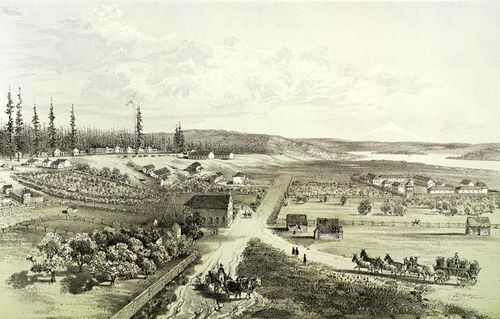
Fort Vancouver, Washington.
Established in 1824, Fort Vancouver was a trading post that served as the headquarters of the Hudson’s Bay Company in its Columbia District, which encompassed 700,000 square miles, stretching from Russian Alaska to Mexican California and from the Rocky Mountains to the Hawaiian Islands. Situated along the north bank of the Columbia River in present-day Vancouver, Washington, it was named for Captain George Vancouver.
Hudson Bay’s man, George Simpson, was instrumental in establishing the fort, and Dr. John McLoughlin became its first manager. McLoughlin, who would later be hailed as the Father of Oregon, welcomed and helped new settlers to the area.
However, the Hudson’s Bay Company was unhappy with these actions because new settlers interfered with the lucrative fur trade. He later left the organization and founded Oregon City in the Willamette Valley.
The original post, comprised of about 40 buildings, including homes, a school, a library, a pharmacy, a chapel, a blacksmith, and a large manufacturing facility, was surrounded by a 20-foot-high palisade that measured approximately 750 feet long and 450 feet wide. Outside its tall walls, the large corporate monopoly also built additional housing, a shipyard, a hospital, a distillery, a tannery, a sawmill, a dairy, agricultural fields, and fruit orchards.
As the administrative center and principal supply depot of the vast area, the fort was the hub of an extensive fur trading network, utilizing two dozen posts, six ships, and approximately 600 employees during peak seasons, most of whom were involved in agricultural activities.
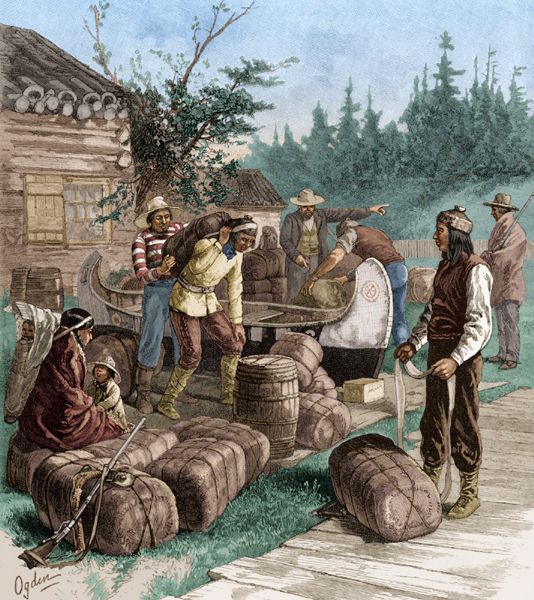
Hudson’s Bay Company Trading Post.
Fort Vancouver became a center of activity and influence, supported by a multicultural village that included inhabitants from over 35 ethnic and tribal groups. Though it was a British establishment, the primary languages were Canadian French and Chinook Jargon. It became one of the largest settlements in the West at the time and served as the western terminus of the Oregon Trail for American immigrants.
During the late 1840s and early 1850s, declining returns from trapping and the growing number of settlers led to a shift in focus from fur brigades to land-based mercantile opportunities. With this change came a shift in the village activity and population. The number of Hawaiian employees increased, and by the 1850s the village was known as “Kanaka Town” or “Kanaka Village,” a term derived from the Hawaiian word for “person.”
Not only was the village a living quarters for Company employees, but it also became the site where the U.S. Army established a permanent presence in the Pacific Northwest. In May 1849, the U.S. Army set up Camp Columbia on a rise 20 feet above the trading post.
Although the Hudson’s Bay Company assisted the soldiers by allowing them to use its sawmill to cut timber, the construction of the post was delayed by the California Gold Rush. Amid labor and supply shortages, high prices, and numerous desertions, those who were left continued to toil, but construction was not complete until the spring of 1851. At that time, the army post was renamed Columbia Barracks.
The traders and soldiers initially coexisted amicably, and the Army rented many of the village buildings and hired more locals. In the early 1850s, the Army constructed several new buildings, including the Quartermaster Depot and Captain Rufus Ingalls’ house, where Ulysses S. Grant resided from 1852 to 1853. The army post expanded to more than 10,000 acres and was renamed Fort Vancouver Military Reservation.
Due to increasing pressure from new settlers for land and declining returns from trapping, relations between traders and soldiers deteriorated in the latter half of the 1850s. Finally, in June 1860, the Hudson’s Bay Company withdrew its operations to Victoria, British Columbia.
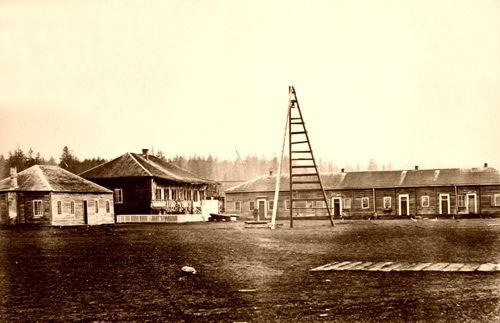
Fort Vancouver, 1860.
The soldiers occupied some old trading post buildings, and the Vancouver Arsenal was established in 1859. However, in 1866, a raging fire destroyed all signs of the original trading post buildings.
However, the soldiers stayed on and rebuilt the buildings, including two double-story barracks on opposite sides of the parade ground, each with a kitchen and mess room to the rear. Seven log and four frame buildings served as Officers’ Quarters.
In 1879, the post was renamed Vancouver Barracks and underwent expansion during World War I. Later, during World War II, the post was used as a staging area for the Seattle Port of Embarkation. Finally, in 1946, the fort was closed.
Due to its historical significance, the site was designated a U.S. National Monument on June 19, 1948, and subsequently re-designated as Fort Vancouver National Historic Site on June 30, 1961. Today, the historic site features a full-scale replica of the fort, including the manager’s house, bakery, blacksmith shop, central stores, and fur storage facility. Numerous exhibits are available for viewing, and re-enactments and demonstrations are held throughout the year.
Contact Information:
Fort Vancouver National Historic Site
612 East Reserve Street
Vancouver, Washington 98661
360-816-6230
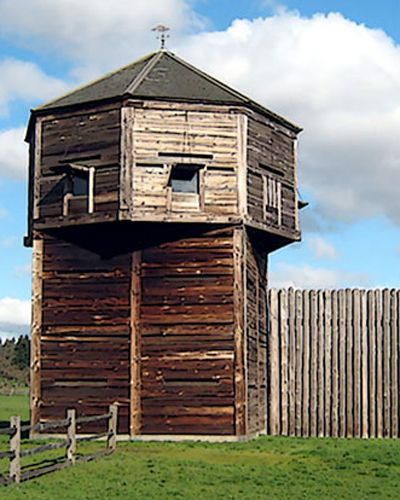
Fort Vancouver today courtesy Clark County, Washington.
©Kathy Alexander/Legends of America, updated September 2025.
Also See:
Washington – The Evergreen State
Washington State Photo Gallery
See Sources.