
By William Pugh Duncan
The year 2026 marks the 250th anniversary of the founding of the United States — our semiquincentennial. Across the country, commemorations will gather around July 4th, but my co‑author, Dr. MacCutcheon, and I felt that such a milestone deserved something that could accompany people throughout the entire year. Exploration and discovery have shaped the American story in ways unlike many other nations, and we wanted to create a way for readers to revisit that heritage slowly, day by day.
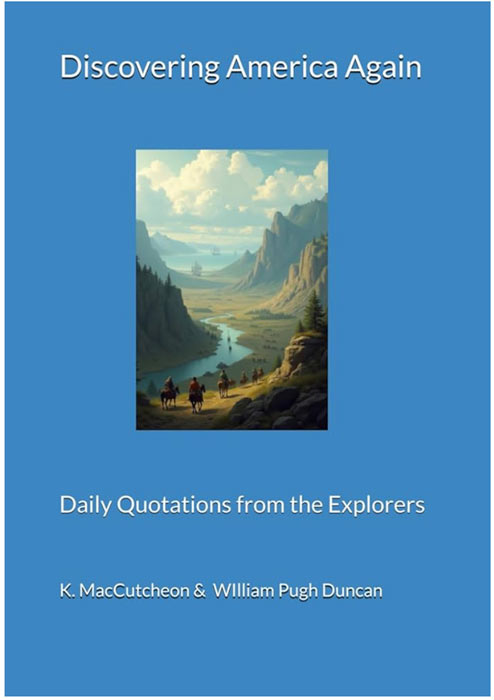
Available via Amazon here
With that in mind, we assembled a guided journal for the 250th year. Each day offers a quotation from an explorer or pioneer, paired with a short reflection — sometimes about the individual and their era, sometimes about the broader meaning of their words. Space is left for readers to add their own thoughts, making the journey a personal one. A few entries feature longer passages that stand on their own.
The voices gathered here span centuries: from Columbus to Lewis and Clark to Neil Armstrong. Alongside the familiar names are many whose contributions have faded from memory. Together, they form a tapestry of experiences that shaped the nation. Even seasoned students of American history may find themselves meeting new figures or rediscovering forgotten ones. In this article, we share a few examples.
January 12 — Alvar Núñez Cabeza de Vaca
“If one lives where all suffer and starve, one acts on one’s own impulse to help. But where plenty abounds, we surrender our generosity, believing that our country replaces us each and several. This is not so, and indeed a delusion. On the contrary the power of maintaining life in others, lives within each of us, and from each of us does it recede when unused. It is a concentrated power. If you are not acquainted with it, your Majesty can have no inkling of what it is like, what it portends, or the ways in which it slips from one.”
Alvar Núñez Cabeza de Vaca remains one of the most remarkable — and least remembered — explorers of the early Americas. He was the first European to reach, by land or sea, what are now Alabama, Mississippi, Louisiana, Texas, New Mexico, and Arizona. In 1527, he joined an expedition to the lands west of Florida. Poor leadership doomed the venture, and only four men survived. Their path carried them from Cuba to Florida, along the Gulf Coast, and eventually into the interior of Texas and the Southwest.
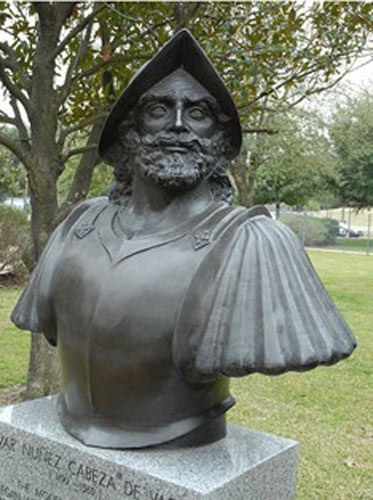
Bronze bust of Cabeza de Vaca in Houston, TX.
Shipwrecked near Galveston, enslaved for years, and later wandering among Indigenous communities, Cabeza de Vaca lived as trader, healer, and traveler before finally reaching Spanish settlements near the Gulf of California. His account, published in 1542, remains one of the earliest and most vivid descriptions of life in the region.
His words for January 12 speak to the responsibility of individual compassion. Hardship taught him that generosity cannot be delegated — that each of us carries the power to sustain others, and that this power fades when left unused. As we navigate our own journeys, even in moments that feel like shipwrecks, his reminder endures.
February 20 — Bill Pickett
“What’s gonna happen, gonna happen.”
February’s entries highlight African American history, bringing voices from many eras into conversation. Bill Pickett, born in 1870, was a cowboy of African American and Native American heritage who pioneered the rodeo technique known as “bulldogging,” the forerunner of modern steer wrestling. His daring performances carried him across the country and into early Western films of the 1920s. He died in 1932 after being kicked by a bronco — a fittingly rugged end to a rugged life.
Pickett’s simple, steady phrase reflects the mindset of someone who faced danger as part of daily work. Prepare well, act boldly, and accept what follows. It’s a reminder that overthinking can be its own obstacle.
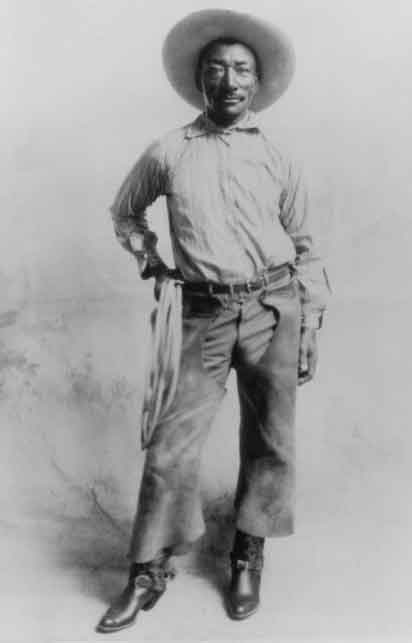
Bill Picket, circa 1902. Photo from the North Fort Worth Historical Society.
The journal contains 366 quotations — including one for February 29, should a leap year inspire someone to begin then. Throughout the year, certain months highlight particular themes: African American history in February, women’s history in March, inventors in May, astronauts during Space Week in October, and Native American history in November. Otherwise, the quotations follow a loose chronological flow. Readers may begin on January 1 or on any day that feels right; the pages can be read in sequence or all at once.
Within these entries are mariners, soldiers, surveyors, fur traders, pioneers, and countless others: survivors like Virginia Reed; those who did not survive, like Davy Crockett at the Alamo; and lesser‑known figures such as Robert Hayman, Charley Willis, Sarah Raymond Herndon, Saint Herman of Alaska, Frederick McKinley Jones, John Boit, David Thompson, Zenas Leonard, Joseph Meek, Gene Cernan, George Copway, and Hank Monk. We also note the first recorded visitor to each state — many of whom arrived far earlier than one might expect.
In this 250th year, there is much to rediscover about the people who crossed, mapped, and imagined these lands. We invite readers to explore alongside them.
© William Pugh Duncan, for Legends of America, submitted February 2026.
Sold on Amazon
About the author: William Pugh Duncan is co-author of Discovering America Again: Daily Quotations from the Explorers with Dr. K. MacCutcheon, American patriots who have written the work to encourage others to renew their patriotism and belief in America.
Also See: