
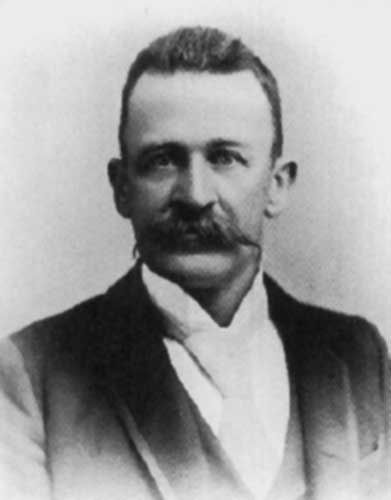
William M. Breakenridge.
Known as one of the most courteous and modest peace officers to ever work in the lawless town of Tombstone, William “Billy” Milton Breakenridge was not to be trifled with.
Born on December 26, 1846, in Watertown, Wisconsin, he traveled to the Pike’s Peak mining area at 15. Three years later, in 1864, he joined Company B of the Third Colorado Cavalry for service in the Civil War, where he fought in the Battle of Sand Creek and several other skirmishes.
Around 1876, he headed to Arizona Territory, arriving in Tombstone by 1880. There, he worked for Sheriff Johnny Behan. That same year, he was appointed a U.S. Deputy Marshal, a position he would hold until 1889. This designation gave him more authority than what was allowed by Cochise County, helping him to become one of Tombstone’s most effective lawmen.
Though he put several outlaws in the Boot Hill cemetery, Breakenridge used a gun only as a last resort. But when necessary, he used it quickly and accurately. Before long, his gun skills earned him a reputation as a lethal gunfighter, and few outlaws even challenged him.
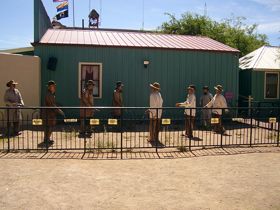
Re-creation of the Gunfight at the O.K. Corral
He was present in Tombstone during the famous Gunfight at the O.K. Corral. He was said to have been on friendly terms with the Clanton faction, and of course, working under Johnny Behan, he is generally perceived to have sided with those opposing the Earps. Many years later, when he wrote his memoirs, he said Wyatt Earp was a desperate character.
Many outlaws would not challenge him, but that changed on March 26, 1882. The night before, two men named Zwing Hunt and Billy Grounds attempted to rob the Tombstone Mining and Milling Company in Charleston, Arizona. After being challenged, they shot and killed a man before panicking and taking off without a dime.
Soon, Breakendridge deputized three men to ride with him in a posse, and they began tracking the two killers. Finding them at the Jack Chandler Ranch near Tombstone, a gunfight ensued. Though it lasted only seconds when the smoke cleared, Breakenridge had killed Billy Grounds, and Zwing Hunt had been wounded. Unfortunately, one deputized man, John Gillespie, was also dead. The other two posse members were wounded but would recover. Outlaw Zwing Hunt would also recover and escape but was killed by Apache Indians a short time later.
In 1888, Breckenridge completely changed tactics, accepting a position as a surveyor for Maricopa County. In this capacity, he was soon tasked with surveying the Salt River for potential dam sites. After examining several sites, he returned with a party from Phoenix in July 1889, which included James McClintock, William J. Murphy, and John R. Norton, to examine the sites Breakenridge recommended and conduct a feasibility study. It took the men a week to travel on horseback to reach Box Canyon, near the confluence of Tonto Creek and the Salt River. Breakenridge insisted this was the best place for a dam, and he was right. Though construction would not start until September 1906, more than a decade later, Breakenridge had accurately predicted the perfect site for what is now Roosevelt Dam, completed in 1911.
Later, James McClintock became one of Arizona’s official historians, writing the three-volume book series Arizona: The Youngest State, from which many excerpts appear here on Legends of America’s pages.
Breakenridge would eventually return to “looking after the peace” when he accepted a position as a detective with the Southern Pacific Railroad.
In 1895, the railroad had been held up or attempted to be robbed several times by outlaws Grant Wheeler and Joe George. Breakenridge and a posse wasted no time tracking the men and trailed Wheeler into Colorado, near Mancos, on April 25. The next morning, the outlaw was surrounded and briefly resisted with a few shots from his gun. Still, sure that he would be taken to jail or killed, Wheeler chose to take his own life instead. On his seventieth birthday, the ex-lawman began writing his memoirs, including his lawless days in Tombstone, the Gunfight at the O.K. Corral, numerous accounts of his encounters with outlaws and Indians, and his days working for the railroad. In 1928, his book, Helldorado: Bringing the Law to the Mesquite, was published. Wyatt Earp and his wife, Josie, became major critics of the book, claiming that much of what Breakenridge wrote was biased and more fiction than fact. Regardless, it generated enough interest in Tombstone that citizens created Helldorado Days, which are still celebrated annually in October to commemorate the famous gunfight.
Three years after his book was published, the Arizona pioneer and lawman would die in Tucson, Arizona, on January 31, 1931. Before his death, Breakenridge said he would gladly do it all again.
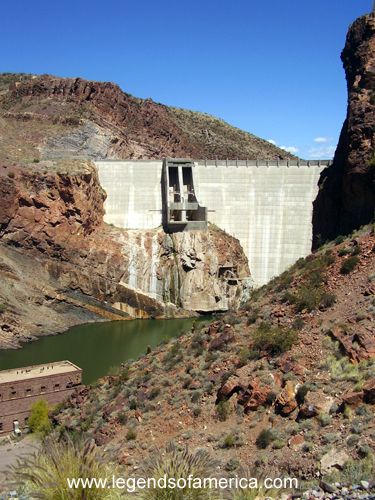
Roosevelt Dam, Arizona.
©Kathy Alexander/Legends of America, updated September 2026.
Also See:
Tombstone – The Town Too Tough to Die
Arizona – The Grand Canyon State
See Sources.