
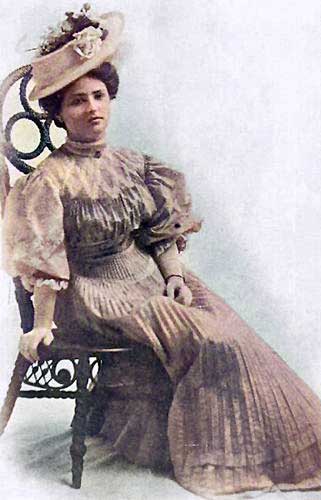
Lottie Deno.
By Maggie Van Ostrand.
Cowboys and Longhorns, soldiers and forts, Comanche, the buffalo trade, 18 saloons, and an abundance of “soiled doves” were the sights greeting beautiful Lottie Deno as she rode into Fort Griffin from Jacksboro, sitting next to the driver atop the stagecoach. To the denizens of Fort Griffin Flat, known as “The Toughest Town in Texas” and described as “one of the wildest… gambling hellholes ever spawned on the frontier,” this was shocking behavior from a well-bred lady of culture and refinement.
The wild and woolly town of Fort Griffin, also known as “The Flat,” enjoyed a reputation in the 1870s as having “a man for breakfast every morning.” The frontier community sprang up at the crossroads of two significant cattle trails that converged below a bluff, atop which the U.S. military established a frontier fort in 1867 during the Indian Wars. Frontier legends Wyatt Earp, Doc Holliday, John Wesley Hardin, Billy the Kid, Sheriff Pat Garrett, and Bat Masterson once sauntered down its streets.
Lottie took up residence in a Clear Fork shanty. An air of mystery began to surround her. She was a vivacious redhead with sparkling brown eyes, who was seldom seen except when she visited the stores for supplies or at night when she played cards at the Bee Hive Saloon or presided over its gambling room.
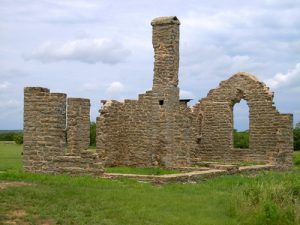
Fort Griffin, Texas Administration Building by Kathy Alexander.
Lottie was known by many names, including Carlotta J. Thompkins (the name she was christened with), Laura Denbo, Faro Nell, and Charlotte Thurmond. She was dubbed Lottie Deno the night she won every poker hand from every opponent foolish enough to think he could win. After the very last hand of the very last game had been played and won by her, a drunken cowboy yelled out from the saloon’s rear corner, “Honey, with winnings like them, you ought to call yourself ‘Lotta Dinero.”
Seeing the advantages of a nickname to protect her real identity from family and friends, she then called herself “Lottie Deno.” This new name protected Lottie’s pious Episcopalian family back in Kentucky from knowing that she supported herself by gambling and that the money she frequently sent them came from what they would have considered shocking and illicit means. Instead, she told her mother and sister that she had married a wealthy Texas cattleman. She would never see her family again, nor would they ever learn the truth about her.
She was born on April 21, 1844, to upper-class farm owners in Warsaw, Kentucky. In the areas around Lexington and Louisville, Warsaw traded with both northern and southern states (her father served in the Kentucky General Assembly), though the region was southern in flavor, and slavery was prevalent. As did many a young lady of the same exalted station in life, Lottie had her own nanny, Mary Poindexter, a seven-foot-tall slave who served as both protector and companion, exhibiting devotion and loyalty to Lottie even after the Civil War and for many years to come.
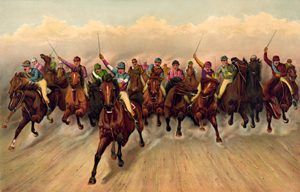
Horse Racing by Currier and Ives, 1888.
The main crops of the Warsaw region were tobacco and hemp, which were shipped north to Detroit and south to New Orleans. Other interests of the area, then as now, were horse breeding, horse racing, and horse-trading. Lottie’s father engaged in these lucrative pursuits and sold crops.
After completing her education at an Episcopalian convent with her younger sister, Lottie usually accompanied her father on many business trips to Detroit, New Orleans, and even Europe.
When racing his horses in New Orleans, Lottie’s father also indulged in another favorite pastime, one in which he excelled: gambling. He taught his daughter all the tricks he knew about card playing, believing that there was more to survival than simply being a southern belle. She had been well versed in the social graces at the convent, and since he had no son to carry on after him, he expected his eldest daughter to be strong, independent, and able to care for her younger sister when the time came financially. He showed her how to gamble on land and riverboats, and he passed on to her his passionate skill at cards, known as “flipping the pasteboards.”
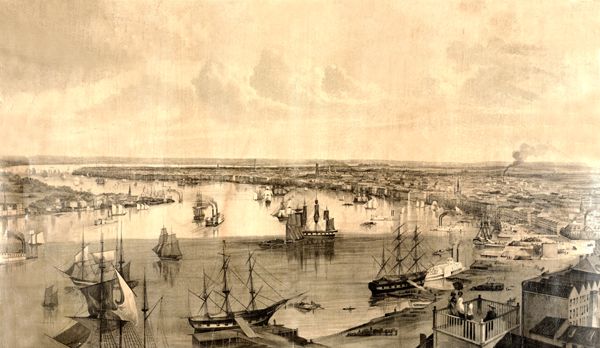
New Orleans, Louisiana, 1852
In the 1850s, New Orleans was known as the “Good Time Town,” a playground for grown-ups and the racing mecca of the entire nation. Lottie’s father conducted his business and found his pleasures at establishments like the St. Charles Hotel, Creole Orleans, Victor’s, and the Café de Quatre Saisons. He visited the Gem on Royal Street, the most elegant drinking house in the city, and placed bets at the Common Street Gallery “where men tried to shoot the flame of burning candles at 12 paces twenty times in succession. Men could bet on bullfights, cockfights, dog races, and even rat races,” writes Cynthia Rose in Lottie Deno: Gambling Queen of Hearts. Lottie’s father was free to do as he wished at night since New Orleans had a strict curfew for both ladies and slaves, and young Lottie and Mary had to be inside by 8:00 p.m., or Mary would have been arrested and her owner fined.
The North and South were already politically polarized when John Brown and his men attacked Harpers Ferry in 1859. Kentucky tried to remain neutral, but in September 1861, Confederate troops invaded western Kentucky. Ulysses S. Grant moved in and occupied Paducah, forcing Kentucky to join with him and drive out the Confederates.
This was the year 17-year-old Lottie’s father, a southerner at heart, enlisted in the Confederate army. He was killed in battle, and the health of Lottie’s mother began to fail. Relatives decided to send Lottie to friends in Detroit, hoping she would meet and marry a wealthy man who would take over the family business. They collected enough to pay the fare north for Lottie and Mary Poindexter.
Lottie quickly took to Detroit’s social life and happily attended parties, dancing the nights away. But instead of concentrating on finding a suitable husband of means, Lottie fell for Johnny Golden, one of her father’s former jockeys, now a gambler himself. It is speculated that Lottie and Johnny had an affair earlier in New Orleans, and that was the real reason she was shipped off to Detroit by her family, who wanted her to forget about Johnny, a nobody.
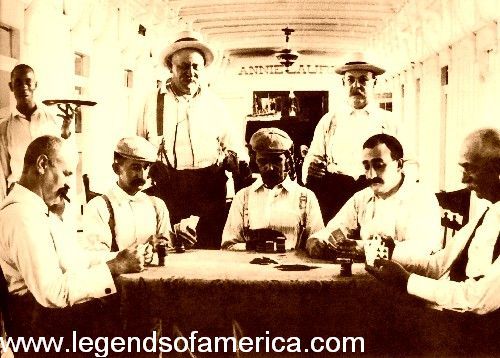
1890s vintage photo of Mississippi River Gambling.
Instead, Lottie, Johnny, and the ever-present Mary Poindexter took to the Mississippi River, becoming experts working the riverboat gambling parlors and tidewater towns.
“Not much is known about Lottie’s days on the river,” says Rose, but in her later life, Lottie recounted a story that “the boat [she] and Mary were traveling on stopped along a sandbar in the river. Late in the evening, Lottie and Mary decided to take a walk. Lottie preceded Mary along the shoreline, carrying her parasol and enjoying the evening air. Suddenly, Mary’s sharp eye spotted a large rattlesnake coiled and ready to strike her mistress. The tall, strong woman lunged forward and threw herself on top of the reptile, saving Lottie from injury. Mary herself was bitten and became deathly ill, necessitating the amputation of a finger.”
Near the end of the War, Lottie decided to head west to San Antonio, where she would continue practicing her profession. On one occasion, a young Union soldier accused Lottie of cheating and went for her. Mary Poindexter jumped between the two, grabbed the soldier, and threw him overboard into the river.

Old San Antonio, Texas.
On the frontier, every professional gambler cheated. As one biographer put it, “An expert card player, Lottie could win a good percentage of the time,” but “that was not enough for a woman who depended on gambling for a living and expected to maintain the standard of elegance she had known from childhood.”
San Antonio, Texas, was a wide-open gambling town, and Lottie was soon hired as a dealer at Frank Thurmond’s University Club, receiving a percentage of the winnings. Cowboys lined up, hats in hand, for the privilege of playing the pretty lady.
As a lady of social distinction, Lottie wore the latest fashions and never permitted smoking, drinking, or cussing at her table. Mary Poindexter sat behind her on a stool and watched for cheaters or surly losers. Lottie’s dress and manners dispelled suspicions that she was cheating, and she became the highly respected “Angel of San Antonio.”
Lottie fell in love with her part-Cherokee boss, Frank Thurmond, and remained loyal to him, dumping her other admirers. During a poker game, Frank and another player got into a fight. Frank killed the man with his Bowie knife, which he kept on a string down his back and could easily access just by reaching down his shirt collar. The man’s family put a bounty on Frank, forcing him to leave town. It is thought that Frank later taught his friend, Doc Holliday, the location of the Bowie knife’s hiding place.
Soon, Lottie followed, looking for him, gambling her way around West Texas in Fort Concho (where she was called “Mystic Maude”), San Angelo, Denison, Fort Worth, and Jacksboro, eventually finding Frank working at the Bee Hive in Fort Griffin. Lottie got a job there dealing cards, and it was here that she was introduced to Frank’s friend, Doc Holliday, who soon became an admiring customer at Lottie’s faro table. On one well-recorded occasion, Doc lost $3,000 to the lady.
Over the front batwing doors of the Bee Hive hung this rhyme:
Within this Hive, we are alive;
Good whiskey makes us funny.
Get your horse tied, come inside.
And taste the flavor of our honey.
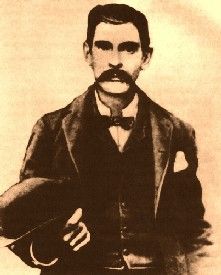
Doc Holliday.
Legend has it that, during a faro game at the Bee Hive, Doc and Lottie were in the middle of a game when Big Nose Kate Elder, Doc’s girlfriend, arrived in a jealous rage. An argument ensued in which both women drew their guns, ready to fire. Doc had to step in and stop the fight.
Cynthia Rose claims that “according to several historians, Kate and Lottie had heated words one night over Doc. After Kate and Doc had made it known they were a team, Kate began to show her jealousy,” and “one evening she accused Lottie of trying to steal his affections. The accusation brought Lottie to her feet:
“Why, you low-down slinkin’ slut!” shouted Lottie. “If I should step in soft cow manure, I would not even clean my boot on that bastard! I’ll show you a thing or two!” whereupon she pulled a gun, and Kate also drew a weapon. Doc Holliday placed himself between the two women.”
Considering Lottie’s reputation as an elegant lady and the fact that stories tend to get juicier when told by many people over a long period, this may not be historically accurate, no matter what the historians say. But one thing is probable — the two women had serious words over Doc.
At Fort Griffin, Johnny Golden, the jockey-gambler, came back into Lottie’s life — but not for long. Although he found his former sweetheart dealing cards at the Bee Hive, the next day, he was shot dead on the street behind the saloon. Lottie paid for his burial suit plus $65.00 for a coffin, but did not attend the funeral. Instead, she sat in her house with the curtains drawn.

Playing Faro.
The most famous story about Lottie during her Fort Griffin days is this one, taken from “Doc Holliday” by John Myers:
“It was during the time [Lottie] was dealing faro in the Flats that a couple of tinhorn gamblers, known respectfully as Monte Bill and Smokey Joe, quarreled over a short card game. Each accused the other of cheating, and each was probably right. Each thought he could beat the other to the draw, and each was only half right. There were two corpses on the floor when Sheriff Bill Cruger rushed in to take charge. Everybody who could have made tracks, except for the redheaded Lottie, who was coolly counting her chips as the sheriff arrived. When the sheriff said that he couldn’t understand why she had remained on the scene, she merely murmured, “But then you have never been a desperate woman.”
In several versions of the story, the money on the table that night disappeared, and most witnesses believed it ended up in Lottie’s purse.
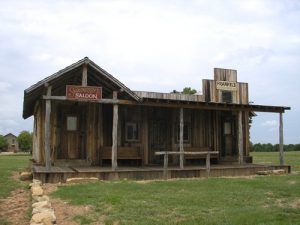
Shaughnessy’s Saloon at Fort Griffin, Texas
It was said of Lottie that she had class and refinement. Many years later, a lifelong friend told an interviewer that she “was a fine looker… in manners a typical Southern Lady. She had nothing to do with the common prostitutes… she was not a ‘gold digger.'” Lottie “stood apart from the rabble.”
After five years, Lottie and Frank left Texas for New Mexico, where they finally married. Not long after, Frank, for the second time, used his Bowie knife to terminate a man. It was self-defense, but it was the turning point for Frank and Lottie. They swore off gambling and settled down in Deming. Frank succeeded in mining and real estate, eventually becoming vice president of the Deming National Bank.
Lottie, under her married name Charlotte Thurmond, became a well-respected member of the community. Although she quit dealing, according to legend, in 1892, the original structure of St. Luke’s frontier church was financed by $40,000 in winnings from a poker game attended by Doc Holliday and hosted by Lottie Deno. And, for a fact, Lottie Deno made one of the altar cloths used by St. Luke’s. Respectability was at last hers.
Frank and Lottie were together for over 40 years when he passed away in 1908. Lottie lived another 26 years. When she died in 1934, she was buried beside Frank; her headstone was set a few inches behind Frank’s left shoulder “in the lookout seat.”
Epilogue: The character immortalized as the beautiful, redheaded Miss Kitty who ran the Longbranch Saloon in the famous “Gunsmoke” radio and television series was based on Lottie Deno.

Vintage Deming, New Mexico.
©Maggie Van Ostrand, August 2007, updated March 2026.
Also See:
Complete List of Female Pioneers, Heroines, Outlaws & More
The History of Poker in the Old West
Fort Griffin – Lawlessness on the Brazos
About the Author: Maggie Van Ostrand’s articles have appeared in the Chicago Tribune, the Boston Globe, various magazines, monthly in the Mexican publication, El Ojo Del Lago, and on mexconnect.com, and numerous contributions to Texas Escapes Online Magazine, from which this article was provided.