
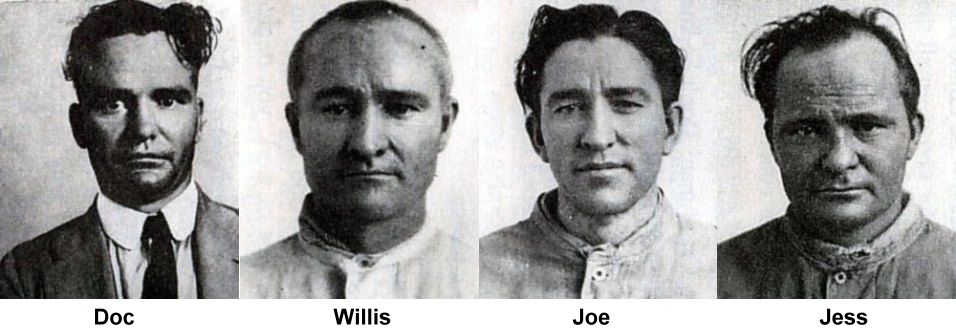
The Newton Brothers, photo from The Digital Research Library of Illinois History Journal.
By 1914, Willis Newton was fed up with being a dirt-poor cotton farmer in Uvalde County, Texas. The townspeople of Uvalde would have scoffed, wondering whether he had ever really worked. By this time, Newton had already gained a reputation as a thief from a young age. The Newton brothers had started breaking into stores when they were still kids. Before long, if something went missing anywhere within hundreds of miles of Uvalde, people quickly assumed the Newton boys were to blame.
But breaking into stores didn’t satisfy four out of five of the Newton boys, as they soon moved on to robbing banks and trains.
Willis first robbed the railroad when he and a friend boarded a train at Cline, Texas. After taking everything of value from its passengers, they disembarked just short of Spofford in Kinney County with some $4,700 in their pockets. Later, while in Durant, Oklahoma, Willis joined a gang that robbed a bank in Boswell and made off with about $10,000.
By 1919, four of the five Newton brothers – Willis, Willie “Doc,” Jess, and Joe- were serving time in different prisons for various crimes. However, Willis and Joe were released that year, and Willis soon convinced his brother to form their own gang. The following year, “Doc” escaped from a Texas prison and quickly joined his brothers, who were then living in Tulsa, Oklahoma. The following spring, Jess was released, making up the final member of the gang.
Between 1919 and 1924, the Newton Gang robbed 87 banks and six trains, taking more loot than the Dalton boys, Butch Cassidy, and the James Gang combined. Stretching all over the United States, the gang hit their home state of Texas, as well as Oklahoma, Kansas, Nebraska, Iowa, North Dakota, Illinois, Wisconsin, and even Canada.
They committed most of their bank heists at night after cashing the joint for several days. Using nitroglycerin, they would blow open the safes, take the cash, and quickly disappear. On one occasion, they robbed two banks in Hondo, Texas, on the same night.
Though they preferred to do their “work” at night to avoid meeting anyone, they were known to commit robberies during the day on some occasions, where their victims described them as extremely polite. They went out of their way to ensure that the people in the bank or on the train were comfortable and not too upset, explaining that they would never hurt anyone. And, during these many escapades, they never did.
Amazingly, these robberies were not connected, nor were the Newton brothers ever suspected, until their final robbery, which, because of the large amount taken, brought down the combined forces of several law enforcement agencies.
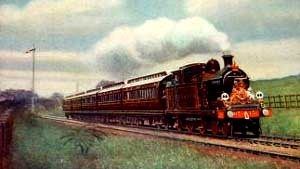
1924 Train.
On June 12, 1924, the Newton boys joined up with two Chicago gangsters, a Chicago racketeer, and a postal inspector, and robbed a train at Rondout, Illinois, netting them more than three million dollars. It remains the largest train robbery in U.S. history.
Boarding a mail train in Chicago, the Postal Inspector, named William J. Fahyand, along with Willis Newton, forced the train to stop at Rondout and demanded that the mail sacks containing some three million dollars in cash and securities be thrown from the train, enforcing their demands by firing bullets and tear gas into the mail car. In the confusion, Willie “Doc” Newton was hit in the leg by a stray bullet. With the cash, the Newton boys loaded the wounded Willie into a waiting car and took off. However, while loading him, a bystander heard one of them call him “Willie,” giving authorities a lead on the outlaws.
A few days later, when the police got a tip that a wounded man was being cared for in a northside Chicago house, they followed up, and the gang’s plans began to unravel. Within days, Doc, Willis, and Joe Newton had been arrested. However, Brother Jess had managed to get out of Chicago and headed toward Texas with about $35,000 in cash from the robbery.
But Jess made a mistake when he got drunk in San Antonio. Sure that he needed to hide the stolen loot, he hired a cab that took him into the country, where he buried the cash. The next day, he went to Mexico to dig up the money. However, he couldn’t remember where he buried it. He even found the cab driver who had driven him the night before, but the driver had also been drinking and couldn’t remember where they had gone. After searching for some time, Jess finally abandoned the idea and headed to Mexico anyway. But his freedom was short-lived when a federal agent located him in Via Acuna and brought him back across the border.
All eight were eventually arrested, and except for about $100,000, the stolen loot was returned in exchange for lighter sentences. All eight went to prison, with William J. Fahy, the postal official who had masterminded the robbery, receiving the longest sentence of 25 years in the Federal Penitentiary at Leavenworth, Kansas.
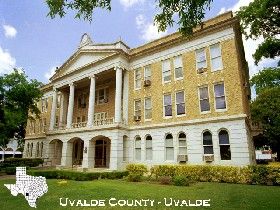 After serving their time, the Newton brothers were released from prison and returned to their hometown of Uvalde, Texas. Jess Newton lived the remainder of his life as a cowboy in Uvalde. He died on March 4, 1960.
But old habits die hard. In 1968, in Rowena, Texas, Doc Newton, in his mid-70s, made a bungled attempt to break into the bank. Because of his age, he was turned away. Doc died in 1974 at the age of 83.
In 1973, Willis Newton was implicated in a bank robbery in Bracketville, Texas, but there wasn’t enough evidence to prove a case against him. Willis died in August of 1979.
Joe Newton became the owner of a cafe along with other small businesses in Uvalde. He died at age 88 in February of 1989.
The missing $100,000 has never been found, even though the Newton brothers hunted for it after their release from prison. Willis said that Jess buried the money on top of a hill, where he dug a hole and put a large rock over it. In court and under oath, Jess testified that he buried the money somewhere along Fredericksburg Road, but based on what he told his brothers, Willis was convinced it was more likely on the road to Bandera.
©Kathy Alexander/Legends of America, updated October 2026.
“We never killed anybody, and we never wanted to. All we wanted was the money… Robbing banks and trains was our way of getting it. That was our business.”
— Willis Newton, 1976
Also See:
Outlaw & Scoundrel Photo Galleries
See Sources.
Found on YouTube, Johnny Carson interviews Joe Newton in November of 1980, with clips of Willis Newton edited in from a previous documentary. Hat tip to Paul Mosley of Texas for pointing us to this.