
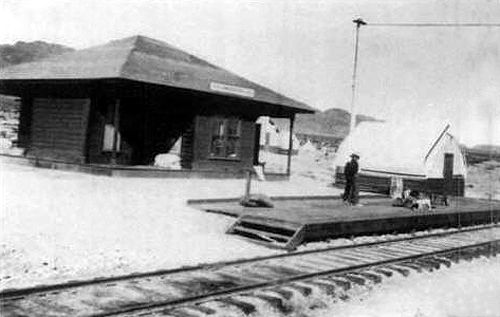
Amargosa Station,1906.
Amargosa – First called Johnnie Station- was once an essential stop on the Las Vegas & Tonopah Railroad, established initially as a temporary site. At the same time, crews laid tracks westward toward Rhyolite and Beatty. However, it became a permanent station when strikes were made at Johnnie. When a post office was opened in December 1901, the name was changed to Amargosa, meaning “bitter water” in Spanish, because a recent well dug in the area had brought up nothing but brackish water. However, the post office was short-lived and closed just a year later. Another opened three miles West of Rhyolite in 1904, then servicing the Amargosa community. By then, the tiny settlement boasted a few businesses, including a store, hotel, restaurant, and blacksmith shop.
Amargosa was an important shipping point for Johnnie and other areas to the West. A daily stage was established from Amargosa to Johnnie. It also became a stopping point, a freight stop for people and supplies heading to the new copper finds at Greenwater, California. When the Tonopah & Tidewater Railroad was completed westward in 1907, Amargosa’s shipping activities declined, as did the town, leaving only the railroad agent and one merchant.
However, when the mines at Johnnie began to produce again, people soon returned. In 1914, it supported about 25 people but was abandoned entirely three years later. The only remnant of Amargosa is the large concrete foundation of the old station, and it’s hard to find. The old townsite is located about 16.5 miles East of Amargosa Valley on the North side of U.S. 95.
Note: The townsites of Original, Nevada, and Death Valley Junction, California, were also called Amargosa for a time. Bullfrog, Nevada, was also briefly called Amargosa City.
Ashton – About 15 miles Southwest of Beatty, Ashton was a small water stop on the Tonopah & Tidewater Railroad. It never really developed and was abandoned after the railroad pulled out. There are no remains today.
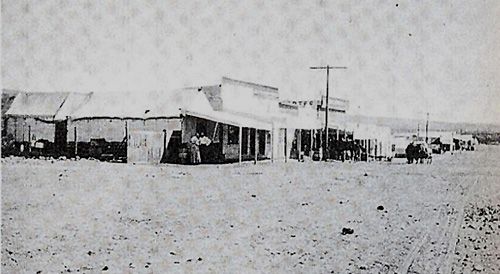
Beatty, Nevada, 1906.
Beatty – Not a ghost town, but a vital part of Death Valley’s mining days, Beatty is a small community today with a population of about 1,100 people. It was established in 1905 when the Las Vegas and Tonopah Railroad planned to come through the area. The town was named after Montillus Murray, “Old Man” Beatty, who settled on a ranch in the Oasis Valley in 1896 and became Beatty’s first postmaster. A townsite was soon laid out, and Ernest Alexander “Bob” Montgomery, owner of the Montgomery-Shoshone Mine near Rhyolite, built one of its first significant buildings—the Montgomery Hotel.
During Beatty’s first year, wagons pulled by teams of horses or mules hauled freight between the Bullfrog District, which included the boomtown camps of Rhyolite, Bullfrog, Gold Center, Transvaal, and Springdale, and the nearest railroad, at that time in Las Vegas. By the middle of 1905, some 1,500 horses were being utilized. That same year, Beatty gained a newspaper called the Beatty Bullfrog Miner. The town became a central transportation hub when the railroad arrived in October 1906. The following year, in April, the Bullfrog & Goldfield Railroad arrived, and the Tonopah & Tidewater added a third railroad in October 1907.
Unfortunately, when the mining towns Beatty supported declined after the Panic of 1907, Beatty did as well. The Beatty Bullfrog Miner went out of business in 1909. Residents then got their news from the nearby Rhyolite Herald, which also ceased publication in 1912.
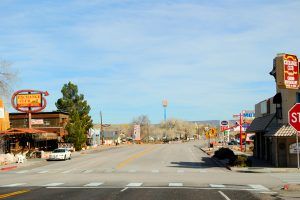
Beatty, Nevada, Kathy Alexander.
The Las Vegas and Tonopah Railroad ceased operations in Beatty in 1918. The Bullfrog & Goldfield Railroad followed suit a decade later, in 1928. However, the town still sported the Tonopah and Tidewater and continued to act as a railhead for the area. It, too, would pull out of the small town in 1940. However, that same decade, Nellis Air Force Base and other federal installations contributed to the town’s economy, as did tourism from Death Valley National Park and the rise of Las Vegas as an entertainment center. By 1950, however, it was home to only 485 people.
The Beatty area had no newspaper for decades, until 1947, when the Beatty Bulletin, a supplement to the Goldfield News, began publication. However, it would only last until 1956.
When a new mine opened West of Beatty in 1988, the population briefly surged from about 1,000 to nearly 2,000 by the end of 1990. However, like the mines before it, this one also closed in 1998, and the population fell to its former level. Today, the small town is home to the Beatty Museum and Historical Society and businesses that cater to tourists.
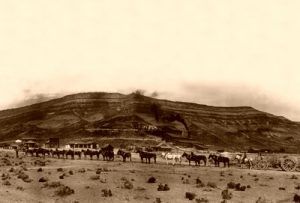
Bonnie Claire in 1908, California Panorama Co.
Bonnie Claire – Also known by several other names, including Clare, Clair, Thorp’s Wells, Thorp, Montana Station, Summerville, and Gold Mountain, mining began in the area in the 1880s, and a small stamp mill was built at a site then known as Thorp’s Wells. It served several mines near Gold Mountain, some six miles northwest. It operated into the early 1900s when the Bonnie Claire Bullfrog Mining Company purchased it. A small camp formed, and a stage line from Bullfrog to Goldfield ran through it; the camp was then called Thorp. Another small camp, Summerville, also developed about a mile northwest but was short-lived. In 1904, the company built a larger mill called the Bonnie Claire, which processed ore from across the district. A post office called Thorp was established in June 1905.
The camp grew slowly until September 1906, when the Bullfrog-Goldfield Railroad arrived. The new station was called Montana Station, but when a townsite was platted the following month, it was called Bonnie Claire. However, the post office wasn’t renamed from Thorp to Bonnie Claire until 1909 because of government issues.
Several properties began to be produced on Gold Mountain, and the Bonnie Claire Bullfrog Mining Company built a 20-stamp mill at about the same time the community peaked with a population of about 100 people. However, the Panic of 1907 scared investors, which suspended mining operations and dashed the dreams of town promoters. The town limped along with a few residents but continued only because the railroad passed through the small community.
In 1925, the town was boosted by the building of Scotty’s Castle, a fantasy house in the green oasis of Grapevine Canyon some 20 miles to the Southwest. For the next three years, nearly all the materials needed for the castle’s difficult construction arrived at the Bonnie Claire station over the Tonopah & Tidewater Railroad. From there, mule-drawn wagons and four-wheel-drive trucks hauled the supplies to the site.
The elaborate mansion was never finished, and in 1928, when the railroad pulled out of Bonnie Claire, the town quickly died. Its post office closed, and the railroad tracks were removed in 1931. Later, the area was revived by the Lippincott Smelter, which processed lead ore from the Lippincott Mine from 1935 to 1953.
Significant ruins remain at the site, including the Lippincott Smelter, Montana Station Mill, and a couple of buildings. It is about 20 miles northeast of Scotty’s Castle on CA-72/NV267.
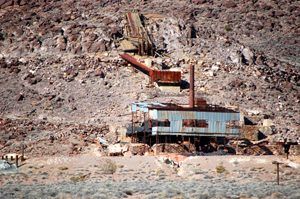
Remains of the Bonnie Claire Mine, photo by Dave Alexander.
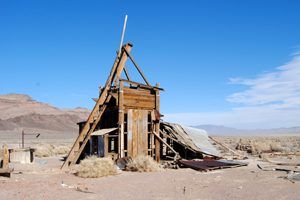
A smaller mine across from the main Bonnie Claire Mine, photo by Kathy Alexander.
Bowlerville – A mining camp in the early 20th Century, it was located a few miles South of the Johnnie Mine. It was named to commemorate Fred Bowler, who owned the mine.
Browne’s Camp – Located in Nye County, Nevada, this short-lived mining camp operated around 1907. Though some shallow ore deposits were found, they were not productive enough to continue, and the camp was abandoned. By the 1920s, it had disappeared from maps. There are no remains.
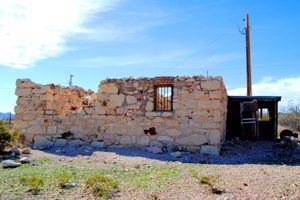
Old jail at Bullfrog, Nevada, Kathy Alexander.
Bullfrog – Also called Bonanza and Amargosa City, Bullfrog was established after famous prospector Shorty Harris discovered gold nearby in 1904, and the Original Bullfrog Mine was opened. The entire tent town of Original (also called Amargosa), located near the original Bullfrog mine, moved to the Bullfrog townsite in March 1905. Within no time, the town boasted about 1,000 people, a two-story hotel, a jail, a post office, another three-story hotel, a lodging house, a general store, a bank, an icehouse, and several other businesses and homes. However, the nearby town of Rhyolite was also being established at the same time, which quickly caused fierce competition between the two communities. Making matters worse for the fledgling mining camp were several fatal gunfights.
Bullfrog declined as Rhyolite grew, and in 1907, it was nearly empty. Many of its buildings had been moved to Rhyolite. The post office lasted until May 1909. Both Rhyolite and what was left of Bullfrog were doomed by the financial Panic of 1907. The town’s last large building, a hotel, burned to the ground in June 1906. Today, all that is left of the old townsite are the remains of an ice house and a jail. Nearby is the Bullfrog-Rhyolite cemetery, just South of the Bullfrog townsite. It is located at the North end of the Amargosa Desert, about four miles West of Beatty. Less than a mile North of Bullfrog are the Bullfrog Hills and the ghost town of Rhyolite.
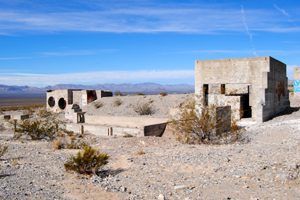
An old cement plant near the ghost town of Carrara, Nevada. Photo by Kathy Alexander.
Carrara – Founded on marble quarrying, the settlement began as early as 1904 but wasn’t officially dedicated until 1913. The post office closed in 1924. A cement company built several buildings about a mile North of the townsite in 1936, but never began operations. The ruins of several large stone buildings associated with the old cement company are still visible. At the townsite itself, little is left but a few foundations. The sparse remains of the Gold Ace Mine and the marble quarries are up the hill. It is located 8.75 miles South of Beatty, Nevada, on U.S. 95.
Charlestown – Located in Nye County, Nevada, Charlestown was an obscure railroad and mining camp that emerged in 1906 as the Las Vegas & Tonopah Railroad progressed westward to Rhyolite. The camp was abandoned when the railroad tore up its tracks in 1918. Only some wood rubble from the water tank tower marks the site.
Chloride City – This settlement was established in 1905 when the Bullfrog strike brought people into the area to rework old mining claims dating back to 1873. Having a very short life, it became a ghost town within a year. It was revived in 1916, and the remains that can be seen today are primarily from that time period. A few mine openings, mill ruins, dumps, and the remains of three stamp mills can be seen in the area, along with the grave of a man named James McKay, of whom nothing is known. It is located on the East-central side of Death Valley, 14 miles Southwest of Beatty, Nevada.
Currie Well – Currie Well’s claim to fame rests mainly on its use as a desert watering hole for stages and trains traveling between Rhyolite and Goldfield. Located some eleven miles North of Rhyolite, the water from this site was first used to supply thirsty horses, mules, teamsters, and passengers traveling through the area. The site was claimed in succession by several miners and entrepreneurs, who tried to eke out a living by selling water, travelers providing meals, and foraging for animals. No indication suggests these efforts, which lasted intermittently from 1907 to 1909, ever paid off. Later, sporadic efforts were made to improve the well site, with no obvious success, and in 1911, two brave souls attempted to start a farm garden and alfalfa field. Again, the short life of these operations indicates that they were entirely unsuccessful.
The two brief spurts of real activity that surrounded the well site came in 1907, when the Las Vegas & Tonopah Railroad’s construction crew made the place a work camp due to its water source, and in 1909, when the good owner unsuccessfully tried to improve the water flow to pipe it to adjacent mines. These spurts of activity were brief, however, and soon died out. Several short-lived mining companies also briefly tried to develop their claims in the area, but all these efforts died quickly.
Today, the site is littered with debris, but still contains some low stone walls and the ruins of a small beehive furnace. It lies about 11 miles north of Rhyolite, along the grade of the abandoned Las Vegas & Tonopah Railroad.
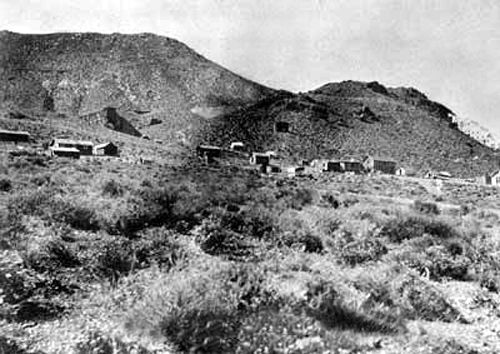
Gold Bar, Nevada.
Gold Bar – A small mining camp in the Bullfrog Mining District, it started in 1905 at the base of the Gold Bar Mine and the Homestake-King Mine and Mill. Sitting side by side, the mines did very well for the first several years, partly because of their proximity to the Las Vegas & Tonopah Railroad, which made ore transportation much less costly. The townsite of Gold Bar eventually supported about 50 people and had several substantial buildings. Ultimately, the Gold Bar Mine was a hoax, with the promoters making all the money.
However, the Homestake-King Mine was one of the most honestly and wisely run companies of its time. By 1908, the recession caused by the Panic of 1907 caught up with Gold Bar and nearby Rhyolite, and operations began to slow and eventually stop. The Gold Bar Mine closed in 1908, and the Homestake-King the following year. Most of the buildings were then moved to Rhyolite. In the 1930s, Homestake-King was purchased; in 1937, 14 men worked there. However, it was short-lived. It is now part of the Death Valley National Park. Nothing remains of the mining camp, and only a little of the Gold Bar property—a few shafts, adits, and the foundations of the mill site. The Homestake-King mine has several ruins, including shafts, adits, and six large mill foundations. To get to the site, travel West from Bullfrog one mile and take a right at the fork. Continue for another ½ mile and take another right at the fork. Follow this road for 3 ½ miles to Gold Bar.
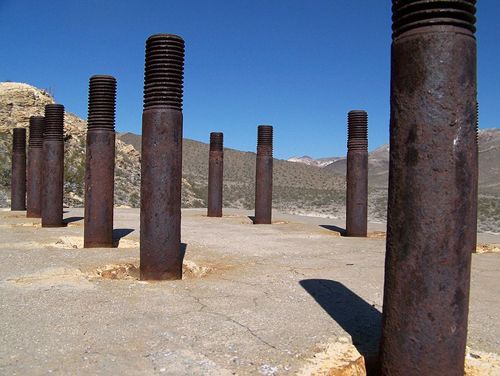
Mill Foundations at Gold Center, Nevada, courtesy of Wikipedia.
Gold Center – Located in the Bullfrog Mining District near Tonopah, Gold Center was established in December 1904, and a post office opened the next month. Why it was called Gold Center is a mystery, as there was no gold there. Instead, it was a transportation hub and critical water source for Bullfrog, Rhyolite, and Carrara. The Tonopah & Tidewater Railroad, the Atlantic & Pacific Railroad, and the Union Pacific Railroad all ran through the town. At its peak in 1907, it boasted a hotel, a bank, brokerage firms, a newspaper, a few mercantile stores, numerous saloons, an ice house, and two mills. The most imposing building in Gold Center was the Gold Center Ice and Brewing Company, the area’s first brewery. When nearby Rhyolite began to decline in late 1908, Gold Center also faded, and by 1911, the population was only about 25 people. The railroad tracks were pulled up in 1918. Today, little remains of the town other than the foundations of a stamp mill and brewery, the footers for a tank at the cyanide plant, and sections of the water line that ran between Gold Center and Carrara.
Johnnie – The story of Johnnie begins with the “Lost Breyfogle Mine.” The tale began in 1863, when a prospector named Joshua Breyfogle brought a vibrant piece of ore to the mining center of Austin, Nevada. Breyfogle, who had been prospecting in Death Valley, had gotten lost after fleeing an Indian attack. Much later, his memories fuzzy, he began to search for the rich quartz ledge, but though he searched for 26 years, he died before ever finding it. In 1891, while brothers George and Bob Montgomery were searching for the Lost Breyfogle Mine, they hired a Paiute Indian named “Indian Johnnie” as a guide. Steering them to a rich site of gold, the brothers believed it to be the Lost Breyfogle.
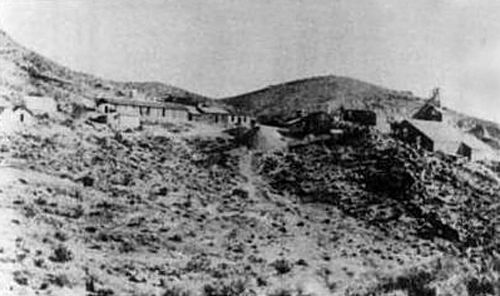
Johnnie, Nevada, 1930s.
The camp that grew up around the mine was first known as Montgomery, but the mine was known as the Johnnie Mine, after the Indian who had guided the brothers to the discovery. Soon, the camp was also called Johnnie and supported about 100 people. The Johnnie mine site was a few miles northeast of the townsite. The Congress Mine, sometimes called the Chispa Mine, also supported the camp and was located just West of the townsite. A post office was opened in August 1891. A few years later, the office of the former Progress Mine closed in March 1894. When a new mill was built for the Congress Mine in September 1895, it employed 70 men and revived the camp briefly before it emptied. The Congress Mine was sold in 1898, and about 50 men were back. But unresolved labor disputes quickly shut down operations again.
Still, it was not the end for Johnnie. When several discoveries were made in 1905, the Congress Mine reopened, and several new claims were staked. Just two years later, the camp boasted a population of about 350 people, several stores, saloons, hotels, and restaurants. By 1914, the boom was over, and the population dropped to less than 15 people. Just two years later, another discovery started Johnnie up again. The Eureka Johnnie Gold Mining Company began operations in 1921 and continued until 1925.
But Johnnie didn’t die. Enough gold remained in the area for prospectors to keep working. However, the post office closed in November 1935, and soon, everyone was gone. Over the next several years, the site changed hands several times. Though the site has numerous remains, including a few wooden cabins, it is on private property, and visitors are not allowed. It is located about 16 miles North of Pahrump on the West side of NV-160.
Leeland – Another Tonopah & Tidewater Railroad station was established in 1906. It soon became the railhead for nearby mining camps, including Lee, California/Nevada. In 1911, a post office was established, lasting until 1914. The tracks were removed in the early 1940s. Located about 17 miles South of Beatty, Nevada, little remains except the foundations of the water tank and other railroad debris.
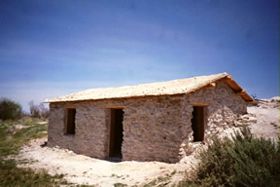
Longstreet Cabin.
Longstreet Cabin – This historic cabin was originally built in 1895 by Jack Longstreet, who settled in the Ash Meadows area. He lived there for several years before selling the property in 1906. Longstreet epitomized the mythical Western frontiersman: self-reliant, strong-willed, and fair-minded. He was at various times said to have been a feared gunman, a friend of the Indians, a farmer, a miner, and a saloon keeper. The U.S. Fish and Wildlife Service rebuilt the Longstreet Cabin in the same location, using stones from the original building. It is located in the Ash Meadows National Wildlife Refuge in Amargosa Valley, Nevada.
Manse Ranch – Also known as Yount’s Ranch, Joseph Yount and his family first settled this place in the 1870s. Located near Manse Springs, it soon became a stopping place for prospectors and travelers moving between Las Vegas and the mining camps to the West. By 1890, the Yount family had built their home into an Oasis, including a large house, storerooms, corrals, stables, and barns. As others settled in the area, a post office was opened at the ranch in 1891, and stagecoaches running from Ivanpah to Bullfrog made regular stops there. In 1905, the Las Vegas Age wrote of the ranch: “Manse has become a resort for travelers, where water, feed, shade, rest and table luxuries abound… watered by the springs and ditches, willows, cottonwood, poplars, and other shade trees have grown to maturity. Around the old ranch home are in abundance clustered umbrella trees, apples, walnuts, peaches, pears, plums, and the smaller fruits and vegetables.” The area’s population was about 50 in 1911. Though the post office closed in 1914, the ranch continued to operate. Today, it still operates as a ranch and a dairy farm. It is located near Pahrump, Nevada.
Mexican Camp – Located in the Grapevine Mountains, about 13 miles West of Rhyolite, was the site of a short-term wood-cutting operation during the early years of the Bullfrog boom. Located at a small, intermittent spring, the camp served as the headquarters of a group of Mexicans who cut timber from the surrounding hills and hauled it to Rhyolite via a trail connecting the camp to Titus Canyon. Operations at the camp appeared marginally successful until the Las Vegas & Tonopah Railroad arrived in the Bullfrog District in December 1906. After that, the Mexicans could no longer compete with the price of lumber brought in by the railroad, and the camp was abandoned. Nothing remains of the camp today.
Monarch Canyon Mine – Founded in 1905, this gold mine was located in the South Bullfrog District in Monarch Canyon, about two miles Southwest of Keane Springs. Though never a large operation, the site had a one-stamp mill. It operated until about 1910. Today, the mill’s remains cascade down the mountainside. Much of the mill’s machinery and controls remain, along with portions of the old tram track, a tunnel adit, and some foundations. The old road to the mine has been washed out for a long time, so access requires a one-mile hike. It is located in the northeast portion of Death Valley.
From Beatty, head West on NV-374 for 15.8 miles, then turn left (East) and travel 2.2 miles. Follow the road on the right down into Monarch Canyon until it disappears. Access requires a hike of about a mile further down the canyon.
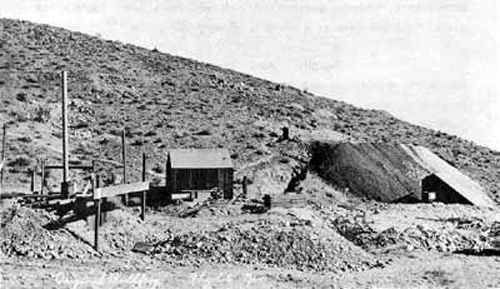
Original Bullfrog Mine, 1905.
Original – First called Amargosa, this small mining camp grew up near the Original Bullfrog Mine. Later, when the Las Vegas & Tonopah Railroad established a stop just South of the mine, the Amargosa townsite was renamed Original. It soon became the district’s major camp, with five stores, seven saloons, a restaurant, a post office, and the Hotel Courtmarsh. However, all the businesses were housed in tents, and the camp struggled because there was no nearby water source. Because hauling water was so expensive, the townsite company soon purchased another site called Bullfrog. There are no remains today.
Pioneer – Located between the Mayflower and Pioneer Mines in the northern Bullfrog Hills, the mining camp started in 1908. A post office opened that March. The town grew quickly, soon sporting as many as 2,500 people and several businesses, including a lumber company, theater, hotels, saloons, restaurants, bakeries, a shoe store, boardinghouses, a cigar store, and a Western Union office. Unfortunately, the very next year, a fire swept through the booming mining camp and burned most of the buildings. Though the town was partially rebuilt, it would never be the same. In 1914, part of the Pioneer Mine collapsed and was forced to shut down along with the mills. It reopened in 1915 and continued through 1931, when it was closed. The post office closed the same year, and the town died. Mining continued on a much smaller basis until 1941, but few structures survived through the end of the 20th Century. During the years, the district produced $1.6 million worth of ore.
Rose’s Well – Beginning as a stage stop, Rose’s Well was, for a time, the only spot between Beatty and Las Vegas that offered shelter, meals, and other accommodations. A well dug at the site yielded 110 barrels of water a day. Later, when the Las Vegas and Tonopah Railroad was built through the area, several structures were built in 1907 to support the nearby boom at Lee, California/Nevada. In the beginning, Rose’s Wells was an important way stop, but it was later used as just a water stop for the railroad. It continued to function until the railroad was discontinued in 1918. The site was then abandoned, and today all that remains is the old well. It is located 17 miles South of Beatty.
Rhyolite – Called the Queen City of Death Valley, Rhyolite once boasted a population of 6,000 people. Located in the Bullfrog Hills, about 120 miles northwest of Las Vegas, near the eastern edge of Death Valley, the town began in early 1905 as one of several mining camps that sprang up after a prospecting discovery in the surrounding hills. The financial Panic of 1907 caused the boom town to decline, and by 1910 it supported just 675 people before it was abandoned. Today, it is one of the most famous ghost towns in the American West because many buildings still stand. It is a tourist destination today, maintained by the Bureau of Land Management. It is located 1.5 miles North of Route 374 near Beatty, Nevada. See full article HERE.
Springdale – Before the coming of settlers to the area, this site was long used by Native Americans. Later, several small ranches were built in a fertile location. In the Winter of 1906, it became a watering station on the Bullfrog-Goldfield Railroad. The railroad built a station house and water tank, and a small settlement grew up around it. By the summer of 1907, it boasted a school, four saloons, several restaurants, a hotel, a livery stable, a popular red-light district, and a 50-ton mill that treated ore from nearby mines. It remained an essential stop on the Bullfrog-Goldfield Railroad until Pioneer began to decline in late 1911, when its population was about 75 people. However, when the mill was forced to close, almost everyone left, and the population at year’s end was only ten people. The post office closed the following year. Though a fairly substantial town at one time, there are scant remains today. Even though the trains stopped running in 1928, Springdale faded into history. It is located ten miles North of Beatty, Nevada, off Highway 95.
Sterling – The Sterling Mine was discovered in 1869, but it was never highly productive. By the early 1890s, a small mill was processing the ore. But activity soon fell off, and the site was abandoned. In the early 20th Century, the Ore City Mining Company reopened the Sterling Mine and began intensive operations. Finding gold and copper at the mine and in other area claims, a townsite was platted at the base of Mount Sterling, and before long, about 25 residents lived there. But the town only lasted for about a year. There are only scant ruins today. It was located about 20 miles North of Pahrump, Nevada.
Strozzi Ranch – Located two miles Southeast of the Phinney Mine, or about sixteen miles northwest of Rhyolite, this was the scene of a 1930s-era ranching effort in the Grapevine Mountains.
Caesar Strozzi homesteaded the site around 1931 and used it seasonally until 1947. The ranch is located just North of Brier Springs, which Strozzi used as a water source. During the sixteen years Strozzi used the ranch site, he built several significant improvements. Today, the remains of the main house, built of wood and tin, and several hacks used in the ranching operations are visible. Several fruit trees planted by Strozzi can still be seen in the area.
Telluride – A very small camp, it was called Telluride because of the colorful tellurium found in the ore. Very near the camp of Fluorine, it never had a population of more than 25 people and had disappeared from the maps by 1910. Only some small tailing piles mark the site. It was located about 4.5 miles Southeast of Beatty, Nevada.
Transvaal – One of the fastest-growing and fastest-dying boom towns in Nevada mining history, this camp began in February 1906, when George Probasco found gold in the East of Oasis Valley. By early April, more than 75 tents stood in the camp, housing about 700 people, plus four saloons, an assay office, a lumberyard, a boarding house, two newspapers, and several other businesses. Two daily stages ran from Beatty to Transvaal, and the Tonopah & Tidewater Railroad began planning a six-mile spur to the camp. However, by the second week of May, they found the initial discoveries contained little valuable ore, and everyone was gone by the end of the month. No remains remain except some mine dumps. Located about 12 miles North of Rhyolite, the site is challenging to get to.
©Kathy Alexander/Legends of America, updated October 2026.
Also See:
Death Valley Ghost Towns & Mines (index)
Lost Gunsight Mine of Death Valley
Rhyolite, Nevada – Little More Than a Memory
See Sources.