

The Las Vegas & Tonopah Railroad was built in 1906 & 1907 from Las Vegas to Tonopah and had stops in Beatty, Bullfrog, Rhyolite, and Goldfield. The LV & T ran for 14 years, until October 31, 1918, when the Nevada Department of Highways purchased the railroad right-of-way for Highway 95.
The early 20th-century mining booms at Tonopah, Goldfield, and Rhyolite produced significant economic and social changes in southern and central Nevada. They also significantly restructured Nevada’s transportation system. As the new camps boomed and prospered, they soon outgrew the capacity of mule teams and freighters to meet demand, and for the first time, railroads were drawn into this region of Nevada. The lure of rich profits from the new camps spurred new rail lines, but the fortunate geographic alignment of the camps along a rough north-south line made a new railroad link through Nevada possible.
Such a railroad would cost a great deal of money, though, and traffic volumes in the early 1900s did not warrant building a single line. As a result, independent railroads connected the north-south line only partially. By the time the Bullfrog boom was well underway, this process had already begun.
The Tonopah Railroad Company completed its line from the North into Tonopah in July 1904. It connected that camp with the Southern Pacific Railroad via the Nevada & California Railway and the Virginia & Truckee Railroad. Within another year, as Tonopah and Goldfield were proven to be solid producers and Rhyolite appeared to be following their example, various plans were laid to continue the southbound connections. The Tonopah Railroad became the Tonopah & Goldfield Railroad in late 1905, and shortly after that, construction began from Tonopah South to Goldfield.

Francis “Borax” Smith.
Completing a railroad to Tonopah, halfway between Carson City and Las Vegas, finalized the northern connection. Meanwhile, “Borax” Smith envisioned a railroad linking his borax mines in southern Nevada and southeastern California to the outside world, as twenty-mule team borax wagons were no longer economically feasible. After Senator William Clark completed his San Pedro, Los Angeles & Salt Lake Railroad in January 1905, Smith aimed to connect his mines to it in Las Vegas, leading to the formation of the Tonopah & Tidewater Railroad.
However, Clark decided to extend his line into the northern gold camps, breaking his agreement with Smith and creating his rival, the Las Vegas & Tonopah Railroad. Both railroads sought to reach the Bullfrog District and beyond to Goldfield and Tonopah, aiming to capitalize on the mining camps’ potential.
Clark was the first to set up a business. His engineers conducted a preliminary survey from Las Vegas to Tonopah in early 1905 and completed it in late February. The proposed line would run North towards the Bullfrog District but bypass the district itself by running through Beatty instead of Rhyolite. The route via Beatty would be comparatively flat and smooth and would avoid the extensive construction costs of climbing the mountains into Rhyolite. After several months of negotiations with Borax Smith, who was forced to shift his operations from Las Vegas on the San Pedro, Los Angeles, and Salt Lake City line to Ludlow, California, where he would connect with the Atchison, Topeka & Santa Fe Railroad, construction on both roads began in the fall of 1905.
Around the same time, a third railroad entered the picture when John Brock of the Tonopah & Goldfield Railroad also spotted the potential of the Bullfrog District and announced the formation of another railroad company. This one would be a nominal extension of the Tonopah & Goldfield Railroad, extending those lines South from Goldfield into the Bullfrog District. It soon became apparent to all parties involved that the first railroad to complete its line would have the greatest chance of success, and a race ensued.
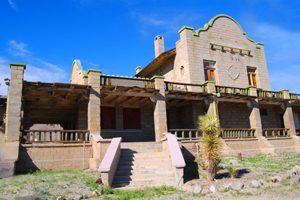
Rhyolite Depot, which Kathy Alexander later turned into a casino.
In January 1906, the Las Vegas & Tonopah Railroad laid its first rails North of Las Vegas, completing twenty-four miles by February. Rhyolite was thrilled about being connected to three railroads but worried that linking at Beatty, just four miles away, would threaten its prosperity. To prevent being on a branch line, Rhyolite’s leaders negotiated with the railroad to extend the line directly through their town. In exchange, Rhyolite committed to securing the necessary property rights and right-of-way. Although this route meant higher construction costs—comparable to building the entire 115 miles from Las Vegas to Beatty—the railroad believed the investment would pay off. Direct access would let more mines ship ore without incurring extra transportation costs to Beatty, increasing freight profits. Additionally, the railroad expected more passenger traffic for those heading to Rhyolite rather than Beatty. Despite the need to attach extra engines to climb the steep grade from Beatty to Rhyolite, the railroad was convinced it was a sound decision.
The Rhyolite Board of Trade put the matter to a vote of the citizens, who approved the plan. The town announced that it would provide all necessary rights-of-way and property rights for the railroad if it, in turn, guaranteed that the route through Rhyolite would be a through route and not just a branch line. The Las Vegas & Tonopah concurred, and plans were formalized. Doubling the pleasure of Bullfroggers, the Bullfrog-Goldfield Railroad, which had recently incorporated to build South from Goldfield, also announced that its terminus would be in Rhyolite. This road, however, would avoid the hilly route between Beatty and Rhyolite and instead build to Beatty, then swing South around the hills and hook back North, entering Rhyolite from the South.

Las Vegas & Tonopah Railroad.
Construction on the Las Vegas & Tonopah Railroad proceeded apace through early 1906. By March, 53 miles of track had been laid, and graders worked eighty-four miles North of Las Vegas. To the Southeast, “Borax” Smith’s Tonopah and Tidewater railroad was inching out of Ludlow, but it appeared that the Las Vegas and Tonopah would win the race to the Bullfrog District. By mid-June, it had finished its grade into Beatty, although the rails were still twenty-nine miles short of that town. The Tonopah and Tidewater had extended its rails 75 miles from Ludlow, California, but the summer heat halted construction. Meanwhile, the Bullfrog-Goldfield finally started work on its line on May 8, but progress was slow at first.
The Las Vegas & Tonopah surveyed and laid out its rail yards at Gold Center, where the trains would be made up and where northbound trains would pick up extra engines to climb from Beatty to Rhyolite. Its future grade was surveyed through Rhyolite out to the West around the Bullfrog Hills, then back up to the North towards Mud Summit. This 16-mile stretch, called the “high line,” would be the most challenging part of constructing the entire line between Las Vegas and Goldfield, because after cresting the ridge at Mud Summit, the remaining sixty-some miles were relatively flat and smooth. Surveying this line laid to rest recurring rumors that the Las Vegas & Tonopah would stop at Rhyolite and let the Bullfrog-Goldfield handle northbound traffic.
Grading work on the “high line” between Beatty and Rhyolite began in August 1906, and the rails, meanwhile, slowly crept up the already completed grade toward Beatty. On October 7, 1906, the first work train pulled into Gold Center on its completed tracks, and two weeks later, the railroad was completed as far as Beatty. Clark had won his race, for he entered the Bullfrog District a full six months ahead of his competitors. Beatty, as usual, held a wild and grand Railroad Day Festival, and all Bullfroggers joined in the celebration, for their town was at last connected with the outside world.
In mid-November, work began on laying rails between Beatty and Rhyolite, and on December 14, the first Las Vegas & Tonopah train arrived in Rhyolite. This marked the start of freight shipments of lumber, supplies, and mining equipment, greatly reducing the high freight rates from mule-team transports across the desert. Rhyolite quickly transformed from a tent city into a more permanent town, with over one hundred freight cars in the yard within a week. After some initial confusion, the Las Vegas & Tonopah extended its tracks through the town but temporarily halted further construction pending grading work in Goldfield.
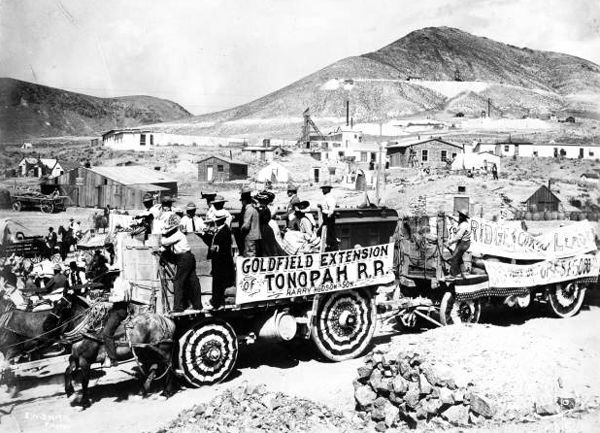
Goldfield Extension of the Las Vegas & Tonopah Railroad.
By the end of May 1907, grading the Las Vegas & Tonopah line to Goldfield was almost complete, and work began again on laying the tracks. In June, the railroad slowly extended out of Rhyolite, around the Bullfrog Hills, and towards Goldfield. By mid-August, the rails were complete through the entire Bullfrog District and extended as far North as Bonnie Claire, a third of the way between Rhyolite and Goldfield. Construction continued despite the financial problems brought about by the Panic of 1907. On October 26, they drove the ceremonial final spike at Goldfield, marking the completion of the Las Vegas & Tonopah line. Few citizens, however, were in the mood to celebrate.
Four days later, the Tonopah & Tidewater Railroad entered Gold Center from the South and linked its tracks with the Bullfrog-Goldfield. Not surprisingly, the two railroads soon announced plans for cooperation, and two complete southern lines thus served Goldfield and the Bullfrog District. Potential passengers and shippers could travel from Goldfield to Las Vegas and Tonopah. They could also travel from Goldfield to Las Vegas, where connections to the West Coast and the Rocky Mountains were possible, or they could take the Bullfrog-Goldfield line to Beatty and switch to the Tonopah & Tidewater for the trip to Ludlow, California, with similar east-west connections at the southern terminus. Although the Las Vegas & Tonopah was the first railroad to reach the district, the Tonopah & Tidewater quickly gained an advantage over its rival. The latter’s connections to the West Coast were quicker and more economical. Las Vegas & Tonopah countered by advertising that its route went “all the way” and that passengers would be spared the need to change trains in Beatty.
Now that the race was over, the competing roads settled down to business—hoping that the market for hauling in supplies and equipment and hauling out ore would justify construction costs. The Las Vegas & Tonopah concentrated on improvements to its property, including the rail yards at Rhyolite and its passenger station, which was finished in June of 1908. Although events would prove that passenger traffic never warranted such a large station, the company reaped short-term publicity benefits from owning what was rightly called one of the showplaces of the southern Nevada desert.
Unfortunately, traffic volumes on all the railroads serving the Bullfrog District proved lighter than expected, since the district never became the producer the boom’s early years predicted. The Las Vegas & Tonopah made a small profit during the first year of operation, but that was the last year it did. Because it chose to use the “high line” to tap the mines of the Bullfrog Hills, the Las Vegas & Tonopah was saddled with higher operating expenses than its rivals, since all northbound trains had to stop at Beatty and add an extra engine to negotiate the climb into Rhyolite. Ore from the high line never reached predicted levels, leaving the railroad with high construction costs and no expected profits from heavy ore shipments.

Bullfrog-Goldfield Railroad.
The Bullfrog-Goldfield and Tonopah & Tidewater railroads faced similar challenges. Still, their shorter, cheaper routes to the West Coast allowed them to maintain higher shipping volumes than the Las Vegas & Tonopah. “Borax” Smith’s monopoly on ore shipments from his borax mines along the Tonopah & Tidewater substantially boosted its revenues. All the railroads struggled with poor public relations. After the railroad celebrations, miners and businessmen complained about high freight rates. As mines produced lower-grade ores, these rates began to feel exploitative. While miners had a point—many operations were unprofitable—the Bullfrog District mines often needed free shipping to survive. Despite occasional rate reductions, discontent persisted, fueled by the perception that railroads were profiting hugely. This sentiment led to heavy property taxes; for instance, the Las Vegas & Tonopah paid Nye County nearly $11,942.70 in taxes by the end of 1907.
In summary, the decline of the Bullfrog railroads, particularly the Las Vegas & Tonopah, mirrored the Bullfrog District’s downturn. As mines closed, passenger and freight traffic fell, reducing demand for supplies. Meanwhile, Goldfield and Tonopah, though they outlasted Rhyolite, began experiencing declines by the 1910s. In 1911, the Tonopah and Goldfield Railroad proposed selling its line to the Las Vegas & Tonopah, which would have provided a direct route across much of Nevada. Senator Clark was interested but lost focus on business after the tragic death of his son on the Titanic in April 1912, and the deal was eventually abandoned.
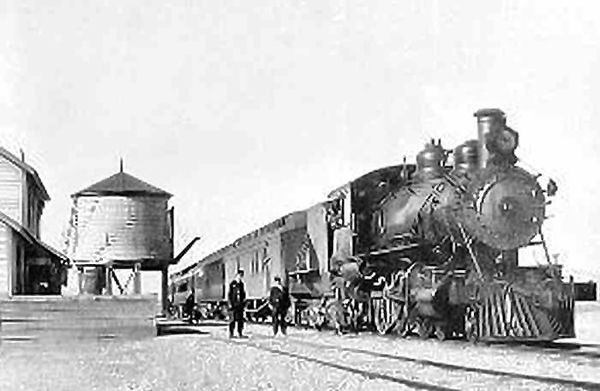
The Bonnie Claire Express.
Matters were becoming serious, and it became clear that unless the three competing lines were consolidated, all three would fail. The smallest of the three, the Bullfrog-Goldfield, moved first, but its attempt to sell itself to the Tonopah and Goldfield Railroad fell flat. The Las Vegas & Tonopah then stepped in, and the two railroads made plans to consolidate their lines. Because both roads had tracks running between Beatty and Goldfield, they decided to use each line’s best parts and abandon the rest. Accordingly, the Las Vegas & Tonopah tracks would be used from Goldfield to a point just South of Bonnie Claire, where trains would shift to the Bullfrog-Goldfield tracks South to Beatty. This move would cut maintenance costs for both lines and enable the Las Vegas & Tonopah to avoid running its trains over the costly “high line” from Beatty through the Bullfrog Hills. Through service would run through Beatty, bypassing Rhyolite completely, although a short branch line would still serve that town. However, all the tracks West and North of Rhyolite, including the section that ran through the present boundaries of Death Valley National Monument, were abandoned.
The Railroad Commission of Nevada approved the plans despite protests from Rhyolite citizens, and the new combined route took effect in June 1914. For the first time, the Bullfrog-Goldfield Railroad made a profit—ironically, much of it came from hauling ripped-up tracks and ties from its old roadbed North to Goldfield for salvage. However, the Las Vegas & Tonopah was not so lucky and continued to run in the red. Service over the remaining portion of the “high line” from Beatty to Rhyolite was finally discontinued in 1916, and the rails were removed.
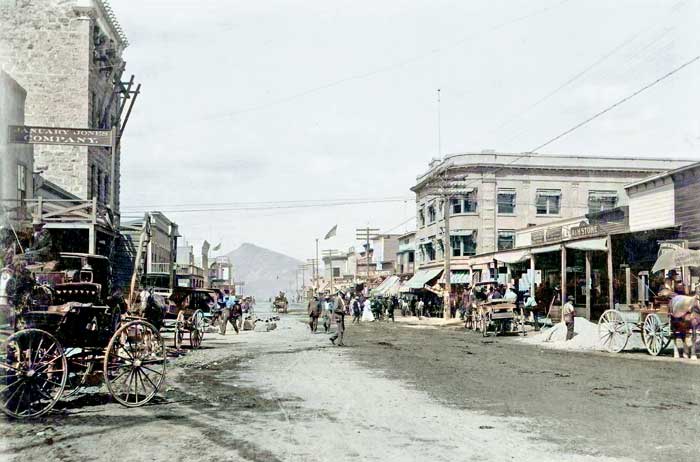
Goldfield, Nevada, around 1906 or 1907.
As the years slowly passed, revenues and traffic on the Las Vegas & Tonopah continued to decline. The company maintained daily service between Las Vegas and Goldfield until February 1917, when it switched to tri-weekly service. Then, World War I problems spelled the end of the line. Because of war shortages and efforts to economize, the Freight Traffic Committee of the U.S. Railroad Administration ordered that all perishable and merchandise traffic that formerly traveled via the Las Vegas & Tonopah be shipped immediately only on the shorter Tonopah and Tidewater connections to the West Coast. In other words, the Las Vegas & Tonopah was not allowed to haul anything but ore, and there was little ore to haul. For a short while, the Railroad Administration ran the railroad. Still, that body soon decided the Las Vegas & Tonopah was “not considered essential or necessary to the uses of the Government” and turned it loose.
By this time, it was a moot question whether the railroad was essential to anyone, and the end soon came. The Las Vegas & Tonopah had lost money every year since 1908, but never enough to consider abandoning its lines. Revenues plunged drastically, and the road was faced with bankruptcy. During World War I, high scrap metal prices spurred Clark to salvage as much of his railroad as he could. On September 18, 1918, he applied to the Railroad Commission of Nevada for permission to cease operations. On October 31, the last train pulled off the line, and they took up and sold the tracks. With the line’s demise, the Las Vegas & Tonopah also abandoned its passenger station in Rhyolite, and one of the last surviving structures in that dying town was added to the delinquent tax list.
After the Las Vegas & Tonopah died, the Bullfrog-Goldfield Railroad returned to its old partner, the Tonopah & Tidewater, and the two roads combined operations. In practical terms, the Tonopah & Tidewater operated the line the entire distance from Ludlow to Goldfield. The Bullfrog-Goldfield had almost no rolling stock or engines left. Nevertheless, the railroad continued to operate as long as the Goldfield mines operated. As the 1910s gave way to the 1920s, those mines began to close down one after another, and revenues on the Bullfrog-Goldfield slowly and surely declined. Finally, in January 1928, the railroad was abandoned as well.
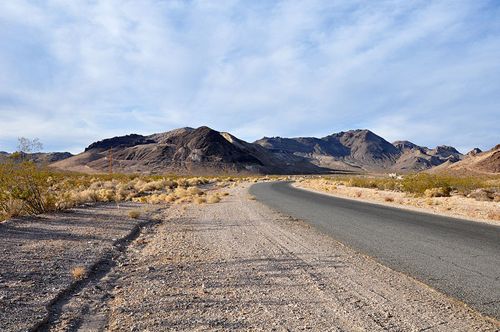
Bullfrog Hills, Nevada by Kathy Alexander.
Thus, the Tonopah & Tidewater, the last railroad to reach the Bullfrog District, remained the last and only railroad operating in the vicinity. As the gold mines in the region began to play out, the Tonopah & Tidewater relied more and more upon its borax mines in the vicinity for revenue. Other scattered clay, marble, and talc mines contributed enough freight to keep the railroad operating, albeit weakly, through the 1910s and 1920s. The road became a lifeline to the scattered population of the southern Nevada desert.
But towards the latter part of the 1920s, the borax mines began to close, and the life of the Tonopah & Tidewater was threatened. The Borax Consolidated Company, the parent of the Tonopah & Tidewater, continued to operate the road at a loss, preserving the rails and stock for future need. Still, year after year, heavy losses became too much to handle. In 1938, the Tonopah & Tidewater applied for permission to abandon its lines. Local road patrons caught the ears of their politicians, and approval of the abandonment was delayed for several years as they sought ways to keep the line operating. But those efforts were ultimately unsuccessful, and on June 14, 1940, the Tonopah & Tidewater ceased operations. The railroad tracks were left in place for two years in hopes the railroad could resume, but the need for scrap metal during World War II led to their salvage in 1942 and 1943. The last Bullfrog district railroad had finally died.
The demise of the railroads did not end their influence on southern Nevada’s transportation history; during the early days of highway construction, the old roadbed of the Las Vegas & Tonopah was designated as part of the state highway system. When the construction of U. S. Route 95 between Las Vegas and Carson City began, the first major north-south highway through the state, the road was built along the old grade of the Las Vegas & Tonopah from Las Vegas to Beatty. Today, travelers heading North out of Las Vegas toward Beatty and Carson City follow the same line that carried so much hope and optimism during the Bullfrog boom.
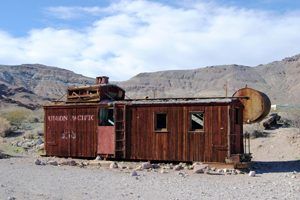
An Old Railroad Boxcar in Rhyolite, Nevada by Kathy Alexander.
Because Highway 95 was built on the old Las Vegas & Tonopah grade, all traces of the railroad bed have disappeared between Las Vegas and Beatty. However, the old “high line” is still visible to visitors, running from Beatty into Rhyolite and then through the Bullfrog Hills to the North. This portion of the road, the first part of the railroad abandoned in 1914, winds for twelve miles through Death Valley National Monument. For most of this distance, the old grade is visible against the desert floor and, with its cuts and fills, is in relatively good condition, considering the ravages of time and weather.
With a few exceptions, today’s visitor may walk or drive on the old roadbed from Rhyolite to the Original Bullfrog Mine, up through the cuts towards Mud Summit, North to Currie’s Wells, and on North out of the Monument’s boundaries. The walk is haunting; for a while, tracing the route on its lonely way across the desert landscape, you can almost hear the whistle and rumbles of trains long gone. Just North of Mud Summit, more concrete evidence of the past lies in the ruins of an old section camp. Here, where the helper engines were dropped after the trains climbed the grade up the “high line,” lies the site of several edifices that supported the railroad. Concrete foundations, a ground cistern, and what are probably the foundations of an old water tank mark the spot. While not enough remains at the site to make it particularly significant on its own, its location along the railroad grade makes it worthy of protection.
©Kathy Alexander/Legends of America, updated October 2026.
Also See:
Rhyolite – Little More than a Memory