Taking the pre-1937 Route 66 alignment from Albuquerque to the south is an interesting choice, as you pass by several historic sites and old towns that once thrived along the Mother Road. Heading south some 13 miles, you will first come to the Isleta Pueblo.
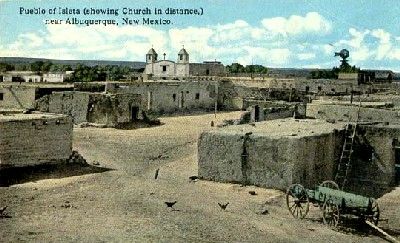
Isleta Pueblo.
Isleta Pueblo – Home to the Tiwa Tribe
Originally established around 1200 A.D., the Isleta Pueblo is home to the Tiwa tribe, descended from remote Shoshoncan stock, the first people to enter the Americas some 30,000 years ago. Due to its location on a strip of land projecting from the Rio Grande, the conquering Spaniards gave the pueblo the name of Isleta, meaning “little island.”
Around 1629, refugees from outlying pueblos converged on the Isleta Pueblo, abandoning their homes due to savage Apache raids. The Spanish Mission of San Agustín de la Isleta was built in the pueblo around 1629 or 1630 by the Spanish Franciscan friar Juan de Salas.
When the Pueblo Revolt began in 1680, the Pueblo was home to approximately 2,000 people, including many Spanish settlers. Though Isleta was spared the massacre at other pueblos due to its Spanish residents, many of its native members fled to Hopi settlements in Arizona. Others accompanied the Spanish to their retreat at El Paso del Norte (present-day El Paso, Texas). After the rebellion, the Isleta people returned to the pueblo, many with Hopi spouses. Though they submitted to Governor Otermin, secretly, their allegiance was with the other Pueblo peoples. When Governor Otermin found this out, he burned the pueblo and forced the remaining members to El Paso.
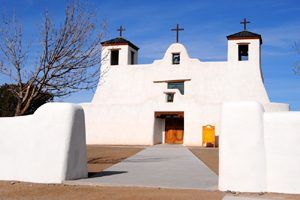
St. Augustine Church, Isleta Pueblo, New Mexico, by Kathy Alexander.
In 1692, when Diego De Vargas re-conquered the area, he found the Isleta church in ruins and the pueblo abandoned. Around 1710, the original Tiwa Indians reoccupied the pueblo, and in 1716, the original church was rebuilt and named St. Augustine. Still standing today, the St. Augustine Mission is one of the oldest in the United States.
During the 18th and 19th centuries, Isleta became one of the largest and most prosperous pueblos in New Mexico, noted for its extensive crops and orchards. The oldest section comprises adobe buildings surrounding a central plaza, with cultivated lands on either side.
Later in the 1800s, friction arose between members of Laguna Pueblo and Acoma Pueblo, who had joined the Isleta community, leading to the establishment of the satellite settlement of Oraibi. Today, as well as the main pueblo, Isleta includes the small communities of Oraibi and Chicale.
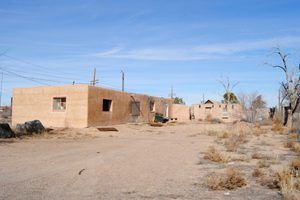
Isleta Pueblo by Kathy Alexander.
On October 21, 1887, Father Anton Docher went to New Mexico, where he was ordained as a priest in the Cathedral of Santa Fé. After three years in Santa Fe and one year in Taos, he arrived at the Isleta Pueblo in December 1891, where he would spend the next 34 years. A French Franciscan Roman Catholic priest and a strong defender of the Indians, known as “The Padre of Isleta,” is buried near the church’s altar, alongside Padre Padilla, in Isleta.
The pueblo now has a population of about 4,000, where traditions, songs, and dances are still practiced and passed down from one generation to the next. Although they continue to live with much of their ancient culture, they also operate several modern business enterprises, including the Isleta Casino & Resort.
Isleta Pueblo surrounds the northern portion of the village of Bosque Farms, a small agricultural community that has evolved into a suburban village within the Albuquerque metropolitan region. Contact Information: Isleta Pueblo, PO Box 1270, Isleta, New Mexico 87022, 505-869-3111.
Los Lunas – History Through the Ages
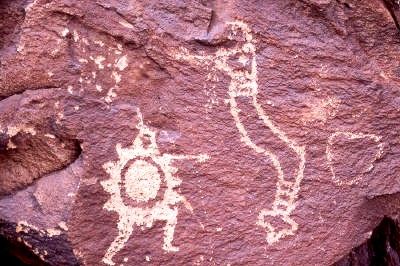
Petroglyphs near Los Lunas, New Mexico.
Just another nine miles down the road brings you to Los Lunas, New Mexico, a city rich in its diversity of history. Sheltered from the urban sprawl of Albuquerque by the Isleta Indian Pueblo to the north and the Rio Grande to the east, this small town of around 10,000 people enjoys the charm of small-town living with easy access to the metropolitan amenities of nearby Albuquerque. From the prehistoric Ancient Puebloan (Anasazi) Indians to Spanish explorers and the many who traveled this part of the Mother Road in its early days, Los Lunas offers much to explore for the nostalgic history buff.
Initially, the area that would become Los Lunas was located on the San Clemente Land Grant. In 1716, the land was granted to Don Felix Candelaria after his mother had petitioned for it.
Shortly afterward, the Luna family claimed the grant and took possession, and a small settlement was formed. In 1808, Antonio Jose Luna was born, eventually becoming a civic and political leader. Often referred to as the father of Los Lunas, he grew up to marry Isabella Baca, daughter of a prominent family from Belén, a community ten miles south of Los Lunas. The tradition continued as Antonio and Isabella’s son also married into a prominent family. The Lunas family dominated Valencia County for almost a century. Their influence led to the county seat being moved from Tomé to Los Lunas in 1876.
When the Santa Fe Railroad arrived in the 1880s, a depot was built that facilitated the movement of livestock, hay, general merchandise, and passengers to and from the developing city. More transportation arrived in the city when the first alignment of Route 66 came through in 1925. Soon, several services emerged in the city.
Today, the Los Lunas area has numerous opportunities to peek into the past, not only the “recent” past of vintage Route 66 but also the history of prehistoric Ancient Puebloan Indians and Spanish Explorers.
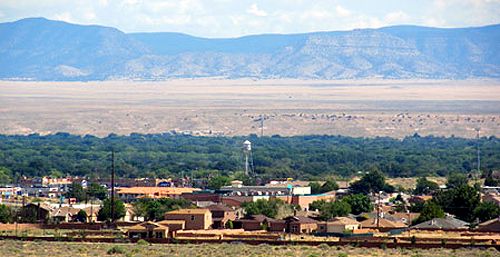
Los Lunas, New Mexico.
While in Los Lunas, check out The Luna-Otero Mansion, dating back to 1881 and listed on the National Register of Historic Places. The old mansion is said to be haunted by Josefita Otero. Believe it or not.
In the downtown area, there are several historic structures and Route 66 era buildings, including the town offices located in Old Route 66 cabins, Teofilo’s Restaurant that dates back to 1912, the White Café, the Huning Mercantile established in 1860, the San Antonio Mission built in 1790, and Sam’s Tires – a 1928 Route 66 gas station.
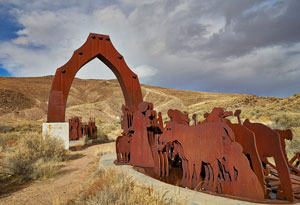
Tomé, New Mexico, sculpture by Carol Highsmith.
While not on Route 66, a short six-mile side trip south on US-85/NM-314 to Tomé Hill is well worth the drive. Dominating the landscape between Los Lunas and Belén, this landmark along the El Camino Real (the Royal Road) has been used as a religious site, a refuge from hostile enemies and floods, and as an observation point since prehistoric times. More than 1,800 petroglyphs have been recorded on the hill, some dating back over 2,000 years. At the foot of the hill is a large steel sculpture called La Puerta del Sol (Gateway to the Sun), intended to reflect the region’s diverse cultures. The sculpture marks the beginning of a 10-acre park featuring pathways, picnic tables, and interpretive panels that tell the story of Cerro del Tomé and the people of Tomé. A self-guided tour of the ancient petroglyphs, sculptures, and Camino Real history is currently available.
Nearby, the Tomé Immaculate Conception Church has an extensive museum with a history exhibit and hand-carved wood saints. Tomé is the oldest Hispanic settlement in Valencia County, established in 1739. Another four miles south of Tomé is the old city of Belén, where you can see the Harvey House Museum in one of the original railroad depots. In 1910, the depot housed one of the famous Harvey House restaurants.
Returning to Los Lunas, you will head west on New Mexico Highway 6 to continue your journey along the Mother Road. This stretch, passing through numerous rock mesas in the Rio Puerco Valley on your way to Laguna, is one of the most beautiful on all of Route 66.
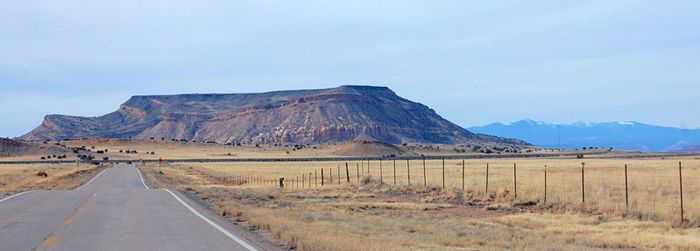
Pre-1937 Route 66 west of Los Lunas, New Mexico. Photo by Kathy Alexander.
© Kathy Alexander/Legends of America, updated August 2025.
Also See:
New Mexico Route 66 Photo Gallery
Pueblo and Indian Reservation Etiquette
El Camino Real de Tierra Adentro National Historic Trail
Sources: