
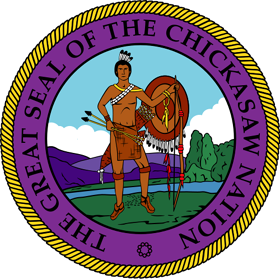
Chickasaw Seal.
Although the Chickasaw are generally the least known of the Five Civilized Tribes, no other tribe played a more significant role in Britain’s victory over France for control of North America. Variously described as the “Unconquered” or the “Spartans of the Lower Mississippi Valley,” the Chickasaw were the most formidable warriors of the American Southeast. British traders from the Carolinas quickly recognized their prowess in this area, arming the Chickasaw, after which the French were crippled in engaging in any commerce along the lower Mississippi River. The tribe never lost a battle until they sided with the Confederates during the Civil War. Even then, the Chickasaw Nation was the last Confederate government to surrender to Union forces.
An important Muscogean tribe, the Chickasaw were closely related to the Choctaw in language and customs, although the two tribes were mutually hostile. The principal difference between the two tribes was that the Choctaw were more sedentary and devoted to agricultural pursuits, while the Chickasaw were more turbulent, restless, and warlike.
The earliest known Chickasaw habitat was in north Mississippi. Their villages in the 18th century centered around Pontotoc and Union Counties, where the headwaters of the Tombigbee River met those of the Yazoo River and its affluent, the Tallahatchie River. This is where Hernando de Soto’s narratives placed them in 1540 under the name Chicaza.
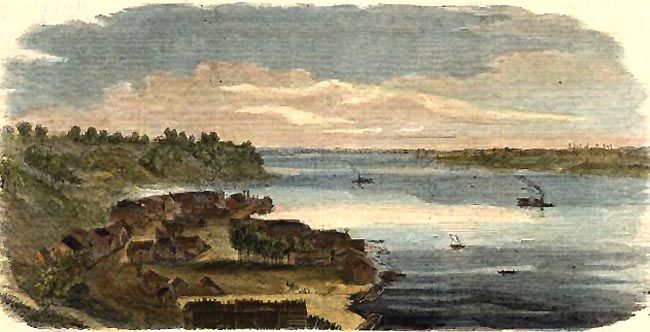
Chickasaw Bluffs, Tennessee.
Their principal landing place on the Mississippi River was at Chickasaw Bluffs, now the site of Memphis, Tennessee, where a trail more than 160 miles long led to their villages. They also had two other landing places farther up the Mississippi River.
The Chickasaw were noted for their bravery, independence, and warlike disposition early on. They constantly fought with neighboring tribes, sometimes with the Choctaw and Creek, and later, with the Cherokee, Illinois, Kickapoo, Shawnee, Mobile, Osage, and Quapaw. They combined with the Cherokee in about 1715 and drove the Shawnee from their territory on the Cumberland River. In 1732, they destroyed a war party of Iroquois who had invaded their country.
In 1744, the English trader James Adair guided a pack train of trade goods into the Chickasaw Nation and began to do business with the tribe. He would maintain a friendly relationship with them for the next two decades. When he departed Chickasaw for the last time in 1768, he took with him a book-length manuscript he was determined to see published. Over 500 pages, Adair’s manuscript contained a wealth of information about the tribe. Adair stated that the Chickasaw had four contiguous settlements, each with several villages. Their townsites were described as sophisticated; they practiced agriculture and possessed a highly developed ruling system with laws and religion.
However, the warlike Chickasaw claimed other territories far beyond the narrow limits of their villages, land that extended north to the confluence of the Ohio and Tennessee Rivers, as well as a large area north of the Tennessee River to the ridge between the Duck and Cumberland Rivers, and south to the Tennessee River.
According to other reports, an outlying Chickasaw colony dwelt on the Savannah River, nearly opposite Augusta, Georgia. Still, trouble with the Creek tribe drove them westward again.
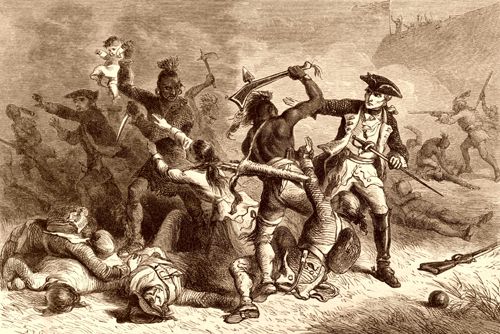
French and Indian War by Felix Carr, about 1870.
They were constant enemies of the French, a feeling intensified by the intrigues of British traders and their hatred of the Choctaw, who had entered into friendly relations with the French colonists. The Chickasaw urged the Natchez to resist the French encroachments and gave shelter to them when driven from their home.
In the French and Indian War of 1756 to 1763, a war between Great Britain and France, the French allied with the English, fought in several battles, and the war resulted in British domination of America.
Though they had formerly allied with the Cherokee to drive the Shawnee from their territory, they would later fight with them when they tried to drive the Chickasaw out. Although the Cherokee outnumbered the Chickasaw five to one, the Chickasaw would prevail in the end. After eleven years of skirmishes, the Cherokee were routed at a battle near the Chickasaw Old Fields in 1769. The British arranged peace the following year, and although they never relinquished their claim to the disputed area, the Cherokee chose not to rechallenge the Chickasaw.
Negotiations with the United States began with the Hopewell Treaty in 1786, when their northern boundary was fixed at the Ohio River. They began emigrating west of the Mississippi River as early as 1822, and treaties to remove those who remained in their old locations were made in 1832 and 1834.
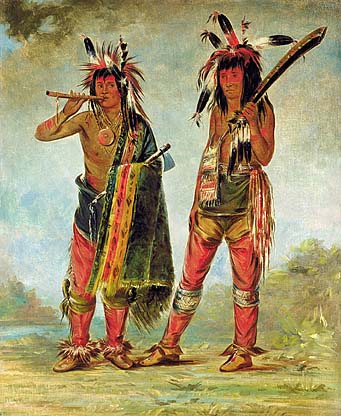
Chickasaw Men.
During the Indian Removal to Indian Territory (Oklahoma), the Chickasaw were, unlike other tribes, exchanging land grants; instead, they were to receive $3 million in financial compensation for their lands east of the Mississippi River. In 1836, the Chickasaw reached an agreement to purchase land from the previously removed Choctaw, paying the other tribe $530,000 for the westernmost part of Choctaw land. The first group of Chickasaw moved in 1837. However, the $3 million the U.S. owed the Chickasaw went unpaid for nearly 30 years.
Though they lived on separate land from the Choctaw, the government saw the two tribes as one until 1856, when the tribes were “officially” separated, and the Chickasaw were given direct authority over their affairs and formed their government. Tribal leaders established the capital at Tishomingo, Oklahoma, adopted a constitution, and organized executive, legislative, and judicial departments.
When the Civil War erupted, the Chickasaw Nation was the first of the Five Civilized Tribes to become an ally of the Confederate States of America, passing a resolution in May 1861. Part of their reason for siding with the South was the United States having abandoned Fort Washita, which left the Chickasaw Nation defenseless against the Plains tribes. The other reason was that they were slaveholders. They soon raised troops to fight with the Confederacy and were the last Confederate community to surrender to the United States in 1866.
The peace treaty with the government included the provision that the tribe emancipate their slaves and give them full citizenship in the nation. These people became known as Chickasaw Freedmen. However, the Chickasaw Nation refused to automatically grant its Freedmen citizenship, requiring them to go through the same process as anyone else to gain citizenship. These requirements provided that citizens be born of a Chickasaw parent or petition for citizenship if they were not a known blood Chickasaw. Due to their refusal to automatically make their former slaves citizens of their nation, the U.S. Government penalized the tribe by taking over half of their lands without compensation.
Although the tribe suffered hardships after the defeat of the Confederacy, it regained prosperity, with many of its members becoming successful farmers and ranchers. The tribe also built some of the first schools, banks, and businesses in Indian Territory.
After Oklahoma became a state in 1907, the government began to appoint the principal officers of the Chickasaw Nation. This finally changed in 1970, when Congress enacted legislation allowing the Five Civilized Tribes to elect their principal officers. In 1983, a new Chickasaw constitution was adopted.
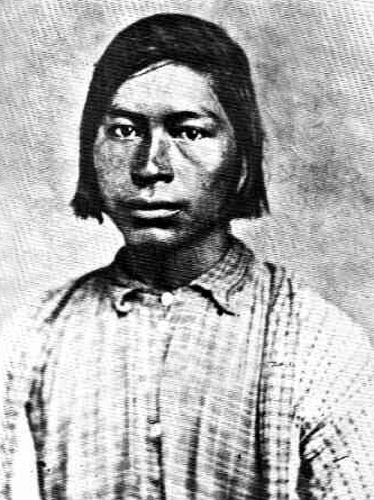
Chickasaw Brave.
Early estimates of the population vary widely; those of the 18th century ranged from 2,000 to nearly 6,000. However, James Adair, who had befriended the Chickasaw for two decades, estimated their population more closely in 1744 at between 3,000 and 4,000. In 1865, the estimated population was 4,500, and in 1904, the official number was 4,820, including mixed bloods.
Today, the Chickasaw Nation numbers approximately 38,000 members, making it the eighth-largest Indian nation in the United States. Though they live throughout the United States, most still reside in Oklahoma. With its headquarters in Ada, Oklahoma, the Chickasaw successfully commingle culturally and economically with the non-Indian society while retaining their language and traditions. The tribe is currently involved in economic development and other ventures with government at the city, county, and state levels, as well as with private enterprise.
The tribal government headquarters in Ada includes a cultural center, library, and an extensive American Indian art collection.
The Chickasaw National Recreation Area in Sulphur, Oklahoma, is one of the state’s two national parks, named by the Chickasaw people as the “Peaceful Valley of Rippling Waters,” where inter-tribal disputes and warfare were forbidden. Adjacent to the Chickasaw National Recreation Area is the new Chickasaw Cultural Center. Located on 109 acres, the center will use live performances, high-technology multimedia exhibits, galleries, and natural outdoor spaces to share the story of the unconquered and unconquerable Chickasaw Nation.
In the historic capital city of Tishomingo, visitors can see the stately granite Chickasaw Nation Capitol Building or the Chickasaw National Bank, both built in the 19th century. The Chickasaw Council House Museum looks back at the lives of those who helped settle this part of the state and provides genealogical services.
Native American Tribes Poster, available at Legends’ General Store.
Other ventures include several casinos, hotels, and travel plazas.
More Information:
Chickasaw Nation
P.O. Box 1548
Ada, Oklahoma 74821
©Kathy Alexander/Legends of America, updated November 2025.
Also See:
Native American Photo Galleries
See Sources.