
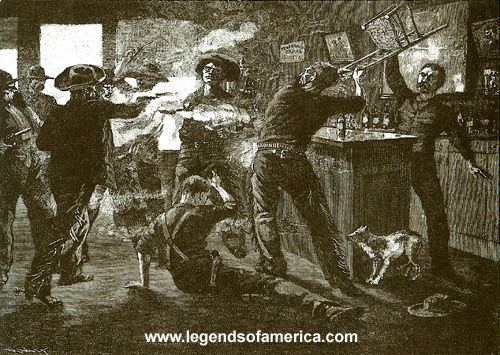
Saloon gunfight.
On August 20, 1871, one of the largest gunfights ever in the American West took place in Newton, Kansas. Known as the Hyde Park Gunfight or the Newton Massacre, the shootout claimed more lives than many more famous gunfights, such as the Dalton Gang Gunfight at Coffeyville, Kansas, or the Gunfight at the O.K. Corral in Tombstone, Arizona.
When the Santa Fe Railroad extended its line to Newton, Kansas, in 1871, this new frontier town succeeded Abilene as the terminus of the Chisholm Trail. Like other Kansas cowtowns, Newton quickly filled up with saloons, gambling parlors, brothels, and inevitably — lawless and violent men.
The whole affair began when two local lawmen, Billy Bailey and Mike McCluskie, argued over local politics on August 11 at the Red Front Saloon.
McCluskie, an Irishman from Ohio and a rough man by anyone’s standards, had made his way to Kansas via his employment with the Santa Fe Railroad as a Night Policeman.
Shortly after his arrival, he befriended an 18-year-old man named James Riley, who was dying of tuberculosis. This is relevant because Riley would soon play a major role in the famous gunfight that was to come. Billy Bailey was a Texas cowboy who had probably wound up in Newton after one of the long cattle drives.
Both men had been hired by Newton authorities as Special Policemen to keep order in the city during the heated August elections. At that time, the fledgling city was trying to form a new county, and who would lead these efforts was a major debate among the locals. Though working in tandem, McCluskie and Bailey had a personality conflict from the start. Constantly arguing, the two men were in the Red Front Saloon on August 11, and their dispute soon led to violence. Starting as a fistfight, Bailey was knocked out of the saloon and into the dusty street. McCluskie followed, drew his pistol, and fired two shots at Bailey, hitting him in the chest. The wounded man died the next day.
McCluskie immediately fled town to avoid arrest but returned just a few days later, after he heard that the shooting would most likely be deemed self-defense. Though Bailey never produced a weapon, McCluskie claimed he feared for his life because Bailey had been in three previous gunfights, in which he had killed two men.
Several of Bailey’s cowboy friends from Texas heard about his death and vowed to take revenge against his killer. Late on the evening of August 1971, McCluskie strode into Tuttle’s Dance Hall, located in an area of town called Hyde Park. Accompanied by a friend named Jim Martin, a Texas cowboy, the two sat down to play faro. Already in the saloon was McCluskie’s “shadow,” James Riley.
After midnight, three of Bailey’s Texas cowboy friends by the names of Billy Garrett, Henry Kearnes, and Jim Wilkerson also entered the dance hall. All were armed, and Billy Garrett had a history of at least two prior gunfights, where he had been successful in killing two men. The three mingled in the saloon, waiting and watching McCluskie gamble. Soon, another Texas cowboy named Hugh Anderson, the son of a wealthy Bell County, Texas cattle rancher, also entered the dancehall, walking directly up to McCluskie and yelling, “You are a cowardly son-of-a-bitch! I will blow the top of your head off!”
Though Jim Martin jumped up and attempted to stop any violence, Anderson ignored him and shot McCluskie in the neck. McCluskie, in the meantime, tried to return the shot, but his pistol misfired, and he fell to the floor. Anderson, now standing over him, pumped several more bullets into his back.
In the meantime, Texas cowboys Kearns, Garrett, and Wilkerson also began firing, perhaps to keep the crowd back. James Riley, McCluskie’s friend, then pulled his two Colt revolvers and opened fire on the Texans. Though Riley had never been in a gunfight before and probably couldn’t see in the smoke-filled room, he unloaded his guns into melee, hitting seven men.
Among those hit was would-be peacemaker Jim Martin, who took a shot in the neck before stumbling out of the saloon and dying across the dusty street on the steps of Krum’s dance hall. Texas cowboy, Billy Garrett, was shot in the shoulder and chest and died a few hours later. His friend Henry Kearnes also took a mortal wound but hung on for a week before he died.
Others, who had no part in the squabble, also took some of Riley’s wild bullets, including a Santa Fe Railroad brakeman named Patrick Lee, who was shot in the stomach and died two days later. Another Santa Fe employee named Hickey was also shot in the calf, but the wound was not serious, and he survived.
The other two Texas cowboys, Jim Wilkerson and the first shooter, Hugh Anderson, were also wounded. Wilkerson was shot in the nose and the leg, but recovered from his wounds. Anderson took two shots in the leg and also recovered.
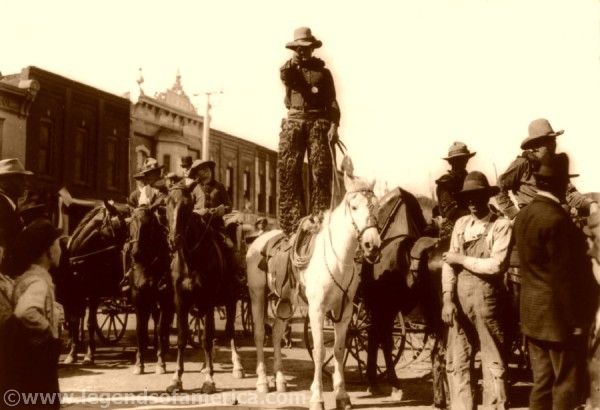
Newton, Kansas, cowboy.
With seven men lying on the floor, young James Riley, who, previous to this time, had never been in trouble, walked out of the smoke-filled saloon and was never seen again.
Later that day, a warrant was issued for the arrest of Hugh Anderson. However, his father and friends smuggled him aboard a train to Kansas City. Later, he made his way back to Texas and was never brought to trial for McCluskie’s murder.
However, the whole affair was not yet over. Now, Arthur McCluskie, Mike’s brother, wanted revenge against Hugh Anderson. For two years, Arthur and his friends kept a lookout for Anderson, who was safely hiding in Texas. But Anderson made the mistake of returning to Kansas in 1873, where Arthur tracked him down in Medicine Lodge. Working at Harding’s Trading Post as a bartender, Arthur sent a man in on July 4, 1873, inviting Anderson to a duel and offering him a choice of weapons: guns or knives. Anderson chose pistols and soon emerged from the trading post.
After both men emptied their guns into each other, they then resorted to knives, and in the end, both were dead.
Though the Hyde Park Gunfight received much publicity at the time, it has received little historical attention, despite producing a higher body count than many more famous gunfights, such as the Gunfight at the O.K. Corral or the Four Dead in Five Seconds Gunfight of 1881. Perhaps this is because there were no “famous” people involved.
Historical Accounts:
August 24, Abilene Chronicle
During the fracas, McCluskie received three pistol shots, any one of which would cause death. He must have exhibited great courage and bravery ere the fatal bullets pierced his body, for the barrels of his six-shooter, when picked up, were found to have been emptied of their charges. He lived but a few hours.
Another Texan, whose name we have been unable to ascertain, was also shot and killed.
As far as we have been able to learn, the names of the wounded are as follows: Pat Lee, a brakesman on the railroad, a looker-on, in the abdomen, probably fatally; Billy Garrett, a Texan, in the arm, slight; _______ Hickey, a section boss on the railroad, in the calf of the leg, slight; Jim Wilkerson, a Texan, in the nose, slight; Henry Kearnes, in the right breast, fatal; Hugh Anderson, the supposed instigator of the riot, thigh, and leg, not serious. The brakesman, Lee, and Kearnes will probably die.
On Monday evening, the last threats were made by many desperadoes that, in case Tom Carson, late a policeman in Abilene [Wild Bill Hickok, city marshal], was placed upon the police force, they would kill him. He was, however, appointed a police officer, and that evening patrolled his allotted beat as unmolested as if he were in Abilene, no disturbance whatever occurring.
Thus ends the third or fourth chapter in Newton’s bloody history — a town only a little over three months old. Let good and honest men strengthen its police force, and all violators of the law be made to suffer the extreme penalties of its wise provisions. Then bloodshed will cease. But if the worst than beastly prostitution of the sexes is continued, and the town is controlled by characters who have no regard for virtue, decency, or honor, it will not soon become fit for the abode of respectable people.
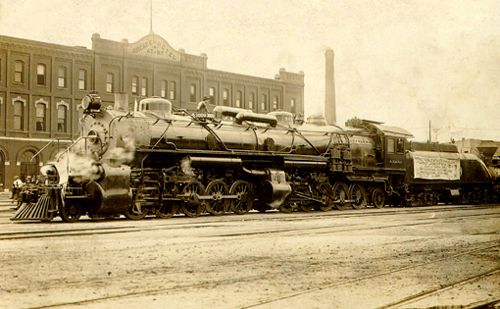
Historic Newton, Kansas.
August 25, 1871
Wholesale Murder At Newton. Five Men Killed And Six Wounded. The Jury Ordered To Leave. The “Leading Man” Not Arrested
On Sunday morning last, a row on August 20 in Newton, which resulted in the murder of two men and the wounding of nine others, three of whom have since died from wounds received in the affray. This affair occurred in one of the sinks of iniquity near the town called a “dance house.” A former resident of this town who was at Newton gives us the following particulars of the affair:
It seems that this murderous affair was the result of several less fatal shooting scrapes that have been happening in Newton for some weeks.
It must be borne in mind that the state of society in that town is now at its worst. Prostitutes, gamblers, and whiskey-sellers largely inhabit the town. Pistol shooting is a common amusement. All the frequenters of the saloons, gambling dens, and houses of ill-fame are armed at all times, mostly with two pistols.
About two weeks ago, Captain French, from Texas, had George [or Arthur] Delany, alias Wm. [or Mike] McCluskie, a St. Louis hard case, arrested on a charge of garroting. He was tried before Esquire [C.S.] Bowman, and they failed to prove anything against him.
On the day of the election on railroad bonds, McCluskie and a man named Bailey, both of whom were on the special police, got into a difficulty over the arrest and over a woman. Bailey’s got drunk. The difficulty commenced at one of the dance houses, just out of the town, and after coming to the village, Bailey was shot and killed by McCluskie. French and other Texans, among whom was one named Bill [or Hugh] Anderson, then swore they would put an end to McCluskie’s life and break up his crowd. Several small difficulties occurred between the parties and their friends. At 1 o’clock last Sabbath morning, when all but one of the dance houses were closed, and most of their frequenters had left, the murderers proceeded to carry out their desperate threats. One of these disreputable places remained open. McCluskie was one of the loiterers. It proved to be his last hour on earth. If he had known this, he would doubtless have preferred to spend it elsewhere.
Several of the bloodthirsty Texans entered the place, accompanied by a few lookers-on, who had found out the intentions of the murderers. One or two innocent men were shot in the affray who were present only to see. Directly Anderson entered, and immediately the bloody work commenced. With murder in his eye and his foul mouth filled with oaths and epithets, he stepped up to McCluskie and shot him. The ball entered McCluskie’s neck. He sprang to his feet and shot Anderson and then fell to the ground. The shooting then became general. McCluskie was shot in three places and died in a couple of hours. John Martin, a herd boss, was shot through the jugular vein and died. Bill Anderson, an owner of Texas cattle, was shot through the thigh; John Anderson, his brother, was shot through the right arm and lungs; [William] Garrett was shot through the lungs, and has since died; Patrick Lee, a railroad employee, was shot through the loins and has since died. He was in no way a party to the difficulty. Hickey was shot in three places, and we believe he has since died. [Jim] Wilkinson was shot through the jaw and nose. Bartlett was shot in the left shoulder.
On Sunday, two other white men and a negro were shot, but our informant did not learn their names. Neither of them was killed. A coroner’s jury was called on Sunday morning, and after an investigation, which lasted from 8 o’clock a. m. to 12:30 p. m., they found Bill Anderson guilty of manslaughter, having proved that he fired the first shot. They adjourned, and soon after received notice that if they did not leave at once their bodies would be found Monday morning “ornamenting neighboring telegraph poles.” On Monday morning, three of them took the early train, and the other three went to Wichita. Anderson came on the same train and went to Topeka to have his wounds attended to. Anderson and his men had such control over the crowd that the officers were afraid to arrest them.
Gunfight.
The Texans were talking Sunday night of burning the town and running out the prostitutes and gamblers. Several of them left, and as we have heard of no such action on their part, we conclude they have abandoned the matter.
This was one of the bloodiest affrays ever to occur in our State, and we hope that measures will be taken to prevent its recurrence.