
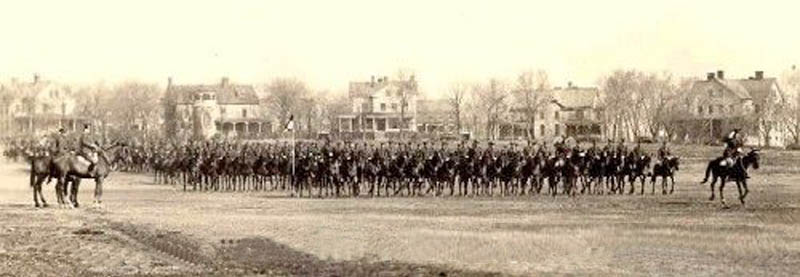
Fort Riley, Kansas, 2nd Cavalry, 1920s.
Surveyors chose the site of Fort Riley, Kansas, in the fall of 1852. Due to its proximity to the geographical center of the United States, it was first called Camp Center. The following spring, three companies of the 6th Infantry began constructing temporary quarters at the camp.
On June 27, 1853, the camp’s name was changed to Fort Riley in honor of Major General Bennett C. Riley, who had led the first military escort along the Santa Fe Trail and died earlier that month.
The fort initially aimed to protect the pioneers and traders moving along the Oregon-California and Santa Fe Trails.
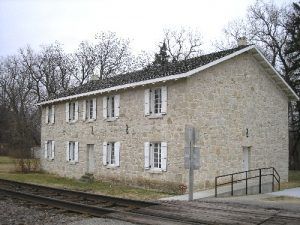
The First Territorial Capitol at Pawnee, Kansas, was used for only one session before moving to Lecompton, Kansas, when pro-slavery advocates controlled the state. Photo by Kathy Alexander.
Many of the fort’s buildings were built with the area’s native limestone, several of which remain today. By 1855, the post was well-established, and as more people moved westward, additional quarters, stables, and administrative buildings were authorized to be built. In July, 56 mule teams arrived at the fort, loaded with materials and soldiers to expand the fort.
However, just a few short weeks later, cholera broke out in the fort, and though the epidemic lasted only a few days, it left some 75-125 people dead in its wake.
As tensions and bloodshed increased between the pro- and anti-slavery settlers, resulting in what has become known as “Bleeding Kansas,” Fort Riley’s troops took on the additional task of “policing” the troubled territory while continuing to patrol the Santa Fe Trail as Indian attacks increased.
When the Civil War broke out, most troops stationed at Fort Riley were sent eastward. However, some soldiers were left to guard those traveling West, and the base was utilized as a prisoner-of-war camp for captured Confederates. After the Civil War, troops from Fort Riley were needed to protect workers constructing the Kansas Pacific Railroad from Indian attacks.
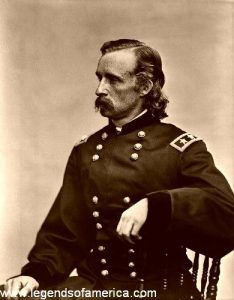
George A. Custer.
Lieutenant George Armstrong Custer was stationed at the fort in 1866 and 1867. Wild Bill Hickok served as a scout at Fort Riley starting in 1867. On January 1, 1893, Fort Riley became the Cavalry and Light Artillery School site, which continued until 1943, when the Cavalry was disbanded. Several times over the years, the famous 9th and 10th Cavalry Regiments of all-Black soldiers, known as Buffalo Soldiers, were stationed at the fort.
The post has remained active through both World Wars and continues to this today. The military reservation now covers more than 100,000 acres and has a daytime population of nearly 25,000, including the 1st Infantry Division, nicknamed the Big Red One.
Fort Riley is located on the North bank of the Kansas River, three miles North of Junction City.
Contact Information:
Fort Riley Museum Division
785-239-2737
Fort Riley Hauntings
Artillery Parade Field – A woman wrapped in chains is said to have often been seen walking across the field on clear nights. No one knows who this woman was or what she did to end up in chains.
Camp Funston – Camp Funston was the largest of 16 divisional cantonments (temporary or semi-permanent military quarters) training camps constructed during World War I. Designated for Fort Riley because of its central location in the nation, construction began on July 1, 1917, and the camp was completed on December 1. With a capacity of over 50,000, it drew trainees from all over the Great Plains states. However, not long after the camp was completed and filled with soldiers, the 1918 flu epidemic, called the “Influenza Pandemic of 1918,” hit the camp. Worldwide, this fatal flu virus, cited as the most devastating epidemic in recorded world history, killed more people than in World War I, an estimated 20 to 40 million people, including some 675,000 Americans. A global disaster, the flu took its toll on Camp Funston and Fort Riley, like it did the rest of the world.
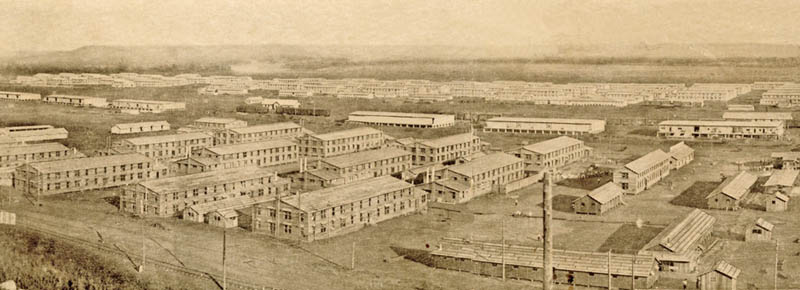
Camp Funston, Kansas, about 1918.
After the war ended in 1918, the camp and the Army shrank, and by 1922, Camp Funston officially ceased to exist. Today, its many buildings now serve as temporary housing.
Though those WWI soldiers-in-training are long gone, at least one has chosen to stay. First reported in the late 1960s, a ghostly soldier in World War I uniform has been seen in the area, continuing his patrol. The tale says a Public Works employee first spotted the ghostly figure while repairing downed electrical lines. Amid a snowstorm, he noticed a soldier in a heavy wool overcoat and a rifle over his shoulder, pacing back and forth near the site of the old World War I-era gymnasium. After repairing the lines, he decided to share his thermos of hot coffee with the young man; however, when he approached the area where he had spied him, the soldier was gone. More perplexing was the snow-covered ground, which showed no sign of footprints. Many believe that this long-forgotten soldier is one of those who died during the 1918 flu pandemic.
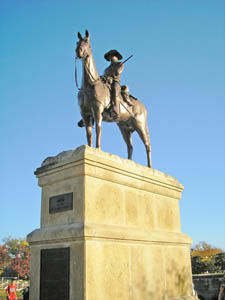
Old Trooper Statue at Fort Riley, Kansas, by Kathy Alexander.
Cavalry Parade Field – Allegedly, a group of spectral riders is often seen and heard galloping across Cavalry Parade Field. According to the tales, many people first feel a low vibration and hear distant thunder before seeing a troop of soldiers galloping across the parade grounds. The riders then slowed at the intersection of Sheridan and Forsyth Avenues, where, after one rider dismounted, the rest of the troop wheeled around and rode away.
Lieutenant Colonel George Armstrong Custer once lived at the intersection where the riders stopped. Though Custer’s original home burned down long ago, it stood near this intersection. Some believe that the original dwelling stood where Quarters 21 is now located.
This group of spectral riders is believed to be Custer’s escort, and the dismounted soldier is thought to be the Lieutenant himself.
In 1867, when Custer was stationed at the fort but off on a military campaign, he got the news that cholera had broken out at the fort where his beloved wife Libby was waiting for him.
Fearing for her safety, he selected an escort of his finest horsemen, turned over the 7th Cavalry to another officer, and the men rode back to the fort as fast as they could. Though he arrived to find Libby in good health, Custer was later court-martialed for deserting his unit and was relieved of command for one year. Perhaps this emotionally charged event has become a “place memory” haunting.
Interestingly, when these dark riders “appear” on the parade grounds, different people sense them in different ways.
Some witnesses see and hear the troops, but more report seeing or hearing them, not both. Those who hear them often hear various sounds, including thundering hoofs, voices, and the metallic jingle that accompanies horsemen.
Custer House – Formerly known as Quarters 24, this is one of four original buildings from the post and has been in continual use since it was built. Made of native limestone, the building is structurally similar to the original officers’ quarters where George Armstrong Custer and his wife, Libby, lived from 1866 to 1867. The actual building near the Custer House that the Lieutenant lived in had long been burned down. Today, Quarters 24 is a museum exhibiting life at the fort in the late 1860s.
Haunting reports from this house first began in 1855, when the fort was hit by a cholera epidemic that claimed many lives. Immediately, the ghostly spirits were blamed on those who had died of the horrible disease.
Specific reports include a sergeant who worked in the building in the 1970s and said he often heard strange noises from the upstairs rooms, including what sounded like someone putting on a boot and stamping his foot on the floor. These noises always came when no one was in the upstairs rooms. The same sergeant also reported that a teddy bear in the children’s room kept moving around. Though he always placed it on the bed before leaving, he would arrive the next day to find it had been moved again, usually sitting atop a rocking horse in the room.
Another soldier who worked in the Custer House reported that she would often arrive in the morning to find a bed in an upstairs room that appeared to have been slept in. The same soldier also reported often feeling as if she was being watched in the museum.
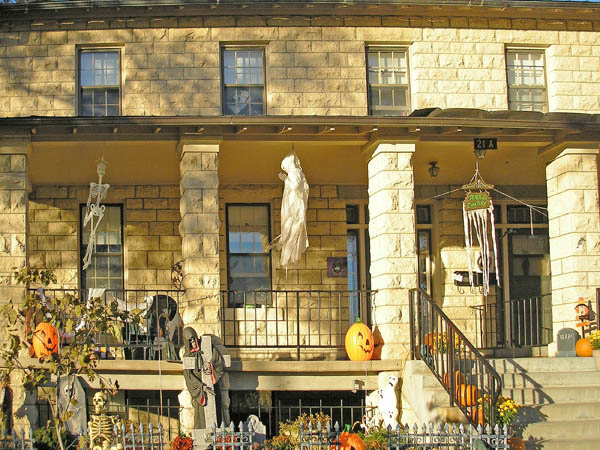
Custer House at Fort Riley, Kansas, by Kathy Alexander.
Infantry Parade Field — Long ago, this field was also used as a polo field. Today, witnesses say two polo-playing gentlemen are still seen riding their horses and playing polo. The two men are not polite if their game is interrupted. One soldier, who had a personal experience, was walking across the field one evening when he heard faint shouts and cheers in the distance. He then saw what looked like two figures playing polo. As he stopped to watch, the ball came near him, and the two riders galloped toward him. As they drew near, the soldier saw that one of the riders had no face. Instead, there was nothing but a grinning skull. Shocked, the man stared, only to be surprised to hear the apparition yell, “Leave! Now, while you still can!” Panicked, the witness immediately ran from the field.
IACH (The Hospital) — In the Bio-Medical room, the fire alarm frequently sounds without being triggered. On one such occasion, after the alarm had gone off eight times, the fire marshal came and disconnected it; the alarm sounded three times after that.
Kansas Territorial Capitol – The first territorial capital was built in 1855 at the site of the now-extinct Pawnee City. Near the old Capitol building is the Kaw River Nature and History Trail, where the sorrowful voice of a woman can sometimes be heard drifting up from the banks of the river. One man, who often stopped to walk along the trail, says he heard a woman singing a sad melody as he walked. Investigating, he moved closer to the river to investigate the source of the mournful voice. Upon arriving, he saw the shaded form of a flatboat or barge pulled across the river by a dark, human-shaped form. Both vanished when the apparition and the phantom boat reached the river’s other side.
Most believe this may be the soul of a long-dead slave woman who belonged to the man who owned the ferry in the 1850s. It is known that the ferry owner used a slave woman to pull the ferry back and forth across the river. Though this is the most likely explanation, might the spirit also be that of La Llorona, the weeping ghost who has long been known to haunt the rivers and waters of the American West?.
Lower Parade Field – For many years, people have reported seeing a lone rider galloping madly across the field in the morning, only to disappear as quickly as he appeared.
Fort Riley Post Headquarters.
Main Post — In this old building, people have often seen the ghostly figure of an old nurse.
NCO Club – Ghosts are said to haunt the doors of this club. An MP reported that a ghostly force jerked open the door he was guarding, even though it was locked.
No. 1 Stable – For years, soldiers on night duty have reported seeing a man in old-fashioned clothing ride through the stable and then disappear. Years later, when workers were working on the stable, they found the skeletons of a horse and rider in an old ravine.
Post Cemetery — In the summer of 1855, a woman named Cornelia Armistead died of the cholera epidemic that was raging through the fort. Cornelia was the second wife of Major Lewis A. Armistead of the Sixth United States Infantry Regiment. As the cholera epidemic had already begun by July 1855, Armistead feared an outbreak among his troops and left Fort Riley, heading Southwest. However, after traveling only nine miles, the disease took hold among his men, and the unit was forced to stop. In the meantime, the epidemic was raging through Fort Riley, leaving in its wake as many as 125 men, women, and children dead. On the very day that Major Armistead returned to the fort, his wife had died. A few years later, when the Civil War broke out, Armistead was killed in 1863. Since his death, Armistead has often been seen kneeling at his wife’s grave. Upset and weeping, his ghostly presence wears a dark blue uniform and wishes to be left alone if approached.
Quarters 124 – This house is reportedly haunted by a woman who drowned herself in a well on the fort grounds in the 1860s. Over the years, residents have reported hearing loud noises at night, such as someone dragging a wooden box up and down the stairs. At one point, it was so bad that a priest was called in to do an exorcism. At first, the ceremony was successful, but the ghost returned several years later. However, no one has heard from the ghost recently.
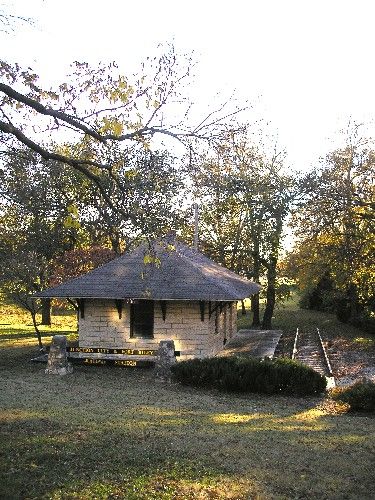
Fort Riley Trolley Station.
Trolley Station — In July of 1855, cholera was diagnosed at the fort, and by the end of August, most of the Fort was dead. Susan Fox lived with her stepfather in a small frame building across the creek from the trolley station. Engaged to be married soon, she was home alone for several days while her father was away and her fiancé was in the nearby town of Pawnee City caring for the sick.
Contracting the horrible disease, she died alone in her home on August 30. Her fiancé discovered her body after he returned to the fort, and she was buried in her wedding dress in a small grave near the railway bridge to the trolley station.
After her death, the residents of the house described many strange occurrences. Her fiancée said, “It was a difficult passage for her, and Susan returned to her old home several times demanding to be let in.”
Residents often reported hearing strange noises and shrieks. On another occasion, a maid ironing in front of a window was so frightened seeing Susan staring at her that she threw the iron through the window.
The Post Commander, so irritated by the complaints and disturbances, paid (out of Fort funds) for a priest from Junction City to perform an exorcism. Afterward, they razed the building to ensure Susan’s hauntings would stop. But still, she is seen in many parts of the Fort, especially around the trolley station, looking for something or someone she lost.
These stories are but a fraction of the many haunting tales of Fort Riley. Each year, the Historical and Archaeological Society of Fort Riley provides a Ghost Tour that tells the many tales of this historic and, apparently, extremely haunted post. Books at the Fort Riley Museum also detail these many apparitions.
©Kathy Alexander/Legends of America, updated October 2026.
Also See:
Forts & Presidios Across America
Haunted Forts & Battlegrounds
See Sources.