
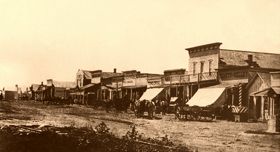
Dodge City, Kansas 1876.
Dodge City is a wicked little town. Here those nomads in regions remote from the restraints of moral, civil, social, and law-enforcing life, the Texas cattle drovers, from the very tendencies of their situation the embodiment of waywardness and wantonness, end the journey with their herds, and here they loiter and dissipate, sometimes for months, and share the boughten dalliances of fallen women.
– January 1, 1878 – Letter in the Washington, D. C.Evening Star
October 1873 – Letter from Frances Marie Antoinette Mack Roe
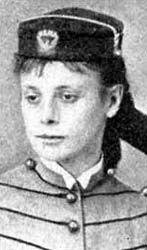
Frances Roe
Frances was the wife of Fayette Washington Roe, a Lieutenant Colonel in the United States Army. In October 1871, Roe was sent to Fort Lyon in Colorado Territory, and his wife Frances went with him. During this time, she wrote a number of letters describing her experiences on the frontier. In 1909, these were published in a book called Army Letters From an Officer’s Wife.
“Dodge City used to be that way, and there was a reign of terror in the town until finally, the twelve organized vigilantes became desperate and took affairs into their own hands. They notified six of the leading desperadoes that they must be out of the place by a certain day and hour. Four went, but two were defiant and remained. When the specified hour had passed, twelve double-barreled shotguns were loaded with buckshot, and in a body, the vigilantes hunted these men down as they would mad dogs and riddled each one through and through with the big shot! It was an awful thing to do, but it seems to have been absolutely necessary and the only way of establishing law and order. Our friends at Fort Dodge tell us that the place is now quite decent and that a man can safely walk in the streets without pistols and a belt full of cartridges.”
May 13, 1874 – Resolution of the Ford County Commissioners
“Any person who is not engaged in any legitimate business, and any person under the influence of intoxicating drinks, and any person who has ever borne arms against the Government of the United States, who shall be found within the limits of the town of Dodge City, bearing on his person a pistol, bowie knife, dirk, or other deadly weapon, shall be subject to arrest upon a charge of misdemeanor, and upon conviction shall be fined in a sum not exceeding $100, or by imprisonment in the county jail not exceeding three months, or both, at the discretion of the court, and same to take effect on date.”
June 25, 1874 – Dodge City Messenger
“Dodge City Town Company, Ford Co., Kansas. Inducements offered to actual settlers! Prospects of the town better than any other in the upper Arkansas Valley! Free Bridge across the Arkansas River! The town a little over one-year-old, and contains over seventy buildings! Good school, hotel, etc. AT&SF RR depot in town. Enquire of: R. M. Wright at Chas. Rath & Co. store or E. B. Kirk, Secy and Treas., Fort Dodge, June 25, 1874.”
April 24, 1876 – Letter from Governor Thomas Osborn to Charles Bassett, Sheriff of Ford County, Kansas
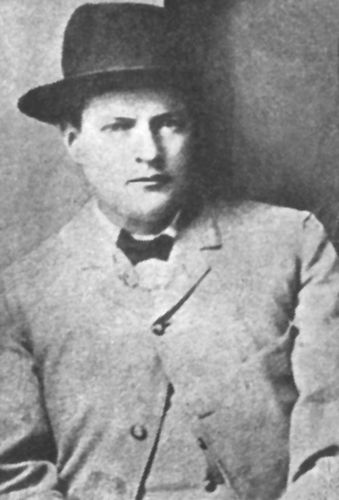
Charlie Bassett, Dodge City Lawman
“This will be handed to you by Mr. R. C. Callaham, whose son, John F. Callaham, was executed by mob violence in your county on the 8th. He visits Ford County for the purpose of making a thorough investigation of all the facts and circumstances attending the death of his son. He claims that there is no doubt of his son’s innocence, and if this claim is correct, the atrocity of the crime – an utterly law-defying one at the best – certainly demands the attention of all law-abiding people, and more especially of the officers to whom is entrusted the execution of the law and the preservation of the public peace.
I trust that you will extend to Mr. Callaham all the “assistance, counsel, and encouragement which it may be in your power to extend. There must be an end to mob violence in this state, and local officers exercising vigilance and energy in its suppression and punishment may rely upon the Executive for support and assistance. Let me know in what manner I can be of service in bringing to justice the perpetrators of this recent outrage, and I shall not be slow in responding to any practical suggestion. In the meantime, I trust that you will do everything in your power to facilitate the inquiry which Mr. Callaham proposes to institute.”
April 28, 1876 – Response to Osborn from Sheriff Bassett
“Through what little information I gave him and his own exertions, he has ascertained the fact that his son, John Calleham, was at Dodge City on the 3rd day of April 1876, the day on which we held our municipal election. It appears from the statements made by the Sumner County and other papers that the horses were stolen on the 30th, and that the parties in pursuit followed the thieves a distance of 30 miles. The theory is that if the deceased John Calleham was here on the 3rd day of April that it would be physically impossible for him to have stolen those horses. Several Citizens of good standing are willing to qualify that they spoke with him on the 3rd of April, at Dodge City. If he was one of the thieves, the time given him to travel over 300 miles of ground was 3 days from the night of the 30th of March to the morning of the 3rd of April. I do not hesitate to say that this fete could not be performed by any one horse or horseman in the time given, especially as the ground was so soft as to leave an impression, so plain that it could be followed at a very rapid gait.
To be brief, I am now of the opinion that the man was innocent of the crime alleged and for which he has suffered death. Mr. Calleham wishes me to go to Sumner County and arrest the parties interested in the hanging, but without the assistance of the executive department, I am totally unable to do anything, as I am in a poor fix financially to undertake so lengthy a journey.”
July 7, 1877 – Dodge City Times
“Wyatt Earp, who was on our city police force last summer, is in town again. We hope he will accept a position on the force once more. He had a quiet way of taking the most desperate characters into custody which invariably gave one the impression that the city was able to enforce her mandates and preserve her dignity. It wasn’t considered policy to draw a gun on Wyatt unless you got the drop and meant to bum powder without any preliminary talk.”
July 7, 1877 – Dodge City Times
“Mr. G. C. Noble, of the Atchison Champion, made the following observations during his recent visit here:
‘At Dodge City, we found everything, and everybody was as busy as they could comfortably be. This being our first visit to the metropolis of the West, we were very pleasantly surprised after the cock and bull stories that lunatic correspondents had given the public. Not a man was seen swinging from a telegraph pole; not a pistol was fired; no disturbance of any kind was noted. Instead of being called on to disgorge the few ducats in our possession, we were hospitably treated by all. It might be unpleasant for one or two old-time correspondents to be seen here, but they deserve all that would be meeted [meted] out to them. The Texas cattlemen and cowboys, instead of being armed to the teeth, with blood in their eyes, conduct themselves with propriety, many of them being thorough gentlemen.
Dodge City is supported principally by the immense cattle trade that is carried on here. During the season that has just now fairly opened, not less than 200,000 head will find a market here, and there are nearly a hundred purchasers who make their headquarters here during the season. Mr. A. H. Johnson, the gentlemanly stock agent of the A.T.& S.F. Co. informs us that the drive to this point during the season will be larger than ever before. May it prove a matter of great good to the company and to Dodge City.
From our window in the Dodge House — which, by the way, is one of the best and most commodious in the West — can be seen five herds, ranging from 1,000 to 10,000 each, that are awaiting transportation. The stockyards here are the largest west of St. Louis and just now are well filled.
Chas. Rath & Co. have a yard in which are about 50,000 green and dried buffalo hides.
F. C. Zimmermann, an old patron of the Champion, runs a general outfitting store and flourishes financially and physically.
Many other friends of the leading journal are doing business and are awaiting patiently the opening up of the country to agricultural purposes.
In the long run, Dodge is destined to become the metropolis of Western Kansas and only awaits the development of its vast resources.'”
August 11, 1877 – Dodge City Times
“The blood spilling events of the past week, if accurately related, would make our friends abroad think we were not such a strictly moral town as we pretend to be. To begin with, slugging has been the order of the day. All along the line, this pastime has been general; no less than five or six of the wayward females have had their bewitching countenances pounded into unnatural shape by the fists of their more muscular companions. We hope things will move more smoothly hereafter, as broken heads and disfigured countenances are not pleasant to look upon.”
August 11, 1877 – Reminiscences of Dodge by Frank Barnard of the Corpus Christi Gazette, reprinted in the Dodge City Times
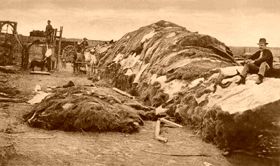
Charles Rath sitting atop buffalo hides in Dodge City, 1878.
“By virtue of the falling off in the cattle drive to Kansas for this year and the large number of cattle driven under contract, Dodge City became the principal depot for the sale of surplus stock; buyers met drovers at this point, purchased and received purchases without unnecessary delay, thereby greatly facilitating business and enabling quick returns of both owners and hands. In the future, situated as it is upon one of the best railroads traversing the country from east to west, the Atchison, Topeka & Santa Fe, it will probably occupy an enviable position as a cattle market. “Dodge has many characteristics which prevent its being classed as a town of strictly moral ideas and principles, notwithstanding it is supplied with a church, courthouse, and jail. Other institutions counterbalance the good works supposed to emanate from the first mentioned. Like all frontier towns of this modern day, fast men and fast women are around by the score, seeking whom they may devour, hunting for a soft snap, taking him in for cash, and many are the Texas cowboy who can testify as to their ability to follow up successfully the calling they have embraced in quest of money.
Gambling ranges from a game of five-cent chuck-aluck to a thousand-dollar poker pot. Nothing is secret, but with open doors upon the main streets, the ball rolls on uninterruptedly. More than occasionally some darkeyed virago or some brazen-faced blonde, with a modern sundown, will saunter in among the roughs of the gambling houses and saloons, entering with inexplicable zest into the disgusting sport, breathing the immoral atmosphere with a gusto which I defy modern writers to explain. Dance houses are ranged along the convenient distances and supplied with all the trappings and paraphernalia which go to complete institutions of that character. Here, you see the greatest abandon. Men of every grade assemble to join in the dance. Nice men with white neckties, the cattle dealer with his good clothes, the sport with his well-turned fingers, smooth tongue, and artistically twisted mustache, and last but not least the cowboy, booted and spurred as he comes from the trail, his hard earnings in his pocket, all join in the wild revel; and yet with all this mixture of strange human nature a remarkable degree of order is preserved. Arms are not allowed to be worn, and any noisy whisky demonstrations are promptly checked by incarceration in the lock-up. Even the mayor of the city indulges in the giddy dance with the girls, and with his cigar in one corner of his mouth and his hat tilted to one side, he makes a charming-looking officer.
Some things occur in Dodge that the world never knows of. Probably it is best so. Other things occur that leak out by degrees, notwithstanding the use of hush money. That, too, is perhaps the best. Men learn by such means.
Most places are satisfied with one abode of the dead. In the grave, there is no distinction. The rich are known from the poor only by their tombstones, so the sods that are upon the grave fail to reflect the characters buried beneath them. And yet Dodge boasts of two burying spots, one for the tainted whose very souls were steeped in immorality and who have generally died with their boots on. ‘Boot Hill‘ is the somewhat singular title applied to the burial place of the class just mentioned. The other is not designated by any particular title, but it is supposed to contain the bodies of those who died with a clean sheet on their beds-the soul, in this case, is a secondary consideration.”
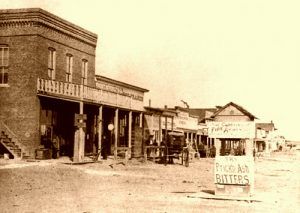
Looking east on Dodge City’s Front Street, 1878.
“Dodge is the Deadwood of Kansas; her incorporate limits are the rendezvous of all the unemployed scalawagism in seven States; her principal business is polygamy without the sanction of religion; her code of morals is the honor of thieves, and decency she knows not.”
— Hays City Sentinel, 1877
September 15, 1877 – Hays City, Kansas Sentinel
“Dodge City is dull at the present time, and the town is relapsing into morality. At this writing, there are only seventeen saloons and dance houses, sixty prostitutes, thirty gamblers, and eighty cowboys in the entire town. ”
September 22, 1877 – Dodge City Times
“A Verdant Editor Visits Our Brothels and Bagnios.
The editor of the Hays Sentinel was here about three weeks ago and, after thoroughly interviewing and inspecting all the bagnios and back places of a suspicious nature, writes them up in flourishing style. From the tone of his “article” our first impression was that the unsophisticated youth must have went too deep in the dark recesses of the lascivious things he speaks of and went away in the condition of the monkey who got his tail too near the coals. He says:

One of the many “ladies of the line.”
‘After a long days ride in the scorching sun, I arrived in Dodge. Dodge is the Deadwood of Kansas; her incorporate limits are the rendezvous of all the unemployed scalawagism in seven States; her principal business is polygamy without the sanction of religion; her code of morals is the honor of thieves and decency she knows not. In short, she is an exaggerated frontier town, and all of her consistencies are operated on the same principle. Her everyday occurrences are such as would make the face of a Haysite, accustomed as he is to similar sights, color to the very roots of his hirsuite [hirsute] honors, and draw away disgusted. Dodge is a fast town, and all of her speedy proclivities exhibit to the best advantage. The employment of many citizens is gambling, her virtue is prostitution, and her beverage is whisky. She is a merry town, and the only visible means of support of a great number of her citizens is jocularity.
Here, rowdyism has taken its most aggravated form, and was it not for the exceedingly stringent ordinances (some of which are unconstitutional) and a fair attempt to enforce them, the town would be suddenly depopulated and very much in the same manner as Ireland got rid of her snakes. Seventeen saloons furnish inspiration, and many people become inspired—not to say drunk. Every facility is afforded for the exercise of conviviality, and no restriction is placed on licentiousness. The town is full of prostitutes, and every other house is a brothel.
Dodge by day and Dodge by night are different towns. Gazing up the principal street at high noon, nothing may be seen but a few sleepy-looking barkeepers sunning themselves in front of their respective saloons, a few cowboys who spent the night in debauchery and who are trying to “sober up” enough to ride, and Marshal Deiger [Deger] with his ubiquitous police force. But with the coming of darkness, all is changed. Gamblers crawl from no one knows and man innumerable gambling devices; the city street is brilliantly lighted and thronged with gaudily dressed women and men whose garb betokens the cow-boy; from every saloon proceed rollicking strains of music (and good music it is, too) that go floating out into the darkness to repeat the tale of degradation; the dance halls are crowded with lewd women and rough men who plunge into the intricacies of the dance with a reckless abandon, and inflamed by drink, make the night hideous with their boisterous revelries, and so through the night it goes.
But I do not wish to be understood to say Dodge has no respectable citizens. She has many very highly respectable people, but I would also remark in this connection that rowdyism elsewhere would pass as a modified form of respectability in this benighted city.
There are many good citizens who earn a living in an honorable way and very agreeable we found them too, but the bad are in the majority.
A shrill scream was heard, and a moment later, a woman with a battered visage appears on the street and informs Marshal Deger that a “feller” had performed an operation upon her, known as “slugology” in police court idiom. Marshal Deger gave his pistol a slight hitch and, in ten minutes, appeared at police headquarters, puffing and blowing like a tugboat, but with the “feller” in tow. A few lazy loafers gather around Frost, with a dignity born of long practice, ridiculous in its conception and absurd in its execution, arraigns the prisoner and elicits a sullen “Not Guilty!” Attorney Colborn produces his evidence and, in a masterly speech, demonstrates the guilt of the woman beater and the total unreliability of his legal opponent. The legal opponent is riled and proceeds to annihilate Mr. Colborn after the most approved and long-established custom. From one thing to another, they pass, and human carnage is imminent, but the lacerated feelings are amicably poulticed, and the Judge finds the prisoner guilty. Then, the woman pays her “feller’s” fine and goes out with the proud consciousness of having been revenged. Such is life, and this is an everyday occurrence in Dodge.
Dodge has a live little newspaper, and I have often wondered how the editors escaped the wrath of the many “hard cases” written up in its columns. But now all is clear. The said editors are the “hardest” of them all.’
If the editor of the Sentinel, in his afterlife, ever has occasion to travel or visit any other large city like Dodge, he will there find the naughty as well as the good, and he is at liberty to choose his crowd. During his stay here, the poor boy was carried away by the giddy creatures of whom he has so much to say, and at times the lewd desire seized him, and his fondest hope and highest ambition was to “cut him out a girl,” lay down the quill, and earn his bread “gulping gilleys.” But we advise him to seek better society, be virtuous and be happy.”
October 6, 1877 – Russell, Kansas Record, commenting upon the article in the Hays Sentinel
“We are of opinion that Montgomery’s indignation was only assumed and that it was an alarm sounded to detract attention from the frailties of his own town, as when the curtains of night are drawn, Hays falls into the hands of the saloon keepers, and the Bacchanalian revel begins which throws Dodge City in the shade. So Brother Montgomery, before you proceed to hunt for a “smote” in the eye of Dodge, you had better pull the “beam” from your eye. ”
November 24, 1877 – Hays City, Kansas Sentinel
“It is not the absence of good society, culture, and refinement that is depopulating Dodge; it is the exorbitant price of beer.”
December 8, 1877 – Dodge City Times
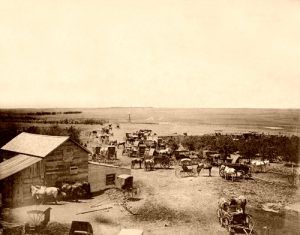
Dodge City Gathering, late 1800s.
“There is an evident purpose to malign and create false impressions that a person here is insecure in life and that the citizens of Dodge City are walking howitzers. This is a bad impression that should, by all means, be corrected. Having but a short residence in this town, it is our deliberate opinion, from careful observation, that Dodge City is as quiet and orderly as any town of its size in Kansas. We have been treated with the utmost cordiality. We have observed officers prompt and efficient in the discharge of their duties. There is an ordinance prohibiting the carrying of firearms, which is rigidly enforced. The citizens are cordial, industrious, and display a business alacrity characteristic of the frontier tradesman.
We are surprised to note the difference in character of this town and the impression aimed to be made upon us before coming here. There is a lurking jealousy somewhere that gives rise to false rumors, and we trust every citizen of Dodge City will correct these false impressions as far as lies in his power.
Time alone would efface bad impressions and false rumors, but forbearance ceases to be a virtue, and we kindly protest.”
December 29, 1877 – Dodge City Times
“Every blackguard that comes to Dodge City, after being filled with cheap whisky, generously and gratuitously given, goes home and writes and talks about the bad character of this town. We observe that these fellows like “to do the city of Dodge by gaslight.” The dance houses, in which they lug and hug the frail creatures, are the special scenes of attraction and in which they weary away the dull hours until midnight “train time.”
September 29, 1877 – Dodge City Times
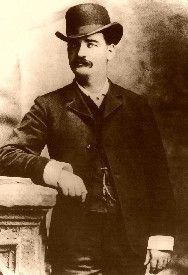
Bat Masterson, 1879
“A dispatch was received by Sheriff Bassett last Wednesday from Superintendent Morse, stating that the train robbers had started south and would probably cross the A. T. & S. F. near Lakin. Accordingly, Bassett, under-sheriff Bat Masterson, and John Webb went west on the Thursday morning train, but they heard nothing of the robbers and returned Friday morning, thinking it more likely that the robbers would cross near Dodge. A few hours before they arrived, news was brought into town that five men had crossed the railroad going south about thirty miles west of here. As soon as preparations could be made, Bassett, Bat Masterson, and Webb started southwest on horseback, intending to try to intercept the robbers if possible. Assistant Marshal Ed Masterson and Deputy Sheriff Miles Mix traveled west the same day to learn what they could about the men who crossed the road. They could learn nothing of any importance except that the men had been seen on Thursday morning, but no one had taken particular notice of them. Masterson and Mix returned the same evening. Nothing has been heard from Sheriff Bassett and his men since they started from here yesterday morning.”
1878 – Topeka Times
“We were down there again last week and were surprised by the change in the city. It has developed well, with a fine courthouse, church, good schools, large business blocks, a good hall, first-class hotels, and two live newspapers. Dodge is coming out and is destined to be a city of considerable size.”
March 30, 1878 – Dodge City Times
“City Marshal [Edward] Masterson contemplates organizing a tramp brigade for the purpose of clearing the streets and alleys of the filth and rubbish that has been accumulating for a year or so. There are about thirty tramps now sojourning among us, all of whom have no visible means of support and are liable to arrest under the vagrant act.”
April 10, 1878 – Ford County Globe
“At ten o’clock last night. City Marshal Edward Masterson discovered that a cowboy named Jack Wagner, who was working for Obum of Kansas City, was carrying a six-shooter contrary to the City Ordinance. Wagner was at the time under the influence of liquor but quietly gave up the pistol. The Marshal gave it to some of Wagner’s friends for safekeeping and stepped out into the street. No sooner had he done so than Wagner ran out after him, pulling another pistol, which the Marshal had not observed. The Marshal saw him coming and turned upon Wagner and grabbed hold of him.
Wagner shot Marshal Masterson at once through the abdomen, being so close to him that the discharge set the Marshal’s clothes on fire. Marshal Masterson then shot Wagner.
About this time, a man named Walker got mixed up in the fight. It appears he was boss herder for Obum, and Wagner was working under him. He also got shot once through the left lung, and his right arm was twice broken.
Marshal Masterson walked across the street to George M. Hoover’s saloon, where after telling that he was shot, he sank to the floor. He was immediately removed to his room, where in half an hour he expired.
Walker and Wagner were nearly all night insensible, and none thought that either of them could live through the night. However, morning has come, and neither is dead; both are in a very precarious condition, and their chances for recovery are very small.
The city is in mourning; every door is draped with crape; business is entirely suspended till after the funeral of Marshal Masterson, which will take place at two o’clock p.m. and will be attended by everybody in the city.
Marshal Masterson will be buried in the Military Cemetery at Fort Dodge.”
April 13, 1878 – Dodge City Times
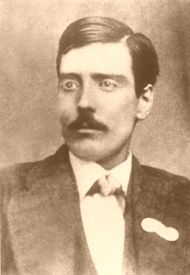
Ed Masterson
“Died. In this city, on Tuesday, April 9th, in the 26th year of his age, Edward J. Masterson, City Marshal.
The subject of this sketch was born in Henryville, Canada East, on September 22d, 1852, and removed to Wichita, Kansas, with his parents in 1869, where he continued to reside until attaining his majority when he left his home and became one of the first inhabitants of this city.
On June 5, 1877, he accepted the appointment of Assistant Marshal, and in December 1877, having displayed marked adaptability for the position, he was promoted to the Marshalship, in the discharge of the duties of which he continued until his unfortunate death.
Possessed of a geniality of temperament, a kindness of heart, and a richness of personal bravery, he had many warm friends and admirers.
As an officer, he followed the dictation of duty, striving at all times for its honest and complete discharge and gaming for himself the dignity and respect that of necessity followed from his determined intrepidity.
He died in the service he performed so well and has added one other to the list of those who, living, were so many representatives, each of his day and generation, but who dead, belong to all time, and whose voices ring down the ages in solemn protest against the reign of violence and blood.”
July 1878 – Kokomo, Indiana Dispatch
“The Wickedest City in America! Its character as a hell, out on the great plains, will be maintained in the minds of traveling newspaper writers, just so long as the city shall remain a rendezvous for the broad and immense uninhabited plains, by narrating the wildest and wickedest phases of Dodge City. … My experience in Dodge was a surprise all around. I found nothing as I pictured it in my mind. I had expected, from the descriptions I had read of it, to find it a perfect bedlam, a sort of Hogathian Gin Alley, where rum ran down the street gutters, and loud profanity and vile stenches contended for the mastery of the atmosphere. On the contrary, I was happily surprised to find the place in the daytime as quiet and orderly as a country village in Indiana, and at night, the traffic in the wares of the fickle Goddess and human souls was conducted with a system so orderly and quiet as to actually be painful to behold. It is a most difficult task, I confess, to write up Dodge City in a manner to do impartial fairness to every interest; the place has many redeeming points, a few of which I have already mentioned. It is not nearly so awful a place as reports make it. It is not true that the stranger in the place runs a risk of being shot down in cold blood, for no offense whatever.”
July 26, 1878 – Dodge City Times
“Yesterday morning, about 3 o’clock, this peaceful suburban city was thrown into unusual excitement, and the turmoil was all caused by a cantankerous cowboy who started the mischief by a too-free use of his little revolver.
In Dodge City, after dark, the report of a revolver generally means business and is an indication that somebody is on the warpath therefore when the noise of this shooting and the yells of excited voices rang out on the midnight breeze, the sleeping community awoke from their slumbers, listened a while to the click of the revolver, wondered who was shot this time, and then went to sleep again. But in the morning, many dreaded to hear the result of the war lest it should be a story of bloodshed and carnage or of death to some familiar friend. But in this instance, there was an abundance of noise and smoke, with no very terrible results.
It seems that three or four herders were paying their respects to the city and its institutions and, as is usually their custom, remained until about 3 o’clock in the morning when they prepared to return to their camps. They buckled on their revolvers, which they were not allowed to wear around town, and mounted their horses when, all at once, one of them conceived the idea that to finish the night’s revelry and give the natives due warning of his departure, he must do some shooting, and forthwith he commenced to bang away, one of the bullets whizzing into a dance hall nearby, causing no little commotion among the participants in the “dreamy waltz” and quadrille. Wyatt Earp and James Masterson made a raid on the shootist, who gave them two or three volleys, but fortunately without effect. The policemen returned the fire and followed the herders with the intention of arresting them.
The firing then became general, and some rooster who did not exactly understand the situation perched himself in the window of the dance hall and indulged in a promiscuous shoot all by himself. The herders rode across the bridge, followed by the officers. A few yards from the bridge, one of the herders fell from his horse from weakness caused by a wound in the arm that he had received during the fracas. The other herder made good his escape. The wounded man was properly cared for, and his wound, which proved to be a bad one, was dressed by Dr. T. L. McCarty. His name is George Hoy, and he is rather an intelligent-looking young man.”
January 1, 1878 – Letter in the Washington D.C. Evening Star
“Dodge City is a wicked little town. Indeed, its character is so clearly and egregiously bad that one might conclude, were the evidence in these later times positive of its possibility, that it was marked for special Providential punishment. Here, those nomads in regions remote from the restraints of moral, civil, social, and law-enforcing life, the Texas cattle drovers, from the very tendencies of their situation the embodiment of waywardness and wantonness, end the journey with their herds, and here they loiter and dissipate, sometimes for months, and share the boughten dalliances of fallen women. Truly, the more demonstrative portion of humanity at Dodge City gives now no hopeful sign of moral improvement, no bright prospect of human exaltation; but with Dodge City itself, it will not always be as now. The hamlet of today, like Wichita and Newton farther east in the state, will antagonize with a nobler trait, at some future day, its present outlandish condition. The denizen of little Dodge City declares, with a great deal of confidence, that the region around about the place is good for nothing for agricultural purposes. He says the seasons are too dry, that the country is good for nothing but for grazing, and that all they raise around Dodge is cattle and hell. The desire of his heart is the father of the statement. He is content with just what it is, and he wants that to remain. He wants the cattle droves and his associations and surroundings to be a presence and a heritage forever.”
January, 1878 – Response to Washington article by the Ford County Globe
“We think this correspondent had a sour stomach when he portrayed the wickedness of our city. But we must expect it unless we ourselves try to improve the present condition of things. There is not a more peaceful, well-regulated, and orderly community in the western country.”
August 27, 1878 – Ford County Globe
“On Wednesday last, George Hoy, the young Texan who was wounded some weeks since in the midnight scrimmage, died from the effects of his wound. George was apparently rather a good young man, having those chivalrous qualities so common to frontiersmen, well-developed. He was, at the time of his death, under a bond of $1,500 for his appearance in Texas on account of some cattle scrape, wherein he was charged with aiding and assisting some other men in “rounding up” about 1,000 head of cattle, which were claimed by other parties. He had many friends and no enemies among Texas men who knew him. George was nothing but a poor cowboy, but his brother cowboys permitted him to want for nothing during his illness and buried him in grand style when dead, which was very creditable to them We have been informed by those who pretend to know that the deceased although under bond for a misdemeanor in Texas, was in no wise a criminal and would have been released at the next sitting of the court if he had not been removed by death from its jurisdiction. “Let his faults, if he had any, be hidden in the grave.”
April 8, 1879 – Ford County Globe
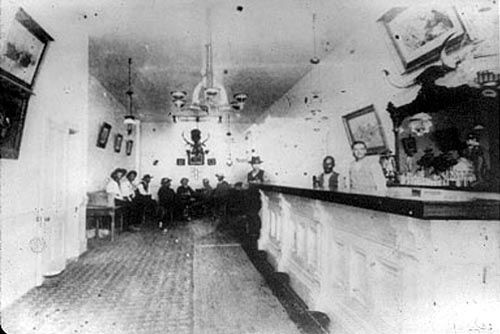
The original Long Branch Saloon, courtesy Ford County Historical Society
There is seldom witnessed in any civilized town or country such a scene as transpired at the Long Branch Saloon in this city last Saturday evening, resulting in the killing of Levi Richason, a well-known freighter of this city, by a gambler named Frank Loving. For several months, Loving has been living with a woman toward whom Richardson seems to have cherished tender feelings, and on one or two occasions previous to this which resulted so fatally, they have quarreled and even come to blows.
Richardson was a man who had lived for several years on the frontier, and though well-liked in many respects, he had cultivated habits of boldness and daringness, which are always likely to get a man into trouble. Such a disposition as he possessed might be termed bravery by many, and indeed, we believe he was the reverse of a coward. He was a hard-working, industrious man, but young and strong and reckless. Loving is a man of whom we know but very little.
He is a gambler by profession; not much of a rowdy, but more of the cool and desperate order when he has a killing on hand. He is about 23 years old. Both or either of these men, we believe, might have avoided this shooting if either had possessed a desire to do so. But both being willing to risk their lives, each with confidence in himself, they fought because they wanted to fight. As stated in the evidence below, they met, one said “I don’t believe you will fight.” The other answered, “Try me and see,” and immediately both drew murderous revolvers and at it, they went, in a room filled with people, the leaden missives flying in all directions. Neither exhibited any sign of a desire to escape the other, and there is no telling how long the fight might have lasted had not Richardson been pierced with bullets and Loving’s pistol left without a cartridge. Richardson was shot in the breast, through the side, and through the right arm. It seems strange that Loving was not hit, except for a slight scratch on the hand, as the two men were so close together that their pistols almost touched each other. Eleven shots were fired, six by Loving and five by Richardson. Richardson only lived a few moments after the shooting. Loving was placed in jail to await the verdict of the coroner’s Jury, which was “self-defense,” and he was released. Richardson has no relatives in this vicinity. He was from Wisconsin. About twenty-eight years old.
Together with all the better class of our community, we greatly regret this terrible affair. We do not believe it is a proper way to settle difficulties, and we are positive it is not according to any law, human or divine. But if men must continue to persist in settling their disputes with firearms, we would be in favor of the dueling system, which would not necessarily endanger the lives of those who might be passing up or down the street attending to their own business.
We do not know that there is cause to censure the police unless it be to urge upon them the necessity of strictly enforcing the ordinance preventing the carrying of concealed weapons. Neither of these men had a right to carry such weapons. Gamblers, as a class, are desperate men. They consider it necessary in their business that they keep up their fighting reputation and never take a bluff. On no account should they be allowed to carry deadly weapons.
April 1879 – Witness statement by Adam Jackson, bartender, regarding the Long Branch Saloon Gunfight
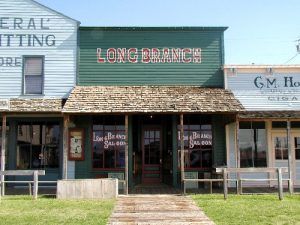
Long Branch Saloon, Dodge City, Kansas by Dave Alexander
“I was in the Long Branch Saloon about 8 or 9 o’clock Saturday evening. I know Levi Richason. He was in the saloon just before the fuss, standing by the stove. He started to go out and went as far as the door when Loving came in at the door. Richardson turned and followed back into the house. Loving sat down on the hazard table. Richardson came and sat near him on the same table. Then Loving immediately got up, making some remark to Richardson, could not understand what it was. Richardson was sitting on the table at the time, and Loving standing up. Loving says to Richardson: ‘If you have anything to say about me, why don’t you come and say it to my face like a gentleman and not to my back, you dam son of a bitch.’ Richardson then stood up and said: ‘You wouldn’t fight anything, you dam—’ could not hear the rest. Loving said, ‘you try me and see.’ Richardson pulled his pistol first, and Loving also drew a pistol.
Three or four shots were fired when Richardson fell by the billiard table. Richardson did not fire after he fell. He fell on his hands and knees. No shots were fired after Richardson fell. No persons were shooting except the two mentioned. Loving’s pistol snapped twice, and I think Richardson shot twice before Loving’s pistol was discharged.”
April, 1879 – Witness statement by Marshal Charles Bassett, regarding the Long Branch Saloon Gunfight
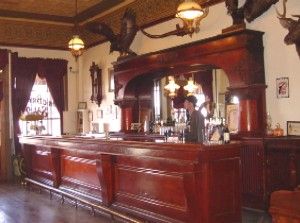
Inside the Long Branch Saloon, Kathy Alexander.
“When I first heard the firing, I was at Beatty & Kelley’s saloon. Ran up to the Long Branch as fast as I could. Saw Frank Loving, Levi Richason, and Duffey. Richardson was dodging and running around the billiard table. Loving was also running and dodging around the table. I got as far as the stove when the shooting had about ended. I caught Loving’s pistol. Think there was two shots fired after I got into the room, am positive there was one. Loving fired that shot, to the best of my knowledge. Did not see Richardson fire any shot and did not see him have a pistol. I examined the pistol which was shown me as the one Richardson had. It contained five empty shells. Richardson fell while I was there. Whether he was shot before or after I came in am unable to say. I think the shots fired after I came in were fired by Loving at Richardson. Richardson fell immediately after the shot I heard. Did not see any other person shoot at Richardson Did not see Duffey take Richardson’s pistol. Do not know whether Loving knew that Richardson’s pistol had been taken away from him There was considerable smoke in the room. Loving’s pistol was a Remington No 44 and was empty after the shooting.”
September 9, 1879 – Ford County Globe
“Dodge City has added another item to her history of blood, and rum has found another victim. Yesterday afternoon B. Martin and A. H. Webb became involved in a dispute in a saloon on Main street. Many complimentary allusions to the parentage, habits, and previous history of the parties, usually passed during such scenes in Dodge circles, were freely bandied between the two, ending by Webb knocking Martin down. Martin, who was a remarkably small man, generally inoffensive and timid, made an apology to Webb for some of his strongest epithets and then went out and sat upon a bench in front of his little tailor shop adjoining Henry Sturm’s saloon. Webb seemed to be very little placated by the submission of his little antagonist. He walked up Main Street, threatening more vengeance at every step. He went into Zimmennan’s hardware store and asked Mr. Connor to loan him a pistol, but he was refused. He then went to his house on the hill, saddled his horse, got his Winchester rifle, and returned to Main Street. He hitched his horse at Straeter’s corner, walked to where Martin was seated, raised the rifle with both hands and brought the barrel of it down on Martin’s head with terrific force. Martin fell like a log and never was conscious afterward.
Webb then jumped for his horse to make off. The murderous blow, however, had been seen by several persons, who ran to prevent the escape. Marshal Bassett seized him and took away his rifle, which was found to be loaded and cocked. He was first taken to the calaboose, but a crowd gathering quickly, among whom were some who favored lynching, the sheriff deemed it prudent to remove the prisoner to the County Jail.”
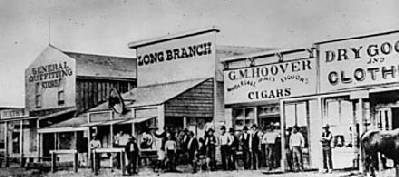
Dodge City, Kansas 1874, courtesy Ford County Historical Society
“Kansas has but one Dodge City, with a broad expanse of territory sufficiently vast for an empire; we have only room for one Dodge City; Dodge, a synonym for all that is wild, reckless, and violent; Hell on the Plains.” — A Kansas Newspaper in the 1870’s
April 26, 1883 – Dodge City Ordinance No. 70
“Section 1: Any person or persons who shall keep or maintain in this city a brothel, bawdy house, house of ill fame, or of assignation, shall upon conviction thereof be fined in a sum not less than Ten nor more than One Hundred Dollars.
Section 2: Any person, whether male or female, being an inmate or resident of any brothel, bawdy house, or house of ill-fame in this city, shall upon conviction thereof be fined in a sum not less than Five nor more than Fifty Dollars.
Section 3: Any person or persons as defined in sections one and two of this ordinance found upon the streets or in any public place within the corporate limits of the city of Dodge City for the purpose of plying or advertising her or their calling or business as defined in section one and two of this ordinance, shall upon conviction thereof be fined in a sum not less than Five nor more than Fifty Dollars.
Section 4: The general reputation of any such houses mentioned in the foregoing sections, or of its inmates and residents, shall be prima facie evidence of the character of such houses or persons.”
May 1, 1883 – Ford County Globe
“All day, armed groups of officials, both city and county, might have been seen by the least inquisitive, and the very determined look of their countenances indicated to the most confiding that they meant business, and business it was. In order to show why this determined stand was being made by the authorities, we must go back to the passage of sundry ordinances by the new city council, to which some exception was taken by those whom it seemed to press down upon most heavily the same being “an Ordinance for the Suppression of vice and Immorality within the city of Dodge” and another “to Define and Punish Vagrancy” passed April 23d 1883. It was not the ordinance itself that was objectionable to those it was calculated to reach but the partial manner of its enforcement, as they think, which caused the trouble.
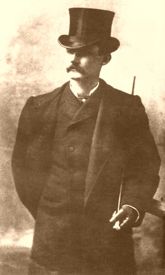
Luke Short
Saturday night, the first arrest was made under the new ordinances, the same being that of three women in the Long Branch Saloon. This was peaceably accomplished and without any resistance so far as we are enabled to learn. Yet, later in the night, Luke Short and L. C. Hartman met upon the street and paid their respective compliments to each other by exchanging shots, fortunately no one was hurt.
Hartman, it seems, was a special who helped to make the arrests. Short was one of the partners of the saloon from which these women were taken. It was claimed by the proprietors that partiality was shown in arresting women in their house when two were allowed to remain in A. B. Webster’s saloon, one at Heinz & Kramer’s, two at Nelson Gary’s, and a whole herd of them at Bond & Nixon’s dance hall, and if this is true, it would be most natural for them to think so and give expression to their feelings.
No doubt they spoke unpleasant words toward our city government that may have caused them to rise in their majesty and cause the arrest yesterday of Luke Short, Thomas Lane, saloon keepers, and half dozen others known by the professional name of gamblers.
All were hustled into the city bastile without any resistance on their part and were allowed to languish there until the arrival of their choice of trains, both east and west come along, when they were invited to take passage without any further ceremony or explanation. The women who had been jugged Saturday were all brought up before his honor Bobby Bums and he imposed a heavy fine on each one of them for their disregard of the law.
Thus the shouldering volcano has burst forth in all its fury, and has stricken terror to the hearts of the inhabitants that so closely surround it and causes one to reflect as to whether or not it will be followed up by a St. John cyclone and sweep away in its train the dispenser of ardent spirits, and thus give us another evidence of the moral and temperance element of our citizens and show that the righteous must and shall prevail in the city of Dodge.”
May 3, 1883 – Dodge City Times
“The city has been under an intense commotion for several days, growing out of the ordinance in relation to the “Suppression of gambling and prostitution.” On Saturday night, an additional police force was put on, and the work of enforcement was commenced. Three prostitutes pretendedly employed in Harris & Short’s saloon, as “singers,” but employed evidently to evade the ordinance in relation to prostitution, were arrested and put in the lockup. This action engendered bitter feelings, and City Clerk Hartman, who was on the police force, was afterward met by Luke Short, and his assassination was attempted. Short fired two shots at Hartman, the latter replying with one shot, none of the shots taking effect. Short was arrested and placed under $2,000 bonds. Mayor Deger, learning that a conspiracy had been formed, which had for its object the armed resistance to the enforcement of the law and consequent murder of some of our best citizens, organized a police force on Sunday, and on Monday, the plan was carried out. Luke Short was the first one arrested and placed in the calaboose. Subsequently, five others were arrested, as follows: W. H. Bennett, a former New Mexico desperado. Dr. Niel, a gambler, Johnson Gallagher, a gambler, and L. A. Hyatt, a gambler. These men, Hyatt, being retained a couple of days, were given the “choice of trains,” and on Tuesday, under orders of Mayor Deger, were sent out of town. Short, Lane, and Gallagher went east, Bennett went west, and Niel went south.
As a precaution, about one hundred and fifty citizens were on watch Monday night, and a large police force is still held on duty night and day. Mayor Deger, the police force, and the citizens of Dodge City are determined that the lawless element shall not thrive in this city. No halfway measures will be used in the suppression of either lawlessness or riot. Mayor Deger is a resolute, fearless, and obstinate officer. All good and law-abiding citizens are standing by him in this trying emergency.
It must be understood that no foolishness will be allowed in the conduct of city affairs. Let the people employ their pursuits peacefully. And evildoers must stand the consequences of their lawless conduct.”
May 5, 1883 – Letter to Luke Short from Otto Muller
“The situation here in town is unchanged except so far as relates to public opinion, which is gradually but steadily changing in your favor. All your friends are at work with a determination which is bound to win in the end. Of course, every movement must be made with the greatest care and caution, and as many are too timid to express themselves, it will naturally require time before the organization that style themselves “the Vigilantes” will be convinced that they must give way to public opinion. And a beautiful lot of reformers they are these vigilantes, under the leadership of their captain, Tom Nixon of Dance Hall fame. But no matter how slow, you may rest assured that this time will surely come. As the heat of passion subsides and men begin to look over the past more calmly, they can not help to see that a great wrong has been committed, and many are frank enough to admit that fact. Men of good standing in this community, against whom nothing can be said but who take little interest in the management of public affairs, feel that they are not safe in the enjoyment of their life and property in a place where such outrages may be committed without the interference of the authorities, and feel more alarmed when they begin to realize the fact that the outrages here were committed not only without interference but under the guidance of the municipal government, whose duty it should be to protect even those charged with the commission of a crime against violence.”
May 9, 1883 – Kansas City Evening Star
“Just before the last city election, the mayor was a man named Webster, the proprietor of a dive, half saloon and the other half gambling house and variety hall. He was a representative of the tougher element of the sporting fraternity. The head of the other faction was W. H. Harris, of Harris & Short, proprietors of the Long Branch Saloon. Harris represented the quieter and more reputable element, and there was bitter feeling between the two.
At the last election, Harris was beaten in the race for mayor by one Deger, Webster’s candidate, and since then, it has been conceded that it was only a matter of time when all of Harris’s sympathizers would be driven out of the town. Thus, Dodge has been hovering on the brink of trouble for a long time. About ten days ago, it came. Mr. Short, who is Harris’s partner and a police officer, had a shooting affray. Neither were hurt, and the evidence showed that Short was Bred on first. He was nevertheless placed under bonds, and next day thrown into jail. The marshal of Dodge, who made the arrest, is Jack Bridges, a well-known character who formerly lived here and traveled principally upon having “killed his man.”
A short time later, five gamblers were arrested and also jailed. That night, a vigilance committee was formed with Tom Nixon, the proprietor of one of the hardest dance halls that ever existed in the West, at the head. This crowd repaired to the jail and notified the prisoners that they must leave town next morning and that they would be given their choice of trains going east or west. Meantime the vigilantes took possession of the town.
The correspondent of the Chicago Times and other leading papers were notified that they must not be permitted to send any telegrams in reference to the situation, and a body of armed men watched the arrival of each train to see that there was no interference. A lawyer from Lamed, sent for by one of the prisoners, was met by a vigilante who leveled a shotgun at his head and told him not to stop. He passed on. Next morning the five gamblers were put on a westward-bound train, and Short left for Kansas City, where he is at present.
The trouble has by no means yet abated. The place is practically in the hands of the “vigilantes,” and the situation is more serious from the fact that the mayor is acting with them, and it was he who notified the prisoners that they must go. The trains are still watched, and armed men guard the town, while a list of others who will be ordered out has been prepared. Every source of reliable information indicates that Dodge is now in the hands of desperadoes, and that incident to the ejection of Short and the others, the lives and property of citizens are by no means safe. For this reason, martial law is being asked. That there will be trouble of a very serious character there, is anticipated.”
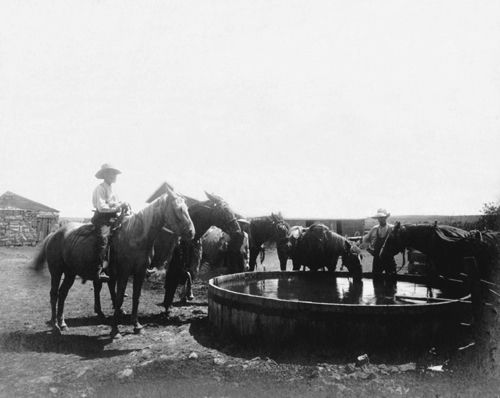
Cowboys at the water tank in Dodge City, Kansas.
May 12, 1883 – Letter from Governor George Washington Glick to George Hinkle, Ford County Sheriff
“Your telegram to me of the 11th is at hand. I am glad to be assured by you that you are able to preserve the peace of Dodge City and of your county. The accounts of the way things have been going on there are simply monstrous, and it requires that the disgrace that is being brought upon Dodge City and the State of Kansas by the conduct that is represented to have occurred there, should be wiped out. Your dispatch to me presents an extraordinary state of affairs, one that is outrageous upon its face. You tell me that the mayor has compelled several parties to leave the town for refusing to comply with the ordinances. Such a statement as that if true, simply shows that the mayor is unfit for his place, that he does not do his duty, and instead of occupying the position of peacemaker, the man whose duty it is to see that the ordinances are enforced by legal process in the courts, starts out to head a mob to drive people away from their homes and their business.
It was the mayor’s duty if he did anything, to have appointed and sworn in special policemen to protect citizens, and if he could not do it, to have called upon you, or have called upon me, for assistance to aid him in executing his duties as mayor, and in preserving the peace of his town. It is represented to me by affidavits and by statements that the best men in Dodge City have been threatened with assassination and with being driven away from their homes if they raised their voices against the conduct of this mob. Now if this is true, it is your duty to call to your assistance a respectable number of people, sufficient to enforce the law and protect every man in Dodge City, without any reference to who he is or what his business is, and if he is charged with crime, or the violation of law, to see that he has a fair trial before a proper tribunal and that the sentence of the law is executed by you or by the authorities, according to the command of the court.
It is also represented to me that this mob is in the habit of going to the trains armed, searching for people that may be coming to their homes, and for the alleged purpose of driving any persons away or threatening their lives, who may seek to return to their homes, and to their business. The further statement is also made to me that instead of its being disreputable characters that were driven away for the purpose of peace, it is simply a difficulty between saloon men and dance houses, and that the mayor of the town with his marshal has taken sides with one party against the other, to drive them out of business, and instead of the mayor enforcing the ordinances against lewd women visiting saloons, it is reported to me that he has called to his assistance those who were running dance houses with women in them, and entered saloons to drive out men who were keeping other saloons and that he has set himself up as the judge as to who may violate the ordinances and who shall not, and that he proposes to permit certain parties to violate the ordinances of the city, while others are driven from their homes for violating ordinances, and not prosecuting others according to law for the violation of the ordinances.
I hope this is all untrue and that the mayor has not been guilty of any such offenses. I cannot believe these statements of the mayor of Dodge City, as I believe him to be a clear-headed, honorable gentleman and would not become a party to such transactions or permit any such things to be done. I hope to learn from you that he has been wrongfully represented to me. His own good name and the good name of the state that is placed in his hands for protection certainly would be sufficient inducement to him to see that such charges could not be truthfully made.
It is represented to me also that at this very time, and ever since this pretense of the mayor that he was trying to enforce two ordinances against women visiting saloons, that he has prohibited it only as to one saloon, made arrests in one case, and permitted that ordinance to be violated every day and every night, to his own personal knowledge, and that of the marshal and police officers of the city, by other men who were running saloons where women are permitted to visit, and sing and dance.
Now Mr. Sheriff, I desire to remind you that your duty as a public conservator of the peace, and also having authority over and above the mayor of Dodge City, if he fails to discharge his duties, that it is your duty to see that these things are not permitted and are not tolerated and that no citizens shall be interfered with, that no citizen shall be driven away from his home, that the mayor of Dodge City shall not pick out men and say that the ordinances shall be enforced against them, and shall not be enforced against others.”
May 12, 1883 – Topeka Daily Capital
“Luke Short is a Texan who came to Dodge some two years ago and having been interested in the cattle business himself – as, indeed, he is still – he had an extensive acquaintance with other cattlemen and their employees. At Dodge, he engaged in the saloon business with a man named Harris, and his friendly relations with the numerous Texans coming to Dodge has made Harris & Short’s saloon the most popular and profitable one in the city. Mr. Webster, late mayor of Dodge City, is also a saloon keeper and, during his term of office, removed from a more remote location to one next door to Harris & Short’s “Long Branch,” on Front Street.
While Short’s popularity has increased, that gentleman modestly stated, Webster’s has declined, and finding it impracticable to secure his re-election to the mayoralty, Webster, some weeks before election, brought out Mr. Deger as a candidate, against whom Harris, Short’s partner, was nominated.
Deger had been a foreman for Lee & Reynolds, who are engaged in freighting and had their place of business outside the city limits. About March 1st, however, it is said that Deger began boarding at the hotel in town in order to gain a legal residence.
The night before the election, the construction trains of the Santa Fe railroad, manned by men residing at different places scattered along the line, were run into Dodge, and the next morning, the men were all on hand and obtained control of the election board by filling vacancies under the forms of law, and voted. Thus Deger was elected by a majority of seventy-one in a poll of between 300 and 400 votes. Deger, Messrs. Short and Petition declare, is a mere creature of Webster.
The saloons of Dodge City, these gentlemen say, are all of similar character including bars for drinking, gambling tables, and games of various kinds, arrangements for variety performances, or at least singing, and all employ women who are admittedly of loose character and are provided with facilities for plying their business. In addition to the saloons, there is a dance house carried on by a man named Nixon, who was formerly an adherent of Harris, but, shortly before the election, transferred his allegiance to the Deger-Webster party. His place is said to be of the lowest and vilest character.
May 13, 1883 – The Daily Kansas City Journal
“The troubles at Dodge City are assuming serious proportions, and the governor must interfere very soon, or a terrible tragedy will undoubtedly result. The men driven out may be men who are classed with the sporting fraternity, but as far as known, they are no worse than the men who have been chiefly instrumental in driving them out.
But setting all questions of comparative respectability aside, the whole affair resolves itself into a matter of victory for superior force and not law. Luke Short, the chief of the band of men lately exiled, has his interests in the town, and claims he has been wronged. The vigilantes who drove him and his friends away assert that they are evil characters. Law has been set aside and force is the sole resort. Governor Click has been attempting to preserve the peace, but so far has made no great progress. The sheriff acknowledges that he cannot protect the exiled men should they return, and so the matter stands at present.
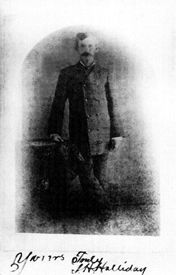
Doc Holliday, in 1879
Yesterday, a new man arrived on the scene who is destined to play a part in a great tragedy. This man is Bat Masterson, ex-sheriff of Ford County, and one of the most dangerous men the West has ever produced. A few years ago he incurred the enmity of the same men who drove Short away, and he was exiled upon pain of death if he returned. His presence in Kansas City means just one thing, and that is he is going to visit Dodge City. Masterson precedes by twenty-four hours a few other pleasant gentlemen who are on their way to the tea party at Dodge. One of them is Wyatt Earp, the famous marshal of Dodge, another is Joe Lowe, otherwise known as “Rowdy Joe,” and still another is “Shotgun” Collins; but worse than all is another ex-citizen and officer of Dodge, the famous Doc Holliday.
A brief history of the careers of these gentlemen who will meet here tomorrow will explain the gravity of the situation. At the head is Bat Masterson. He is a young man who is credited with having killed one man for every year of his life. This may be exaggerated, but he is certainly entitled to a record of a dozen or more. He is a cool, brave man, pleasant in his manners, but terrible in a fight, and particularly dangerous to the ruling clique, which he hates bitterly, Doc Holliday is another famous “killer.” Among the desperate men of the West, he is looked upon with the respect born of awe, for he has killed in single combat no less than eight desperadoes. He was the chief character in the Earp war at Tombstone, where the celebrated brothers, aided by Holliday, broke up the terrible rustlers.
Wyatt Earp is equally famous in the cheerful business of depopulating the country. He has killed, within our personal knowledge, six men, and he is popularly accredited with relegating to the dust no less than ten of his fellow men. “Shot-Gun” Collins was a Wells, Fargo & Co. messenger, and obtained his name from the peculiar weapon he used, a sawed off shot gun. He has killed two men in Montana and two in Arizona, but beyond this his exploits are not known. Luke Short, the man for whom these men have rallied, is a noted man himself. He has killed several men and is utterly devoid of fear. There are others who will make up the party, but as yet they have not yet arrived.
This gathering means something, and it means exactly that these men are going to Dodge City. They have all good reason to go back. Masterson says he wants to see his old friends. Short wants to look after his business. Earp and Holliday, who are old deputy sheriffs of Dodge, also intend visiting friends, so they say, and Collins is going along to keep the others company. “Rowdy Joe,” who has killed about ten men, and is the terror of Colorado, goes about for pleasure. Altogether, it is a very pleasant party. Their entrance into Dodge will mean that a desperate fight will take place. Governor Glick has, up to the present time, failed to preserve order, and unless he takes some determined action within the next twenty-four hours, the men swear they will go to Dodge and protect themselves. For the good of the state of Kansas, it is hoped the governor will prevent violence.”
May 13, 1883 – The Daily Kansas City Journal
“Luke Short, over whom all this Dodge City excitement and sensation has been created, don’t look like a man that would be dangerous to let live in any community. In fact he is a regular dandy, quite handsome, and Dr. Galland says, a perfect ladies man. He dresses fashionably, is particular as to his appearance, and always takes pains to look as neat as possible. At Dodge City, he associates with the very best element and leads in almost every social event that is gotten up. Dr. Galland thinks the ladies will yet be heard from in Mr. Short’s behalf. They have been very anxious to get up a petition among themselves to send the governor, and it will probably come yet.”
May 23, 1883 – Letter to the Daily Kansas State Journal by Luke Short
“They speak of Mr. Harris being a man without character and that he is living in an open state of adultery with a prostitute, which is an infamous lie, and I will venture to say that there is not a man in Kansas who knows Mr. Harris but will say that he is an honest and an honorable man, and a good citizen, and can buy and sell every man whose name appears on that official list. As to his living with a prostitute, I consider that a rather broad assertion to make and consider such things his own private affairs and nobody’s business. I can say, however that if the accusation is true, it is nothing more than what Sutton, Webster, Diger, Chipman, Hartman, and others of that outfit have done in the past and are doing at present. Webster abandoned his family for a prostitute, Nixon did the same, and there are only those who cannot get a prostitute to live with, who have not got them, and it is a conceded fact by all who have any knowledge of Dodge, that all the thieves, thugs and prostitutes who have been in the town in the past two years have been directly and indirectly connected with the city government. These assertions I am prepared to prove in any court of justice in the world.
They go further on and state that I am a desperate character and that not long since I murdered an old grey-haired man in Arizona and that I have been run out of nearly every country I have lived in. Which is as infamous as it is false, as there is not a civilized country under the face of the sun that I can not go to with perfect safety excepting Dodge City, and there is no law to prevent me from living there, nothing but a band of cut throats and midnight assassins, who have banded together for the purpose of keeping all those out of the place who are liable to oppose them at the polls or offer them opposition in their business.
As to my murdering an old grey-haired man in Arizona, I was tried in a court of justice for any offense I committed there, and the records will show that it was a fair and impartial trial and that I was honorably acquitted. The delegation who came here to see the governor and who claim to represent the moral element of the town was principally composed of tramps, who do not own a single foot of ground in the country and never have.”
June 5, 1883 Topeka Daily Commonwealth
“Masterson, Wyatt Earp, and all the sports in the country held a meeting at Silverton and decided to take Dodge City by storm. Short is at Caldwell but will meet the party at Cimarron, 18 miles west of Dodge, perhaps Sunday night or soon after. Horses will be taken at Cimarron and the whole party will rendezvous at Mr. Oliver’s, two miles west of Dodge. Doc Holliday and Wyatt Earp are now secretly in Dodge City, watching matters. When the time for action comes, a telegram will reach them worded as follows: “Your tools will be there at ____,” giving the time agreed upon. The plan is to drive all of Short’s enemies out of Dodge at the mouth of the revolvers.”
June 7, 1883 – Kansas City Evening Star
“The much talked of a band of noted killers who were to congregate here and accompany Luke Short, the exile, back to Dodge City, Kansas is, in part, at least, at that place now. Advices from there state that Luke Short, Bat Masterson, Charley Bassett and Doc Holliday at present hold the fort and that trouble is liable to ensue at any moment. Mr. Bassett was here for quite a time and with Colonel Ricketts at the Marble Hall. He is a man of undoubted nerve and has been tried and not found wanting when it comes to a personal encounter. But Masterson and Doc Holliday are too well known to need comment or biography. A notice has been posted up at Dodge ordering them out and, as they are fully armed and determined to stay, there may be hot work there tonight.”
June 9, 1883 – Bat Masterson when interviewed by the Daily Kansas State Journal
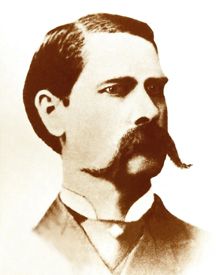
Wyatt Earp
“I arrived here yesterday and was met at the train by a delegation of friends who escorted me without molestation to the business house of Harris & Short. I think the inflammatory reports published about Dodge City and its inhabitants have been greatly exaggerated, and if at any time they did ‘don the war paint,’ it was completely washed off before I reached here. I never met a more gracious lot of people in my life. They all seemed favorably disposed, and hailed the return of Short and his friends with exultant joy. I have been unable as yet to find a single individual who participated with the crowd that forced him to leave here at first. I have conversed with a great many and they are unanimous in their expression of love for Short, both as a man and a good citizen. They say that he is gentlemanly, courteous, and unostentatious – ‘in fact a perfect ladies’ man.’ Wyatt Earp, Charley Bassett, McClain, and others too numerous to mention are among the late arrivals and are making the ‘Long Branch’ saloon their headquarters. All the gambling is closed in obedience to a proclamation issued by the mayor, but how long it will remain so I am unable to say at present. Not long, I hope. The closing of this legitimate calling has caused a general depression in business of every description, and I am under the impression that the more liberal and thinking class will prevail upon the mayor to rescind the proclamation in a day or two.”
June 12, 1883 – Ford County Globe
“Our city trouble is about over, and things, in general, will be conducted as of old. All parties that were run out have returned, and no further effort will be made to drive them away. Gambling houses, we understand, are again to be opened, but with screen doors (probably ornate oriental-type door shields designed to obscure the view from one room to another rather than fly screens) in front of their place of business. A new dance house was opened Saturday night where all the warriors met and settled their past differences, and everything was made lovely and serene. All opposing factions, both saloon men and gamblers, met and agreed to stand by each other for the good of their trade. Not an unlocked for result.
The mayor stood firm on his gambling proclamation, but as his most ardent supporters have gone over to his enemies, it will stand without that moral support he had calculated upon to help him in enforcing it. We have all along held that our mayor was over-advised in the action he has taken and had he followed his own better judgment, and not the advice of schemers and tricksters who had selfish interests at stake, and not the best interests of this community, he would have fared much better. No one knows this now any better than himself. He has freed himself from that cropped-winged moral element and stands on the side of the business interests of Dodge.”
June, 1883 – Charles D. Ulmer, Sterling Bulletin
“On Friday, the party visited Dodge City, the rip-roaring burg of the West. As we glided into the depot, we looked anxiously along the street, expecting to see many squads of festive cowboys, rigged out with arms enough to equip a regiment and ready to pop a shot at any plug hat that might be in the crowd, but nothing of the kind was to be observed; instead, there was a busy, hustling little city, like many others in Kansas, with, perhaps, a few extra saloons thrown in for variety. Dodge City was a surprise to us. It is beautifully located — the residence portion on the hills which command a magnificent view of the country, east, west, and south. The business portion is on the level bottom at the foot of the hills. The railroad track is a little close to the main business street for convenience.
“The party, on landing, instead of being received by a howling lot of cowboys, with six shooters and Winchester rifles rampant, were received by a delegation of as gentlemanly and courteous men as can be found in the state. During our stay in Dodge, we had the pleasure of meeting most of the men who have been so prominently mentioned in the late trouble at that place. Instead of low-browed ruffians and cutthroats, we found them to be cultivated gentlemen but evidently possessing plenty of nerve for any emergency. Among those we met and conversed with was Luke Short, his partner, Mr. Harris, who is vice-president of the Dodge City bank, and Mr. Webster. The late trouble originated in differences between Messrs. Short and Webster, and, we believe, after both sides get together it could and should have been settled without the hubbub made, and interference of the state authorities. Mr. Short, Mr. Harris, and others assured us that their side, at all times, was ready and willing to submit their differences to the decision of the courts. The trouble has been amicably adjusted, and no further trouble is anticipated on the old score.”
July 5, 1885 – Letter from Jeremiah Strang to John Martin, Kansas Governor
“The Texas cattle quarantine law passed last winter is quietly working out the salvation of Dodge City. The festive cowboy is already becoming conspicuous by his absence in Dodge, and ere long, he will be seen & heard there, in his glory, no more forever. The cowboy gone, the gamblers and prostitutes will find their occupations gone, and, from necessity, must follow. The bulk of the saloons will then die out because there will be no sufficient support left, and the temperance people can close the rest as easily as they could in any other city in Kansas.”
November 5, 1885 – Letter from Governor John Martin to Dodge City Mayor Robert Wright
“The fact is the condition of affairs in Dodge, instead of improving as I had hoped, seems to be growing worse. I hear, every now and then, of robberies committed on innocent strangers who have come to Kansas to seek homes. Visitors inform me that the saloons are increasing, not only in numbers but in depravity, and that thieves, desperadoes, gamblers, and criminals generally are multiplying. It is also alleged that these lawless characters dominate the city, that they have terrorized all the better elements of society, that they openly and defiantly flaunt their viciousness and depravity, and that they appear to think there is no power or authority that can reach or punish them.”
November 9, 1885 – Letter from Dodge City Mayor Robert Wright to Governor John Martin
“You must recollect that our situation is different from that of other towns in the Eastern part of the State, which have always enjoyed the benefits of churches, schools & other civilizing influences. We have always been a frontier Town, where the wild & reckless sons of the Plains have congregated, their influences are still felt here, but we are rapidly overcoming them, let us alone & we will work out our own salvation in due season. I flatter myself that I know how to handle the boys; they cannot be driven. Please do not borrow trouble, Governor, about the conduct or management of Dodge City.”
January 14, 1931 – Dodge City Daily Globe
“Ham Bell says the idea that he never drew a gun on a man when he was sheriff here in the early days is all wrong. He never shot a man, he says, and that was mainly because he was always careful to draw his gun in plenty of time before the other man drew his. ‘If I’d never drawn a gun,’ he says, ‘I wouldn’t have lived a week.'”
© Kathy Alexander/Legends of America, updated February 2024.
Note: These are not always exact quotes; some spelling errors and punctuation have been corrected.
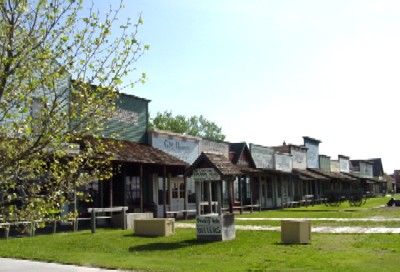
Dodge City Boot Hill Museum, by Kathy Alexander.
Also See:
Dodge City — A Wicked Little Town
Fort Dodge History and Hauntings
Wyatt Earp – Frontier Lawman of the American West
Luke Short – A Dandy Gunfighter
Bat Masterson – Loyalty in Lawlessness
Historical Accounts of American History