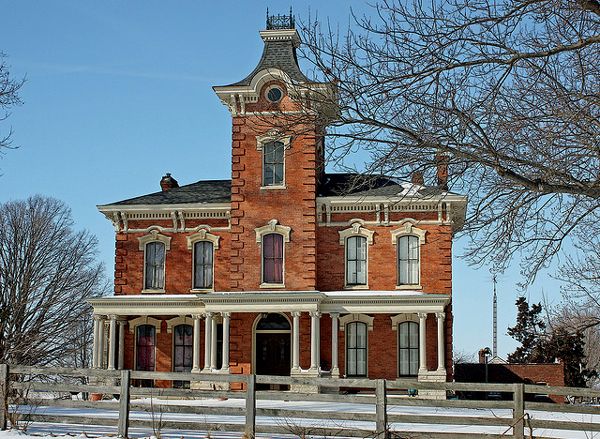
Chatham, Caldwell Mansion.
About nine miles south of Springfield is Chatham, home to about 10,000 residents and one of the fastest-growing areas in central Illinois. The town started when the first settlers arrived in 1816 to take advantage of the fertile prairie land between Lick and Panther Creeks in Sangamon County. Farming families soon had plentiful corn fields in the area, attracting more settlers, even though there was a risk of Indian attacks.
One of the earliest settlers was John Campbell from Tennessee, who settled on Lick Creek and built an old-fashioned horse mill. Other early pioneers included Henry Brown, John Darneille, brothers Levi and Samuel Harbour, and Baptist Minister Simon Lindley. In 1821, the Baptists organized the first church; the following year, the area was large enough for a school held in a small log cabin, where Ira McGlassen taught. The first water mill was a sawmill, built and operated by Johnson Hardin on Lick Creek in about 1828.
The village of Chatham was officially laid out in October 1836 by Luther N. Ransom, who built the first house of logs. However, the town would grow slowly during the first two decades. The school was first held in the newly founded village in 1837 in Luther N. Ransom’s smokehouse. Roxana S. Lyman taught it.
Many of its residents were closely intertwined with Abraham Lincoln during Chatham’s early years. In 1837, two state senators and seven representatives from Sangamon County persuaded the General Assembly to move the State Capitol from Vandalia to Springfield. These legislators, called the “Long Nine,” included Lincoln and John Dawson. Lincoln was a good friend of Reverend Josiah Porter, minister of the Chatham Presbyterian Church. Dr. John Lewis of Chatham and Abraham Lincoln surveyed and purchased rights to build the railroad from Springfield through Chatham to St. Louis, Missouri.
In 1838, a post office was established, and mail was delivered by a stagecoach running from Springfield, Illinois, to St. Louis, Missouri. A frame schoolhouse was built in 1839 and served the village for the next 19 years. Later, when the number of students outgrew the building, it was used as a grocery store.
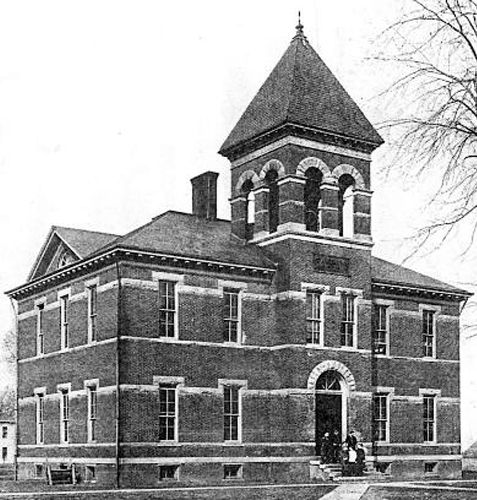
Chatham Caldwell High School.
When the Chicago, Alton & St. Louis Railroad arrived in 1852, the village began to grow. The first steam grist mill was erected four years later by S.N. Fullenwider, which would manufacture flour for the next several years. In 1858, a new two-story school was built.
One of Chatham’s most famous residents was Ben F. Caldwell, who moved near the town with his parents when he was just a boy. His formal school education ended at age 15 when his father died. Caldwell became active in real estate, banking, and livestock raising, and eventually owned 1000 acres of farmland in the area. In 1876, he built the towered Italianate-style mansion on Route 4 north of Chatham. He was also a partner and served as President of the Bank of Chatham, which opened for business in January 1880. He also served as president of the Farmers’ State Bank in Springfield and as a member of the Illinois House and Senate before becoming a U.S. Representative in 1899. The 6,000-square-foot residence and immaculate barn sit on five acres and are listed on the National Register of Historic Places. It is privately owned.
By the early 1880s, Chatham Township had three church buildings —Presbyterian, Methodist, and Baptist —and seven schools.
In 1895, Ben Caldwell also paid for a new school for the city of Chatham, named Caldwell School. The school served as a combined grade and high school until 1904, when it was destroyed by fire. A new school was built in 1905 and was also called Caldwell School. It continued to be utilized as a combination school until 1938, when it served as a grade school only until 1961. Three years later, it was also destroyed by a fire in 1964.
Over the years, Chatham moved into the 20th Century and welcomed travelers on Route 66 with typical service stations and restaurants. As it continued to grow over the years, its businesses moved north, closer to Springfield, which is now a typical suburban sprawl of strip malls and fast-food restaurants.
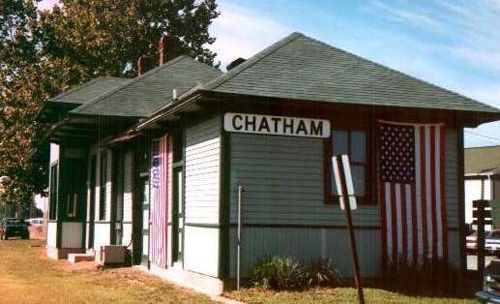
Chatham Depot Museum.
However, Chatham still offers a few glimpses into its past — one at the Chatham Railroad Museum housed in the 1902 depot building. In the early 1900s, 12 passenger trains came through Chatham daily. After 70 years of service, the station was closed with the merger of Illinois Central and the Gulf, Mobile & Ohio Railroads in 1972. In 1991, it was restored and turned into a museum located at 100 N. State Street. Chatham’s earlier Mulberry Street business district also has a few old buildings.
Today, this village offers the conveniences of a nearby larger city, Springfield, while still retaining small-town charm. The city hosts the Chatham Sweet Corn Festival and the Illinois Championship Cow Chip Throw each July.
Continue southward on IL-4 as your Route 66 journey moves on to Auburn. About four miles south of Chatham, before you reach Auburn, watch for Snell Road to the west. At 5029 Snell Road is Becky’s Barn, a Route 66 snack shop, information center, and antique store. It is located right off the historic 1931 1.4-mile hand-laid brick road.
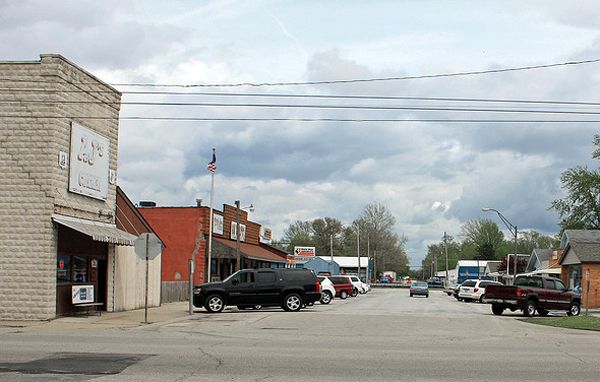
Chatham Mulberry Street.
More Information:
Chatham, Illinois
116 E Mulberry
Chatham, Illinois 62629
217-483-2451
©Kathy Alexander/Legends of America, updated November 2025.
Also See:
See Sources.