
|
 
Legends Home
Site Map
What's New!!
Content Categories:
American History
Destinations-States
Ghost Towns
Ghostly Legends
Historic People
Native Americans
Old West
Route 66
Travel Center
Treasure Tales
About Us
Advertising
Article/Photo
Use
Copyright
Information
Blog
Forum
Guestbook
Links
Newsletter
Privacy Policy
Writing Credits
We welcome corrections
and feedback!
Contact Us
Legends Of America's

Old West Mercantile
Route 66 Emporium
TeePee Trading Post
Book Shelf
History Tech
Postcard Rack
Wall Art
and
Much More!

Legends' Photo Prints

Ghost Town Prints
Native American
Prints
Old West Prints
Route 66 Prints
and
Much More!!

| |
| |
|
CALIFORNIA
LEGENDS
Lost Mines of California |
|

|
|
<< Previous 1
2 3
Next >>
|
|
Lost Mines of
California
Cement Gold Mine of Mammoth Mountain
Dutch Oven Mine of San Bernardino County
Goose Egg Mine of El Dorado County
Gunsight Mine of Death Valley
Humbug Creek Mine
Kanuka Jack's Mine in Mother Lode Country
Water Fall Mine

Book your
lodging right
HERE online
|

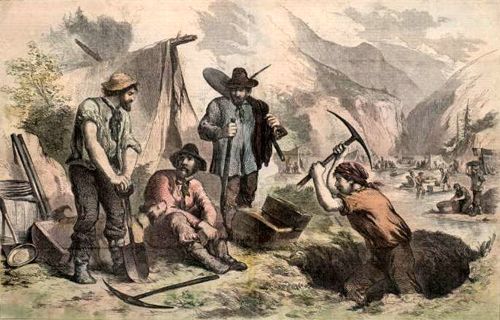
A prospector gold panning.
This image available for
photographic prints
and downloads
HERE!
|
|
Once gold was discovered and the
California
Gold Rush began, more than 500 camps, villages and towns sprang up
almost overnight as some 80,000 prospectors poured into the Mother
Lode country in 1849 alone. For more than a decade, the flood of
people continued to come, arriving
overland on the
California Trail, by ship around Cape Horn, or through the Panama
shortcut. In the beginning, the miners easily gathered the
surface gold, scratching more than $10 million from the land in 1849.
By 1853 the yield had peaked at more than $81 million before dropping
in 1855 to $55 million.
Among these tens of thousands of
prospectors and an almost equal amount of claims, tales of "lost
mines" began almost immediately as pioneers were killed, sickened, or
lost their way back to many of the rich ore finds in the mountains and
deserts of the Golden State.
Whether these tales of lost mines are
fact or fiction, their legends are still alive for hopeful prospectors
of
California.
Cement Gold Mine of
Mammoth Mountain
In 1857 two German men who had been
traveling with a
California-bound
wagon train, left the rest of the group and headed out on their own. Winding up in the Mono Lake region of northern
California,
one of the men would later describe the area as "the burnt country." While crossing the Sierra Nevada near the headwaters of the Owens
River, they sat down to rest near a stream. Here, they noticed a
curious looking rock ledge of red lava filled with what appeared to be
pure lumps of gold "cemented" together, hence, the name.
The ledge was so loaded with the ore that
one of the men didn't believe it to be real, laughing at the other as
he pounded away about ten pounds of the ore to take with him. The believer drew a map to the location and the two continued their
journey. Along the way, the disbeliever died and the gold-laden
traveler tossed the majority of the samples. After crossing the
mountains, he followed the San Joaquin River to the mining camp of
Millerton,
California. During his journey, the German had become ill
and soon went to San Francisco for treatment. He was diagnosed
and cared for by a Dr. Randall who told the man he was terminally ill
with consumption (tuberculosis). With no money to pay the doctor
and too ill to return to the treasure, he paid his caretaker with the
ore, the map he had drawn, and provided him with a detailed
description.
Dr. Randall shared this
knowledge with a few of his friends and together they arrived at old
Monoville in the spring of 1861. Engaging additional men to help,
Randall's group began to prospect on a quarter-section of land called
Pumice Flat. Thought to have been some eight miles north of Mammoth
Canyon, the 120 acres were near what became known as Whiteman's Camp.
|
|
|
|

Mammoth Mountain, courtesy U.S. Geological Survey
|
Word spread quickly and before long miners
flooded the area hunting for the gold laden red "cement." One story
tells that two of Dr. Randall's party had in fact found the "Cement Mine,"
taking several thousand dollars from the ledge. Unfortunately, for
those two men, the area was rife with the Owens Valley
Indian War
which began in 1861.
The Paiute
Indians,
who had heretofore been generally peaceful, balked at the large numbers of
prospectors who had invaded their lands. The two miners who had
allegedly found the lost ledge were killed by the
Indians
before they were able to tell of its location.
Though the "cement"
outcropping was never found, the many prospectors who flooded the eastern
Sierra region did find gold, resulting in the mining camps of Dogtown,
Mammoth City, Lundy Canyon, Bodie, and many others.
|
|
The lost lode is said to lie somewhere in the
dense woods near the Sierra Mountain headwaters of the San Joaquin River's
middle fork.
Dutch Oven Mine of San
Bernardino County
|
|
In
1894, Tom Scofield, a railroad worker, was surveying near the Clipper
Mountains northwest of Essex,
California
when he decided to do a little exploring. When he was about three
miles up the side of the mountain, he ran across an old abandoned stone
house that appeared to have been built years previously. Continuing
along, he hiked approximately nine more miles when he came upon a spring. There, he followed a trail that led over the hill where he came upon a
rock atop the peak that he described as being as big as a house. The
large boulder was split in two and the trail continued straight through
it. Beyond the passageway he stumbled into what appeared to be an
old Spanish camp.
Tom found himself
standing on a high shelf, surrounded by high walls. Through other
openings in the rock walls, he could see that the "shelf” was sitting high
above the ground at about 500 feet. The only way in or out of the
little flat was through the split rock. Scattered about the long
deserted camp, Scofield found rusty mining tools, pots, pans, fragments of
a bedroll, and an old iron Dutch oven.
|

The Clipper Mountains are northwest of Essex,
California |
|
Also on the shelf was a
mine shaft, in which he found the skeletons of seven burrows. Next
to the shaft was a mine dump that contained numerous stones still
containing rich gold quartz. By the time he had finished exploring the
campsite, he realized that it was too late to return to his base camp. Cold and hungry, he bedded down on the shelf planning to leave at
daybreak. In the morning, as he was leaving, he tripped over the
Dutch oven and out tumbled a mound of pure gold nuggets. Shocked,
Tom gathered as many nuggets as he could carry and returned to his base
camp. From there he caught a train to
Los Angeles, where he spent
the next two months in a drunken frenzy, gambling and living the high
life. After squandering all the money he had received from the sale
of the gold nuggets, Scofield found himself sober and completely broke. It would be two years before he was able to make his way back to the
Clipper Mountains to search for the "Dutch Oven Mine.” Try as he might,
it seemed to him that everything had changed and he was completely unable
to retrace his steps. Disillusioned, he finally gave up the search.
When Scofield was 84, he
was interviewed by Walter H. Miller and George Haight in 1936. Living in an abandoned store in the Mojave Desert outside Danby,
California,
Scofield was at first hesitant to tell his story. After having been
hounded for four decades by treasure hunters wanting more information
about the mine, he had long tired of the story even though he continued to
insist that it was true.
Today, the Dutch Oven Mine continues to be lost, or at
least no one has ever claimed to have found it.
The Clipper Mountains are located in
the Mojave Desert of southeastern
California.
The range is found just south of Interstate 40 and the Clipper Valley,
between the freeway and National Old Trails Highway, northwest of the
small community of Essex. The range is home to at least three springs, as
well as the Tom Reed Mine.
Continued Next Page
|
|
|
Also See:
Bandit Hordes
in California
Desert
Steamers in Death Valley
Honey Valley
Treasure
Lost Mines of
California
Lost
Treasures of Northern California
Milton
Sharp's Buried Loot
Rattlesnake
Dick's Stolen Loot
Ruggles
Brothers Loot in Middle Creek
More
California Treasures Just Waiting To Be Found
|
|
<< Previous 1
2 3
Next >>
|
|
From the Rocky Mountain General Store
Old
West Exclusive Products -
Legends of America and the
Rocky Mountain
General Store now provide a number of
exclusive products that you won't find anywhere else!
Utilizing our vintage photos,
Old West
words, and original graphics, you'll find selections for
t-shirts, bumper stickers,
Old West prints and calendars, and much more. Click
HERE to see the entire line.
|
| |
|