
By James Harvey McClintock in 1913.
Discovery of Tombstone’s Riches
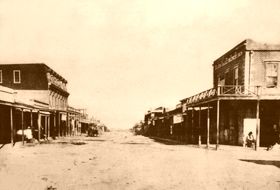
Allen Street, Tombstone, Arizona, 1882
There was nothing prosaic about the richness of Tombstone, Arizona’s mines. They were founded on romance and excitement, both of which dominated the days of their operation. The romance was in their location.
In the winter of 1877-78, Ed Schieffelin, after a short civilian service with a company of soldiers, was employed to conduct an assessment of the Brunckow Mine, about a mile north of the site of Charleston. This was the only mine known in that locality at the time. It had been discovered in 1858 by a Polish scientist, who had given the claim his own name. But the mine was valueless. Schieffelin’s idle time was spent prospecting in the hills. He was probably the only man in the camp who cared to prospect, for the hill slopes were uninviting, and it was known that they contained Apache Indians. As he started on one particular expedition, a companion queried, “Where are you going, Ed?” “Just out in the hills to look for stones,” was the reply, and the parting observation as he tramped away was: “The stone you will find will be your tombstone.”
Possibly that very day, at a point a short distance below the present town, he traced some rich silver “float” to a ledge on which he set his foot and cried, “At last, I have found my tombstone!” He recorded this claim, which he named the Tombstone, at Tucson on September 3, 1877. It was several miles from the latter camp of Tombstone and about four miles from the San Pedro
When his work on the Brunckow Mine was finished, Schieffelin went to Silver King, where he learned that his brother, Al, had gone to Signal in Mohave County. He journeyed there and showed his “float” to Dick Gird, assayer at the time in the Signal Mill. Much interested, Gird and Al Schieffelin accompanied him back to Southern Arizona, and soon, letters arrived in Signal telling them they had struck it rich, causing an exodus of much of the male population of that camp bound for the new strike. The original location, the Tombstone, did not prove of much value, but much better success attended the development of a number of claims staked out on the very site of the town shortly after it was established. These claims included the Tough Nut, Goodenough, Lucky Cuss, East Side, and West Side.
Soon after the arrival of the Schieffelin Party, the upper mineral section of the district was accidentally stumbled upon by Ed Williams and Jack Friday. In the night, their mules had broken loose from a dry camp that they had made and struck out for water along an Indian trail. In the morning, the men tracked the mules that had cleared the trail by dragging a chain attached to one of the animals.
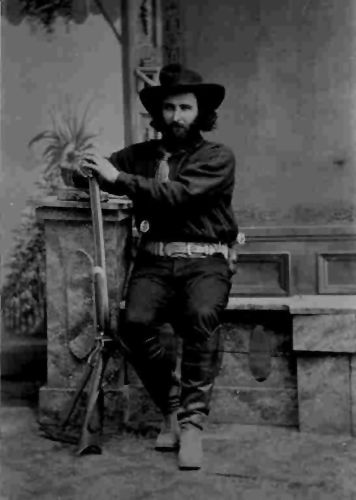
Ed Schieffelin
Following the chain trail, Williams noticed the bright gleam of metal where the iron had been dragged and discovered what would become the Contention Lode, the richest location ever made in the district. The mules were followed over into the Schieffelin camp, where the new mine received its logical name in the contention that arose over its ownership, for Schieffelin was none too well pleased that a stranger had discovered mineral almost under his very nose.
The quarrel was settled; however, by the division of the ground, the Schieffelin interests took the lower end — the Contention, and Williams and his partner the other, which was called the Grand Central. Gus Barren, a skilled miner and friend of Schieffelin, was then called up from Mexico to supervise the development.
Soon after the discovery, the Contention Mine was purchased by J.H. White and S. Denson, who represented W.D. Dean of San Francisco. The price was $10,000, considered exorbitant by the sellers themselves, who could not foresee the future production of millions of dollars.
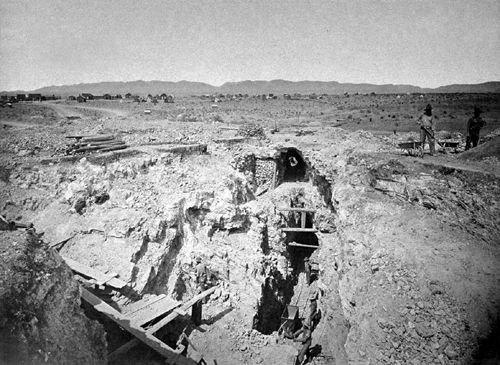
Tough Nut Mine in Tombstone, Arizona.
The principal mining companies during the camp’s palmy days were Contention Consolidated, Grand Central, Tombstone Milling and Mining Company, Vizina, Empire, and Stonewall. Water was struck in the Sulphuret shaft at 500 feet. The Grand Central and Contention put in pumps but found they were draining the district, while the other companies refused to pay their share of the cost. The Grand Central, which had surface works materially higher than any other in the district, continued to pump to some extent until May 1886, when the surface works burned.
The Grand Central pump was modeled after those that had proved successful in the Virginia City section and is said to have cost $300,000. It was of the Cornish type, with an immense wooden pump rod operated by a massive walking beam that reared about thirty feet above its foundation.
This beam and the equally enormous flywheel are still on the hillside, a monument to departed greatness. About a year after the fire, the Contention hoist and pumping works were also burned, effectively marking the closure of the entire district.
In the spring of 1880, the Tombstone District had four towns. Tombstone then had a population of about 1,000, established on or near the Tough Nut group of mines. Richmond was a settlement a mile and a quarter to the southeast. At Charleston, on the San Pedro River, were the Corbin and Tombstone Mills. The Contention Mill was at Contention City, also on the San Pedro River. In this same area was also the “Old Bronco Mine,” which had a dark history that was mixed with the murders of sixteen men. Dick Gird claimed that the old Brunckow house had been the headquarters for a band of smugglers who did a little mining as a blind.
Early in 1880, Gird was superintendent of the Tombstone Gold and Silver Milling and Mining Company, of which ex-Governor Safford was president and which owned the Tough Nut and five other claims. On March 13, 1879, the Corbin brothers, Hamilton Distin of Philadelphia and Simmons Squire of Boston, purchased the interest of the Schieffelin brothers in the Tough Nut group for $1,000,000. Gird later received the same sum for his third.
The Corbin Company, comprising about the same interests, purchased the other original mining claims located by the Schieffelins and Gird, including the Lucky Cuss. In the same period, the Grand Central was mentioned only as a prospect that had been developed to a depth of 280 feet.
Fortunes of Ed Schieffelin
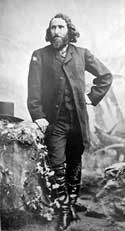
Ed Schieffelin
Ed Schieffelin was born near Pittsburgh, Pennsylvania, in 1848, when he was only a lad, and was taken by his parents to Oregon. Disliking his father’s occupation as a farmer, he ran away from home to prospect for minerals in Southern Oregon. Thereafter, he knew no life save that of the prospector in Nevada, Idaho, Colorado, and New Mexico. He worked at anything else only in order to secure funds for another trip to the mountains. Almost continually, his life was in danger from Indians of various sorts.
A description of him, written about 1876, tells that he was “about the queerest specimen of human flesh ever seen, about 6 feet 2 inches in height, with black curly hair that hung several inches below his shoulders. His long, untrimmed beard was a mass of unkempt knots and mats. His clothing was worn out and covered with patches of deerskins, corduroy, and flannel, and his old slouch hat, too, was so pieced with rabbit skin that very little of the original felt remained. Although only 27 years of age, he looked at least forty.” It was about that time that Schieffelin had temporary service with the army as a scout, but in 1877, he was again punching a burro in the hills of Southern Arizona.
It is probable that riches brought little pleasure to Schieffelin and that never again was he as happy as in his Arizona days. His brother died while still in possession of his share of the return from the mines and left his money to relatives.
Ed gave away large sums to old friends and family connections and lost much through speculation, proving him a very bad businessman indeed. Dissatisfied with civilization, he moved from the home he had established in New Jersey, left his wife in California, and again started out as a prospector, though on a rather elaborate scale. He bought a small stern-wheel steamer and, for a summer, prospected the bars of the Yukon River in Alaska.
In May 1897, his body was found in a cabin near Canonville, Oregon, death having come suddenly of heart disease. When his will was opened, it was found that his thoughts had ever lingered with Arizona, for there was a direction that he was to be buried in the garb of a prospector together with his old pick and canteen near the mines he had discovered. The wish was carried out, and burial was on a lonely granite point several miles west of Tombstone, where he had made his camp at the time of his discovery.
The monument, of cemented rock, is sixteen feet high and rests upon a foundation twenty feet square and, though out of the path of travel, can be seen from the car windows of the Fairbank-Tombstone train. Upon it is a simple inscription: “Ed Schieffelin; died May 12, 1897, aged 49 years eight months; a dutiful son; a faithful husband; a kind brother; a true friend.”
Consolidation of the Tombstone Mines
In the early days of the camp, A.L. Grow was one of those who came from Signal. In 1891, he was made local agent for a couple of the companies, and in 1894, that included the Grand Central property within the scope of his supervision. He evolved a great idea: consolidating all the district’s mines into one corporation that could handle the water and thus again make available the riches of the flooded lower workings. Grow got satisfactory bonds on all the properties. He tried to float the consolidation in New York and London but failed, though he once came very near to success.
In 1901, E.B. Gage came to the fore and took over the bonds. Gage knew the property very well indeed, for he had been superintendent and later president of the Grand Central Company.
The new controlling corporation, the Tombstone Consolidated Mines Company, was more or less a subsidiary of the Development Company of America, which had been organized mainly through the efforts of Frank M. Murphy of Prescott, controlling the stock of companies operating mines at Imperial, Congress, Poland, and other Arizona points.
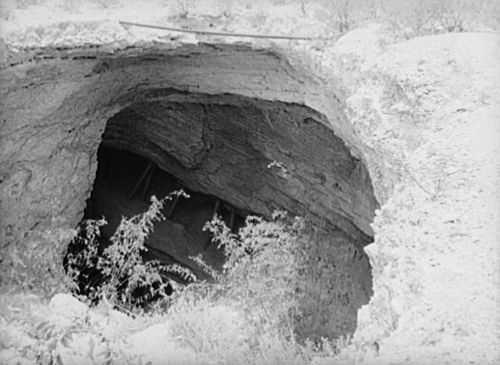
Tombstone mine shaft, 1940
Not far from the old Contention workings, a Boom shaft, with the view toward tapping the great ledge at depth, was driven down to 1,080 feet. Good silver ore was found, and it was felt that a wonderful copper body eventually would be uncovered a little further down. Other shafts were cleaned out and equipped, and an expensive 40-stamp mill was built. As depth was attained, difficulty with water increased with every foot of sinking. A dozen great boilers were found necessary to provide steam for pumps that, at one time, were raising 8,000,000 gallons of water a day, the oil-fuel expense alone amounting to $700 a day. It was said that, all in all, the company showed debts amounting to over $5,000,000 during the term of its activities, with only relatively small returns from the ore extracted, as the main workings did not reach the point where the managers believed the best ore lay. Disaster came quickly in June 1909. Failure to properly drain the oil tanks allowed water to enter the fuel pipes under the boilers, and the fires were immediately extinguished. In the shaft, the water leaped upward and drowned out the pumps within an hour. New sinking pumps were lowered, but only 15 months later, the pumping station on the 1,000-foot level was drained again. The expense proved too much for the company to bear, and on January 19, 1911, the fires were pulled, and the water was allowed to rise unchecked to its natural level again. On August 10, 1911, the company went into bankruptcy. On June 23, 1914, at the receiver’s sale, the whole property of the Tombstone Consolidated Mines Company was purchased for $500,000 by the Phelps-Dodge Company.
The Phelps-Dodge Company, warned by the experience of its predecessor, has not attempted to drain the locality but is proceeding with an exploration of the ground that may take years before pumps are started again.
During the period of bankruptcy, the trustee in bankruptcy of the property was none other than Mr. Grow, and it is notable that during this term, instead of sitting idly, he made the mines bear more than their own expense, producing $46,000 under a system of leases, with a minimum outlay. The property in the district, now controlled by the Phelps-Dodge Company, embraces about 150 claims.
An aftermath of Tombstone’s failure was a suit filed on June 4, 1914, by the Development Company of America against the Southern Pacific Railroad of Kentucky, seeking $15,000,000 in damages. The complaint, on the evidence of Frank M. Murphy of the Development Company, included a passing reference to the manner in which the Southern Pacific had checkmated Murphy and the Santa Fe in their attempt to enter the transportation field of Southern Arizona.
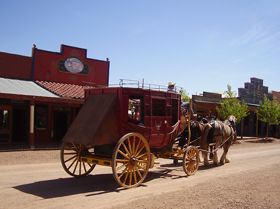
Tombstone, Arizona Stagecoach
Apparently involved in the transfer of the Santa Fe Railroad east of Phoenix to the Southern Pacific was an agreement under which 51% of the Development Company’s stock was to be taken by the Southern Pacific for $3,500,000. With it, it would have gained control of the stock of the Tombstone, Imperial, Congress, and Poland mining companies, as well as the railroad out of Red Rock and a concession to build a railroad into Mexico. It was alleged that in July 1910, in consideration of the agreement, the defendant company, through its president, R.S. Lovett, promised to loan the Development Company $500,000; that this agreement was not kept; that the plaintiff was forced to borrow, under unfavorable terms, later to lose the hypothecated stock and that the mines finally had to be closed down for lack of funds to continue their operation.
The Commonwealth Mine was discovered in 1894 by a miner, from whom the resulting camp of Pearce took its name. Two years later, the property was sold for $275,000, though the deepest shaft was only fifty feet. A 200-ton mill, then placed in the mine, was destroyed by fire in June 1900. It was succeeded by an eighty-stamp mill, which continued in operation until December 1904, when the mines were closed down. The ores were assumed to have been much leaner than had been known, though the cause given for the stoppage was a serious cave-in. It has been said that the output over four years was approximately $4,000,000, mainly in gold. The owners were Pennsylvania people, including Senator Boise Penrose. The following year, Swatling & Smith, former heads of the mining and reduction departments, paid the owners $200,000 in lease percentages and were assumed to have cleared at least as much more for themselves during that year. In 1909, Swatling & Smith, having bought the property, added to its equipment only to see the mill destroyed by fire again. In all, the mine is credited with producing at least $10,000,000 in gold. The property is still operated.
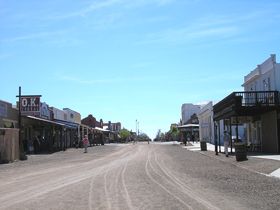
Tombstone, Arizona by Kathy Alexander.
Written by James Harvey McClintock in 1913, compiled and edited by Kathy Alexander/Legends of America, updated February 2026.
Notes and Author: This article is primarily a tale told by James Harvey McClintock between 1913 and 1916, when he published a three-volume history of Arizona titled Arizona: The Youngest State. However, the article presented here is not verbatim. While the story remains essentially the same as originally published, heavy editing has been made for spelling and grammar corrections, revisions for a modern reader, and updates to the historical tale. McClintock began his career working at the Salt River Herald (later known as the Arizona Republic). He later earned a teaching certificate, served as Theodore Roosevelt’s right-hand man in the Rough Riders, and became an Arizona State Representative. He died in California on May 10, 1934, at the age of 70.
Also See: