
By James Harvey McClintock in 1913.
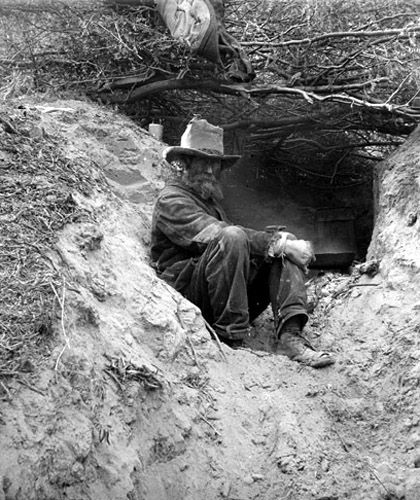
Arizona Prospector.
Almost every prospector, professional or tenderfoot, had his pet “lost mine” that he looked for. Hundreds of “lost mine” stories have been recorded across the West. The richest were always somewhere in the desert, beyond water, or within almost inaccessible mountains, where wild Indians guarded the golden secret handed down to them by their forefathers. Of course, most of these tales were merely inventions or distorted dreams. But the prospector, with only his burro for companionship, was wont to dream strange dreams and, eventually, to transmute them into what he considered reality. On the deserts lie the bones of scores of men who believed these tales and staked their lives searching for things that did not exist.
Lost Soldier Mine
One of the best-authenticated stories was “Lost Soldier Mine.” The story has had little embellishment and may, in part, be true. Briefly narrated, it is this: In the summer of 1869, Abner McKeever and his family were ambushed by Apache Indians on a ranch near the Big Bend of the Gila River. McKeever’s daughter, Belle, was taken captive, and several soldiers gave chase.
The Apache separated into several bands, whose trails were followed by small detachments of soldiers; the most westerly band was followed by Sergeant Crossthwaite and two privates, Joe Wormley and Eugene Flannigan. Two of their horses dropped from fatigue and thirst, and their provisions ran out. Taking some of the horseflesh with them, they struck northerly, seeking water in what is supposed to have been the Granite Wash range of mountains in Northern Yuma County. Water was found just in time to save their lives, for Wormley had already become delirious. In the morning, they found the spring fairly paved with gold nuggets. Above it were two quartz veins, one narrow and the other sixteen feet wide. The soldiers dug out coarse gold with their knives. They loaded 50 pounds of this golden quartz on the remaining horse and then set out for the Gila River.
Less than a day’s journey from the river, the three men separated after the horse had dropped dead. Wormley reached the river, almost demented from his sufferings, and could not guide a party back into the desert. Men struck out on his trail and soon found Flannigan, who would have lasted only a few hours longer. He told the story of the gold find, and the rescuing party went further to find Crossthwaite’s body. In a pocket was a map, very roughly made and probably wildly inaccurate, on which he had attempted to show the position of the golden spring. Better evidence was secured a few days later in the discovery of the dead horse with the gold ore strapped to its back. The ore was all that Flannigan claimed, and $1,800 was realized from its sale. Flannigan made several unsuccessful attempts to return to the find but dreaded the desert and never went far from the river. He died in Phoenix in 1880. The district the party penetrated has been thoroughly prospected during the past twenty years and contains many mines of demonstrated richness. It is possible that the mountain was the Harqua Hala. The find might have been the later-famous Bonanza, in a western extension of the mountain, from which several million dollars in free gold were extracted. Further west, around Tyson’s Wells, placer gold has also been found, though none of these discoveries exactly match the special conditions of the Lost Soldier mine.
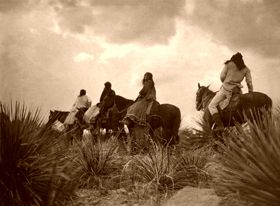
Apache Before the Storm, Edward S. Curtis, 1906.
Another “Lost Soldier Mine” was found by a scouting soldier from old Fort Grant in the hills north of the Gila River, not very far from the mouth of the San Pedro. His discovery was of quartz speckled with free gold. The country has been thoroughly prospected since that time, and important mines have been worked in that vicinity. Still, the nearest approach to discovering the old-time bonanza has been finding placer gold in several of the gulches.
Most stories of lost mines included an Indian annex. Usually, the story ran that the Indians would bring in gold and silver but refuse to tell the secret of their wealth. A man named Ross Browne, in 1863, said that at the store of Hooper & Hunter in Arizona City, he saw masses of pure gold as large as a palm, brought in by adventurers who stated that certain Indians had assured them that they knew places in the mountains where the same kind of yellow stones covered the surface of the ground. But neither threats nor presents of whiskey, knives, tobacco, blankets, or other items the Indians craved could induce them to guide the white man to the great regions of wealth. The explanation was that the Indians were afraid that the white men would come in such numbers that the Indian preponderance of the population would be lost.
The “Ni**er Ben”
The most popular lost-mine story in pioneer days was that of “Ni**er Ben.” In 1891, a miner named A.H. Peeples, who had been prospecting with the “Weaver Party,” told an editor what he knew of the legend. He said there was a black man in the party, the other miners called “Ni**er Ben,” and described him as a good man, the only one of the party who dared to prospect alone. The Indians would not harm him, evidently on account of his color. He struck up a friendship with several Yavapai chiefs, even when they were the most hostile to the other miners, and they told him of a place where there was much gold, far more than on Rich Hill, where we were working. Ben took a nugget from the prospectors’ stock about the size of a man’s thumb and showed it to a chief who was especially friendly with him. The Indian said he had seen much larger pieces of the same substance and started off to show him the treasure. Ben was taken to some water holes about 65 miles northwest of Antelope, toward McCracken, in southern Mohave County. When they arrived, however, the chief would show him no further, seemingly being struck by some religious compunctions he hadn’t thought of before. All he could be induced to do was to toss his arms and say, “Plenty gold here; go hunt.” Ben hunted for years and was outfitted several times by A.H. Peeples, who believed he finally died of thirst in the desert. Several others have tried to find the Ni**er Ben diggings, but they have not yet been discovered. Ed Schieffelin, who discovered the Tombstone mines, would later search diligently for the lost mine, but if he found it, he never told.
The “Lost Dutchman”
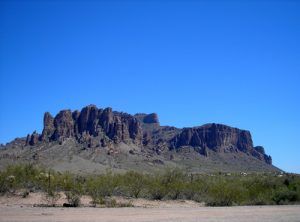
Superstition Mountains by Kathy Alexander.
One version of the “Lost Dutchman” story concerns the activities of a German who established his headquarters in Wickenburg in the early 1870s. He had a very irritating habit of disappearing from the camp occasionally, going by night, and taking with him several burros, whose feet would be so well wrapped that trailing was impossible. He would return at night, in equally as mysterious a manner, his burros loaded with gold ore of remarkable richness. Efforts at tracking him failed. The country for miles around was searched carefully to find the source of his wealth, which could not have been distant. The ore was not the same as that at the Vulture Mine.
The location of the mine never became known to anyone save its discoverer. He disappeared, as usual, one night and never returned. The assumption that Apache Indians murdered him appears to have been sustained by a prospector’s discovery near the Vulture Mine in the summer of 1895 of the barrel of an old muzzle-loading shotgun and, by it, a homemade mesquite gun stock.
The gun had been there so long that even the hammer and trigger had rusted away. Nearby was a human skeleton, bleached from prolonged exposure. The next find was some small heaps of vibrant gold rock, probably where sacks had decayed from around the ore, and then, a short distance away, a shallow prospect hole was discovered, sunk on a gold-bearing ledge. The ore in the heaps was about the same character as that which had been brought into Wickenburg in the early days by the “Lost Dutchman,” but it didn’t agree with the ore in the shallow prospect hole, which was not considered worthy of further development.
In the winter of 1879, trouble was stirred among confiding tenderfeet by the publication of a story in the Phoenix Herald, printed as a transparent fake. It told of the arrival of a prospector from the depths of the Superstition Mountains, from which he had been driven out by pigmy Indians, who had swarmed out of the cliff dwellings. His partner had been killed, and he had escaped only by a miracle. But the two prospectors had discovered some tremendous gold diggings, from which a couple of days’ work had accumulated an almost impossible quantity of dust. The story was widely copied, and from eastern points, so many inquiries came that the Herald editor had to have a little slip printed to be sent back in reply. On the slip was the word “take.” The editor feared even to remain silent, for most of the letters told of the organization in eastern villages, of parties of heavily armed men sent to get the gold dust or die in the attempt. There might have been dire consequences for the imaginative journalist had Phoenix been reached by even one of the desperate rural eastern expeditions.
Miner, Thorne, And Adams Diggings
The most extensive exploring and prospecting expedition Arizona has ever known, since the days of Francisco de Coronado, originated from the tale of a prospector named Miner. He claimed he was the only survivor of a party that had found tremendous placer diggings near a hat-shaped hill beyond the Tonto.
Basin. From a single shovelful of earth had been panned seventeen ounces of gold. In May 1871, he was in Prescott, coming with several companions from Nevada, and in that month, he reached Phoenix from the North with about thirty men. The rendezvous point was near Old Fort Grant, where 267 men joined them, divided into five companies.
At the head of the Prescott Party was Ed. Peck, discoverer of the famous Peck Mine at Alexandria. Other members were Bob Groom, the noted pioneer; Al Sieber, the foremost Indian campaign scout of the Southwest; Willard Rice and Dan O’Leary. Governor A.P.K. Safford commanded the recruits from Tucson and was elected commander-in-chief of the party at the camp near Grant.
From Tucson and Sonora, they were joined by two large companies of Mexicans. From Grant, they marched to the Gila River, up the San Carlos, and then to the Salt River. There, they spied the hat-shaped mountain known as Sombrero Butte, and the men prospected widely through the Tonto Creek and Cherry Creek Valleys and over the Sierra Ancha Mountains. Returning down Cherry Creek, prospecting continued up the Pinto Creek and Pinal Creek Valleys.
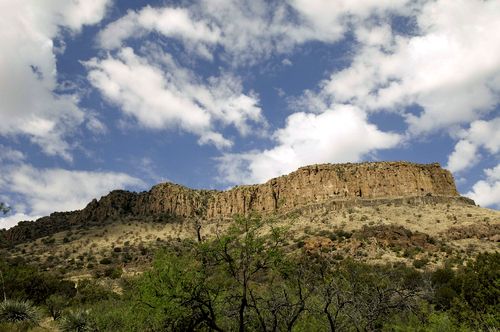
Sombrero Butte.
Finally, disgusted, the different parties separated at Wheatfields and returned to their homes. Miner, at the time, was thought to have been mistaken in his bearings, but members of the party later became convinced that he was merely a liar.
The lost Thorne Mine may have been connected to the Miner tale that led Safford and his party very far afield. This story was based on the adventures of a young surgeon named Thorne, who, having cured the eye troubles of a couple of Apache Indians at his station, was induced to visit the Indian village where an epidemic of the same disorder was raging. He was blindfolded and taken to the village, not knowing his direction. After conquering the epidemic, he was mounted and taken to a deep, rock-walled canyon with a high quartz ledge that glittered with flecks of gold. Below, in the sand of the wash, was almost a pavement of gold nuggets. Thorne pretended that the sand was of little value but furtively took all he could. In the distance, he saw a high mountain crowned with a peculiar rocky formation like a gigantic thumb turned backward (a description that might be Sombrero Butte) to the east of Cherry Creek Valley. Though the Indians pressed handfuls of the nuggets upon him, Thorne persisted that the stuff was worthless and refused to take any, convinced he could find the treasure again. He led two expeditions into the country but found no fewer than four such formations as he remembered, and the bonanza was never discovered. Thorne was afterward denounced as an impostor. It is a fact, however, that the Cibicu Indians of the Cherry Creek Valley knew of a rich placer field. On one occasion, Alchisay, a Chiricahua Apache scout, is known to have pawned a nugget worth $500 for $10 in supplies and later redeemed the gold, of which he seemed to know the full value.
In the desert somewhere west of Vurna, many expeditions have searched for the lost Peg-Leg Mine, said to have been discovered by a one-legged individual named Smith about 40 years ago. Some thought the mine was located in Arizona, but wherever it was, it has never been found and may have existed only in the imagination of a rum-soaked prospector.
Prominent among the “lost mines” stories of Northern Arizona was that of the “Adams Diggings.” Most indefinite are the details, and the locations indicated lie anywhere from the Colorado River to Globe. Adams was understood to have been a San Bernardino colony Mormon; in 1886, he heard from a Mexican a story of a rich gold deposit, and, forming a party of 22 men, struck eastward to a point supposed to be near Fort Apache, where the “Diggings” were found. The story continues that eleven of the party set out for the Pima villages to obtain supplies after working for a while. They failed to return, and nine more, driven by impending hunger, took the same trail, leaving only Adams and two others in camp. The three, finally driven out by famine, started and found on their trail the bodies of all their comrades, who the Apache Indians had murdered. The trio returned safely to San Bernardino and, in 1875, gathered 12 men to return to the lost bonanza. James C. Bell, later of Globe, with two companions, joined this party near Prescott and was made a member, while four more joined at Fort Verde. The lapse of time had made Adams very uncertain of his location. Still, he remembered that it was in a deep canyon running eastward, at a point where a gold ledge was sharply defined along the sides of the gulch and near two black buttes. The men searched as far as the Gila River, near San Carlos, then up to the Gila River’s headwaters, and back again to Fort Apache. However, they had no success, and the ashes of an old cabin where Adams told Bell that gold dust was worth at least $5,000 remain undiscovered.
Written by James Harvey McClintock in 1913, compiled and edited by Kathy Alexander/Legends of America, updated April 2026.
Notes and Author: This article is primarily a tale by James Harvey McClintock, published between 1913 and 1916 in his three-volume work, Arizona: The Youngest State. However, the article that appears here is far from verbatim. While the story remains essentially the same as originally published, heavy editing has occurred for spelling and grammar corrections, revisions for the modern reader, and updates to this historic tale. McClintock began his career working at the Salt River Herald (later known as the Arizona Republic). He later earned a teaching certificate, served as Theodore Roosevelt’s right-hand man in the Rough Riders, and became an Arizona State Representative. He died in California on May 10, 1934, at the age of 70.
Also See: