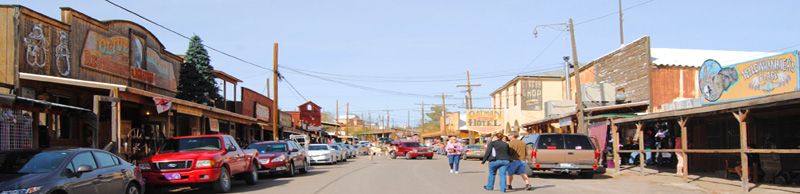
Oatman, Arizona, by Kathy Alexander.
Oatman, Arizona, is located in the Black Mountains of Mohave County. It started as a mining camp after prospectors struck gold in the area in the early 1900s. Later, it became part of Route 66.
Often described as a ghost town, it doesn’t quite fit the category, but it is close enough, considering that it once boasted over 10,000 people and now supports just a little over 100 people year-round.
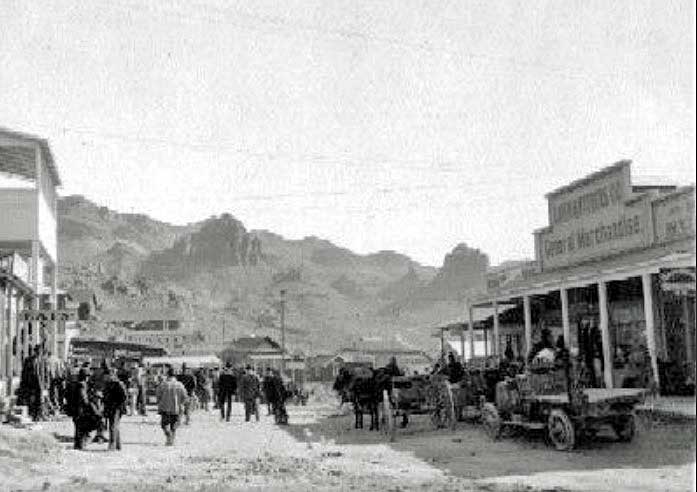
Oatman, Arizona, in 1900.
Though Oatman is only a shadow of its former self, it is well worth a visit to this lively “ghost town” that provides not only several historic buildings and photo opportunities but also the sights of burros walking the streets, costumed gunfighters, and 1890s-style ladies strolling. In its heyday, from the early 1900s to the 1940s, Oatman and the nearby town of Gold Road were Arizona’s largest gold producers.
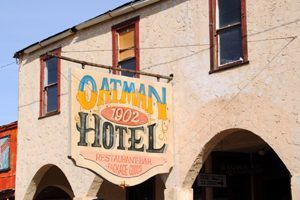
Oatman, Arizona Hotel Sign, by Kathy Alexander.
Prospector Johnny Moss first mined the area for Gold in the 1860s, staking claims to two mines, one named Moss, the other Oatman, after Olive Oatman, who was kidnapped by Apache warriors, sold to Mojave Indians, and released after five years near the current townsite in 1855.
Gold mining in the Black Mountains had ups and downs until the early 1900s. An official town began to form around 1904, complete with a Post Office when the Vivian Mining Company began operations. The tent city called Vivian quickly grew as miners flocked to the area. Between 1904 and 1907, the mine yielded over $3,000,000; a large gold find at the Tom Reed Mine in 1908 brought in $13,000,000. In 1909, the town changed its name to honor Olive Oatman.
The Drulin Hotel, built in 1902, did brisk business with the area miners. This old hotel, renamed the Oatman Hotel in the 1960s, is the only historic two-story adobe building in Mohave County. Though guests no longer stay the night here, a museum sits on the top floor, with a bar and restaurant on the bottom.
In 1915, two miners struck a $14 million gold find, giving the settlement another boom. Soon, the town had a newspaper, the Oatman Miner, and dozens of other businesses.
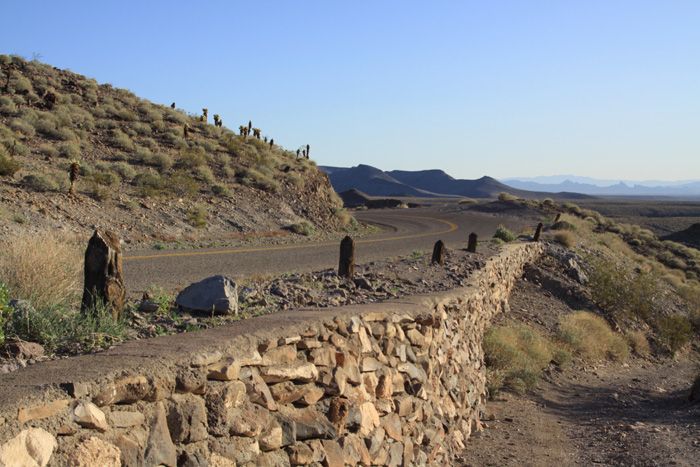
Sitgreaves Pass near Oatman, Arizona, by Jim Hinkley.
When Route 66 was first built in the 1920s, several supporters pushed to run the road parallel to the railroad through Yucca, where they lived. However, Oatman was at its peak as a mining community and had more clout. So, even though it made the drive harder on those old Model Ts, the road took the hazardous route up Sitgreaves Pass and bypassed Yucca.

Oatman, Arizona, 1934, colorized.
In 1921, a fire burned much of Oatman, but the town was rebuilt. Three years later, the leading mining company, United Eastern Mines, shut down operations for good. But with the birth of Route 66 and other smaller mining operations, Oatman hung on, catering to the many travelers along the new highway.
By 1930, an estimated $36 million in gold had come from the mines. The town boasted two banks, seven hotels, twenty saloons, and ten stores. Over 10,000 people lived in the Oatman “area.”
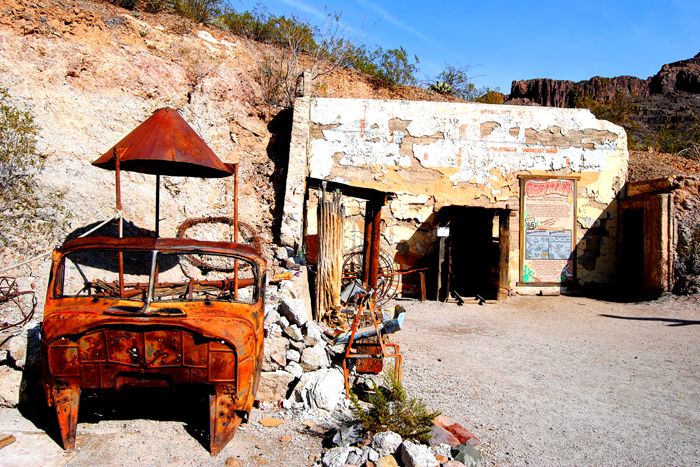
Oatman, Arizona Mine Museum by Kathy Alexander.
During World War II, the government needed other metals for the war effort, so miners were moved to other areas and the Oatman mines were closed, leaving the gold to wait for better times.
In 1953, Route 66 was changed to make traveling South of the mountain passes easier. By then, Oatman no longer held the clout it had when the Mother Road was first implemented. It didn’t take long for Oatman to become practically a ghost town.
In the 1970s, nearby Laughlin, Nevada, began to grow as a popular gambling mecca, and in the late 1980s, Route 66 again became a popular destination for tourists worldwide. Oatman started becoming very lively again.
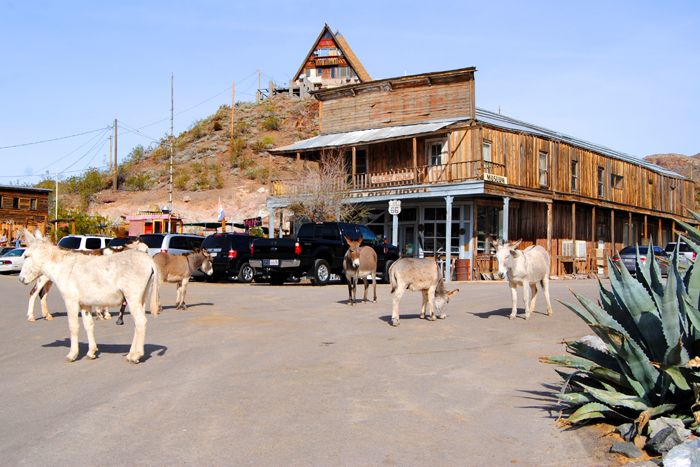
Donkeys roam the streets of Oatman, Arizona, by Kathy Alexander.
Then, in 1995, the Gold Road mine reopened, producing 40,000 ounces of gold annually. In 1998, the mine closed again because of low gold prices. It then offered gold mine tours for several years; however, more recently, with the current price of gold, the tours have ceased as the mine has reopened.
Oatman today is a tourist town. The main street is lined with shops and restaurants. Wild burros, descendants of those brought by long-ago miners, wander the streets. Gunshots ring out as the Ghostrider Gunfighters perform daily, staging blazing six-gun shootouts in the middle of Main Street.
The road to Oatman from Kingman is very narrow and has several sharp hairpin curves. No vehicles over 40 feet long are allowed on this road. The road from Golden Shores is not nearly as steep or sharp. Once in Oatman, parking is limited. RVs or those traveling with trailers can often have difficulty finding a parking spot.
When traveling westbound on Route 66, Oatman Highway continues another 20 miles to Golden Shores. The landscape along the way is dotted with mining remnants of more prosperous times.
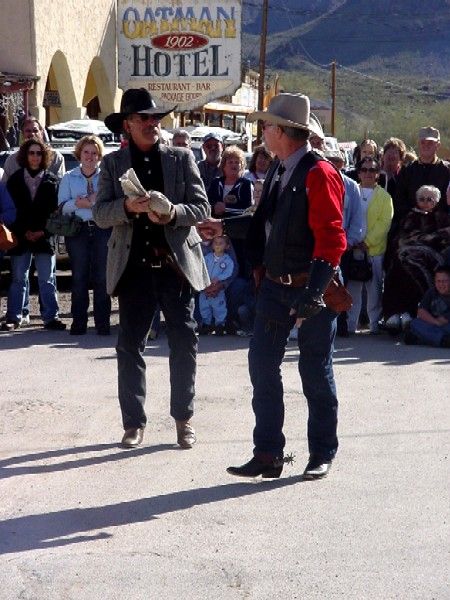
Gunfight Recreation in Oatman, Arizona, by Kathy Alexander.
©Kathy Alexander/Legends of America, updated October 2026.
Also See:
Ghost Towns & Mining Camps of Arizona
Sources:
Ghosttowns.com
National Register of Historic Places
Oatman Chamber of Commerce
Wikipedia
See our complete Oatman Photo Gallery HERE

Return to Route 66