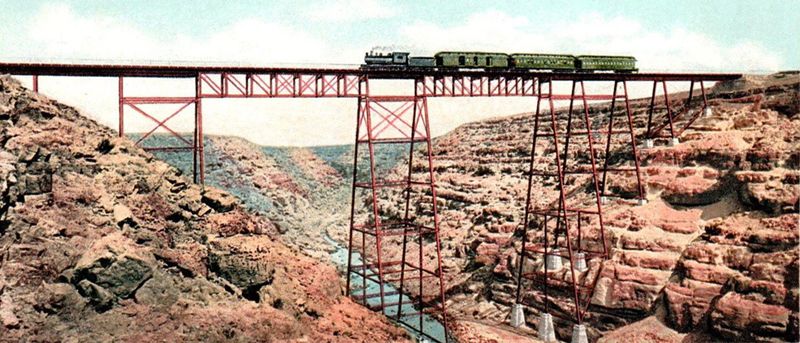
Canyon Diablo, Arizona Railroad Bridge by Detroit Publishing, 1906.
Canyon Diablo, Arizona, originated as a railroad town in 1880 when construction was halted until a bridge could be built over the canyon. Financial difficulties caused a further delay, and it wasn’t until 1890 that the railroad bridge was completed.
The canyon had earlier been named by Lieutenant Amiel Whipple in 1853, when it presented such an obstacle to his 35th parallel survey party. Having to go miles out of their way to get across, he appropriately named it Devil’s Canyon. When the town was born, it took the canyon’s name, which was highly appropriate for the reputation that the town would soon earn.
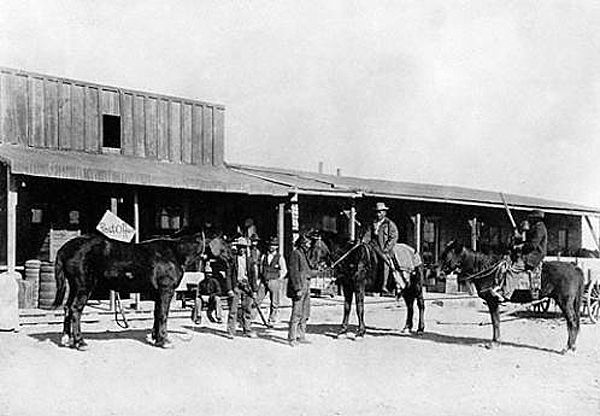
Canyon Diablo, Arizona, about 1890.
There being no law enforcement in the settlement, it quickly became a wild and lawless place as drifters, gamblers, and outlaws made their way to town. With the closest law enforcement about 100 miles away, the settlement earned a reputation of being meaner than Tombstone and Dodge City combined, with many of its “citizens” winding up in the local cemetery. The saloons, gambling dens, and brothels never closed, running 24 hours a day. The town consisted mainly of shacks, with two rows of buildings facing each other across the rocky road on the north side of the railroad right-of-way. The “street,” aptly called Hell Street, included 14 saloons, ten gambling houses, four brothels, and two dance halls. Wedged between these businesses were a couple of eating counters, a grocery, and a dry goods store.
With a population of nearly 2,000, a regular stagecoach operated between Flagstaff and Canyon Diablo, which was the target of many robberies.
When Canyon Diablo finally got a peace officer, the first one pinned on a badge at 3:00 p.m. and was laid out for burial at 8:00 p.m. Five more foolish men also tried their hands at marshaling in this God-forsaken town. None of them lasted more than a month in the position before they, too, were killed.
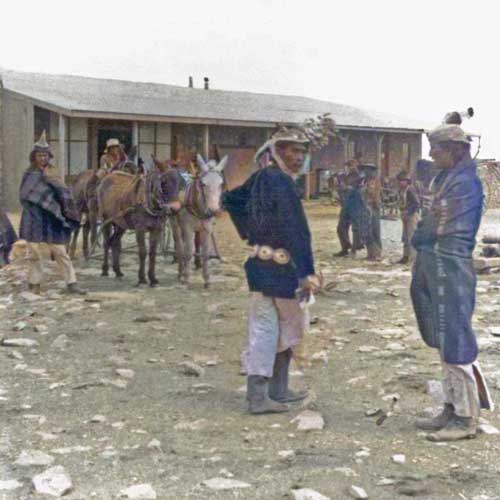
Canyon Diablo, Arizona Trading Post, 1903.
Boot Hill cemetery filled up fast, where at one time, 35 graves could be seen with wooden markers and stone-covered mounds. All are gone today, but that of Herman Wolf, a trader who passed away in 1899, and the only one to have died peacefully.
Once the railroad bridge was built over the canyon, the town began to die. Still wild, the remaining residents requested that the army take over law enforcement, but before they arrived, the town was pretty much dried up, and the lawless drifters had moved on.
Later, when Route 66 came through the area, another town called Two Guns sprouted up just south of Canyon Diablo. Catering to the travelers of the Mother Road, Two Guns was simply a few buildings, including a gas station and roadhouse. Two Guns is also a ghost town that died when I-40 came through.
Today, several foundations, along with the grave of Hermann Wolf, can still be seen at Canyon Diablo, along with the original limestone footings for the railroad trestle, which has since been replaced with a steel arch span.
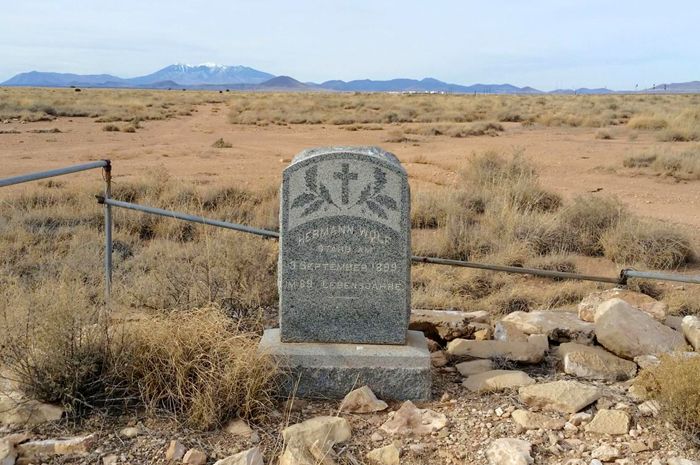
Hermann Wolf’s Grave at Canyon Diablo, Arizona. Photo by William Ascarza, courtesy Tucson.com
Canyon Diablo is north of I-40 between Meteor City and Flagstaff, Arizona. Take the Two Guns Exit (#230). The road to Canyon Diablo is three miles north of Two Guns. This is a rough road and is best traveled with a four-wheel-drive; however, if conditions are good and you take your time, it can be taken in a regular car. The road is very rocky, so caution is advised for any low-clearance vehicle.
Beyond Canyon Diablo, Route 66 continues westward along I-40 to the old Twin Arrows Trading Post.
©Kathy Alexander/Legends of America, updated November 2025.
Also See:
Arizona Route 66 Photo Gallery
Two Guns – A Route 66 Casualty
See Sources.