
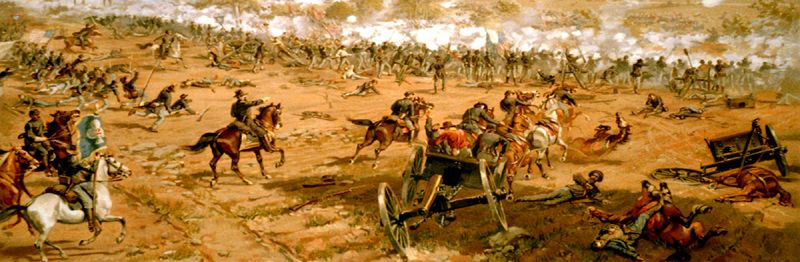
Battle of Gettysburg, Pennsylvania.
During the Civil War, the Gettysburg Campaign was a Confederate Army invasion of Pennsylvania in the summer of 1863 under General Robert E. Lee.
After General Robert E. Lee successfully defeated the Union Army of the Potomac at the Battle of Chancellorsville, Virginia, the commander continued his aggressive tactics by planning a second invasion of the North. Lee’s strategy was to upset the Union’s plans for their summer campaigns, relieve the besieged Confederate garrison at Vicksburg, Mississippi, and supply his army from the prosperous Northern farms while giving war-ravaged Virginia a much-needed rest. He also hoped to threaten the major cities of Baltimore, Philadelphia, and Washington, D.C., to encourage the growing peace movement in the North. His tactics in this campaign were virtually identical to those he had planned in his Maryland Campaign of the prior year.
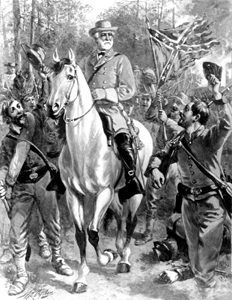
Robert E. Lee at Chancellorsville, Virginia.
On June 3, 1863, Lee’s Army of Northern Virginia moved from Fredericksburg, Virginia, toward Pennsylvania. Major General Joseph Hooker moved his army to pursue Lee, but as both sides moved northward, President Abraham Lincoln replaced the Army Commander with General George Meade.
Hoping to reach Harrisburg or Philadelphia, the Confederate forces were engaged in several battles before they reached Pennsylvania, including the battles at Brandy Station, Winchester, Aldie, Middleburg, and Upperville, Virginia.
In the meantime, the Pennsylvania Governor was scrambling to raise volunteer militia regiments to repel the threatened invasion. Known as the Emergency of 1863, thousands of refugees from Pennsylvania and Maryland fled northward and eastward to avoid the oncoming Confederates.
When Lee heard from his scouts that Major General George Meade was planning to make a stand at Pipe Creek, Maryland, he attacked before Meade reached his defensive positions. Both forces reached Gettysburg, Pennsylvania, on July 1, 1863, in what would constitute the bloodiest battle in Civil War history, with total losses equaling some 51,000 men. The Confederates were driven back, and by the night of July 4, Lee and his men were retreating south.
Both commanding generals were criticized for their conduct of the campaign — Lee for his unwarranted reliance on unseasoned commanders and his authorization of Pickett’s charge, and Meade for failing to organize his forces to counterattack and pursue the fleeing enemy. The campaign marked the high point of Confederate activity during the war; after that, the South’s fortunes declined sharply.
The Gettysburg Campaign was Robert E. Lee’s final major offensive in the Civil War. Afterward, all combat operations of the Army of Northern Virginia were reactive to Union initiatives. The total estimated casualties during the campaign were 32,043 Union and 27,000-32,000 Confederate.
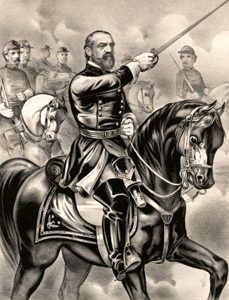
Union Major General George Meade at the Battle of Gettysburg, Pennsylvania, by Currier & Ives, 1863.
Battles:
Brandy Station (June 9, 1863, Virginia)
Winchester II (June 13-15, 1863, Virginia)
Aldie (June 17, 1863, Virginia)
Middleburg (June 17-19, 1863, Virginia)
Upperville (June 21, 1863, Virginia)
Hanover (June 30, 1863, Pennsylvania)
Gettysburg (July 1-3, 1863, Pennsylvania)
Williamsport (July 6-16, 1863, Maryland)
Boonsboro (July 8, 1863, Maryland)
Manassas Gap (July 23, 1863, Virginia)
Battle Summaries:
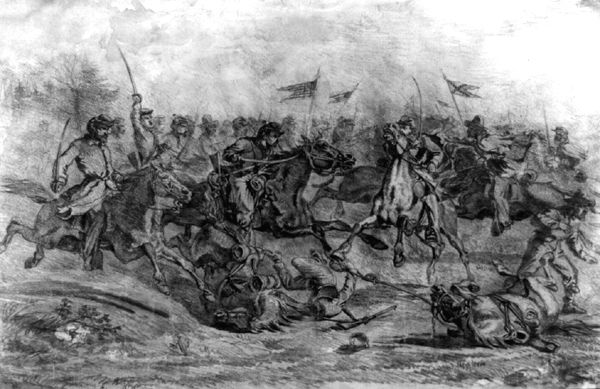
Cavalry charge near Brandy Station, Edwin Forbes.
Brandy Station (June 9, 1863, Virginia) – Sometimes called the Battle of Fleetwood Hill, it was the first battle of the Gettysburg Campaign. Occurring in Culpeper County, Virginia, the Union cavalry corps under Major General Alfred Pleasonton launched a surprise attack on Major General James Ewell Brown “J.E.B.” Stuart’s cavalry at Brandy Station at dawn on June 9, 1863. After an all-day fight in which fortunes changed repeatedly, the Federals retired without discovering Lee’s infantry camped near Culpeper. The Battle of Brandy Station was the largest cavalry battle ever fought on the North American Continent. Of the 22,000 soldiers involved, about 17,000 were of the mounted branch. The inconclusive battle resulted in estimated Union casualties of 907 and Confederate casualties of 523.
Winchester II (June 13-15, 1863, Virginia) – The Second Battle of Winchester, also referred to as the Frederick County or Winchester Battle, occurred in Frederick County, Virginia, on June 13-15, 1863. After the Battle of Brandy Station, several days earlier on June 9, General Robert E. Lee ordered the II Corps, Army of Northern Virginia, under Lieutenant General Richard S. Ewell, to clear the lower Shenandoah Valley of Union opposition. General Ewell’s columns converged on Winchester’s garrison commanded by Brigadier General Robert Milroy. After fighting on the afternoon of June 13 and the capture of West Fort by the Louisiana Brigade on June 14, Milroy abandoned his entrenchments after dark to reach Charles Town. General Edward “Allegheny” Johnson’s division conducted a night flanking march and, before daylight of the 15th, cut off Milroy’s retreat just north of Winchester at Stephenson’s Depot. More than 2,400 Federals surrendered. This Confederate victory cleared the Valley of Union troops and opened the door for Lee’s second invasion of the North. Of the 19,500 troops involved, the total loss was 4,709, of which 4,443 were Union and just 266 Confederate.
Aldie (June 17, 1863, Virginia) – Taking place in Loudoun County, Virginia, Major General James Ewell Brown “J.E.B.” Stuart’s cavalry screened the Confederate infantry as it marched north behind the sheltering Blue Ridge. The Federals of Brigadier General Judson Kilpatrick’s brigade, in advance of Brigadier General David M. Gregg’s division, encountered Confederate Colonel Thomas Munford’s troopers near the village of Aldie, resulting in four hours of stubborn fighting. Both sides mounted assaults by regiments and squadrons. Kilpatrick was reinforced in the afternoon, and Munford withdrew toward Middleburg. Some 250 men lost their lives in the skirmish.
Middleburg (June 17-19, 1863, Virginia) – On the same date as the Battle of Aldie, another took place in Loudoun County in Middleburg. Major General James Ewell Brown “J.E.B.” Stuart, screening Robert E. Lee’s invasion route, sparred with Major General Alfred Pleasonton’s Union cavalry. On June 17, Colonel Alfred Duffie’s isolated 1st Rhode Island Cavalry Regiment was attacked by the brigades of Confederate Colonels Thomas Munford and Beverly Robertson. The 1st Rhode Island Cavalry was routed, taking about 250 casualties. On June 19, Colonel J. Irvin Gregg’s brigade advanced, driving Stuart’s cavalry one mile beyond the town. Both sides were reinforced, and both mounted and dismounted skirmishing continued. Stuart was gradually levered out of his position but fell back to a second ridge, still covering the Blue Ridge gap approaches. Some 390 soldiers lost their lives during the battle.
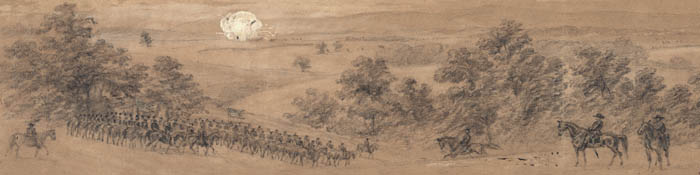
Battle of Middleburg, Virginia, by Alfred Waud.
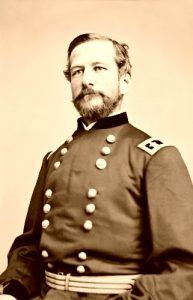
General Alfred Pleasonton.
Upperville (June 21, 1863, Virginia) – Two days later, yet another battle would be fought in Loudoun County, Virginia, on June 21, 1863. In the Upperville Battle, the Union cavalry made a determined effort to pierce Major General J.E.B. Stuart’s cavalry screen. Stuart had been fighting a series of delaying actions in the Loudoun Valley, hoping to keep Union General Alfred Pleasonton’s cavalry from discovering the location of the main body of Robert E. Lee’s Army of Northern Virginia, much of which was in the Shenandoah Valley just west of the small village of Upperville. Reinforcing Stuart were Brigadier General Wade Hampton’s and Colonel Beverly Robertson’s brigades, who made a stand at Goose Creek, west of Middleburg, and beat back Colonel J. Irvin Gregg’s division.
Union Cavalry Officer John Buford’s column detoured to attack the Confederate left flank near Upperville but encountered Confederate Brigadier Generals William E. “Grumble” Jones’s and John R. Chambliss’s brigades while J. Irvin Gregg’s and Judson Kilpatrick’s brigades advanced on Upperville along the Little River Turnpike from the east. After furious mounted fighting, Stuart withdrew to take a solid defensive position in Ashby Gap, even as Confederate infantry crossed the Potomac into Maryland. As cavalry skirmishing diminished, Stuart made the fateful decision to strike east and make a circuit of the Union army as it marched toward Gettysburg. In the battle, 400 soldiers lost their lives.
Hanover (June 30, 1863, Pennsylvania) – Having finally crossed over into York County, Pennsylvania, Major General J.E.B. Stuart’s cavalry, riding north to get around the Union army, attacked a Union cavalry regiment, driving it through the streets of Hanover. Brigadier General Farnsworth’s brigade arrived and counterattacked, routing the Confederate vanguard and nearly capturing Stuart himself. Stuart continued to battle, but a stalemate ensued when Farnsworth was reinforced by Brigadier General George A. Custer’s brigade. Stuart was forced to continue north and east to avoid the Union cavalry, further delaying his attempt to rejoin Lee’s army, which was concentrating at Cashtown Gap west of Gettysburg. The battle cost the lives of some 330 men.
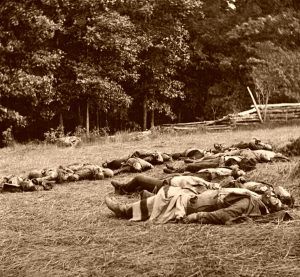
Confederate dead at Gettysburg.
Gettysburg (July 1-3, 1863, Pennsylvania) – While Lee’s troops moved into Pennsylvania, Major General George G. Meade led his Union Army forces north from Washington. Fortunately for General Meade, Lee’s Cavalry Commander, Major General James Ewell Brown “J.E.B.” Stuart, instead of reporting Union movements to Lee, had gone off on a raid deep in the Union rear. Therefore, Lee was “blind” to the Union’s position, and it wasn’t until a scout reported their imminent approach that he was aware of the proximity of the Union forces. Ordering his men to converge west of the small village of Gettysburg, Pennsylvania, the two armies came into first contact on July 1, 1863.
General Robert E. Lee concentrated his full strength against the Union Troops converging on Gettysburg from the west and north, driving Union defenders back through the streets to Cemetery Hill. During the night, reinforcements arrived for both sides, and by the morning of July 2, almost 160,000 men had been assembled.
Lee attempted to envelop the Federals, first striking the Union left flank at the Peach Orchard, Wheatfield, Devil’s Den, and the Little Round Top with Longstreet’s and Hill’s divisions and then attacking the Union right at Culp’s and East Cemetery Hills with Ewell’s divisions. Though the Union defenders suffered significant losses, they held their lines.
During the morning of July 3, the fighting resumed on Culp’s Hill, and the Confederates were driven back. After a preliminary artillery bombardment in the afternoon, Lee attacked the Union center on Cemetery Ridge with some 12,500 soldiers. The Pickett-Pettigrew assault (more popularly, Pickett’s Charge) momentarily pierced the Union line but was driven back with severe casualties. Stuart’s cavalry attempted to gain the Union rear but was repulsed. On July 4, Lee began withdrawing his army toward Williamsport on the Potomac River. His train of wounded stretched more than fourteen miles.
The battle was the bloodiest in the Civil War and is often cited as the war’s turning point. Between 51,000 soldiers lost their lives in the three-day battle, of which 23,000 were Union and 28,000 Confederate.
That November, President Lincoln used the dedication ceremony for the Gettysburg National Cemetery to honor the Union dead and redefine the purpose of the war in his historic Gettysburg Address.
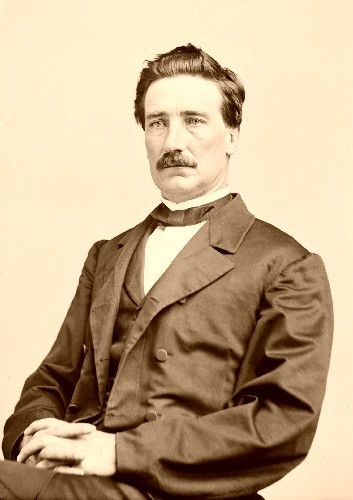
General John D. Imboden
Williamsport (July 6-16, 1863, Maryland) – Also referred to as the Battle of Hagerstown or Falling Waters, this skirmish occurred in Washington County, Maryland. During the night of July 4-5, Lee’s battered army began its retreat from Gettysburg, moving southwest on the Fairfield Road toward Hagerstown and Williamsport, screened by Stuart’s cavalry. The Union infantry followed the next day cautiously, converging on Middletown, Maryland. On July 7, Confederate Brigadier General John D. Imboden stopped John Buford’s Union cavalry from occupying Williamsport and destroying Confederate trains. Brigadier General Judson Kilpatrick’s cavalry division drove two Confederate cavalry brigades through Hagerstown before being forced to retire by the arrival of the rest of Stuart’s command. Lee’s infantry reached the rain-swollen Potomac River but could not cross, as a cavalry raid had destroyed the pontoon bridge.
On July 11, Lee entrenched a line, protecting the river crossings at Williamsport, and waited for Meade’s army to advance. On July 12, Meade reached the vicinity and probed the Confederate line. The next day, skirmishing was heavy along the lines as Meade positioned his forces for an attack. In the meantime, the river fell enough to construct a new bridge, and Lee’s army began crossing the river after dark on the 13th.
On the morning of the 14th, Kilpatrick’s and Buford’s cavalry divisions attacked Henry Heth’s rearguard division on the north bank, taking over 500 prisoners. Confederate Brigadier General James Pettigrew was mortally wounded in the fight. On July 16, David Gregg’s cavalry approached Shepherdstown, where Fitzhugh Lee’s and J.R. Chambliss’s brigades, supported by M.J. Ferguson’s, held the Potomac River fords against the Union infantry. Fitzhugh Lee and Chambliss attacked Gregg, who held out against several attacks and sorties, fighting sporadically until nightfall when he withdrew. In the end, 1,730 soldiers lay dead.
Boonsboro (July 8, 1863, Maryland) – Amid the Williamsport Battle, another took place in Washington County, Maryland, at Boonsboro. On July 8, the Confederate cavalry, holding the South Mountain passes, fought a rearguard action against the Union 1st and 3rd Cavalry Divisions and infantry elements. This action was one of a series of cavalry combats fought around Boonsboro, Hagerstown, and Williamsport. The battle took the lives of 100 soldiers.
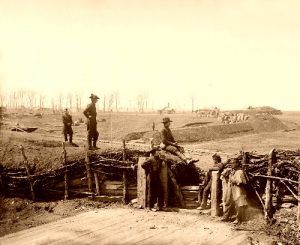
Federal soldiers at a Confederate fortification at Manassas, Virginia.
Manassas Gap (July 23, 1863, Virginia) – As the Confederate forces returned south, the Manassas Gap Battle took place in Warren County, Virginia. Sometimes referred to as the Battle of Wapping Heights, the skirmish occurred after Lee’s army had recrossed the Potomac River into the Shenandoah Valley. Major General George G. Meade crossed the Potomac River east of the Blue Ridge and followed Lee into Virginia. On July 23, Meade ordered the III Corps under Major General William. H. French to cut off the retreating Confederate columns at Front Royal by forcing a passage through Manassas Gap. At first light, the French began slowly pushing Major General Richard Anderson’s division of Walker’s Confederate brigade back into the gap. At about 4:30 pm, a strong Union attack drove Walker’s men until Rodes’s division and artillery reinforced them. By dusk, the poorly coordinated Union attacks were abandoned. During the night, Confederate forces withdrew into the Luray Valley. On July 24, the Union army occupied Front Royal, but Lee’s army was safely beyond pursuit. The battle had claimed 440 lives.
Compiled and edited by Kathy Alexander/Legends of America, updated March 2026.
Also See:
Sources:
Battlefields.org
National Park Service Battle Descriptions (no longer available online)
National Park Service Civil War
Wikipedia