
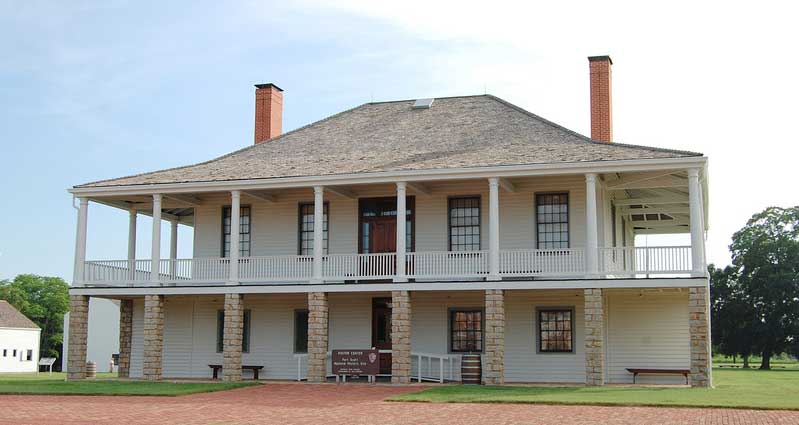
The former Fort Scott Hospital is now a Visitor’s Center, according to Kathy Alexander.
Fort Scott, Kansas, initially called Camp Scott and named in honor of General Winfield Scott, was established on May 30, 1842, at the Marmaton River crossing of the Fort Leavenworth-Fort Gibson Military Road. It was among nine forts originally planned to line the area between the Great Lakes and New Orleans to separate proposed Indian lands and white settlements.
When the fort was established in 1842, the nation was still young and mainly confined to the area east of the Mississippi River. Yet within a few years, Fort Scott’s soldiers became involved in events that would lead to significant growth and expansion. As the nation developed, tensions over slavery led to the conflict and turmoil of “Bleeding Kansas” and the Civil War.
As the young United States expanded, settlers hungry for land forced American Indians west of the Mississippi River. Upon their arrival in this area, tribes were guaranteed land on which white settlement would be prohibited. Established in 1842, Fort Scott was one of a series of forts from Minnesota to Louisiana that helped enforce the promise of a “permanent Indian frontier.” Soldiers kept the peace between white settlers and native peoples like the Osage and relocated Eastern tribes.
Positioned on a bluff overlooking the confluence of Mill Creek and the Marmaton River, Fort Scott filled a gap between Fort Leavenworth, Kansas, to the north and Fort Gibson, Oklahoma, 150 miles south. The fort housed infantry soldiers and dragoons, an elite unit trained to fight on horseback and on foot. The infantry performed many fatigue duties, including fort construction, while the dragoons went on numerous expeditions.
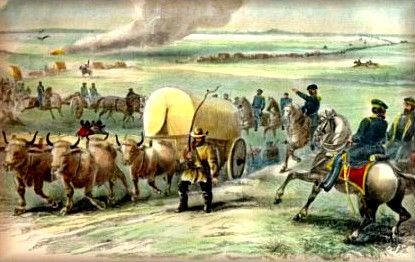
Army Train on the Santa Fe Trail.
In the 1840s, settlers flocked westward to Oregon and California. Dragoons were called upon to maintain order when conflict arose along the Santa Fe and Oregon Trails. Two expeditions rode escort on the Santa Fe Trail in 1843. The following year, dragoons from Scott and Leavenworth marched into Pawnee country to persuade that tribe to cease hostilities against the Sioux. In 1845, they patrolled the Oregon Trail as far west as South Pass, Wyoming, parleying with Indian tribes.
Both infantry and dragoons left Fort Scott to fight in the Mexican-American War (1846-48), which brought vast new lands into U.S. possession. Some Fort Scott dragoons marched with Stephen Kearney into New Mexico and California, while others served with Zachary Taylor at Buena Vista. Infantry soldiers from Fort Scott also fought with Taylor and participated in Winfield Scott’s overland march to Mexico City.
Westward expansion in the 1840s brought about a growth spurt that nearly doubled the country’s size and fulfilled “Manifest Destiny” – the idea that it was America’s divine right to stretch from coast to coast. As the frontier extended westward, the idea of a “permanent” Indian territory quickly died, and the army abandoned Fort Scott in 1853. However, violent events in the region would soon bring soldiers back as the nation experienced growing pains over the issue of slavery.
Slavery divided the nation during its turbulent adolescent years. Conflict arose over whether to allow slavery in the new western territories. Under the Kansas-Nebraska Act (1854), Congress created the Kansas and Nebraska Territories, opening these lands for settlement. It declared that the residents of these territories could decide, by popular vote, whether their state would be free or enslaved. In Kansas, people on both sides of this controversial issue flooded in, trying to influence the vote in their favor.
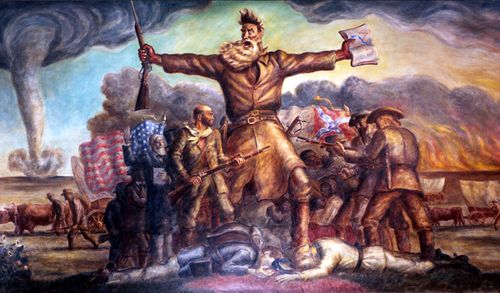
John Brown Painting.
Three distinct political groups occupied Kansas: pro-slavers, free-staters, and abolitionists. Proslavery advocates, as the name implies, supported slavery regardless of whether they owned slaves. Abolitionists wanted to rid the nation of “the peculiar institution.” Free staters didn’t particularly care about slavery, where it already existed, but were opposed to its extension westward. The conflict between these opposing factions soon escalated into violence. As a result, this era became forever known as “Bleeding Kansas,” when violence, destruction, and psychological warfare prevailed in the region.
Fort Scott and the surrounding area were not immune to the turmoil. Sold at auction in 1855, the fort’s buildings became the site of the new town. The townspeople were primarily proslavery, while free-staters and abolitionists dominated the surrounding countryside. This division between opposing factions was illustrated at the “old fort” by the presence of two hotels. One, a former officers’ quarters, became the Fort Scott Hotel, nicknamed the “Free State” Hotel because of the political leanings of many of its guests. Directly across the square, an infantry barracks was now the Western Hotel, a headquarters for proslavery men.
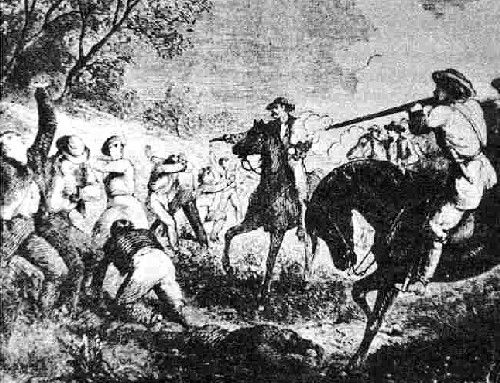
Bleeding Kansas Fight.
By 1858, radical elements from both factions converged on the area. James Montgomery, an ardent abolitionist, became a leader of free-state forces that invaded Fort Scott, a haven for Border Ruffians (extreme proslavery men). During one raid, Montgomery tried to burn the Western Hotel; another raid took the life of John Little, a former deputy marshal.
During this era, soldiers returned periodically to Fort Scott to restore law and order, staying each time until violence subsided, only to have the conflict resume upon their departure. By the time the strife waned in 1859, nearly 60 people had died, and hundreds were terrorized throughout the Kansas Territory in the struggle over slavery. Anti-slavery forces finally prevailed. Kansas entered the Union as a free state on January 29, 1861, but by then the fighting and violence that had once been confined to Kansas threatened to engulf the entire country.
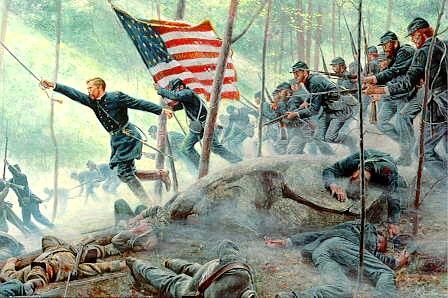
Civil War.
The struggles of an adolescent America culminated in a full-fledged rebellion during the Civil War, as the nation was divided over the issues of slavery and self-determination. The war brought the U.S. Army back to Fort Scott. Union commanders viewed the town as a strategic location in southeastern Kansas for establishing a base of military operations from which the army could protect Kansas against a possible Confederate invasion. Troops reoccupied many of the old fort buildings, including the stables and hospital, and began constructing new buildings and more than 40 miles of fortifications.
Fort Scott served as a central supply depot for Union armies in the West, a general hospital for soldiers in the region, and a haven for people fleeing the war: displaced Indians, escaped slaves, and white farmers. Many of these refugees joined the Union Army, significantly diversifying its ranks. American Indian and African American regiments were recruited in the area, including the 1st Kansas Colored Infantry. Sworn in on the grounds of Fort Scott, this was the 1st African American regiment to engage the Confederates in combat.
Fort Scott’s military stores made it a target of Confederate General Sterling Price, who made two unsuccessful attempts to capture it during the war. Guerilla warfare, which plagued the region, also threatened the town. Intense fighting between the Jayhawkers and the Bushwhackers on the Kansas-Missouri border kept the military occupied. The Union’s presence likely spared Fort Scott from pillage and destruction, which befell other towns in the area.
Railroad Expansion
After the Civil War ended, the nation began to heal and unify. Railroads built across the continent played a significant role in integrating the country. Town leaders in Fort Scott viewed a railroad line as a means to build prosperity by tapping into trade with eastern markets. By 1869, their efforts succeeded as the first railroad reached the city. As workers laid tracks south of town, they encountered squatters who forcibly opposed the railroad. The military returned and established the Post of Southeast Kansas (1869-73) to protect the railroad workers. This set the stage for a rare instance when U.S. troops took up arms against American citizens to protect the country’s business interests.
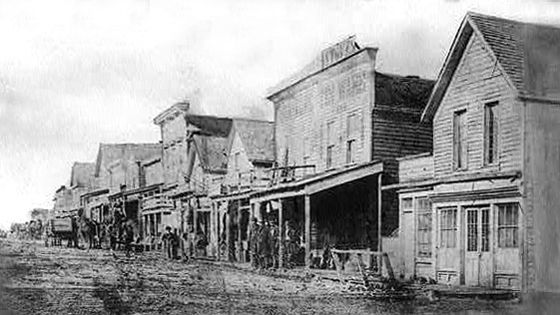
Early day, Fort Scott, Kansas.
From 1842 to 73, Fort Scott evolved from an isolated frontier outpost into a bustling trade center and played a significant role in events that transformed the United States. During that period, America grew from a young, divided republic through the trials of conflict and war to maturity as a united and powerful transcontinental nation.
Today, the city of Fort Scott is the only significant town still existing in Kansas that developed from a U.S. Army fort established before Kansas became a territory and a state.
Today, the fort is restored and preserved as a National Historic Site. The historic site is in downtown Fort Scott at the intersection of U.S. Highways 69 and 54.
Contact Information:
Fort Scott National Historic Site
P.O. Box 918
Fort Scott, Kansas 66701
620-223-0310
Fort Scott Hauntings
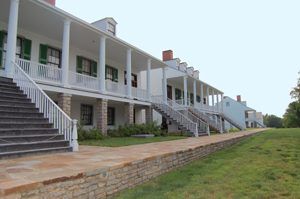
Officer Row, Fort Scott, Kansas
Fort Grounds – There have been several sightings of ghost-like Civil War soldiers looming on the lawn and around the courtyard. Officers have also been seen in the cell blocks and stables.
On one occasion, a visitor to the fort commented on a staff member after a friendly conversation with a gentleman in period costume. However, the staff member was somewhat confused, as no one was scheduled to be in costume that day. Inquiring at the office confirmed this. It appears that the Fort Scott tourist had the “pleasure” of meeting one of the Fort’s many ghosts.
Officers’ Quarters – The Officers’ Quarters are reportedly the most haunted. Long ago, an officer accidentally shot himself when riding up to the building on the left. He had been showing off for his wife. The devastated woman held him in her arms as he died in front of the building. According to our reader, Carol, she has often felt the presence of the long-dead woman in the quarters.
The building on the left once served as the Free State Hotel. However, when the fort was permanently closed, both buildings served as an orphanage home called Goodlander’s for many years. According to staff and guests, these long-ago orphan children are often heard playing in the two buildings.
Several sightings of fog-like apparitions have been reported drifting from the chimney in the officer’s quarters. It is said that at midnight, a ghostly figure can be seen looking out the window of the officer’s building, formerly the Free State Hotel.
©Kathy Alexander/Legends of America, updated December 2025.
Also See:
Forts & Presidios Photo Gallery
Source: Fort Scott National Historic Site