
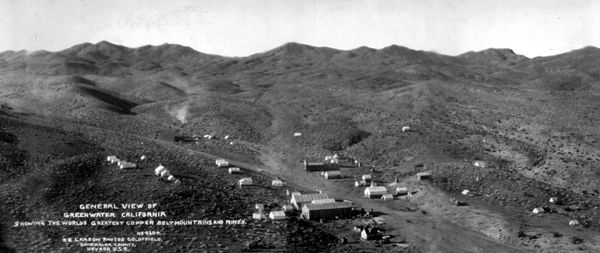
Greenwater Mining District 1906.
Greenwater Valley was the site of the most spectacular boom in the history of Death Valley mining. While other districts, such as Bullfrog, Lee–Echo, Panamint, Skidoo, and Leadfield, had their booms, which saw rushes into new mining areas and the establishment of new mining camps and towns, Greenwater surpassed all the others in the brilliance of its birth. Within a year and a half of the beginning of the rush to Greenwater, the deserted desert was home to over 2,000 people in four towns, 73 incorporated mining companies, and was the focal point of over $ 140 million in capitalization.
But it was not only the amazing rush to Greenwater that set it apart from other booms. Greenwater also experienced the shortest life ever recorded for a boom camp of its size. Within one year of the boom’s height, all but five of the companies had left the district, and Greenwater was practically deserted. By the end of two more years, everyone had given up, and the Greenwater Valley, the scene of so much bustle and excitement a short time before, was once again completely deserted.
This combination of a tremendous boom, a brief life, and then complete desertion, all within fewer than four years, has made Greenwater a name that remains anathema to the investing public and dear to the hearts of desert folklorists. Few, if any, mining camps in the American West have ever combined such initial excitement with such total disappointment.
The real discovery of Greenwater, as with most throughout the Death Valley area, came about due to the Bullfrog boom some 65 miles to the north. The great rush to the Bullfrog Hills soon filled up the ground in that vicinity, and late-arriving prospectors were forced to move farther afield. Two such men, Fred Birney and Phil Creasor, ambled south down the east side of the Black Mountain Range and, in February 1905, while looking for gold, instead uncovered rich surface croppings of an immense copper belt in Greenwater Valley. Birney and Creasor sent samples of their find to Patsy Clark of Spokane, Washington, a well-known copper mining operator, and Clark was sufficiently impressed to buy the claims from the two men in May.
Upon hearing of Clark’s new holdings, which showed amazingly high copper values at the surface, F. August Heinze, the “famous copper king” of Butte, Montana, also visited the new locations and was equally impressed. The rich surface showing was so promising that Heinze and his partners immediately bought 16 copper claims from another pair of early prospectors for $275,000. Commenting upon the transaction, which brought newspaper attention to the area, the Inyo Independent reported that the “vast copper deposits in the Funeral Range have long been known to prospectors, but their inaccessibility to the markets prevented working.” With the booming camp of Bullfrog to the north and the promise of railroads into the desert regions, the transportation and supply problems would be much less severe. However, the Greenwater Valley was still a long way from civilization.
As the news quickly spread that two of copper’s biggest operators had located in Greenwater, a rush ensued. Prospectors and mining men began flocking to the Greenwater area to stake out the close-in ground. As usual, with a new boom, transportation problems exceeded all others, and many prospectors, including one who reported for the Inyo Independent, were reduced to walking from Bullfrog into the new district, a task which took three days. The work was rough since, even in September, the thermometer reached 113 degrees in the afternoon, and the reporter-prospector found he had to sit down and rest after building each monument to mark his claims. The heat was not alleviated by the total lack of water in the district, and prospectors who ran out of water were forced to leave their location work and return to Bullfrog, the nearest point of civilization.
By late June 1905, Patsy Clark already had eight men working at his property, and a shaft had been sunk 35 feet into the ground. As the year progressed, other operators entered the scene, including Arthur Kunze, who secured some of the best-looking ground in the area and had five men working it by year-end.
As 1906 opened, Kunze, Clark, and Heinze began to have plenty of company, for innumerable other mining promoters, prospectors, and miners were entering the district. Clark established a mining camp near his mine to support his operation, and other small camps sprang up along the valley floor.
As the area’s rush continued, however, it soon became apparent that the lack of an adequate water supply anywhere in the vicinity would be a major problem. “The water proposition is the serious drawback in that section at present and will be a matter of considerable expense,” remarked a Rhyolite stockbroker, “yet the earmarks of the country seem to show that any expense would be justified, judging from the surface indications.”
Those surface indications were so rich that men and money continued to rush into the district, regardless of the serious problems with water and transportation. As the spring progressed, some of Nevada mining’s biggest names joined the boom, and fortunes reaped in Tonopah and Goldfield were reinvested in the promising new district.
“All of the great copper magnates are looking to this section,” reported the Inyo Register in May, “which is destined to become the next great copper district of the world.” That prediction seemed to be borne out by June 1906, as the copper belt was “proven” to be at least seven miles long. By that time, four of the larger mines had been incorporated into full-fledged mining companies, and Greenwater seemed assured of a long and lively life.
The rush slowed down somewhat during the hot summer months of 1906. However, the district’s future looked even better when the Las Vegas & Tonopah and the Tonopah & Tidewater Railroads, built into the Bullfrog District, expressed interest in tapping the new copper belt to the south. The local papers declared that the district “will make one of the greatest copper camps in America,” and the continuing rush caused the major national mining journals to take notice of the area. “The weather in Death Valley is the only thing that prevents Greenwater from having one of the biggest booms on record in this country,” wrote the Bullfrog Miner. “But even the midsummer heat of the ‘terrible region’ does not keep prospectors out. Hardly a day passes that Bullfrog prospectors are not seen starting for Greenwater.” In early July, a stage line was started from Ash Meadows into the new district, and water, hauling in from 15 miles away, was selling for $5 per barrel.
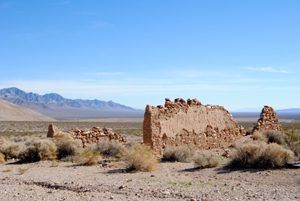
Ruins in Bullfrog, Nevada by Kathy Alexander.
Hundreds of thousands of dollars had changed hands by the end of July as feverish trading of mines and claims took place. Five mining companies were organized, and the capital stock of four of them reached $5,750,000. “This week, after auto-loading with prospective investors, we went to Greenwater, and the demand locally for horses and rigs has almost exceeded the supply,” reported the Bullfrog Miner. The rush was causing scarcities in Greenwater, and water rose to $7.50 per barrel, while horse feed was almost as hard to find. But the rush continued, and as was often the case in new mining booms, several camps formed in the district, spawning the Bullfrog Miner to say: “The townsite epidemic has broken out in a decidedly virulent form. No less than three towns are already planned, and it is difficult to tell which will be the district’s commercial center. That there will be a flourishing town in the district goes without saying, but which and where it will be is a matter of conjecture at this writing.”
As more prospectors flooded the area, concerns arose about their welfare. Printed warnings were published in the Rhyolite papers, warning prospectors to bring all the food and water they would need into the district with them since none could be provided there. Water was being hauled from Furnace Creek in Death Valley, but “Teams making the trip to the creek and back, fifty miles, drink about as much as they can deliver, making it almost impossible to get any reserve supply. Unless travelers heed the timely warning, there is liable to be real suffering, and perhaps several deaths.” Several mine owners, who were importing water to meet mining demands and supply their employees, publicly warned prospective visitors that they could no longer afford to sell water to private individuals.
Despite these serious problems, there was no denying the allure of the Greenwater District, and the rush continued. On July 29, a meeting was held to organize the new district, alleviating some of the problems caused by conflicting claims and eliminating the necessity for prospectors to travel to Independence, California, to record their claims.
By August, the district was beginning to take shape; competing towns had been surveyed and platted, and one of them had established a boarding house. The district population was then estimated at 300, and several stores and restaurants had opened for business. Kimball Brothers, the staging kings of Rhyolite, announced a new stage line that would make thrice-weekly trips into Greenwater. One traveler counted over 100 freight wagons heading towards the district in a single day, straining the resources to supply the growing demands of the new boom camp. Canned tomatoes were an especially popular item for sale at the crude tent stores since they were cheaper than water, which was now selling for $10 a barrel and quenched the thirst almost as well.
The new region’s rush had several unique aspects, which the local newspapers quickly reported. Due to the extremely rich surface showings, money was pouring into the district tremendously before the ground was even broken. As the Rhyolite Herald noted, money seemed to have beaten labor to the scene of activity, as the big capitalists were on the ground and buying claims before any work had been done. It is not a poor man’s region,” agreed the Bullfrog Miner, “but one which will require much money to develop it.”
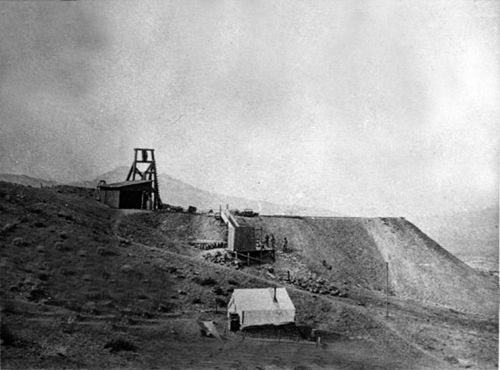
Patsy Clark’s Funeral Creek Copper Mine in its earliest days.
All this business, of course, was good for the Rhyolite area merchants, and the new boom was looked upon favorably. “All Nevada is taking a hand in this rush,” noted the Inyo Independent, “as practically the whole of the United States has been told of its marvelous deposits of copper, which are revelations to geologists and mining men in general. Although the district hardly needed another spur to its boom, it got one anyway on August 10, August 10Greenwater Death Valley Copper Company was organized. Promoted by Charles Schwab, the steel and mining millionaire whose name was magic to Nevada miners, the new company was incorporated for $3,000,000. Together with Patsy Clark’s Furnace Creek Copper Company, assured “a thorough and complete development of the district.”
By the middle of August, the townsite rivalry was taking shape, with two major competitors emerging from the dust. Arthur Kunze was the chief promoter of the first, and his town seemed to have the edge. Alternating between the names of Kunze and Greenwater, Kunze’s townsite was located midway between the mines of the Furnace Creek Copper Company and the Greenwater Death Valley Copper Company—the district’s two largest mines. By mid-August, Kunze’s townsite boasted two stores, a hotel, a restaurant, and several corrals that were under construction. The Salsberry Water Company was under contract to Kunze to keep the camp supplied with water, and a petition was sent to establish a post office.
The Kimball Brothers obligingly routed their stage line to Kunze’s townsite, and the Tonopah Lumber Company, in addition to establishing a lumber yard to supply the hectic construction pace, sent down several 12-horse teams to be used in hauling supplies from Johnnie Siding of the Tonopah & Tidewater Railroad to the new townsite. The lumber company also supplied a 2,500-gallon water tank for the townsite company, and Kunze’s plat of the town, which showed 32 blocks with over 550 lots for sale, was approved by the Inyo County Commissioners on August 13. The Bullfrog Miner predicted that Kunze’s camp seemed to have the inside track over its main rival, the townsite promoted by Harry Ramsey.

Greenwater, California, 1906.
To add to the confusion, Ramsey also insisted on calling his townsite Greenwater, although it was commonly called Ramsey and less commonly called Copperfield.
Today’s location is hard to pin down since it was described as 1-4 miles east or southeast of Kunze’s camp. Nor did Ramsey help alleviate the confusion when he moved his site around at least once. Nevertheless, Ramsey vigorously promoted his own town and even tore down his iron office building at Rhyolite and moved it to his town site.
One observer counted $25,000 worth of supplies heading into the Greenwater District in one day as the rush continued. Another counted 200 miners and prospectors in the area, not including those out in the camps’ hills. The Engineering Mining Journal, assessing the Greenwater boom, noted that the “copper finds there recently have brought about an excitement equal to that at Bullfrog two years ago. Hundreds of people from Tonopah, Goldfield, Lida, Palmetto, and the Bullfrog towns travel towards Greenwater in all sorts of conveyances. As high as $200 is being paid to automobile companies for transportation by wealthy operators who are anxious to get in early.”
Getting into Greenwater was not that easy for those who could not afford the $200 to rent an auto. Those who arrived by train via the Johnnie Siding could sometimes hitch a ride on one of the big freight teams traveling between the railhead and Greenwater, but that trip took from 12 to 15 hours. The Kimball stage took just as long for the relatively reasonable rate of $18 per passenger. Still, spaces were limited, and numerous travelers were forced to wait at Johnnie Siding for a day or two before their turn on the stage came.
As August ended, the Greenwater District braced for the increasing rush that would undoubtedly come with the cooler fall and winter weather. Arthur Kunze and Harry Ramsey continued to promote their towns and endeavored to attract merchants, making their camps the winners. Ramsey formed the Greenwater Townsite Company to promote his camp, and by the end of August, he had a restaurant, two saloons, a hotel, and a store. Kunze, meanwhile, had completed arrangements with several merchants, and the Greenwater Banking Corporation and the Greenwater Mercantile Company were organized, with the latter planning to erect a large general merchandise store. In addition, Kunze’s camp had a lodging house, a store, a saloon, a restaurant, several tents, and an assay office.
The booming mining business was also good for the labor interests, and by late October, the Greenwater Miners Union was over 100 strong. Meetings were held every Tuesday, and the Greenwater Townsite Company donated two “very fine lots to the union, where they intended to build their union hall. The miners started a fund drive to build and staff a union hospital and proudly proclaimed its motto across the Greenwater Times pages: “It is Justice the World Needs! Not Charity!”

Greenwater Valley.
In other news, the Times reported that the chief engineer for the Las Vegas & Tonopah Railroad was in town to select the best rail route into the district and that due to public demand for living space, Patsy Clark had agreed to throw open his townsite of Furnace, which had hitherto been reserved for employees of his mine. Then, as was fitting, the Greenwater Times’ first issue closed with a large advertisement for the Greenwater Townsite Company. Greenwater was, according to this ad, “The Greatest Copper City of the Century.”
The payroll at its mines already exceeded that of Beatty, Bullfrog, and Rhyolite combined, and $52,500 in real estate had been sold in Greenwater in September. Still, however, business lots were available at “ground floor prices” to anyone interested.
Less than a week later, the Inyo Independent took its turn marveling at the wonder of the eastern California desert. Look at the place, the paper said, where only one tent was to be seen back in July.
Now, Greenwater was a well-laid-out city, with over 1,000 people in the district. At the present rate, the population would be 2,000 before the year was over. The Bullfrog Miner, noting the same week that nearly $20,000,000 had been invested in 100 claims in the last six months at Greenwater, agreed that “by far the most sensational jump into prominence of any mining camp added to the map in many years is that of Greenwater… Greenwater is, without doubt, the greatest copper mining territory ever found in the world.” Only the Engineering & Mining Journal, the faraway and much more conventional publication, managed to hold its breath. In a much more realistic appraisal and one which immediately became immensely unpopular in Greenwater, the Journal noted that the “district is too new, however, to permit trustworthy predictions as to its future, and it will take many months before development work can be carried far enough to establish its real value and make it a factor in copper production. The present indications, however, are promising.”
Although the Engineering & Mining Journal was absolutely correct in stating that it would be many months before anyone began making money from copper mining, that was too cold an assessment for a boomtown. There were many easier and quicker methods of making money in a boomtown, and although all of them were risky, there was no lack of men who were willing to try. Charles Crismor, for example, was a favorite Horatio Alger-type story much played up by the local papers. Arriving in Rhyolite in January of 1906 with 30¢ in his pocket, he entered the restaurant business there. With the advent of the Greenwater boom, Crismor had grubstaked two prospectors with leftover food from his dining room and, by November 1, had sold the claims they staked for a $150,000 profit. Such was the way money was made at Greenwater. In turn, the promoters who bought those prospects incorporated a mining company to determine whether there was any ore in the ground and sold stock shares to the investing public, extending from the West Coast to the East Coast. The promoters paid themselves salaries from the proceeds of the stock sales and used the remainder of the funds to look for ore. Profit flows back to the stockholders only if ore is found. In the meantime, as long as the boom lasted and people could be persuaded to invest their money in Greenwater’s mines, everyone on the ground was making money.
As the boom continued and the mineral district spread farther and farther out across the desert, new towns appeared to accommodate those miners who lived too far from Greenwater, Copperfield, or Furnace to walk to work. South Greenwater, for example, was started on the grounds of the Pittsburgh-Greenwater Copper Company, 15 miles south of Greenwater itself, in early November. Later that month, the town of East Greenwater was established to serve the mines in that area, approximately eight miles east. At about the same time, the first gas hoists began to arrive in the district, marking some companies’ transition from exploration to the development stage of mining. Eleven more mining companies were incorporated in November, bringing the total in the district to 41. Many times, the number of small mines, locations, and prospects was also being held and worked on by individual miners awaiting the right price to sell their locations to mining companies.
And the towns continued to grow. The best information comes from Kunze’s Greenwater since the Greenwater Times naturally boosted its own town over the rival camps. On November 6, Greenwater had two barbershops, and 20 wooden buildings were under construction. A lawyer had moved to town to take advantage of the lucrative fees involved in the inevitable mining conflicts. Paul Wiesse had started a butcher shop, and two more restaurants were ready to open, bringing the total to five. T.E. Blake opened a shoe repair shop, two more offices full of mining engineers and surveyors opened, and J.C. Collins announced the grand opening of his Undertaker and Scientific Embalmer services. So many carpenters were now in camp, meeting the demands of the building boom, that they organized themselves as a local branch of the Nevada Carpenters Union.
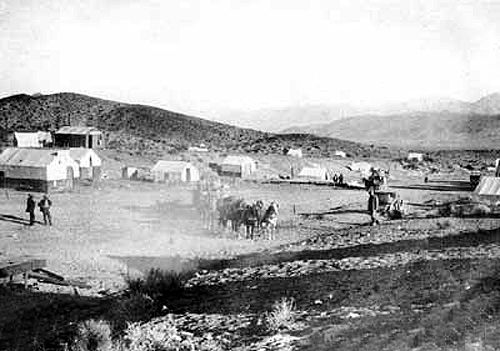
A scene of Greenwater shortly before the townsite merger. The buildings were soon moved to Ramsey’s mining camp, which was renamed Greenwater—often called “New Greenwater.”
Despite the boom fever, several firms besides the Engineering & Mining Journal managed to resist the excitement of the rush. William Clark, president of the Las Vegas & Tonopah Railroad, for example, resisted the heavy local pressure to begin immediate construction of a branch line into Greenwater and, instead, more reasonably announced that the branch road would be built “just as soon as we are fully assured of the camps’ permanency.” The pressure on Clark was tremendous, for if Greenwater did turn into a productive camp, the first railroad into the district would reap enormous profits. Also, the Greenwater fever had invaded the Clark family itself, for J. Ross Clark, William’s brother, had invested in the district and incorporated the Clark Copper Company.
By the middle of November, no fewer than 100 people were arriving in the district every day, yet the demand for labor far exceeded the supply. But the district still had several rather insurmountable problems, and that same month, one of them was graphically highlighted when a water wagon serving the town’s holding tanks broke down. Immediate panic ensued, and water prices shot up to $20 per barrel before the wagon could be repaired. It was a reminder that Greenwater would never become a producing district until the water and transportation problems were solved, if any need be.
By the end of November, the Greenwater stampede was of such proportions that, although the district had yet to ship a single sack of ore, it was getting almost weekly coverage by the national mining journals. As one single example of the continuing boom, Thomas W. Lawson of Boston, a noted copper operator and millionaire, purchased the Greenwater Red Boy and Greenwater Saratoga Mining Companies in late November for a reported $2,000,000 in hard cash and immediately announced plans to erect a copper smelter.
By then, the Greenwater boom was so great that competition between the Kunze and Ramsey townsites had become impractical. Kunze’s site, due to its location near the larger mines and its success in securing a post office, a newspaper, and several leading business houses, was clearly leading in the townsite race over Ramsey’s camp. Still, there were problems involved in Kunze’s physical location. His camp was perched up in the Greenwater Hills, practically on the end line of the Greenwater Death Valley Copper Company mines, and only a wooden fence kept drunken miners from walking off the end of one of Kunze’s streets into one of the mines’ shafts.
Also, the district’s leading mine owners realized that a railroad was an absolute necessity for the future prosperity of Greenwater, and that building a railroad into Kunze’s town would be difficult because of its location in the hills overlooking Greenwater Valley. Nor were the railroad interests very anxious to build directly into the heart of the mining district, for they had painfully learned at Tonopah how expensive it was to lay tracks over active and conflicting mining claims. Thus, the railroad companies, both for ease of construction and to avoid involvement in costly land disputes, preferred to build their railheads at sites away from the mines themselves. Charles Schwab, in turn, was growing uneasy at the prospect of a large town night on top of his mining claims, since that would make it difficult to open up new ground when the time came. For a combination of these reasons, the district’s leading promoters decided in late November to move Kunze’s Greenwater camp from its present location down into the Greenwater Valley below, where railroad construction and acquisition would be much easier and less expensive. After all, the planners at the time expected Greenwater to blossom into a city of thousands, rivaling the other great copper towns of the United States, such as Butte, Montana, and there was not enough room at Kunze’s site for such an expansion.
As a result, Harry Ramsey’s camp of Copperfield, which had never enjoyed Kunze’s prosperity, suddenly saved itself. A new Greenwater Townsite company was incorporated, which bought out the interest of both Ramsey and Kunze in their old townsites and, backed by the capital of the leading mining promoters, announced that the entire Kunze townsite would be moved down into the valley, near Ramsey’s old site. Owners of lots in both Kunze’s and Ramsey’s old townsite would be given lots of equal value and location in the new town, and the new combined townsite would carry the name of Greenwater.
After the townsite consolidation announcement, the Las Vegas & Tonopah Railroad reported it would build a spur to the new site, and John Brock announced he would soon begin construction of a $60,000 hotel. However, all was not well with the coming of winter; although mild snowfalls helped alleviate the water shortage, the cold weather immediately pointed out another serious supply problem in the district. Wood was almost unavailable as fuel to warm the district’s tents and buildings, and Greenwater residents began to experience a “lively skirmish to get enough greasewood to keep warm.”
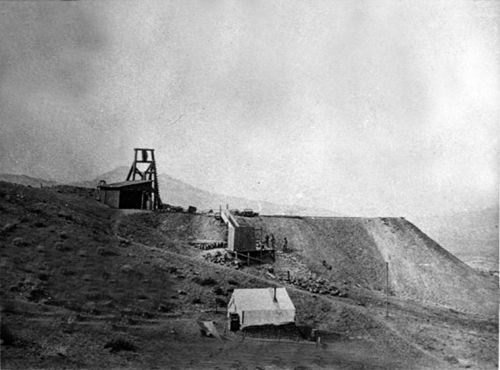
Patsy Clark Mine, Furnace, California.
Then, to keep the townsite situation from becoming too calm, Patsy Clark promoted his Furnace townsite, and ads began running in the Rhyolite newspapers. According to the ads, lots were on sale for $250 to $750 apiece, and over $30,000 worth of lots had already been sold. The ad also proclaimed, “Furnace Will Be the Metropolis of the Greenwater District.”
But, wherever they were located, and whatever they were called, all the district’s towns continued to expand. The Southern Nevada Telegraph and Telephone Company completed the extension of its telegraph lines into the district in mid-December. They promised that the telephone lines would soon be finished as well. Several hopeful individuals were sinking wells, and water was struck in one, eighteen miles from town. The Greenwater Townsite Company began laying pipe from Greenwater Springs to the townsite, although the flow of that spring was nowhere near enough to accommodate the demand.
By the end of 1906, with the district’s population approaching 1,500, the boom was finally slowing. However, everyone blamed the unprecedented cold weather rather than any abatement of the Greenwater fever. Several snowstorms in late December caused widespread suffering, and the price of greasewood, which became increasingly scarce, rose to $15 per wagonload. Twenty loads, it was reported, were necessary to equal the burning power of a normal cord of wood.
The cold weather halted work at most mines, for only those whose shafts were deep enough to escape its effects could continue. Still, nine more mining companies were incorporated in the district in December, bringing the total to 50, and everyone sat back, waiting for a break in the weather so that Greenwater’s unprecedented stampede could continue. During the lull in the action, the townsite move began, and New Greenwater, “The Greatest Copper Camp on Earth,” was born.

Charles M. Schwab.
Hard on the heels of the townsite consolidation came the news of another large merger, which set even the feverish minds of Greenwater agog. Several of the leading mine owners, realizing that the district needed a smelter to become a producer, announced plans for a giant merger toward that end. On December 15, Schwab, John Brock, and some Philadelphia financiers formed the Greenwater Death Valley Copper Mines & Smelting Company. By pooling their resources, Schwab and his partners hoped to cut costs and erect a large smelting plant to process ore from each mine. Although no specific site was announced, Ash Meadows immediately became the leading contender for the smelter site due to its proximity to abundant water supplies and railroads.
The new company announced that it would build its own branch railroad from the mines to the smelter area, 30 miles away. That work would immediately begin on the railroad spur, the water development at the smelter site, and the construction of the smelter itself. In the meantime, although the mines involved in the merger came under the umbrella supervision of the new corporation, each would retain its separate identity and would continue to pursue its own development independently.
Spurred by this news, developments at Greenwater continued at a hectic pace. The townsite merger was being carried out, and Patsy Clark, who stayed outside of both the townsite and mining mergers, continued to plug his town of Furnace. By January 1, January 1ry 1te contained stores, business houses, and a hotel. A separate stage line connected it with Amargosa, and a post office had been requested.
The new townsite of Greenwater was likewise experiencing growth and the confusion of consolidation. A second weekly newspaper, the Greenwater Miner, was started by an editor attracted to the booming district from Nome, Alaska, and several more assaying, surveying, and brokerage offices opened. January 1907 saw yet another young publication start-up, which became one of Greenwater’s unique claims to fame. On January 1, Chuck-Walla’s first issue hit the streets, published by C.E. Kunze and C.B. Glasscock.
As its advertisements read, it was “A Magazine for MEN.” It was “written in a vein to please. It is both entertaining and valuable. It exposes the crooks, the wildcats, and the frauds and roasts the knockers.” And, as the cover declared, it was “Published on the desert at the brink of Death Valley. Mixing the dope, cool from the mountains and hot from the desert, and putting out a concoction with which you can do as you damn well please as soon as you have paid for it. PRICE, TEN CENTS.”
The first issue of the Death Valley Chuck-Walla was especially distinctive, for it vividly described the total confusion inherent in the townsite move then underway. In an article aptly titled “A Town on Wheels,” the movement was portrayed: “… pandemonium reigns. Saloons and boarding houses, stores, and brokerage firms are doing business on the run and trying to be on both sides of the mountain simultaneously. A barkeep puts down his case of bottles on a knoll en route from the old camp to the new and serves the passing throng laden with bedding and store fixtures… The butcher kills a cow en route and deals out steaks and roasts to the hungry multitude, hurrying back to the old camp to get the necessities for the new. Those who remain in the old camp walk two miles to the new one to get the eggs for breakfast. Those who have journeyed to the new are walking two miles to the old to get their mail and a pair of socks. Through it all, Jack Salsbury, Harry Ramsey, and the Townsite Company smile…”
The Chuck-Walla had other aspects as well. Although the editors were totally committed to boosting the Greenwater District, they also realized that the proliferation of fraudulent mining schemes would hurt the district in the long run. They made it their pet project to uncover mining companies that were bilking the public. The first issue carried a long article damning the Boston-Greenwater Copper Company’s manipulations, promoted by J. Grant Lyman and his Union Securities Company. Lyman had earlier been arrested in Boston for pushing stock sales for non-existent mines around the Bullfrog area, and he was doing the same at Greenwater.
By January 4, the Herald reported that the townsite consolidation was complete. Although the district and its town’s total population was not easy to estimate since so many men thronged through the hills, the Herald estimated it at 1,500 and 2,000. More importantly, however, the development of the mining district was advanced by the Fairbanks-Morse Company’s report that it had received orders for at least twenty hoists of various sizes for the district, indicating that more and more companies were beginning the transition from exploration to the development stage of mining. All the district needed to pass from a boom camp into a permanent mining town was for one big mine to take the next step from development into production.
New Greenwater, meanwhile, reported thriving business. The townsite company surveyed 2,200 lots across more than 130 blocks at the new site and reported brisk sales. Lots on Main Street sold from $500 to $5,000 apiece, and the county supervisors of Inyo County approved the townsite plat. The continuing cold weather, however, put a damper on business, as one miner reported that it was “fiercely damnable, and we put two-thirds of the time trying to rustle greasewood enough to keep from freezing.” Despite the snowfall, water was still in short supply and sold for $10 per barrel.
The Engineering & Mining Journal was not the only publication to wonder at the immense rush into Greenwater. In late January, the Mining World noted that “It is too early to predict the possibilities of this district. Its remoteness from transportation facilities and water has retarded its development, but very active work is being prosecuted on about 50 different properties, notwithstanding the many difficulties encountered. During the next six months, exploratory work will have probably progressed sufficiently to determine the persistence of the ore deposits.” That was the crux: why was so much money being poured into the district when the very existence of the ore deposits below the surface level had not yet been proven? Apparently, the boom spirit, which had been ravaging throughout Nevada and eastern California since the bonanza discoveries at Tonopah and Goldfield, reached its height at Greenwater. In addition, since copper deposits at other camps, such as Bisbee and Butte, had always improved with depth, everyone assumed that the same would hold for Greenwater. Since the surface richness at Greenwater far surpassed that of any copper camp ever, who could fail to think that Greenwater could indeed become the Greatest Copper Camp on Earth?
One paper, at least, did think exactly that. In late January, the Goldfield Gossip printed its own assessment of the Greenwater District, which flew directly in the face of all the local predictions. “We have dissected reports from as many sources as possible regarding the future of Greenwater,” wrote the Gossip, “and all these agree that the camp would never make a production of copper to amount to anything.” As might be expected, that report caused an immediate and extreme reaction from the Greenwater papers, particularly the Death Valley Chuck-Walla, which more than adequately fulfilled its promise to “roast the knockers.” The Bullfrog Miner also scorned the Goldfield Gossip’s assessment and printed its own: “… there can be but one future for Greenwater and that will be expressed by the six words ‘Greatest Copper Camp in the World.’”
In the end, however, no one would know for sure whether Greenwater would become a producer until the time came, and in the meantime, the Greenwater District enjoyed its booming prosperity. In addition, a town government committee was organized to supervise sanitary and police measures, and Inyo County appointed a Justice of the Peace and a constable for the district.
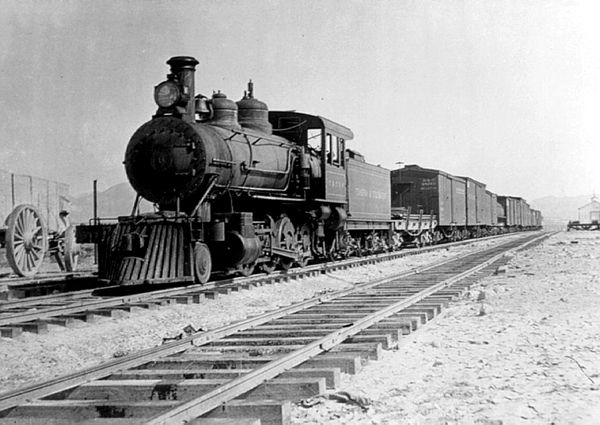
Tonopah Tidewater Railroad.
By mid-February, the Rhyolite Herald reported that it was confident the Tonopah & Tidewater would build a branch line into the Greenwater District and even speculated that the road would be completed by June 1. The June 1 Chuck-Walla, in its mid-February issue, put the district’s population at 2,000, including 500 in the town of Furnace, which was beginning to emerge as a real rival to the new Greenwater townsite.
The Chuck-Walla also carried a large ad for the Greenwater Townsite Company, which optimistically forecasted that Greenwater would soon be the center of three railroads. According to the ad, the district’s population was over 2,000, and two telephone and telegraph lines were doing business. “Since December 1 1in value. This is because there is no question whatever about the permanency and future of the place. Greenwater is destined to be the richest mineral-producing city globally.” Also, the magazine carried ads for several new Greenwater businesses.
But, as February drew to a close, there was a decided slackening in the great Greenwater boom. The district had now been opened for well over a year and had been in a boom stage for more than half that time, and as of yet, none of the companies that were sinking their shafts had found any ore under the surface that could compare with the rich surface streaks that had started the boom. While slow to dawn upon the district itself, this fact was becoming apparent in the national stock market.
The Bullfrog Miner noted the slight slackening of the Greenwater boom and reported that while “there is somewhat of a dullness pervading the camp, as far as the influx of people and industries is concerned, the properties are looking mighty fine.”
But, at the time, no one could have hoped to persuade a Greenwater citizen that the bloom was beginning to fade. On March 1, the Greenwater Death Valley Copper Mines & Smelting Company began to work on the smelter site at Ash Meadows. More immediate encouragement came from the news that Mr. Lemle was opening a sub-agency for Budweiser at Greenwater and arranging daily ice delivery. During the same week, the Greenwater Meat Company was organized and advertised to drive cattle across two mountain ranges from Owens Valley, California, to Greenwater to furnish a constant daily supply of fresh meat to the inhabitants of Greenwater. The Furnace Townsite Company also stepped up its advertisements, and the Greenwater Townsite Company countered by running its own ads, plugging its camp’s unique and desirable aspects.
Still, qualms of uneasiness were beginning to be felt around the district. The Bullfrog Miner was the first local paper to admit such, noting, “As yet there are no real mines in Greenwater, as mining men understand the term.” The paper went on to qualify that statement, adding that the working shafts are located several hundred feet down. The ore bodies are well enough defined for the owners to know they have immense quantities of very valuable rock. Still, the workings so far have been confined to these shafts, and no effort has yet been made to take out ore except for what was necessary for sinking the shafts.” Privately, many Bullfrog operators were glad to see that the Greenwater boom was abating, for, at the height of the rush, the drain of investment money towards Greenwater had decidedly hampered the operation of the mines around the Bullfrog District.
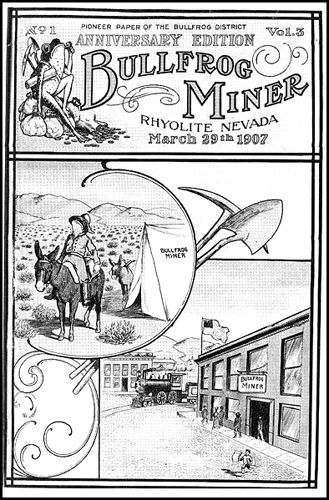
The Bullfrog Miner.
By the end of March, the Bullfrog Miner put the district’s population at 2,000, indicating that it had not grown for the first month since the district was discovered. However, both Greenwater and Furnace were described as being alive and bustling, and both townsites had hotels, lodging houses, saloons, feed corrals, freight companies, meat markets, auto lines, brokerage houses, attorneys, newspapers, boarding houses, etc. Three railroad lines had been surveyed into the district. The Ash Meadows water company was working on piping water into the district, and an electric light system was projected for the towns.
But the boom had definitely slowed, as evidenced by the incorporation of far fewer companies. The Greenwater District’s exploration stage had finally drawn to a close after a short but extremely violent boom, and the district’s future now depended upon what ore bodies were found under the ground during the subsequent development phase.
By May 1, while still actively engaged in development work, it was becoming apparent that the district would be in trouble unless someone soon found a large, profitable copper lode. The investing public, which by now expected great things from the district that had boomed so brilliantly, was becoming impatient, and as another month passed without any big ore strikes being made, stock prices began to slip.
The Death Valley Chuck-Walla noted the stock slump but blamed it on the eastern Wall Street stock manipulators. In reality, the Greenwater boom had led to too great expectations among the investing public, and suspicions of a gigantic fraud began to form among far-off investors. Nor did it help the Greenwater District that the first effects of the Panic of 1907 were beginning to be felt on the eastern stock markets. Naturally, shares of mining companies that were still in the initial development stages were among the first to be unloaded by cash-hungry investors. Still, no one was ready to give up.
On June 1, the Chuck-Walla could still point to 25 companies at work, and although no sizeable ore bodies had yet been found, no one seemed quite willing to give up. Articles from the district’s two other papers, the Greenwater Times and the Greenwater Miner, also contained the same hopeful spirit. The Engineering & Mining Journal noted that 15 gas hoists were at work throughout the district, and more miners were at work than ever before. For once, the labor problem seemed to be solved, for the buying and selling of claims had ceased with the coming of harder times, and more and more miners were willing to give up their dreams of instant wealth and settle down to earning a steady wage.
Then, on June 22, a fire swept through part of Greenwater. Although the relative damage was rather light, considering the destructive potential for fires in mining camps built of canvas and wood, one saloon and the offices and presses of both the Greenwater Miner and the Death Valley Chuck-Walla were consumed. The Chuck-Walla editors had only recently bought out the Greenwater Miner and immediately announced plans to secure new printing equipment and continue both publications. However, after several weeks of financial difficulties trying to get their paper printed at the Bullfrog Miner office, the editors gave up and left the county.
The fire seemed to be an omen, for with the passing of the Death Valley Chuck-Walla, Greenwater’s loudest and brassiest booster, the fire seemed to go out of the district. The Ash Meadows Water Company, for example, had promised on June 29 to connect into Greenwater by August 1, and would be laid into Lee before Greenwater — indicating that the prospects of the Lee District now looked better to that company than those at Greenwater.
As the summer wore on and fall approached, it became apparent to all but the most die-hard that the great Greenwater boom had started to bust, and many people could be seen quietly leaving town. As a continuing barometer, the Ash Meadows Water Company again postponed its connections to Greenwater. It was announced on September 13 that it would not be available to the district until mid-November.
Those who still had faith tried to explain away the district’s decline. But if the mines were still developing, not nearly as many were doing so as in previous months. Of the 73 companies that had incorporated to do business in Greenwater by the spring of 1907, only 12 were left by September. Unless some ore were found soon, the camp would die. The Panic of 1907, which was beginning to hit the West’s mining regions by this time, obviously aggravated the problem.
Businesses, such as the Greenwater Lumber Yard, began to close their doors in the summer of 1907, and as the fall progressed, the trend increased. Fires again played a part in mid-October when Charley Hennessy’s Death Valley Vault Saloon burned to the ground.
In November, businessmen continued to leave, including one of the Greenwater Times editors, who sold his half-interest to his partner. As 1907 ended, ore bodies were still not located, even though the mines had gone deeper and deeper. The population had shrunk to “several hundred,” and only ten companies were still working, five of which had come under the control of the Greenwater Death Valley Cooper Mines & Smelting Company, the large holding company.
As 1908 opened, it was clear that the only hope for the Greenwater District lay in the two big mines that were still operating at great depths to find the ore bodies. The Furnace Creek Copper Company, the Patsy Clark outfit, was still sinking on its property, as was the Greenwater Death Valley Copper Company, the main Schwab holding. Both were sinking below the 500-foot level, and one or the other would have to find ore soon, or Greenwater’s mining history would be extremely short.
The work continued through January and February, but with no results. By mid-February, the once-bustling Greenwater District had shrunk to a mere shadow of its former self. The only business establishments left in the district were the Tonopah Lumber Company, which was still supplying timbers for the mine shafts, two saloons, two stores, and one restaurant. The district’s total population had fallen to about 50, and the remaining buildings at Greenwater were already being torn down and moved to Gold Valley, a small boomtown to the south.
The Furnace Creek Copper Company and the Greenwater Death Valley Copper Company continued to sink through April and May. In late April, the Bullfrog Miner reported again on the district. “The future of the Greenwater District depends very largely upon the shafts which these two companies are sending down. Geologists and mineral experts hold that if copper deposits exist in commercial quantities in the Greenwater District, they will be found below the water level and at great depth, and these companies have undertaken to demonstrate the theory.”
But still, no ore was found, and the district continued to decline. The Greenwater Times, the last of the district’s newspapers, finally gave up and quit publishing shortly after the end of May. By early June, R. J. Fairbanks had the district’s only store and saloon left. The only other business left in town was the Tonopah Lumber Company, which would stay as long as the companies sank and bought timbers for their shafts.
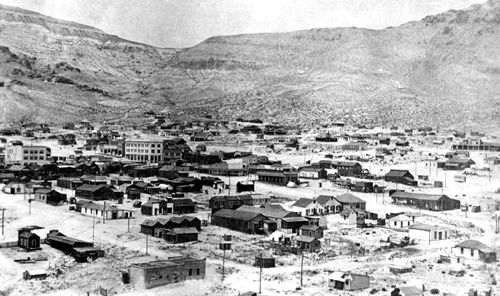
Rholite and the Bullfrog Hills, 1909.
The decline continued through August. The post office at Greenwater was discontinued on the 15th and moved to Death Valley Junction, and Mrs. Spear, the proprietor of Greenwater’s last restaurant, closed down the same month and returned to Rhyolite. During the rest of 1908, the district was exceedingly quiet. The Greenwater Death Valley Copper Company continued to sink its shaft, going deeper and deeper in the search for ore. The Furnace Creek Copper Company did likewise, although at a slower pace. But, as the year ended, no profitable bodies of copper ore had been found anywhere in the district, and it was quite apparent that the time was rapidly running out for Greenwater.
Just when it seemed that Greenwater was finally dead, another revival of hope arose. Early in January of 1909, ore was again found in the Greenwater Death Valley Copper Company’s mine, this time at a depth of nearly 1,100 feet. The mere mention of the discovery, before anyone knew the amount, extent, or richness of the deposit, caused another mild rush back into the district, several other defunct mines reopened their works, and the district’s population soared up to 150.
Developments on several properties continued through March, but the efforts were futile and soon proved worthless. The small mines shut down again, and in March, one of the two giants gave up when the Furnace Creek Copper Company finally abandoned hope and ceased work. Throughout the summer and fall of 1909, only the Greenwater Death Valley Copper Company continued to work, and finally, even that company quit in September. The shaft was stopped at a depth of 1,439 feet, and the papers were finally able to report definitively that Greenwater was completely dead.
The great boom that had propelled its name across the nation’s headlines and stock boards was best forgotten by the thousands of investors who had been badly burned. In its annual review of mining for 1909, the Mining World summed up the demise of the once-heralded in one short sentence: “The copper districts of the county have lapsed into obscurity. With the final crushing of hopes, locations were abandoned, as were titles to the once-thriving business blocks of Greenwater and Furnace.” In the meantime, the Inyo County papers began publishing long lists of delinquent tax payments owed by mining companies, businesses, and citizens who had once owned land in the district. The demise of Greenwater even had a ripple effect, as Amargosa, once a lively station on the railroad that supplied the Greenwater boom, had declined by the middle of 1910 to a population of two.
Mining was never revived in Greenwater, and by 1917, all that a visitor could find at the site of the town of 2,000 inhabitants was one deserted cabin. Most of the buildings at Greenwater and Furnace were readily movable because they were not permanently constructed, and their owners had hauled most of them away. What was left had been taken by R. J. Fairbanks, the last merchant of Greenwater, and hauled to Shoshone, a settlement on the Tonopah & Tidewater Railroad, where Fairbanks started a small store that grew into a thriving desert oasis.
Small attempts at sporadic production were made in 1916-1918 and again in 1929, during periods of very high copper prices. Still, these efforts never amounted to more than one or two-man operations and consisted mostly of gleaning the remains from the old mines’ dumps.
Another last attempt was made in 1970 to revive the Greenwater District. A consortium calling itself the Furnace Creek Copper Company (no relation to Patsy Clark’s outfit) scraped together the mining rights to many claims in the district and paid for a mineral report on the area. Ultimately, the company’s backers decided against resuming mining.
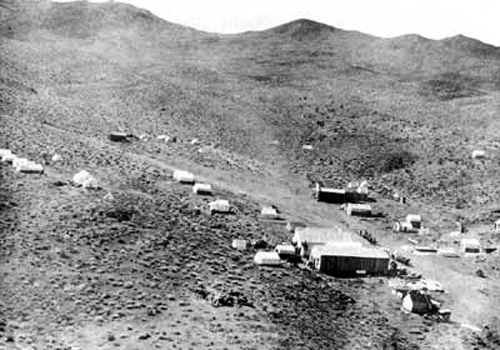
Kunze, California, 1906.
The area of Greenwater, Furnace, and Kunze’s old towns is scattered with tell-tale signs of mining, including numerous dumps, shafts, and barely visible outlines of leveled buildings and tent sites. The old site of Kunze has the remains of an old stone dugout cabin.
©Kathy Alexander/Legends of America, updated April 2026.
Also See:
See Sources.