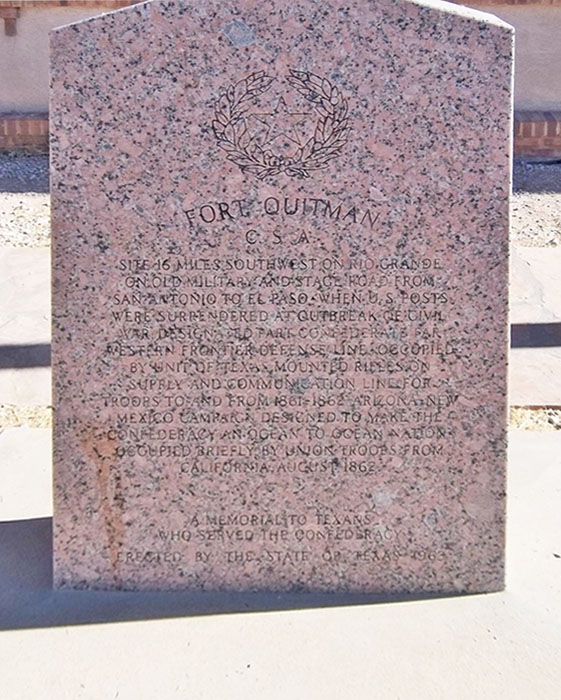
Fort Quitman Marker in Sierra Blanca, Texas.
Fort Quitman, Texas, was a United States Army installation on the Rio Grande, South of present-day Sierra Blanca, in southern Hudspeth County. It was 80 miles below El Paso and 20 miles Southeast of the site of present-day McNary.
On September 28, 1858, Captain Arthur T. Lee and companies C and H of the Eighth Infantry established the post on a barren, sandy plain 400 yards East of the Rio Grande to protect travelers and mail along the route of the mail coaches of the San Antonio–San Diego Mail Line. Later, it was on Butterfield’s Overland Mail. It was named for former Mississippi Governor and Mexican-American War general John A. Quitman, who served as a major general under Zachary Taylor.
Captain Arthur T. Lee commanded the first troops, which included 86 officers and men.
By 1860, the garrison had been reduced to one officer, Second Lieutenant Zenas Bliss, and 20 men. When the Civil War broke out, Texas joined the Confederacy. Lieutenant Bliss and his men were ordered to march to San Antonio with other troops evacuating West Texas garrisons. They believed they would be put on ships and sent to the North, but instead were captured and held as prisoners of war. Bliss was later exchanged and rose to colonel of volunteers. His promotion to general was probably hindered by his having been a prisoner of war.
Federal troops evacuated Fort Quitman on April 5, 1861. During the Civil War, Confederate and Union forces intermittently occupied the fort, which led to its rapid deterioration.
Confederate Texas troops under Brigadier General Henry Hopkins Sibley passed through the post on their way to the New Mexico Campaign in December 1861. The remnants of his Army also passed by the post after their defeat. No evidence shows Confederate troops ever permanently garrisoned the fort.
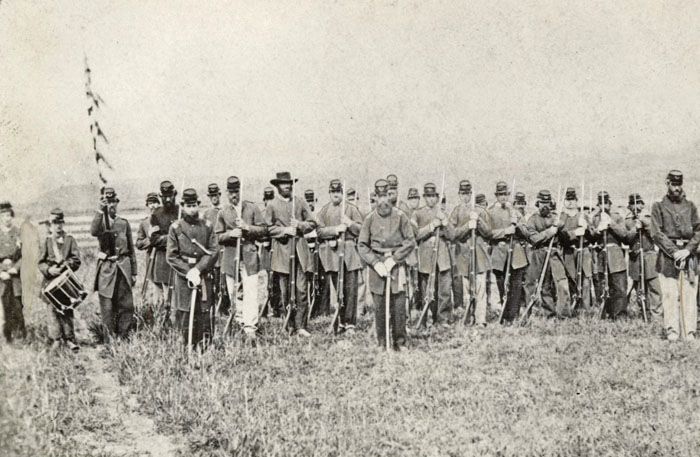
California Column during the Civil War.
In 1863, troops from the California Column inspected the fort for evidence of further Confederate activity or stragglers but saw no need to garrison the post.
On January 1, 1868, Captain Henry Carroll and Company F of the Ninth United States Cavalry and 42 Infantry under the command of Major Albert Payson Morrow of the 9th Cavalry reoccupied the dilapidated adobe buildings. Soldiers complained that adobe from the walls fell into their bunks as they slept because the buildings were in poor condition. It was said, “No worse site for a military post could ever be conceived.” It was almost completely isolated from civilization, with mountain ranges running down both sides of the river.
Later, on February 25, orders from the District of Texas headquarters officially reestablished the fort. Over the next decade, various companies and detachments of Buffalo Soldiers from the Ninth Cavalry and the 25th United States Infantry were stationed there to protect mail deliveries and scout for hostile Native Americans.
Fort Quitman had a reputation as one of Texas’s most uncomfortable military installations. Lydia Spencer Lane described it in 1869 as: “forlorn and tumble-down” and was surprised to observe a sergeant, in full-dress uniform, jumping rope outside the guardhouse. “If any one at Quitman could feel cheerful enough to enjoy so innocent a pastime,” she concluded, “he was to be congratulated.”
Surgeon John J. Culver was more blunt in his assessment of conditions at Fort Quitman in 1870, which he found “entirely unworthy of the name of fort, post, or station for United States troops.” The adobe buildings had been stripped of all wood, including roofs, doors, and window frames. “The dormitories of the barracks,” he sarcastically commented, “having neither doors nor windows, have abundant ventilation.”
The sandy soil and dry hot climate frustrated attempts to cultivate a post garden. Consequently, milk and fresh vegetables had to be hauled in at exorbitant prices from San Elizario, El Paso, or San Ignacio, Chihuahua.
Soldiers at Fort Quitman spent considerable time repairing the buildings, which by 1876 consisted of barracks for two companies, five sets of double officers’ quarters, an adjutant’s office, a hospital, a guardhouse, two storehouses, a bakery, workshops, and wooden cavalry and quartermaster’s stables.
Expeditions against the Apache in the Sacramento Mountains were mounted from Fort Quitman, but they met with little success. The garrison was gradually reduced to a single infantry company. The last unit, Company B of the 25th Infantry Regiment, left in January 1877. An angry mob from San Elizario burned the post later that year during the San Elizario Salt War. The rioters destroyed it to protest federal support for a rival faction.
Fort Quitman was regarrisoned in 1880–82 as a subpost of Fort Davis during the campaign against Apache Chief Victorio. Despite the efforts of Captain Nicholas Nolan and troopers of the Tenth United States Cavalry, Victorio’s warriors crossed and recrossed the Rio Grande near the post during the summer of 1880.
On August 9, 1880, Mescaleros attempting to return to their reservation in New Mexico attacked a stagecoach near the fort, mortally wounding Major General James J. Byrne, an employee of the Texas & Pacific Railway. However, Victorio was killed in Mexico in the fall of 1880.
The 10th Cavalry Regiment garrisoned Fort Quitman through April 1882. The Southern Pacific Railroad’s construction through the pass northwest of the post, effectively bypassing it, eliminated the post’s need. Fort Hancock was established in 1882 at a better site nearby.
In 1963, Texas Historic Landmark number 2007 was placed at the Hudspeth County courthouse in Sierra Blanca, honoring Fort Quitman.
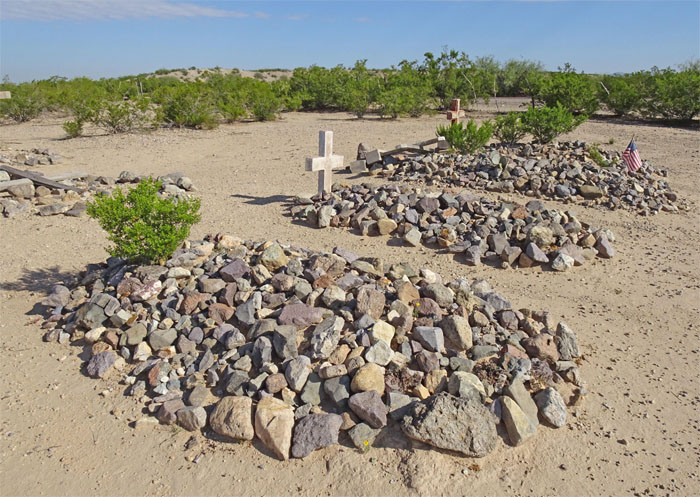
Fort Quitman, Texas Cemetery.
Today, only a cemetery remains near Fort Quitman.
©Kathy Alexander/Legends of America, updated November 2026.
Also See:
Forts & Presidios Across America
Sources: