
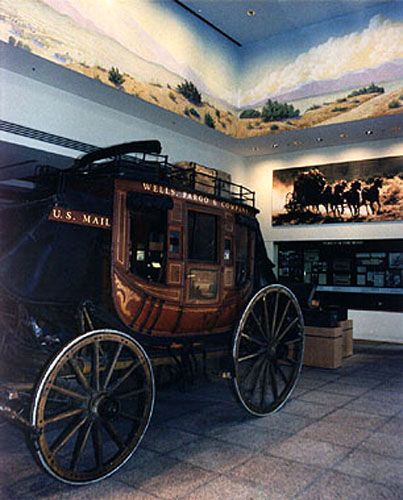
Wells Fargo Museum.
Wells Fargo began when prosperous New York City businessmen Henry Wells and William Fargo recognized a significant opportunity in the West following the discovery of gold. The pair, who had helped found American Express in 1850, officially established Wells Fargo & Co. on March 18, 1852, with two primary objectives: transportation and banking.
In California, where no railroads existed, the Wells Fargo & Co. Express planned to provide “express” services to the many miners flooding the area and freight services to businesses. Its banking division, Wells Fargo & Co. Bank, advertised financial services and general forwarding businesses for mail, valuable deliveries, and freight.
Within the year, Wells Fargo established its first office in San Francisco, soon followed by offices in Sacramento, Monterey, and San Diego, and, within a short time, in almost every mining camp in California. In its early days, Wells Fargo did not operate its own stagecoaches; instead, it subcontracted and invested in those already in operation. They were primarily an express company. Ken Wheeling, a leading expert on wagons, carriages, and stagecoaches, wrote in 2006:
“Although Wells, Fargo & Company shared board members with several stagecoach companies, it was not primarily in the stagecoach business. It was, first and foremost, an express company concerned with expediting the shipment of almost anything between a paying sender and an intended addressee. At times, it was necessary to subsidize this or that stage company so that its own shipping business might not suffer from want of a carrier.”
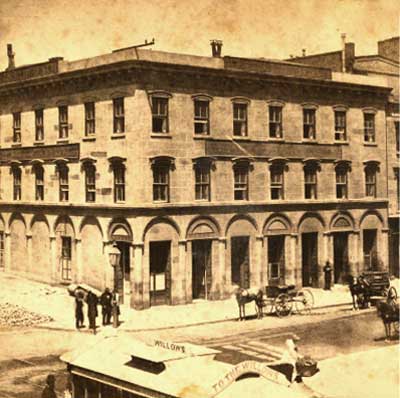
Wells Fargo Office, San Francisco, California.
One of its earliest and most important tasks was transporting gold from the Philadelphia Mint, a service Wells Fargo maintained until the United States Mint in San Francisco opened in April 1854. Another essential task served by Wells Fargo was mail delivery. Post offices were established in California in 1848, but the public preferred express companies because they were cheaper and faster than the U.S. Mail.
By 1855, mining activity in California had declined, and several banks had failed. However, Wells Fargo remained, soon to become the dominant express and banking organization in the West. At that time, they were the only company making large shipments of gold and continued to serve miners by delivering mail and supplies.
In 1857, Wells Fargo helped back the new Overland Mail Company, which provided regular twice-a-week mail service between St. Louis, Missouri, and San Francisco, California.
The Overland Mail Company was organized by men with extensive interests in four leading express companies: Wells Fargo, American Express, United States Express, and Adams Express. John Butterfield, one of the founders of American Express, was made president of the new company, with Wells Fargo being its primary lender.
Nicknamed the “Butterfield Line” after its president, the Overland Mail ran 2,757 miles through the Southwest via El Paso, Tucson, and Los Angeles before arriving in San Francisco. The trek across deserts and mountains took approximately 25 days, with only brief stops to change horses or for passengers to obtain food.
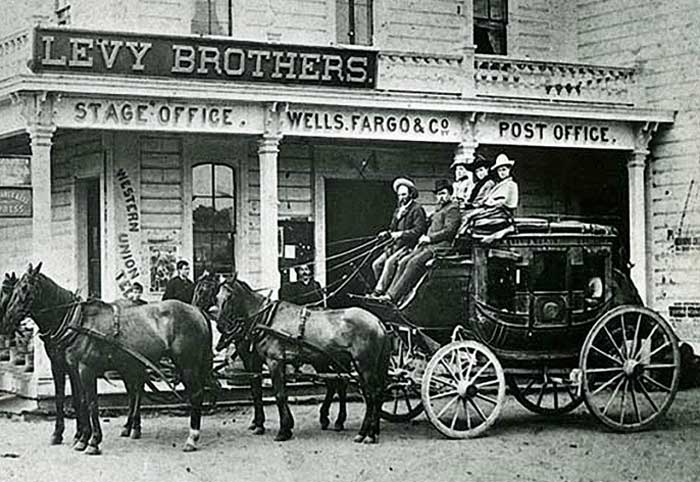
Wells Fargo Stagecoach in front of Levy Brothers in Pescadero, California, 1890.
However, Wells Fargo would still often use its own wagons and guards, as the Overland Mail Company forbade the shipment of valuables. Noted Overland Mail historian Gerald T. Ahnert points out John Butterfield’s Order No. 8 in the Overland Mail’s Special Instructions issued to employees that states, “No money, jewelry, banknotes, or valuables of any nature, will be allowed to be carried under any circumstances whatever.”
John Butterfield was forced out as president of the Overland Mail in 1860, and Wells Fargo increased its investment in the company. By the early 1860s, Wells Fargo monopolized the express business in California, sporting some 147 offices.
When the Civil War broke out, the route changed, moving northward across the Great Plains and the Rocky Mountains before snaking its way to California.
In 1866, Wells Fargo expanded its operations again, acquiring what was then Ben Holladay’s Overland Mail Express and consolidating the other independent companies on the “Central Route” to create the largest stagecoach company in the world. They controlled virtually all the stage lines from Mississippi to California. It was 1867 when Wells Fargo finally achieved the total running of a stage line with its logo on the side of a stagecoach. They placed their first order for 30 Concord stagecoaches with Abbot-Downing & Company on April 20, 1867.
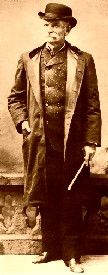
Black Bart, Outlaw.
During these fast and furious stagecoach heydays, Wells Fargo also became the primary focus of bandits and thieves. One of the most famous was Black Bart, who robbed 28 stages before being apprehended. But Black Bart was just one of the many men who attempted to make a career of robbing stagecoaches; others included the James-Younger Gang, the Red Jack Gang, “Rattlesnake Dick,” and dozens of others. During the 1860s, the company suffered 313 stagecoach holdups totaling $415,000.
In the meantime, the railroad had been hammering its way across the West, and in 1869, the Gold Spike joined the rails of the Transcontinental Railroad. This ended many of Wells Fargo’s overland stage operations; however, they continued on a smaller scale, traveling into areas the railroad had not yet reached. The company also evolved into the railroad express business, which became its primary focus until the early 20th century.
Wells Fargo was the target of bandits both on trains and on stagecoaches. The first major train robbery occurred in 1870, when the Central Pacific train from Oakland was held up near Truckee, California, and seven masked men escaped with $42,000 in gold and gold coins. As a result, Wells Fargo hired James B. Hume as its Chief Detective. Hume was with the company for 32 years and became one of the most famous detectives in the country. During his tenure, it was said: “There are two institutions dangerous for bad men to tinker with — the United States Government and Wells Fargo.”
By the turn of the century, Wells Fargo had more than 3,000 offices in nearly every state and in Mexico.
In 1904, Wells Fargo & Company relocated its headquarters to New York City, and the following year it separated its banking and express operations. Wells Fargo Bank subsequently merged with Nevada National Bank, forming Wells Fargo Nevada National Bank.

Stagecoach with a guard sitting on top, protecting whatever wealth it might have been carrying.
Wells Fargo was told to “throw down the box” from a Concord stage for the last time in 1908. The bandits were immediately pursued, this time in automotive vehicles. The last horse-drawn stage carrying Wells Fargo cargo ran between Tonopah and Manhattan, Nevada, in 1909.
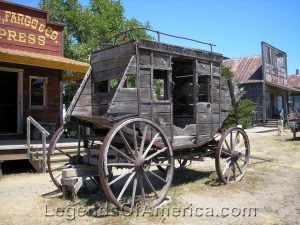
Wells Fargo office and stagecoach, 1880 Town, South Dakota, by Kathy Alexander.
Over the years, several mergers and acquisitions changed banking and express operations. In 1918, the express company merged into the American Railroad Express Company, leaving only the banking division to retain the Wells Fargo name.
Today, Wells Fargo & Co. provides financial services at some 6,000 locations.
The company also sponsors nine museums nationwide that display its rich history, authentic stagecoaches, gold nuggets, and rare exhibits, along with special tours and educational programs, with reservations.
Additional Information:
Wells Fargo Museum
420 Montgomery Street (A0101-106)
San Francisco, California 94163
©Dave Alexander/Legends of America, updated December 2025.
Also See:
John Butterfield & the Overland Mail Company
Tales of the Shotgun-Messenger Service, by Wyatt Earp
Sources:
Gerald T. Ahnert, “Construction of the Overland Mail Co. Stage Line in California,” for SCVHistory.com, 2014.
Wells Fargo Corporate History