
By Emerson Hough in 1905.
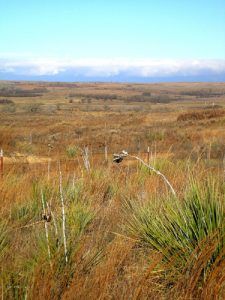
Texas Panhandle Plains by Kathy Alexander.
One prominent feature of early Western life was the population’s transience and mobility. It is astonishing what distances were traveled by the bold men who followed the mining stampedes all over the wilderness of the upper Rockies, despite the unspeakable hardships of a region where travel at its best was rude and travel at its worst almost impossible. The West was first peopled by wanderers and nomads, even in its mountain regions, which usually attached their population to themselves and cut off the disposition to roam. The adventurers’ nomadic nature made law almost impossible. A town was organized and then abandoned on the spur of the moment, out of necessity or rumor. The property was unstable, taxes were impossible, and any corps of executive officers found it difficult to maintain. Before there can be a law, there must be a population attached to it.
Therefore, the lawlessness of the real West was much a matter of conditions, after all, rather than of morals. It proved above all things that human nature is very much akin and that good men may go wrong when sufficiently tempted by great wealth left unguarded.
The first and second decades after the close of the Civil War found the great placers of the Rockies and Sierras exhausted and quartz mines taking their place. As has been shown, this same period marked the advent of the great cattle herds from the South upon the upper ranges of the territories beyond the Missouri River. By this time, the plains began to call the adventurers as the mines had recently called.
Here, then, was wealth, loose, unattached, apparently almost unowned, nomad wealth, and waiting for a nomad population to share it in one way or another. Once more, the home lacked permanence; the law was lacking as well, and man ruled himself in ancient, savage ways. By this time, frontiersmen were well-armed with repeating weapons that used fixed ammunition. More and better-armed men appeared on the plains than were ever known, unorganized, in any land at any period of the earth’s history, and the plains took up what the mountains had begun in wild and desperate deeds.
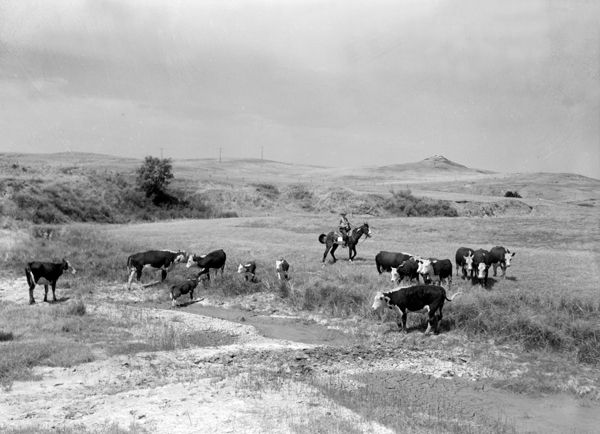
Montana Cattle by Arthur Rothstein.
The only property on the arid plains was that of livestock. Agriculture had not come, and it was supposed never to come. The vast herds of cattle from the lower ranges, Texas and Mexico, pushed north to meet the railroads, now springing westward across the plains, but a large proportion of these cattle were used as breeding stock to furnish the upper cow range with the horned population. Colorado, Wyoming, Montana, western Nebraska, and the Dakotas discovered that they could raise range cattle as well as the southern ranges and fatten them far better; so presently, thousands upon thousands of cattle were turned loose, without a fence in those thousands of miles, to exist as best they might, and guarded as best might be by a class of men as nomadic as their herds. These cat le were cheap at that time, and they provided a readily available food supply, much appreciated in a land just depopulated of its buffalo. For a long time, it was but a venial crime to kill a cow and eat it if one were hungry. A man’s horse was sacred, but his cow was not because there were so many cows that were shifting and changing about so much at best.
Ownership of these herds was widely scattered and difficult to trace. A man might live in Texas and have herds in Montana and vice versa. His prope ty rights were known only by the brand upon the animal, his being but the tenure of a sign.
“The respect for this sign was the whole creed of the cattle trade. The cattl man held his property absolutely without a fence or an atom of actual control. It mingles with the property of others, but it was never confused therewith. It wandered 100 miles from him, and he knew not where it was, but it was surely his and sure to find him. To touch it was a crime. To appropriate it meant punishment. Common necessity made common custom, common custom made common law, and common law made statutory law.”
When the Anglo-Saxons first struck the Southwest, the old Fierro, or iron mark, of the Spanish cattle owner and his “venta,” or sale brand to another, had become common law. The Saxon accepted these customs as wise and rational, and soon they became American law across the American plains.
The great bands of cattle ran almost free in the Southwest for many years, each carrying the owner’s brand if the latter had ever seen it or cared to brand it. Many cattle roamed free without any brand whatsoever, and no one could tell who owned them. When the northern ranges opened, the question of unbranded cattle remained, and the “maverick” industry was still held as a matter of sanction; there seemed to be enough for all. The day is one of glorious freedom and plenty, the baronial day of the great and once unexhausted West.
Now, the venta, or the act of selling an animal to another owner, began to complicate matters to some extent. A purchaser could put his own Fierro brand on a cow, meaning he now owns it.
But, then some suspicious soul asked, “How shall we know whence such and such cows came, and how to tell whether or not this man did not steal them outright from his neighbor’s herd and put his own brand on them?”
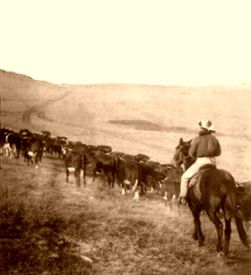
Cattle Trail.
Here was the origin of the bill of sale and the counter brand or “vent brand,” as it is known upon the upper ranges. The owner duplicated his recorded brand on another recorded part of the animal. This means his deed of conveyance, when taken together with the bill of sale, was over his commercial signature. Of course several conveyances would leave the hide much scarred and hard to read, and, as there were “road brands” also used to protect the property while in transit from the South to the North or from the range to the market, the reading of the brands and the determination of the ownership of the animal might be, and very often was, a nice matter, and one not always settled without argument. Arguments in the West often meant bloodshed in those days. Some hard men started up in trade near the old cattle trails and made a business of disputing brands with the trail drivers. Sometimes they made good on their claims, and sometimes they did not. There were graves almost in line from Texas to Montana.
It is now perfectly easy to see what a wide and fertile field was here offered to men who did not want to observe the law. Here was property to be had without work and property whose title could easily be called into question; whose ownership was a matter of testimony and record, to be sure, but testimony which could be erased or altered by the same means which once constituted it a record and sign. The brand was made with an iron, which could be changed with an iron. A large and profitable industry arose in changing these brands. The rustler, brand-burner, or brand-blotcher now became one of the new Western characters, and a new sort of bad-manism had its birth.
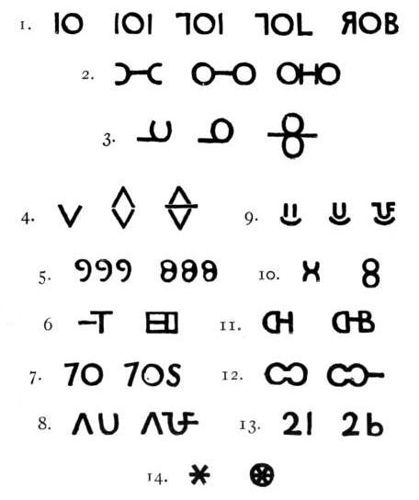
Brand changes.
“It is very easy to see how temptation was offered to the cow thief and ‘brand blotter.’ Here were all these wild cattle running loose over the country. The imprint of a hot iron on a hide made the creature the property of the brander, provided no one else had branded it before. The time for priority was a matter of proof. With the andy “running iron” or straight rod, which was always attached to his saddle when he rode out, could not the cow thief erase a former brand and put one of his own over it? Could he ot, for instance, change a U into an O, or a V into a diamond, or a half-circle into a circle? Could he ot, moreover, kill and skin an animal and sell the beef as his own? Between h m and the owner was only this little mark. Between h m and changing this mark was nothing but his moral principles. The range was very wide. Hardly a figure would show on that unwinking horizon all day long. Avastas a heifer here and there?”
Such temptation and opportunity led many a man to step over the line between right and wrong. Their excuse lies in the fact that the line was newly drawn and often vague and inexact.
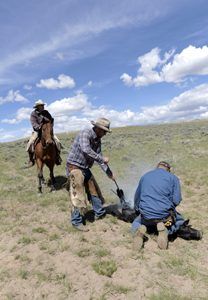
Branding cattle in Moffat County, Colorado, today by Carol Highsmith.
From killing or rebranding an occasional cow, it was easy to see the profits of a more extensive operation. The faithful cowboys who cared for these herds and protected them, even with their lives, in the interest of absent owners, began, in time, to tire of working for a salary and settled down on little ranches of their own, starting with a herd of cattle lawfully purchased and branded. An occasional maverick came across their range, and they branded it. A brand w s faint and not legible, and they put their own iron over it. They learned that pyrography with a hot poker was very profitable. The rest is easy. The first step was the one that counted, but who could tell where it was taken? At any rate, cattle owners began to take notice of their cows as prices rose, and laws were made to protect property that was rapidly increasing in value. Cow owners were required to have fixed or stencil irons and were forbidden to trace a pattern with a straight iron or “running iron.” Each ranch must have its own iron or stencil. Texas, as early as the 1860s, passed laws forbidding the use of the running iron altogether, so that after that, it was not safe to be caught riding the range with a straight iron under the saddle flap.
Any man so discovered had to do some quick explaining. The next step after this was the organization of cattle associations in several territories and states, which made the home of the cattle trade. These associations banded together in a national association. Detectives were placed at the stockyards in Chicago and Kansas City, charged with finding cattle stolen on the range and shipped with or without clean brands. In short, there had now grown up armed and legal warfare between the cowmen themselves — in the first place, very large-handed thieves — and the rustlers and “little fellows” who were accused of being too liberal with their brand blotching. The prosecution of these men was undertaken with something of the old vigor that characterized the pursuit of horse thieves, with this difference. In contrast, all the world had hated a horse thief as a common enemy; very much of the world found an excuse for the so-called rustler, who was known to be doing only what his accusers had done before him.
There may be a certain interest attached to the methods of the range riders of this day, and those who care to go into the history of the cattle trade in its early days are referred to the work earlier quoted, where the matter is more fully covered.
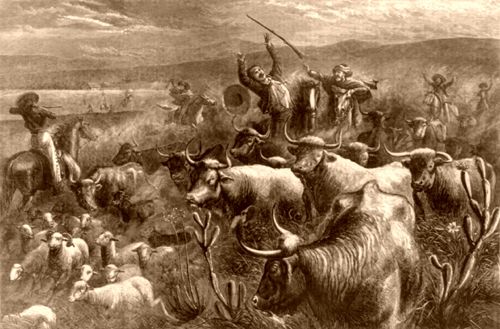
Cattle Rustlers.
The rustler might brand with his straight running iron, as it were, writing over again the brand he wished to change, but this was clumsy and apt to be detected, for the new wound would slough and look suspicious. A piece of red-hot haywire or telegraph wire was a better tool, for this could be twisted into the shape of almost any registered brand, and it would so cunningly connect the edges of both that the whole mark would seem to be one scar of the same date.
The fresh burn fitted in with the older one, making it impossible to swear that it was not part of the first brand mark. Yet another way of softening a fresh and fraudulent brand was to brand it with a wet blanket and a heavy iron, which thus left a wound deep enough but not apt to slough and so betray a brand done long after the round-up, and hence subject to scrutiny.
The ways in which brands were altered in their lines were many and most ingenious. A sample age will be sufficient to show the possibilities of the art by which the rustler set over to his own herds on the free-range the cows of his far-away neighbor, whom he perhaps did not love as himself.
Such, then, was the burglar of the range, the rustler, to whom most of the mysterious and untraceable crimes were ascribed. Such also were the excuses to be offered for some of the men who did what did not seem to them to be wrong acts. The sudden hostility of the newly-come cowmen embittered and inflamed them, and from this, it was easy and natural to resort to the arbitrament of arms.
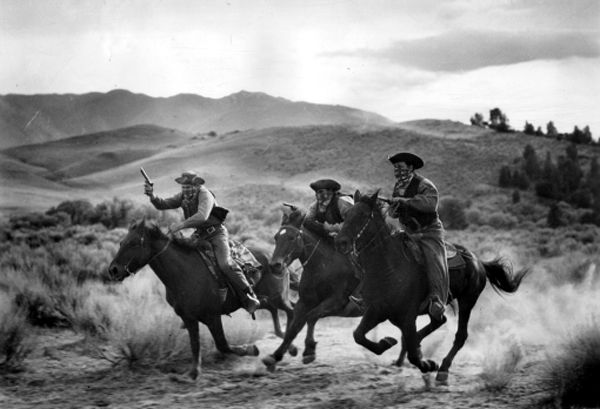
Vigilantes.
The bad men of the plains date to this era, and their acts may be attributed to these causes. There were to be found among these men many refugees and outlaws, as well as many better men who went wrong from the point of view. Fierce and far were the battles between the rustlers and the cow barons. Commerce has its way at last. The lawless man had to go, and he had to go even before the law had come.
The vigilantes of the cattle range, organizing first in Montana and working southward, made a clean sweep in their work. In one campaign, they killed between 60 and 80 men accused of cattle rustling. They hung thirteen men on one railroad bridge one morning in northwestern Nebraska. It is believed that, in the ten years from 1876 to 1886, they executed more men without the process of law than have been executed under the law in all the United States since then. These lynchings were also against the law. In short, it may perhaps begin to appear to those who study the history of our earlier civilization that the term “law” is a very wide, lax, and relative one, and one extremely difficult of exact application.
Go To Next Chapter – Wild Bill Hickok
Compiled and edited by Kathy Alexander/Legends of America, updated April 2026.
About the Author: Excerpted from the book The Story of the Outlaw: A Study of the Western Desperado, by Emerson Hough; Outing Publishing Company, New York, 1907. This story is not verbatim, as it has been edited for clerical errors and updated for the modern reader. Emerson Hugh (1857–1923) was an author and journalist who wrote fictional accounts and historical novels of life in the American West. His works helped establish the Western as a popular genre in literature and motion pictures. For years, Hough wrote the feature “Out-of-Doors” for the Saturday Evening Post and contributed to other major magazines.
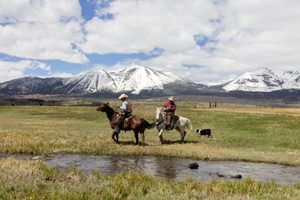
Modern Cowboys in North Park, Colorado by Carol Highsmith.
Other Works by Emerson Hough:
The Story of the Outlaw – A Study of the Western Desperado – Entire Text