
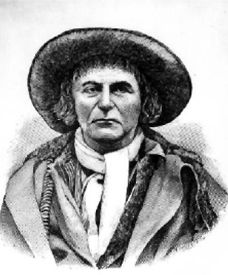
Richens Lacey “Uncle Dick” Wootton.
Richens Lacy “Uncle Dick” Wootton, an American frontiersman, mountain man, trapper, and guide, was born on May 6, 1816, in Mecklenburg County, Virginia. When he was seven, his family relocated to Kentucky, where he spent his childhood until he turned 17. Afterward, he moved to Mississippi, working on his uncle’s cotton plantation for two years before heading to Independence, Missouri, in 1836.
He soon took a job working on a wagon train run by the Bent, St. Vrain & Co., which landed him at Bent’s Fort, near present-day La Junta, Colorado. The fort was the only major permanent white settlement between Missouri and the Mexican settlements on the Santa Fe Trail. As such, it provided explorers, pioneers, and the U.S. Army with supplies, wagon repairs, livestock, food, water, and protection.
Shortly after arriving at the fort, the Bent, St. Vrain & Co. sent him north with about 13 men and wagonloads of goods to trade with the Sioux Indians. He enjoyed this work and became a mountain man for several years, earning his living as a trapper and trader among the Ute, Cheyenne, Sioux, Arapaho, and Comanche tribes. He traveled throughout the Rocky Mountains, reaching as far west as Washington and later heading southwest to California and Arizona.
However, trapping had become less profitable by 1840, and Wootton returned to work for Bent’s Fort as a hunter, scout, and freighter. During the Mexican-American War of 1846, he scouted for the U.S. Military. One of his primary duties at the fort was hunting game and buffalo to provide food for the fort; however, within a few short years, the buffalo herds began to dwindle dramatically, nearly to extinction, as droves of men hunted them only for their hides.
Wootton then briefly operated a buffalo ranch near Pueblo, Colorado, where he raised buffalo and cattle. Three years later, he drove the herd east along the Santa Fe Trail to Kansas City, Missouri, where he sold them all for a profit.
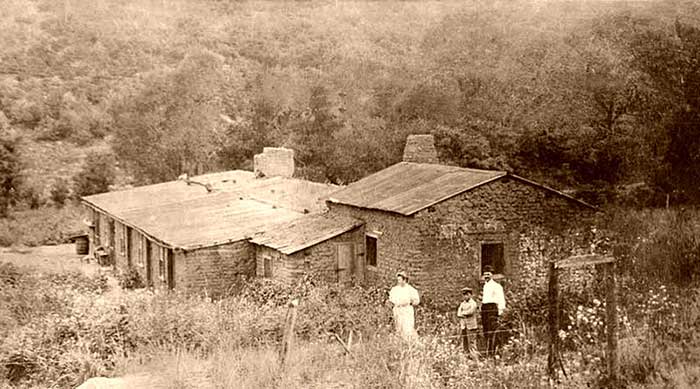
Wootton Ranch on the Santa Fe Trail.
By 1865, Wootton had settled near Trinidad, Colorado, leased land from Lucien Maxwell, owner of the Maxwell Land Grant, and obtained franchises from the territorial legislatures of Colorado and New Mexico to build a 27-mile toll road over Raton Pass in New Mexico.
Hiring Ute Indians to build the road, which required cutting down hillsides, blasting and removing rocks, building bridges, and grading the trail, dramatically improved a tough stretch of the Santa Fe Trail. He then erected a hotel and put up a tollgate in front of his home, charging $1.50 for one wagon or 25 cents for a horseman. However, Indians were always allowed to utilize the road free of charge. His home also acted as a Barlow and Sanderson stagecoach stop, where passengers could get a meal.
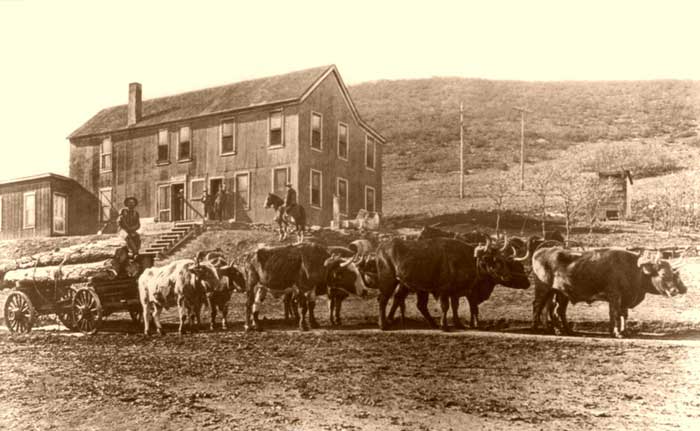
Ox team in Raton Mountains between Trinidad, Colorado and Raton, New Mexico, circa 1915.
The stage line also brought bandits to the road, who often held up the Express stagecoaches with posse men soon on their trail. The hotel was a favorite stopping place for the freighting teams and an open house for youngsters from Trinidad and El Moro, who held dances there weekly.
In 1878, the Atchison, Topeka & Santa Fe Railroad bought the right-of-way, paying him and his wife a lifetime pass and a pension as part of the purchase price. The toll road operated until 1879, when, at 75, Wootton moved to Trinidad, Colorado, where he lived until he died in 1893. Over the years, he had married four times and had 20 children. He outlived all but one of his wives and 17 of the 20 children.
After Dick’s death, his wife continued to receive the pass and the pension, and in 1925, the Santa Fe Railroad doubled the payments. In 1930, it increased again to $75. After Mrs. Wooton’s death, an invalid daughter, Miss Fidelis, got $25 a month during her lifetime.
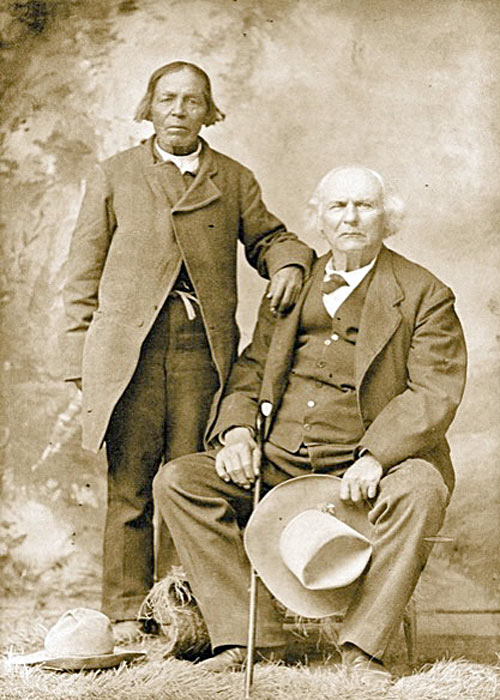
Ute Chief Conniach, also spelled Kaniache (standing left), with Uncle Dick Wootton seated right.
©Kathy Alexander/Legends of America, updated March 2026.
Also See:
Bent’s Fort National Historic Site
The Maxwell Land Grant – Largest Land Grant in U.S. History
Santa Fe Trail – Highway to the Southwest
Santa Fe Trail Famous Men – Uncle Dick Wooten
Santa Fe Trail Photo Print Gallery
The Treacherous Raton Pass on the Santa Fe Trail
See Sources.