
By Emerson Hough, 1907.

Levi Boone Helm.
Henry Plummer might be called a good instance of the gentleman desperado if such a thing is possible; a man of at least a certain amount of refinement and certainly one who, under different surroundings, might have led a different life. For the sake of contrast, if for nothing else, we may take the case of Boone Helm, one of Plummer’s gang, who was the opposite of Plummer in every way except the readiness to rob and kill. Boone Helm was bad, and nothing could have made him anything but bad. He was, by birth and breeding, low, coarse, cruel, animal-like, and utterly depraved, and for him, no name but ruffian can fitly apply.
Helm was born in Kentucky, but his family moved to Missouri during his early youth, so the boy was brought up on the borderland between civilization and the savage frontier, for this was about the time of the closing days of the old Santa Fe Trail, and the towns of Independence and Westport were still sending out their wagon trains to the far mountain regions. By the time Boone Helm was grown, and soon after his marriage, the great gold craze of California broke out, and he joined the rush westward. Already, he was a murderer, and already he had a reputation as a quarrelsome and dangerous man. He was of powerful build and turbulent temper, delighting in nothing so much as feats of strength, skill, and hardihood. His community was glad to be rid of him, like any community he had ever lived in.
Helm continued the line of life mapped out for him from birth in the California diggings. He met men like him there and was ever ready for a duel with weapons. In this way, he killed several men, no one knows how many, but this sort of thing was so common in the case of so many men in those days that little attention was paid to it. It must have been a ruthless murder which, at length, caused him to flee the Coast to escape the vengeance of the miners. He headed north and east, after a fashion of the times, following the California boom, and was bound for the mountain placers in 1853, when he is recorded as appearing at the Dalles, Oregon. He and a half-dozen companions, whom he had picked up on the way and most of whom were strangers to each other, now started for Fort Hall, Idaho, intending to go from there to a point below Salt Lake City.
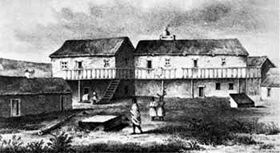
Fort Hall, Idaho.
The beginning of the terrible mountain winter season caught these men somewhere west of the main range in eastern Oregon, in the depths of as rugged a mountain region as any of the West. They were on horseback and so could carry small provisions, but in some way, they pushed on deeper and deeper into the mountains until they got to the Bannack River, where they were attacked by Indians and chased into a country none of them knew. At last, they got east as far as the Soda Springs on the Bear River, where they were on well-known ground. By this time, however, their horses had given out, and their food was exhausted. They killed their horses, made snowshoes with the hides, and sought to reach Fort Hall.
The party was now reduced to one of those awful, starving marches of the wilderness, which are now and then chronicled in Western life. This meant that the weak must perish where they fell.
The strength of Helm and one of the others, Burton, enabled them to push on ahead, leaving their companions behind in the mountains. Almost within reach of Fort Hall, Burton gave out and was left behind in an abandoned cabin. Helm pushed on into the old stockade but found it also abandoned for the winter season, and he could get no food there. He then went back to where he had left Burton, and, according to his report, he was trying to get wood for a fire when he heard a pistol shot and returned to find that Burton had killed himself.
He stayed on at this spot and, like a hyena, preyed upon the dead body of his companion. He ate one leg of the body and then, wrapping up the other in a piece of an old shirt, threw it across his shoulder and started on further east. He had, before this on the march, declared to the party that he had practiced cannibalism at an earlier time and proposed to do so again if it became necessary on this trip across the mountains. His calm threat was now verified. Helm was found at last at an Indian camp by John W. Powell, who learned that he was as hard a character as he had ever run across.
Nonetheless, he took care of Helm, gave him food and clothes, and took him to the settlements around Salt Lake. Powell found that Helm had a bag containing over $1,400 in coins, which he had carried across the divide through all his hardships. He would take no pay from Helm, and the latter never even thanked him for his kindness, leaving him as soon as he reached the Mormon settlements.
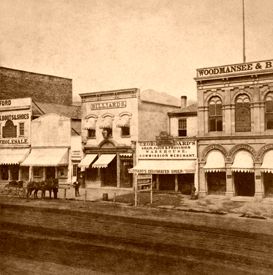
Salt Lake City, Utah, 1871.
Here, the abandoned ruffian boasted of what he had done and settled down briefly to the customary enjoyments of the rough when in town. He spent his money, hired out as a Danite, killed a couple of men whom the Mormons wanted removed, and soon got so bad that he had to leave. Once more, he headed west to California, and once more, he started back north from San Francisco for reasons satisfactory to himself. While in California, as was later learned, he undertook to rob and kill a man at an outlying ranch who had taken him in and befriended him when he was in need and in flight from vengeance. He showed no understanding of gratitude, no matter what was done for him or how great his extremity was.
In Oregon, Helm went back to robbery as his customary means of support, and he killed several men at this time of his life, but how many will never be known. In 1862, as the mountain placers were now beginning to draw the crowds of mining men, it was natural that Boone Helm should show up at Florence. Here, he killed a man in cold blood, in treachery, while his enemy was not armed after their quarrel had been compromised. This victim was Dutch Fred, a man with a reputation as a fighter, but he had never offended Helm, who killed him at the instigation of an enemy of his victim and possibly for hire. He shot Fred while the latter stood looking him in the face, unarmed, and, missing him with the first shot, took deliberate aim with the second and murdered his man in cold blood.
This was pretty bad even for Florence, and he had to leave. That fall, he turned up far to the north, on the Fraser River, in British Columbia. Here, he was once more reduced to the danger of a starving foot march in the wilderness, and here, once more, he was guilty of eating the body of his companion, whom he is supposed to have slain. The British authorities sent him back, and for a time was held in Portland, Oregon, for safekeeping. Later, he was tried in Florence for killing Dutch Fred, but the witnesses had disappeared, and people had long ago lost interest in the crime because of others more recent. Helm escaped justice and was supposed to have gone to Texas, but he soon appeared in the several settlements mentioned in the preceding pages and moved from one to the other. He killed many more men; how many in all was never known.
The courage and hardihood of Boone Helm were evidence of the closeness of his life. Three men of the Vigilantes did the dangerous work of arresting him and took him by closing in on him as he stood in the street talking. “If I’d had a chance,” said he, “or if I had guessed what you all were up to, you’d never have taken me.” He claimed not to know what was wanted of him when brought before the judges of the Vigilante court and solemnly declared that he had never killed a man in all his life! They made him kiss the Bible and swear to this over again to see to what lengths his perjured and depraved soul would go. He swore on the Bible with perfect calmness! This did not move his captors; Helm was little expectant that they would be. He called aside one of them whom he knew, declined a clergyman, and confessed to murder in Missouri and California; he admitted that he had been imprisoned once or twice, but denied that he had been a road agent. He accused some of his warmest friends of the latter crime. Jack Gallager, also under arrest, heard him thus incriminate himself and others of the gang and called him all the names in the calendar, telling him he ought to die.”
I have looked at death in all forms,” said Helm coolly, “and I am not afraid to die.” He then asked for a glass of whiskey, as did many of these murderers when they were brought to the gallows. From then on, he was cool and unconcerned and showed a finish worthy of one ambitious to be thought wholly bad.
There were 6,000 men assembled in Virginia City to see the executions of these criminals, who were fast being rounded up and hanged by the citizens. The place of execution was in a half-finished log building. The ropes were passed over the ridge pole, and, as the front of the building was open, a full view was offered of the murderers as they stood on the boxes arranged for the drops.
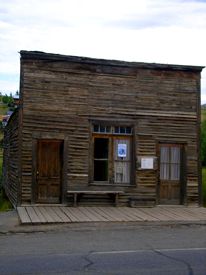
Hangman’s building in Virginia City, Montana.
Boone Helm looked around at his friends placed for death and told Jack to “stop making such a fuss.” “There’s no use being afraid to die,” said he, and indeed, there probably never lived a man more actually devoid of all sense of fear. He valued neither the life of others nor his own. He saw that the end had come and was careless about the rest. He had a sore finger, which was tied up, and this seemed to trouble him more than anything else. There was some delay about the confessions and the last offices of those who prayed for the condemned, and this seemed to irritate Boone Helm.
“For God’s sake,” said he, “if you’re going to hang me, I want you to do it and get through with it. If not, I want you to tie up my finger for me.” “Give me that overcoat of yours, Jack,” he said to Jack Gallager as the latter was stripped for the noose.”
You won’t need it now,” replied Jack Gallager, who was dying blasphemous. About then, George Lane, one of the lines of men about to be hanged, jumped off his box on his account.” There’s one gone to hell,” remarked Boone Helm philosophically. Jack Gallagher was hanged next, and as he struggled, his former friend watched him calmly. “Kick away, old fellow,” said Boone Helm. Then, as though suddenly resolved to end it, he commented, “My turn next. I’ll be in hell with you in a minute!”
Boone Helm was a Confederate and a bitter one, and this seems to have remained with him to the last. “Every man for his principles,” he shouted. “Hurrah for Jeff Davis! Let her rip!” He sprang off the box and finished, utterly brutal and reckless.
Go To the Next Chapter – Death Scenes Of Desperadoes
By Emerson Hough, 1907. Compiled and edited by Kathy Alexander/Legends of America, updated April 2026.
Custom Wanted Poster.
Also See:
Outlaws & Scoundrels Photo Gallery
Plummer’s Gang – the Innocents
About the Author: Excerpted from The Story of the Outlaw: A Study of the Western Desperado, by Emerson Hough; Outing Publishing Company, New York, 1907. This story is not verbatim, as it has been edited for clerical errors and updated for the modern reader. Emerson Hough (1857–1923).was an author and journalist who wrote factional accounts and historical novels of life in the American West. His works helped establish the Western as a popular genre in literature and motion pictures. For years, Hough wrote the feature “Out-of-Doors” for the Saturday Evening Post and contributed to other major magazines.
Other Works by Emerson Hough:
The Story of the Outlaw – A Study of the Western Desperado – Entire Text