
By Jun Joseph Nimmo for Harper’s Bazaar in 1886.
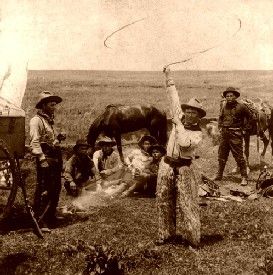
Fancy roping in Oklahoma.
In the mid-19th Century, the American cowboy occupied a place sufficiently important to command considerable public attention. His occupation was unique. In the exercise of his function, he was always a man on horseback. His duty as a worker in the cattle business was, at times, to ride over the range to see that straying cattle did not rove too far from the assigned limits, at times to drive the herd from one locality to another, and at times, to round up the dispersed cattle, by which is meant to collect them together for branding calves, or of selecting beef cattle, which latter were driven to railroad stations for shipment to market. The chief qualifications of efficiency in this calling are courage, physical alertness, ability to endure exposure and fatigue, horsemanship, and skill in using the lariat.
The original cowboy of this country was essentially a creature of circumstance and mainly a product of western and southwestern Texas. Armed to the teeth, booted and spurred, long-haired, and covered with the broad-brimmed sombrero, the distinctive badge of his calling, his personal appearance proclaimed the sort of man he was.
The Texas cowboys were frontiersmen, accustomed from their earliest childhood to the alarms and the struggles incident to forays of Indians of the most ferocious and warlike nature. The section of the State in which they lived was also, for many years, exposed to incursions of bandits from Mexico, who came with predatory intent upon the herds and the homes of the people of Texas.
 The carrying of firearms and other deadly weapons was consequently a prevalent custom among them. Being scattered over vast areas and beyond the efficient protection and restraints of civil law, they, of necessity, became a law unto themselves.
It is not strange that such an occupation and environment should have developed a class of men whom persons accustomed to the usages of cultivated society would characterize as ruffians of the most pronounced type. But among the better disposed of the Texas cowboys, who constitute, it is believed, much more than a majority of them, there were genuine and trusty men, in whom the dangers and fortunes of their lives developed generous and heroic traits of character. The same experiences, however, led the viciously inclined to give free vent to the worst passions. Upon a slight provocation, they would shoot down a fellow man with almost as little compunction as they fired upon the wild beasts.
However, the peculiar characteristics of the Texas cowboys qualified them for important public service. By their courage and recklessness of danger, their excellent horsemanship, and skill in the use of firearms, and by virtue also of the influence which they have exerted upon their gentler brethren of the northern ranges, they have been an efficient instrumentality in preventing Indian outbreaks, and in protecting the frontier settlements of the entire range and ranch cattle area against predatory incursions and massacres by Indians. This has been a natural result of the fact that the cowboys constitute throughout that region a corps of mounted scouts, armed and equipped, twenty thousand strong. They traverse vast ranges and ford rivers and search for cattle amid mountain fastnesses and lurking places of the river bottoms.
It is only twenty years since the discovery was made that between the line of settlement in Dakota, Nebraska, and Kansas at the east and the Sierra Nevada and Coast ranges in the west, there was an area as large as the portion of the United States which is situated east of the Mississippi River, throughout which cattle could be raised and fattened on the open range, seeking their food, water, and shelter without any aid from man, from the time they were dropped until they were in condition to be driven to a railroad station for shipment to market. This discovery, greater in its importance than the discovery of gold in California, silver in Nevada, or petroleum in Pennsylvania, happened, according to the most reliable accounts, in this way.
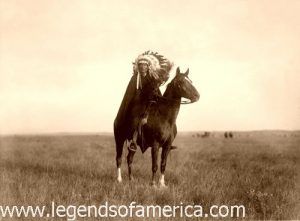
Prairie Chief.
Early in December 1864, a government trader, with a wagon train of supplies drawn by oxen, was on his way west to Camp Douglas in the Territory of Utah. Still, being overtaken on the Laramie Plains by an unusually severe snowstorm, lie was compelled at once to go into winter quarters. He turned his cattle adrift, expecting, as a matter of course, they would soon perish from exposure and starvation, but they remained about the camp, and as the snow was blown off the highlands, the dried grass afforded them an abundance of forage. When the spring opened, they were found to be in even better condition than when they turned out to die four months previously. This at once led to the experiment of herding cattle on the northern ranges. But for years, it was a slow and hazardous business. At that time, it was the custom to allow the Indians upon the reservations to wander off during the summer months throughout the present range and ranch cattle area so that they might hunt buffalo and other large game and then sustain themselves in their accustomed way until the approach of winter, when they returned to their reservations to be again provided for by the government.
Permission to depart on these expeditions was always given upon the promise made to the military and civil officers of the United States that while absent, they would be good Indians. But as cattle were more easily caught than buffalo, they found it greatly to their advantage to swoop down upon the herds, stampede them, and slaughter at their leisure as many as their needs required.
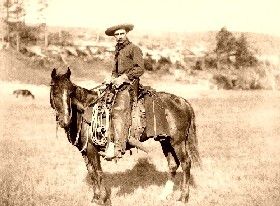
This cowboy is “forking” a horse.
Often, for amusement, they lifted the scalp of a stray cowboy. In many instances, they massacred whole camps of settlers, whose chief occupation was cattle herding. Occasionally, these wards of the nation so far forgot themselves as to put on war paint and set the United States at defiance. The massacre of General Custer and his detachment on the 25th of June, 1876, at the Little Bighorn, Dakota, near the present location of Fort Custer, led, however, to the adoption of a more stringent policy on the part of the United States government concerning requiring the Indians to remain upon their reservations. During the five years following that tragic event, our brave little army, widely scattered over a vast area, had many bloody encounters with the Indians.
At last, the spirit of resistance was broken. Montana, Idaho, and Dakota became comparatively safe for introducing the range cattle business, already known in Colorado and Wyoming as a beautiful enterprise and a speedy avenue to wealth. As the army’s work drew nigh to completion, the cowboy galloped in and became the mounted policeman of a vast area, always on patrol.
But even after the red man had retired to his reservations, the cattlemen were not entirely serene. From time immemorial, the horse thief and the cattle thief seem to have been parasitic growth upon frontier life, apparently begotten of its conditions. So it was on the range. For several years, the entire region, from Kansas and Colorado in the south to Montana and Dakota in the north, was infested by cattle thieves. The country afforded illimitable scope for this nefarious traffic.
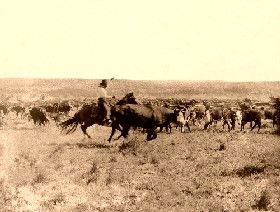
Cutting out from the herd in 1907.
It seemed at one time somewhat a matter of doubt as to which should prosper most, the herdsmen or the cattle thieves. As the cattle of many proprietors intermingled freely on vast ranges, it was comparatively easy and safe for a few marauders to pounce down upon detached groups of cattle here and there separated from the main body of the herds and drive them off over some mountain range to a distant valley or range where grazing was abundant. They brand the calves with a chosen hieroglyphic representative of separate ownership and change the marks of cattle already branded by one or more dashes with a red-hot iron.
It was clearly seen that, to stamp out this new and threatening evil recourse, a drastic remedy was needed. Accordingly, the various cattle associations organized a detective service, composed mainly of brave and trusty cowboys, who were charged with the duty of inspecting the whole country to discover the miscreants in their lairs, also to watch for altered and surreptitious brands at the railroad shipping stations. In this way, many stolen cattle were recovered, and many cattle thieves were apprehended. When the latter were arrested within the limits of the efficient administration of the law, they were handed over to the civil authorities. However, administrative justice was extemporized when it was found to be beyond the limits of organized counties.
The cattlemen and the cowboys themselves supplied judges, jurymen, witnesses, attorneys, constables, and executioners. Sometimes, a level-headed cowboy was placed upon the judicial bench. The cattlemen assert that the extreme and only penalty was never inflicted except upon the most apparent evidence of guilt. When the guilty verdict was pronounced, a short shrift, a stout rope, and a grave without a coffin or a winding sheet ended the proceedings.
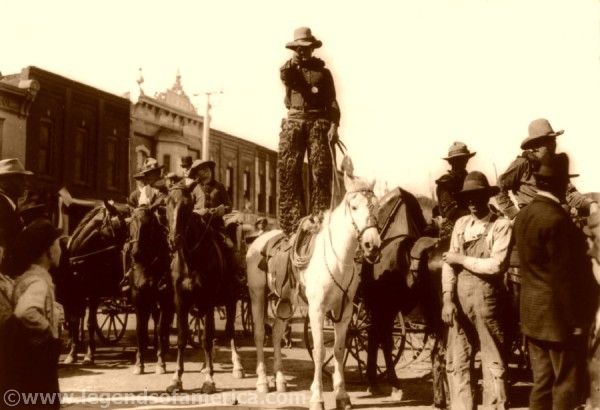
Cowboy Scene, Newton, Kansas, 1908.
But a significant change has taken place. On the northern ranges, cattle stealing has become almost entirely a thing of the past. States and territories have enacted laws requiring that all cattle be branded and that the brands be recorded in the office of the county clerk in which the owner of each herd resides. The brands are also published. Thus, the light of publicity is thrown upon the whole range of cattle business, and at the same time, it has acquired all those securities that characterize organized and well-ordered commercial enterprises.
At first, raising cattle on the northern ranges was confined mainly to settlers of small means. But soon, men of enterprise and capital saw that the placing of great herds on the ranges of the north, as had been done for years in Texas and Mexico, would, under adequate protection, be attended with great profit, for already railroads traversing or extending out into the territories afforded the facilities for transporting cattle to the three great primary cattle markets of the United States, viz., Chicago, St. Louis, and Kansas City — Chicago being by far the largest and thence to the markets of the world.
 It was an enterprise that required both capital and courage. For years, the State of Texas had been a prolific breeding ground for cattle. At that time,e cattle were worth on the ranges of that state but were little more than their hides and tallow. Two-year-old steers could be purchased in almost unlimited quantities for $3.50 to $4.50 per head. Besides, Texas had an army of cowboys who were acquainted with the Indians in all their ways and who instead courted than refused passage at arms with the Indians. There were, therefore, three material elements of success in a great undertaking — capital, cattle, and cowboys. Intelligent enterprise came in and formed the combination, and not long afterward, it became a matter of personal interest for the Indian to remain on his reservation all year round. Soon, the Texas steer superseded the buffalo, and the cowboy became the dominant power throughout New Mexico, Colorado, Wyoming, Montana, and the western portions of Dakota, Nebraska, and Kansas. Within 15 years, the cordon of cattle interests was drawn so close around the Indian reservations that the monarch of the plains became a gentle Indian. As a general rule, the ranch cattle business has been wonderfully successful under good management. Hundreds of men who entered the business a few years ago with exceedingly limited means have become cattle kings and now count their assets in the hundreds of thousands and even in millions. Women have also embarked on the enterprise in certain instances, and among the number are those who now rejoice in the nickname of cattle queens.
The market value of the surplus product of the entire range and ranch cattle area during 1884 was about $40,000,000, aside from the consumption within that area. Besides, the increase in herd value during the year is estimated to be quite a bit higher.
The cattle business was the chief commercial enterprise throughout that area, but as trade developed, it was instrumental in creating important collateral and related trade interests. One of the most important results of this has been that several transcontinental railroads have built up large and profitable local traffic. The original conception of transcontinental traffic was that it would be confined almost entirely to through business. Still, the local tonnage of the Northern Pacific Railroad during the year 1884 constituted 95%. of its total tonnage, and the local tonnage of the Union Pacific Railroad constituted 43% of its total tonnage.
Today’s cowboys, especially in the northern ranges, are entirely different from the original cowboys of Texas. New conditions have produced the change. As already stated, the range cattle business in Kansas, Nebraska, Colorado, Wyoming, Montana, and North Dakota is new. Those engaged in it as proprietors are chiefly from the States east of the Missouri River and north of the Indian Territory.
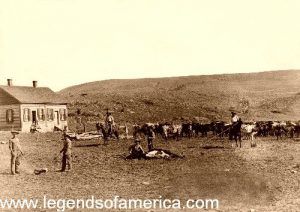
Branding Cattle, 1891.
Among them are also many Englishmen, Scotchmen, Frenchmen, and Germans of considerable means, including titled men who have extensively engaged in the business. Many of these came to America originally as tourists or to hunt buffalo. Still, the attractiveness of the cattle business arrested them, and they have become virtually, if not through the act of naturalization, American herdsmen. From the force of romantic temperament and the exhilaration of range life, some of this class have participated actively in the duties of the cowboy.
Organization, discipline, and order characterize the new undertakings on the northern ranges. In other words, the cattle business of that section is now and has been carried on strictly business principles.
Under such proprietorships and guided by such methods, a new class of cowboys has been introduced and developed. Some have come from Texas and have brought with them knowledge of the arts of their calling, but the number from the other States and the Territories constitutes a large majority of the whole. Some are graduates of American colleges, and others of European colleges. Many have temporarily resorted to the occupation of cowboy to learn the range cattle business, with the view of eventually engaging in it on their own account or in the interest of friends desirous of investing money in the enterprise.
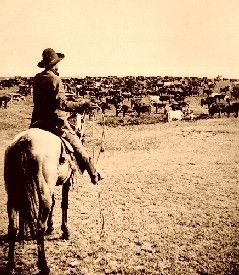
Cattle Roundup.
The cowboy’s life is always one of excitement and romantic interest. His waking hours when riding on the trail are spent in the saddle, and at night, he makes his bed upon the lap of Mother Earth. The great herds, which are yearly driven out of Texas to the northern ranges, usually embrace from 2,500 to 4,000 young cattle each, and the movement, since its beginning about eighteen years ago, has amounted to about 4,000,000 head, worth nearly $50,000,000. Each herd is in charge of a boss, with eight to ten cowboys, a provision wagon, and a cook. Four horses are supplied to each cowboy, for the duty is arduous. When away from their accustomed haunts, the range cattle are suspicious and excitable and need to be managed with the greatest care to keep them from stampeding. When on the trail, they are closely herded at nightfall, and all lie down within a space of about two acres. The cowboys then, by watches, ride around them all night long. The sensible presence of man gives the animals a feeling of security.
The journey from southern Texas to Montana requires four to six months. Herds are also driven from Oregon and the Washington Territory to Wyoming and eastern Montana.
It is impossible for one who has not had actual experience riding on trails to imagine the difficulties involved in driving a large herd of wild cattle over mountain ranges, across desert lands where, in some cases, food and water are not found for many miles, and where streams must be crossed that are liable to dangerous freshets.
A large part of the northern ranges is encompassed by the area that Silas Bent, an accomplished meteorologist, called the birthplace of the tornado. Thunder and lightning are here frequently, and they are incredibly terrifying when they rage at cattle. The most thrilling incident in the life of the cowboy occurs during a thunderstorm at night. Such an occurrence is thus described from personal observation by Mr. William A. Bailhie Grohman, an English writer:
“On the approach of one of these violent outbursts, the whole force is ordered on duty; the spare horses, of which each man always has three, and often as many as eight or ten, are carefully fed and tethered, and the herd is rounded up, that is, collected into as small a space as possible, while the men continue to ride around the densely massed herd. Like horses, cattle derive courage from the close proximity of man. The thunder peals, and the vivid lightning flashes with amazing brilliance, as the herd, with lowered heads, eagerly watches the slow, steady pace of the cow ponies and no doubt derives a comforting sense of protection from it. Sometimes, however, a wild steer cannot control his terror and dashes through a convenient opening. The crisis at hand, for example, will surely be followed, and in two minutes,s the whole herd of 4000 head will have broken through the line of horsemen and be away, one surging, bellowing mass of terrifying beasts.”
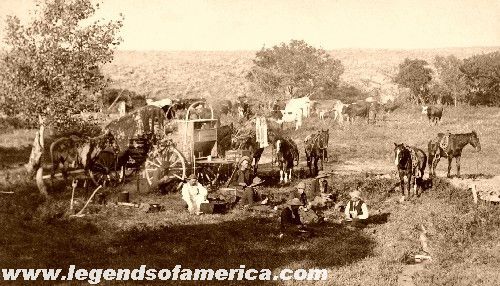
Cowboys gathered around the chuckwagon, ready for “chow” on the ranch in 1887.
Fancy a pitch-dark night, a pouring torrent of rain, the ground not only entirely strange to me but very broken and full of dangerously steep watercourses and hollows, and you will have a picture of cowboy duty on such a night. They must head off the leaders. Once somewhat off, they will stampede twenty, thirty, and even forty miles at a stretch, and many branches will stray from the main herd. Not alone the reckless rider, rushing headlong at a breakneck pace over dangerous ground in dense darkness, but also the horses, small, insignificant beasts, but matchless for hardy endurance and willingness, are perfectly aware how much depends upon their speed that night if it kills them. Unused till the last moment remains the heavy cowhide quirt, or whip, and the powerful spurs with rowels the size of five-shilling pieces. Urged on by a shout, the horses speed alongside the terrified steers until they manage to reach the leaders, when, swinging round and fearless of horns, they press back the bellowing brutes till they turn them. All the men pursuing this maneuver, the headlong rush is at last checked, and the leaders, panting and lashing their sides with their tails, are brought to a stand, and the whole herd is again rounded up.
Throughout their time in northern ranges, the cowboys were enjoined on sobriety, self-restraint, decent behavior, and faithfulness to duty. A great improvement is also observable in the cowboys of Texas. Their violent deeds are now few. The morale of the entire range and ranch cattle business of the United States now compares favorably with that of other large enterprises.
I wish I could find words to express the trueness, the bravery, the hardihood, the sense of honor, the loyalty to their trust and to each other of the old trail hands.
— Charles Goodnight
Compiled and edited by Kathy Alexander/Legends of America, updated April 2026.
The American Cowboy was written by Jun Joseph Nimmo for Harper’s Magazine, Volume 73, Issue 438, November 1886. The article, as it appears here, is not verbatim, as it has been edited.
See our Cowboys & Trailblazers Photo Gallery
Cowboy T-Shirt available at Legends’ General Store
Also See:
List of Trail Blazers, Riders, & Cowboys
Cowboys on the American Frontier