
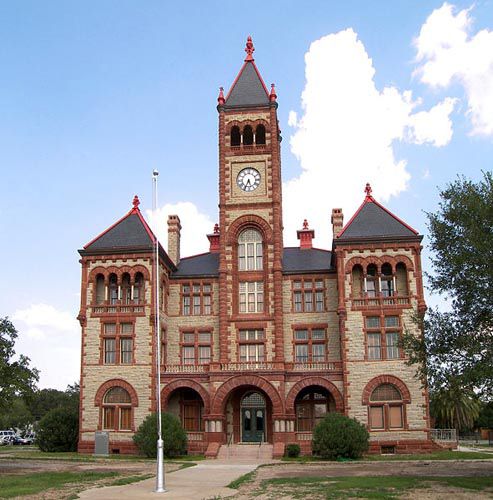
DeWitt County Courthouse in Cuero, Texas. Photo by Larry D. Moore, courtesy of Wikipedia.
Although feuds and range wars in Texas were common in the Old West, the longest and bloodiest was the Sutton-Taylor Feud, which grew out of bitter feelings after the Civil War. Some accounts claim that the Sutton and Taylor families originated from South Carolina, where the feud is said to have begun as early as the 1840s. However, no written evidence supports this, aside from speculation by contemporary journalists.
But there is no doubt about the “war” in DeWitt County, Texas. The area, in the midst of “Reconstruction” following the Civil War, was, for its citizens, a time of turmoil rather than “rebuilding.” Disputes between neighbors were rampant over land boundaries, cattle ownership, and water rights; outlaws ran amok; and Vigilante Groups, often little better than the outlaws themselves, were frequently the only “law” to be found.
Making matters worse were a general depression, drought, and poor crops. Amid this, cattle prices soared, turning many young men into cowboys or cattle rustlers. DeWitt County was in chaos and ripe for an old-fashioned feud.
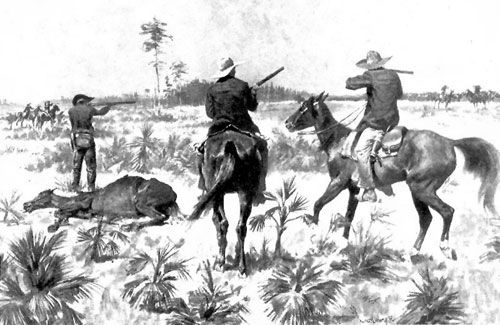
Old West Feud.
The two families involved in the feud were the Taylors, headed by Pitkin Taylor, brother of Creed Taylor, a renowned Texas Ranger. Opposing them were the Suttons, headed by William E. Sutton, a former Confederate soldier who had moved to DeWitt County with his family. A rancher, Sutton also became a deputy sheriff in Clinton, Texas, and on March 25, 1868, shot and killed a Taylor kinsman named Charley Taylor when he tried to arrest him for horse theft. Later that year, on Christmas Eve, Sutton killed Buck Taylor and Dick Chisholm in a saloon in Clinton, after an argument regarding the sale of some horses. Making matters worse for the Taylor faction, Sutton was appointed to the State Police Force under Captain Jack Helm. The Police Force, along with Union soldiers, was tasked with enforcing “Reconstruction,” much to the chagrin of many a Southern sympathizer.
The feud evolved into a struggle between the Taylors and their strong-minded southern friends, including Mannen Clements and his brothers and John Wesley Hardin, and the State Police, often referred to as the Sutton-Helm Faction, with each side recruiting about 200 members.
Ostensibly in pursuit of horse and cattle thieves, the State Police terrorized Southeast Texas, and on August 23, 1869, ambushed and killed Jack Hays Taylor. Almost exactly a year later, on August 26, 1870, the Sutton-Helms men arrested Henry and William Kelly, sons-in-law of Pitkin Taylor, on a trivial charge. However, rather than taking the men in, they shot them down. Jack Helm was dismissed from the force when this and other examples of his misconduct became known; however, he continued to serve as DeWitt County Sheriff. With Helm gone, William “Billy” Sutton became the group’s recognized leader.
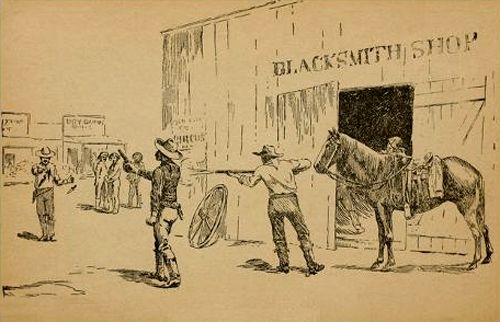
Jack Helm was killed in May 1873.
In the summer of 1872, Pitkin Taylor was lured from his home by a party of Sutton sympathizers and shot down. Severely wounded, he died six months later. His son, Jim Taylor, avowed to avenge his father’s death, and on April 1, 1873, shot through the door of a Cuero saloon, wounding William Sutton. However, Sutton lived, but Jim was not yet through. He again tried to kill him in June, but Sutton was able to escape. In the summer of 1873, the Taylor faction killed a man named Jim Cox and another member of the Sutton group. In May, Jim Taylor and John Wesley Hardin shot down Jack Helm.
After Helm was killed, the Taylor faction moved on to Sutton member Joe Tumlinson’s stronghold, near Yorktown. However, a posse talked the factions into signing a truce. But the peace would last only until December 1873, when the killings began again. Finally, William Sutton took his family out of the county, intending to leave for good. However, as he and his wife, along with friends, Gabriel Slaughter and his wife, boarded a steamer at Indianola, Texas, on March 11, 1874, Jim and Billy Taylor shot down the two men in front of both of their wives.
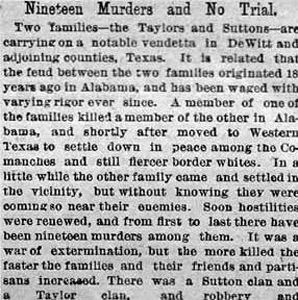
Sutton-Taylor Feud Newspaper Clipping
In retaliation, the Sutton Faction lynched three of the Taylor group, including Kute Tuggle, Jim White, and Scrap Taylor, who were driving a herd up a cattle trail.
Finally, the Texas Rangers, under Captain Leander H. McNelly, were called in to restore peace to the region. For the next several months, they worked diligently at breaking up the feud; however, they had little success.
In the meantime, Billy Taylor, who had been arrested for the killing of Sutton and Slaughter, was being held in jail at Indianola, Texas. His murder trial was scheduled for September 16, 1875. With word of the feud having spread all over the state, the town was filled with visitors and journalists, anxious to witness Billy Taylor’s murder trial. The evening before the trial, Indianola, which was highly vulnerable to tropical storms, was hit by 110-mile-per-hour winds, flooding the town, including the jail. During the night, city officers opened the prisoners’ water-filled cells and freed them from certain death. The hurricane lasted throughout the night and into the morning hours of September 17. When all was calm once again, the city was destroyed, as many as 300 people were dead, and the prisoners who had been freed, including Billy Taylor, were gone.
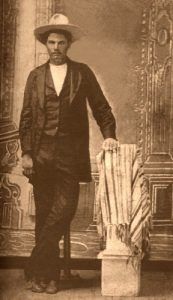
John Wesley Hardin.
On November 17, Reuben H. Brown, the new leader of the Suttons and marshal of Cuero, Texas, was shot down in the Exchange Saloon by John Wesley Hardin. The following month, a gunfight occurred in Clinton, which took the lives of Jim Taylor and two of his friends.
With Jim’s death, the feud slowed, but on September 19, 1876, two more men were to lose their lives in the bloody feud. On that night, a group of masked men ordered Dr. Philip Brassell and his three sons out of the house. Although Brassell’s oldest son, George, was a notorious outlaw with a price on his head, Dr. Brassell was a peace-loving man and highly respected in the community. The masked men marched the four men down the road, where they coldly executed the doctor and George Brassell. The two younger sons escaped. These killings once again brought in the Texas Rangers, and ultimately, eight men were charged with murder and held for trial. However, no one was willing to testify, and a series of legal maneuvers resulted in all but one being released. Only one man was convicted, and he was eventually pardoned.
The Sutton-Taylor Feud finally ended with neither side victorious. During these bloody years, the Taylor faction lost some 22 lives compared to 13 fatalities among the Sutton faction.
©Kathy Alexander/Legends of America, updated October 2026.
Also See:
Reconstruction After the Civil War
See Sources.