
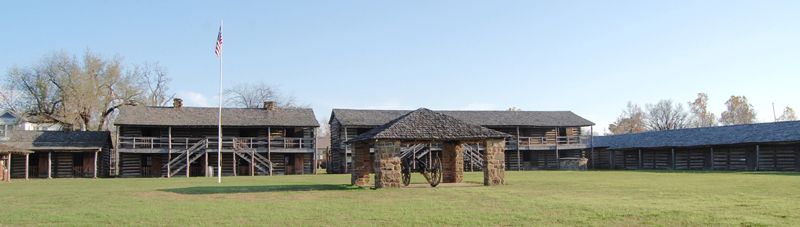
Fort Gibson, Oklahoma, by Kathy Alexander.
Fort Gibson, Oklahoma, was among the most important posts on the “Permanent Indian Frontier.” The first fort established in the Indian Territory was central to the problems of relocating the Five Civilized Tribes from the Southeast. A frontier hub of commerce and military activity, it served as a key transportation point and a testing ground for newly activated organizations such as the Ranger units and Dragoon Regiments.
Established in 1824 by Colonel Matthew Arbuckle on the East bank of the Grand River, just above its confluence with the Verdigris and Arkansas Rivers, the fort helped keep the peace between the Osage Indians, who opposed any intrusion into their territory, and the Cherokee, who were already filtering into Indian Territory.
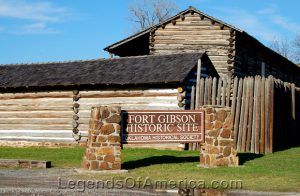
Fort Gibson, Oklahoma Historic Site.
The post replaced Fort Smith, Arkansas, which had been too far South to control the Osage effectively and remained inactive, except for several months, until 1839. During the Indian removal in the 1830s and 1840s, the Fort Gibson garrison helped receive, care for, settle, and enforce peace among immigrant Cherokee, Creek, Choctaw, Seminole, and Chickasaw, and attempted to protect them from the Plains Indians. Troops escorted surveyors marking the boundaries of Indian lands; established other posts in Indian Territory, such as Forts Coffee and Wayne and Camp Holmes; laid out a network of military roads; and tried to control illegal liquor traffic.
In 1834, the fort was the base for the Dragoon Expedition, originally under the command of Colonel Henry Leavenworth, who died of fever en route. His successor, Colonel Henry Dodge, met with some of the southern Plains tribes at the North Fork of the Red River and persuaded them to send delegates to Fort Gibson for negotiations. As a result, in 1835, the tribes made their first treaties with the U.S. Government at Camp Holmes, Oklahoma.
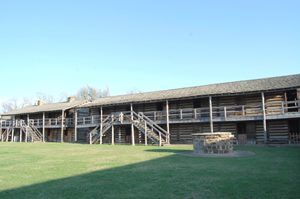
Soldiers’ Barracks at Fort Gibson, Oklahoma by Kathy Alexander.
Fort Gibson was also a center of trade and travel. Located beyond the point where river navigation was virtually impossible, it served as a supply depot for a large area. Keelboats and later river steamers came up the Arkansas River to the fort a few months each year and unloaded passengers, military stores, and Indian trade goods. Traders furnished return cargoes. The Texas Road, which ran from North to South and linked the growing American settlements in Texas with the Missouri River Valley, passed by the fort, which became a way station for emigrants, freighters, and traders. The troops also escorted road traffic. The fort remained a transportation and freight center until the Missouri, Kansas, and Texas Railroad arrived in 1872.
Originally a four-company post, the fort expanded in 1831 to accommodate a regiment, becoming the district headquarters and overtaxing its limited capacity. Situated on low ground, it was also flooded and threatened by malaria. In 1846, construction began on a new post on the hill overlooking the old site. However, the project progressed slowly, and by 1857 only one stone building, the commissary storehouse, was finished. That year, the Cherokee requested that the fort be evacuated, and because the frontier had moved westward, the Army abandoned it, and the tribe took possession.
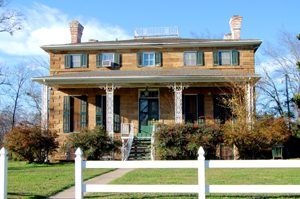
Fort Gibson, Oklahoma Commander’s Quarters by Kathy Alexander.
At the outbreak of the Civil War, the Confederates occupied the fort. However, in 1863, Union forces made it a Federal stronghold in Indian Territory and sought to strengthen the loyal Cherokee element. Regular troops replaced the Volunteers in 1866 and garrisoned the post until 1890. During this period, the fort on the hill was completed, consisting of seven large stone buildings and ten frame ones.
Although the original fort has long since disappeared, the State of Oklahoma, with a Works Progress Administration grant, completed a reconstruction in 1936 on a 55-acre tract, recreating the original log stockade and several outlying log buildings almost on the original site. Except for the use of more durable materials, especially pine timber and lime chinking, the reconstruction is faithful to the original. Interpretive markers guide the visitor.
The second fort site is on the ridge to the East, overlooking the reconstructed stockade. Stone buildings, some now private homes, survive in various stages of repair, together with some ruins. A two-story stone barracks with porches on both levels is the most imposing and is in good condition. Owned by the State Historical Society, it is a private residence. One mile East of Fort Gibson is the Fort Gibson National Cemetery. Many soldiers buried there were removed from the Oklahoma forts of Towson, Arbuckle, and Washita.
Designated as a national historic landmark in 1960, the Fort Gibson Historic Site is a museum that interprets its history and role in developing the Indian Territory frontier, including the Indian Removals, the Mexican-American War, the Civil War, and the Indian Wars period.
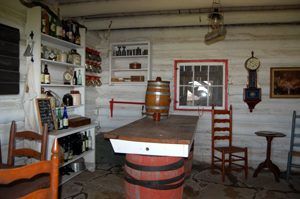
Building Interior at Fort Gibson, Oklahoma, by Kathy Alexander.
Contact Information:
Fort Gibson Historic Site
907 N. Garrison
PO Box 457
Fort Gibson, Oklahoma 74434-0457
918-478-4088
Compiled by Kathy Alexander/Legends of America, updated October 2026. Source: National Park Service
Also See: