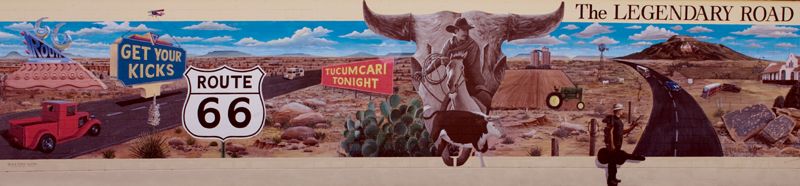
Route 66 Mural in Tucumcari, New Mexico, painted by artists Doug and Sharon Quarries.
Once nicknamed “Six-Shooter Siding,” Tucumcari, New Mexico, started as a rowdy railroad camp filled with saloons and outlaws. The camp began in 1901 when the Rock Island Railroad pushed west. The small settlement of Liberty, some three miles north, wasted no time dismantling and moving closer to the railroad. Soon, the camp was filled with merchants, gamblers, saloon keepers, and dance hall girls.
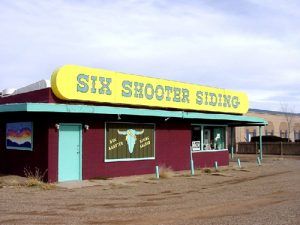
Six-Shooter Siding Tavern, Tucumcari, New Mexico, by Kathy Alexander.
The fathers of Tucumcari were five businessmen from Liberty who filed on the land and then donated 120 acres for the townsite. They were: M.B. Goldenberg, A.D. Goldenberg, Jacob Wertheim, J. A. Street, and Lee K. Smith. J.A. Street is credited with erecting the first tent in the new railroad camp.
The camp was initially called Douglas, but just one year later, the town adopted the name Tucumcari to reflect the scenic Tucumcari Mountains, which served as a backdrop for the city. The meaning of “Tucumcari” is a loose derivation of a Comanche word for lookout.
The first passenger train arrived in Tucumcari on March 12, 1902. Before long, four passenger trains were arriving daily, two from the east and two from the west.
One of the first issues these hardy pioneers faced was the lack of water. Initially, wells were dug into the hard ground, but failure to locate water discouraged further drilling. Therefore, water had to be hauled into the new settlement daily, at a cost of 50¢ per barrel.
Some of the first businesses to open in 1902 were the Waldorf-Astoria Hotel, which offered rooms for $2 a day, the Monarch Saloon, as well as many other bawdy taverns, a furniture store, a livery barn, a boarding house located at First and Turner Streets, several mercantile stores, and the Exchange Bank. Max Goldenberg’s home was the first permanent home built in Tucumcari, and it contained the post office.

Tucumcari, New Mexico, P. Clinton Bortell, 1913.
The Elk Drug Store was established in 1906. It was owned by Drug Store Cowboy Herman Moncus, who collected a vast assortment of items related to the area’s history. He hung his collection from the ceiling of his drug store.
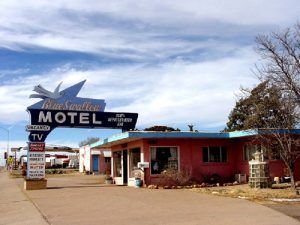
Blue Swallow Motel, Tucumcari, New Mexico, by Kathy Alexander.
Within six years, the mesa lands around Tucumcari had been inundated by homesteaders who had arrived in Oklahoma Indian Territory too late to get land. By 1907, there were 20 small towns scattered about Tucumcari. Three years later, in 1910, Tucumcari had over 70 businesses, a school system, and several churches.
The town thrived primarily from the railroad and area ranching opportunities until the Depression era. At that time, most of the 20 small towns surrounding the city were abandoned and quickly reverted to cow pastures.
However, Tucumcari held on, thanks to the arrival of Route 66, as new businesses opened. In 1940, when the South Canadian River was dammed, some 60,000 acres of irrigated farmland were created. What were once cow pastures soon became rich farmland, pulling Tucumcari out of its slump.
Today, with over 6,000 visitors, Tucumcari offers several attractions, including the Mesalands Dinosaur Museum, the Tucumcari Historical Museum, which includes a historic Route 66 exhibit, and Ute Lake State Park.
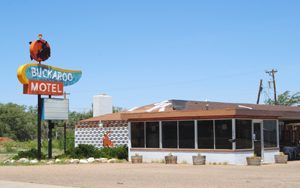
Buckaroo Motel, Tucumcari, New Mexico, by Kathy Alexander.
Not too far off the beaten path are sandstone rocks balancing in pinnacle formations, mesas and mountains, the cool, winding water of the Canadian River, area lakes, and a variety of wildlife, including herds of pronghorn antelope and mule deer, flocks of Canadian geese, and sandhill cranes.
Tucumcari’s five-mile claim to Route 66 fame is along Tucumcari Boulevard, where travelers can glimpse what Route 66 was about. The 1940s and 1950s flavor of the Mother Road is evident here in Tucumcari’s treasure trove of motels, restaurants, and curio shops.
Numerous neon signs beckon the traveler to stop at the legendary Blue Swallow Motel, established in 1939, or the Tee-Pee Curios trading post, a Route 66 icon, the Paradise Motel, and dozens of others.
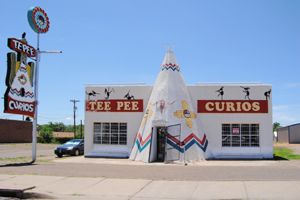
Tee Pee Curios in Tucumcari, New Mexico, by Kathy Alexander.
Along your way, be sure to check out the Cactus Motor Lodge, the Westerner Drive-In, the Last Motel, the Pine Lodge, the Palomino Motel, Del’s Restaurant, the Town House and Safari Motels, the Sahara Sands Motel & Restaurant, Dick’s Auto Service, the Pow Wow Restaurant, the Buckaroo Motel, the Redwood Lodge and the Paradise Motel.
The Tucumcari-Quay County Chamber of Commerce has a wonderful four-color brochure on Route 66, so be sure to ask for a copy at either the museum or the Chamber’s office. The brochure outlines a special Route 66 history tour of Tucumcari.
Tucumcari is truly a Route 66’ers delight. Be sure to allow yourself plenty of time to stop and snap dozens of pictures before heading down the road to Montoya and Santa Rosa.
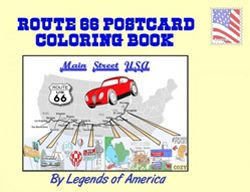
Route 66 Postcard Color Book, available at Legends General Store.
©Kathy Alexander/Legends of America, updated March 2026.
Also See:
New Mexico – Land of Enchantment
See Sources.