
By William H. Ryus, 1913
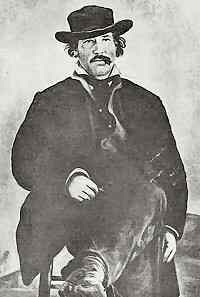
Lucien B. Maxwell.
Lucien B. Maxwell was a thoroughbred Northerner, first opening his eyes in Illinois. He came to New Mexico just before the United States acquired the territory, before the ranch was granted, then known as the Beaubien Grant. He was employed as a hunter and trapper for the American Fur Company.
The ranch, known as the Beaubien Grant, was one of the most interesting and picturesque ranches in all of New Mexico and contained nearly 2 million acres, traversed by the Old Trail.
Lucien Maxwell married a daughter of Carlos Beaubien. Interested in this large ranch with him was a Mr. Miranda. After the death of his father-in-law, Maxwell bought all the interests of Miranda and became the largest landowner in the United States.
The arable acres of this large estate in the broad and fertile valleys were farmed by native Mexicans. The system in effect in the territory at that time was one of peonage. Lucien Maxwell was a good master, however, and employed about 500-600 men.
Maxwell’s house was a veritable palace compared with the usual style and architecture of that time and country. It was built in the old Southern style, large and roomy. It was the hospitable mansion of the traveling public, and I have never known or heard of Maxwell ever charging a cent for a meal’s victuals or a night’s lodging under his roof. The grant ran from the line of Colorado on the Raton mountains, sixty miles south, and took in the little town of Maxwell on the Cimarron River. The place is now known as Springer, New Mexico.
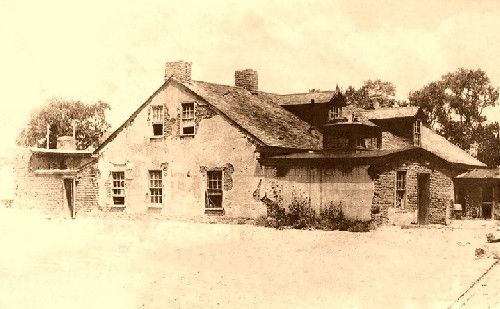
Maxwell House in Cimarron, New Mexico.
In the yard at the Maxwell Palace, as we will call his house, was an old brass cannon, about which we may speak later. He had a grist mill, a sutler’s store, a wagon repair shop, and a trading post for the Indians.
Besides his wife, a Mexican woman, Maxwell had a nice eight-year-old little girl whom he sent to St. Louis, Missouri, with some friends to attend school and learn to become a “high-bred” lady. In the fall of 1864, on one of my trips to Santa Fe, I met Miss Maxwell, a young lady about 16, and took her to her father’s house in New Mexico. As we were crossing the Long Route, I asked her if she spoke Spanish. She told me that she had forgotten every word of it.
Everything at the Maxwell Ranch had on its holiday finery in anticipation of the arrival of this young lady, and Mrs. Maxwell came to meet the coach that bore her beloved child. It was one of the most touching incidents ever in my life, before or since. The mother reached the coach first and had the girl in her arms, crying and laughing over her, speaking in Mexican to her, but the girl never understood one word her mother said, and the mother was at an equal loss to know what the daughter said to her. At last, Maxwell greeted his daughter, who had grown so much that he could hardly recognize her as the little girl he had sent to the States to receive an education, and became the interpreter between mother and daughter at once.
One year later, at Fort Union, I met Miss Maxwell and talked with her. She told me she had mastered the Mexican language and was a fine horsewoman.
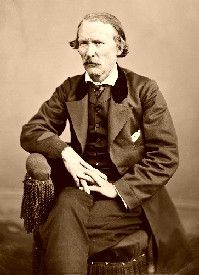
Kit Carson.
In 1853, Maxwell and Kit Carson, who was a favorite friend of Maxwell and not an infrequent visitor at his place, went to California with a drove of sheep. They took the old Oregon Trail by way of Salt Lake, Utah, and arrived in California some four months later, where they sold their sheep to the miners at a substantial price. As I recall, the sum was in the neighborhood of $100,000. They met ill luck on their return. They thought they could return together without being approached by robbers. However, they had been closely watched, and their intentions were pretty well known to a bold band of robbers then plying between the mines of California and New Mexico. After they had reached the Old Oregon Trail, they were held up and robbed of all they carried. However, the robbers accommodated them by returning their horses, saddles, and bridles, and by giving them enough money to make their way home.
During my travels across the plains, I do not believe that for a distance of 45 miles, I was ever out of sight of the herds — cattle, horses, goats, sheep, etc.— belonging to Mr. Maxwell.
A few weeks after Maxwell and Kit Carson were robbed on the Old Oregon Trail, they got together with two other herds of sheep. They went again to California, taking every precaution against the attack of robbers. This time, Kit Carson went the northern route, and Lucien Maxwell took the southern route, arriving in California about seven days apart.
They decided to be strangers during their sojourn in the California town. Putting up at different camps, they disposed of their sheep and made an appointment to come together again, something like a hundred miles distant, going west toward the Pacific Ocean. By these means, they hoped to elude the vigilant eye of robbers and did get home without trouble. Mr. Maxwell was one of the most generous men I ever knew. His table was set daily for at least 30 guests. Sometimes his guests were invited, but usually they were those whose presence was forced upon him because of his palatial residence, rightfully called the “Manor House,” which stood upon the plateau at the foot of the Rocky Mountains. Our stagecoaches were frequently water-bound at Maxwell’s, and our passengers were treated like old and valued friends of the host, who was fond of cards. Poker and seven-up were his favorites. However, he seldom ever played cards with anyone other than personal friends. He often loaned money to his friends to “stake” with $500 or $1000 if needed. Some of the rooms in Maxwell’s house were furnished as lavishly as were the homes of English noblemen, while other rooms were devoid of everything except a table for card playing, chairs, and pipe racks.
There was one room in Maxwell’s house that might be called his “den”; however, it was not very applicable. This room had two fireplaces built diagonally across opposite corners and contained a couple of tables, chairs, and an old bureau where Maxwell kept several thousand dollars in an unlocked drawer. The doors of this room were never locked, and most everyone who came to this house knew that Maxwell kept large sums of money in the “bureau drawer,” but no one ever thought of molesting it, or if they did, never did it. A man once asked Mr. Maxwell if he considered his unique depository very secure. He answered, “God help the man who attempted to rob me, and I knew him!”
In this room, Maxwell received his friends, transacted business, allowed the Indian chiefs to sit by the fire or sleep wrapped in blankets on the hardwood floor, or to exchange ideas in their sign language with his visitors who would sit up all night, fascinated by the Indian guests. If Kit Carson happened to be at the Maxwell ranch, his bed was always on the floor of this very room, and he invariably had several Indian chiefs with him. The Indians loved Kit Carson and liked to see him victorious in the card games.

Vintage Cimarron, New Mexico
Although Lucien Maxwell was a northerner, Mrs. Maxwell was a Mexican, with all the Mexican etiquette of her house. The dining rooms and kitchen were detached from the main house. One of the latter for the male portion of their entourage and guests of that sex, and another for the women members. It was rare to see a woman about the Maxwell premises, though there were many. Occasionally, one would hear the quick rustle or get a hurried view of a petticoat as its wearer appeared for an instant before an open door. The kitchen was presided over by dark-faced maidens bossed by experienced old cronies. Women were not allowed in the dining rooms during meal hours.
The dining tables were profuse with solid silver table service. The tablecloths were of the finest woven flosses. When I was there, Maxwell took me to the “loom shed,” where he had two Indian women at work on a blanket. The floss and silk the women had woven into the blanket cost him $100, and the women had worked on it for one year. It was strictly waterproof. Water could not penetrate it in any way, shape, form, or fashion.
Maxwell loved horse racing and liked to travel over the country, his equipment comprising anything from a two-wheeled buckboard to a fine coach and even down to our rambling Concord stages. He was a reckless horseman and driver.
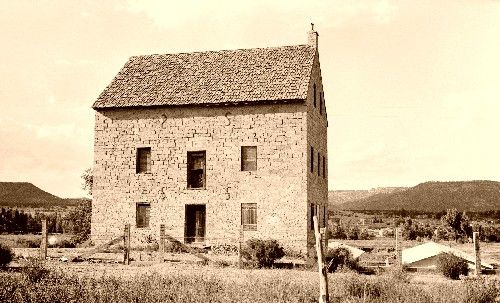
Maxwell built the Aztec Mill in Cimarron, New Mexico.
After the close of the war, an English syndicate claiming to own a large tract of land in southeastern New Mexico, the Rebosca Redunda, came to see Mr. Maxwell and established trade with him. Trading him the “Rebosca Redunda” for his “Beaubien Grant,” thereby swindling Mr. Maxwell out of his fortune. After Mr. Maxwell moved to this place, he found he had bought a bad title and instituted a lawsuit in ejectment, but was unsuccessful and died a poor man.
Once during October 1864, while en route to Kansas City from the old Mexican capital, I stopped at Maxwell’s ranch for lunch.
Mr. Maxwell came out to where I was busy with the coach and told me he wanted me to carry a little package of money to Kansas City for him and deliver it to the Wells Fargo Express Company for delivery to St. Louis.
I told him I would take it, but I said, “How much do you want me to take?” He told me he wanted me to take $52,000. I told him the company wouldn’t want me to put it in the safe unless it was expressed, but he said he didn’t want to express it. “All right,” I said, “unless we are held up and robbed, I will deliver the money to Wells Fargo Express Company.” “Now,” I said, “in what shape is the money?” He pointed to an old black suitcase sitting on a chair and said, “There is the wallet.” I told him to wait until I went into dinner with the passengers, then for him to go out there and take the suitcase and put it in the front boot, then pull a mail sack or two up over it and on top of that throw my blankets and buffalo robes which lay on the seat on top of the mail sacks, then go away and let it alone. Do not let anyone see you do this.
Let me say that Maxwell’s ranch was the headquarters of the Ute agency, which was established a long time before I traveled there. The Government detailed a company of cavalry to camp there to impress the plains tribes who roamed the Santa Fe Trail east of the Raton range. The Ute tribe was very fond of Maxwell and looked up to him as children looked up to their father.
One old Indian watched Maxwell put the money in the boot of the stage, and after he had left to obey my instructions, this old Indian, who would have gone through the “fiery furnace” for Lucien Maxwell, stood guard over the stage. I did not know it then, but the Indian afterward asked me how I made it in. When I returned to the coach, I laid the buffalo robes aside. I laid the mailbags to one side and put the “wallet,” as Mr. Maxwell called the old black suitcase, right in the bottom of the boot and laid one mailbag by the side and laid an old blanket over both these, then piled on the balance of the mail bags and lastly my buffalo robes. I usually slept during the day after I took this money. My driver did not even know I had it. At night, I slept under the driver’s seat in the coach’s boot. At night, I rode before we quit driving for our rest, on the seat of the boot with my brace of pistols between the driver and me.
About three miles from Willow Springs, Kansas, a stage station 25 miles west of Council Grove, I discovered 25 horses hitched to the rack. There was no retreat, so I had to drive right on in. As we drove up, 25 men came out of the settlers’ store and saloon and mounted.
One passenger on my coach was acquainted with every one of them. They were, however, true to my suspicions, a band of the notorious Quantrill gang, who had made the raid on Lawrence, Kansas, and killed so many people after robbing them. My passenger approached the gang and said, “Come on, boys, let’s all have a drink before you go.” They all returned with my passenger and drank, but I told the driver I did not want to leave the coach and for him to grease it, and I would fool around about that to dispel the suspicion that I was guarding my coach. Before we were through with the coach, the men came back and, in my presence, asked the passenger if he believed the coach was worth robbing. “No,” he said, “I have not seen a sign of money.”
I told the boys that it wasn’t worth robbing, that there was not more than $10 in the safe, and that it was mine. I told him I didn’t have much of a haul in the safe, but I said, “Here’s the key, you can go through it if you want to and satisfy yourself.” I laughed and talked with the balance of the boys as if nothing unusual was taking place. One of the gang took the little old iron safe, about 18 inches square and weighing 150 to 200 pounds, and put it on the coach seat, then unlocked it. I had it stuffed full of waybills, letters, and such other plunder, together with a little wallet of mine containing $10. The robber took out the ten dollars and held it up, saying, “Is this what you referred to, conductor?” I told him that it was. “Well,” says he, “I will not take that, it is not tempting enough.” I thanked the accommodating robber in my nicest way for having left me money to buy a few dinners with after I got to Kansas City, and they left us. I was fairly bursting with satisfaction. No one on the stage knew that I had saved the $52,000 of Lucien Maxwell’s. However, boy-like, just before we rolled into Kansas City, I told the passengers about the money.
When we finally gained Kansas City, one of the passengers told Mr. Barnum about the escapade with the robbers and my success in maintaining a “bold front” and the “gold dust.” Mr. Barnum grunted and said, “Oh, well, Billy is one of our conductors who is so stubborn that he has to have everything his own way.” Then, he added, “Did you say he gave his safe keys to the robbers?” “Yes,” the passenger said, “he did.” Barnum replied, “I’ll be dogged.” Then he told the passengers about my having deposited the mail in the river to make a bridge so I could cross my coach and eventually to “reach the other side.”
When I returned from the express office to pick up the money, fulfilling my promise to Maxwell, old Tom Barnum and my passengers were still talking. Barnum approached me, saying, “Been up to some more of your tricks, have you, Billy?” I told him I had been taking “poker chips” to the express office if that was what he meant. They all laughed; then Barnum requested me to show him the receipt I gave Maxwell for the money. “Now, Billy,” said Barnum, “you’re a pretty bird, you know we would not charge Maxwell a cent for express, for we never paid him a cent for board or for feeding our mules—but never mind,”—then he laughed, “oh, that receipt!”
William H. Ryus, 1913. Compiled and edited by Kathy Alexander/Legends of America, updated March 2026.
Excerpted from the book, The Second William Penn – A True Account of Incidents that Happened Along the Old Santa Fe Trail, by William H. Ryus, 1913. William “Billy”. H. Ryus was better known as “the Second William Penn” by passengers and old settlers of the Santa Fe Trail because of his rare and exceptional knowledge of Indian traits and characteristics and his ability to trade and treat with them so tactfully. Ryus was one of the boy drivers of a stage company with U.S. Mail contracts, regularly running along the Santa Fe Trail. During this time, he routinely crossed the plains at a time when the West was still looked upon as “wild and wooly,” and in reality, was fraught with numerous, and often, murderous dangers. The text as it appears here is not verbatim, having been edited for ease of the modern reader.
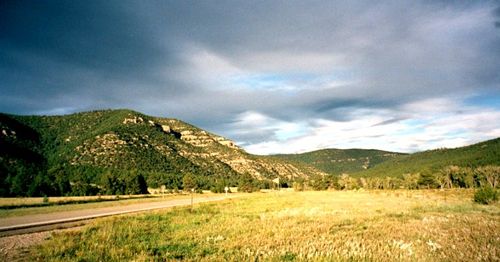
Cimarron Road
Also See:
Kit Carson – Legend of the Southwest
My Friend, Kit Carson, by a Santa Fe Trail Driver
The Largest Land Grant in History – Biography of Lucien Maxwell