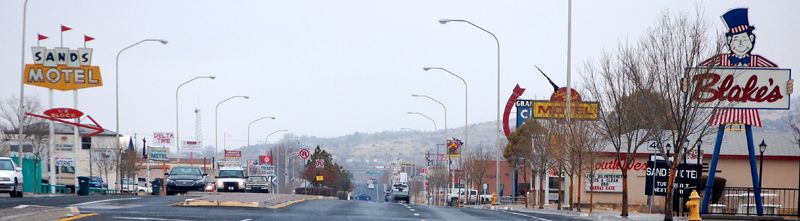
Route 66 in Grants, New Mexico, by Kathy Alexander.
Like most places in New Mexico, Grants was first home to the Ancient Puebloans, who established an advanced civilization in Chaco Canyon, north of present-day Grants, in the 12th Century.
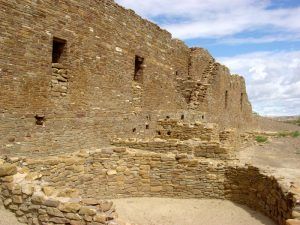
Pueblo del Arroyo at Chaco Canyon, New Mexico, by the National Park Service.
The long-abandoned area changed when the railroad planned to extend its lines from the East. The first resident of the region was Don Jesus Blea, who owned the railroad contracts and established his home in 1872 on the southern side of San Jose Creek. He called his new “settlement” Alamitos (Little Cottonwoods).
Soon, three brothers, Angus, Lewis, and John Grant, were contracted to build the Atlantic and Pacific Railroad through the region, establishing base camps during their work westward. In 1881, the railroad reached Alamitos, and the settlement became a coaling station. Before the railroad arrived, only three or four Hispanic families lived in the area, primarily making their living by ranching. When the trains arrived, Grants developed rapidly, as a tent city sprang up on the west side of town to shelter thousands of railroad workers. Soon, the settlement’s name was changed to Grant’s Camp after the three brothers who had built the railroad.
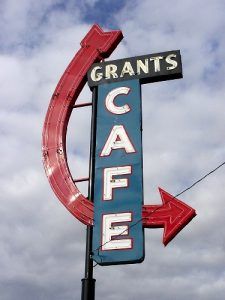
Grants, New Mexico Cafe Sign.
Before long, an entrepreneur named Simon Bibo purchased 160 acres from Jesús Blea and built a store and hotel. He also sold much of the property to other businessmen, and several other businesses sprang up near the railroad tracks in no time.
During the late 1800s, the area surrounding Grant’s Camp had an abundance of water, enticing many homesteaders to farm the region. Others grazed cattle and sheep on nearby ranches or took advantage of the plentiful logging opportunities.
In 1882, the post office was established as Grants, but the population continued to call the settlement Grant’s Camp. Later, when the Railroad Station was built, it became Grant’s Station, and in 1936, the town’s official name changed to plain ole Grants.
Though it remained mostly a quiet farming community, Grants took advantage of the many travelers who came through town when Route 66 was built. Motels and services soon opened right up against the railroad tracks, many of which still operate today.
In 1950, a local rancher named Paddy Martinez found an odd yellow rock in the nearby Haystack Mountains ten miles West of town. Soon, the rock was found to be uranium, which created a booming economy when the U.S. Atomic Energy Commission began to mine the valuable ore. It also started a fever as many invested in Geiger counters and took to the hills.
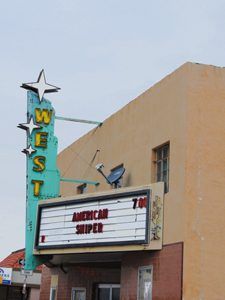
West Theater in Grants, New Mexico by Kathy Alexander.
Whereas the land had never before been posted as “No Trespassing,” it was now posted with “Trespassers Will be Prosecuted or Shot.” Disputes between landowners regarding mineral rights claims became common, and local attorneys had a field day.
The area’s uranium reserves turned out to be among the largest in the world, and Grants’ population boomed from about twelve hundred to nearly twelve thousand. The uranium industry created about six thousand jobs and produced about 63% of all the uranium mined in the United States. Mining continued in full force until the 1982-83 recession forced the closure of the mines and mills.
Meanwhile, Cibola County was created on June 19, 1981, from the westernmost four-fifths of the formerly much larger Valencia County, and Grants became the county seat.
Although it lost some population when the mines closed, the city of Grants diversified its economy and continued to thrive.
Today, Grants is a small town of less than 9,000 residents. A growing tourist destination, it is favored for its fishing and boating at Bluewater and Ramah lakes, its proximity to the Ancient Puebloan ruins, and its outdoor recreation in national monuments and forests.
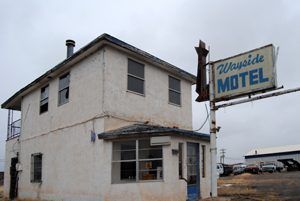
Grants – Old Wayside Motel.
Several icons still appear for the Route 66 enthusiast, including the Lariat Lodge, Grants Cafe, founded in 1937, the Sands Motel, Lavaland Motel, the closed Lux Movie Theatre, the Trail Drive-In Theatre, and many more. In Grants, Old 66 is called Santa Fe Avenue. Several side trips are available from Grants, including the Acoma Pueblo, just 12 miles Southeast of Grants, and the Bandera Ice Caves, another 13 miles down the road.
Continue down Route 66 for a 41-mile stretch to the Continental Divide on your way to Gallup, New Mexico. And as always, kick a little Asphalt along the way.
©Kathy Alexander/Legends of America, updated September 2026.
Also See:
Chaco Canyon – Home of Ancestral Puebloans
New Mexico – Land of Enchantment
See Sources.