LEGENDS OF AMERICA

A Travel Site for the Nostalgic & Historic Minded


  Search


Legends Home

Site Map

What's New!!


Recommend this site


American History

Ghost Towns

Ghostly Legends

Historic People

Native Americans

The Old West

Photo Galleries

Roadside Attractions

Rocky Mtn Store

Route 66

Travel Destinations

Treasure Tales

Legends Blog

Free E-Newsletter


Facebook Fanpage


Twittering


Legends of America's Exclusive Custom Products


Contact Us


Please report broken links, missing pictures, or other problems online by clicking HERE or send us an email.  Thanks!


North Dakota FlagNORTH DAKOTA LEGENDS

North Dakota Forts of the Old West


<< Previous 1 2 3 Next >> 


North Dakota Forts


Fort Abercrombie

Fort Abraham Lincoln

Fort Berthold

Fort Buford

Fort Clark

Fort Ransom

Fort Rice

Fort Stevenson

Fort Totten

Fort Yates

Fort Union


Fort Abercrombie, North Dakota

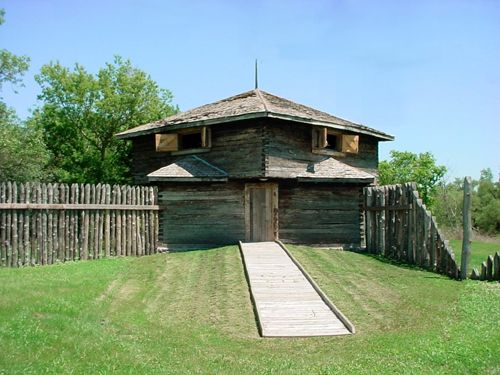
Blockhouse at Fort Abercrombie, photo courtesy Friends of

 Fort Abercrombie.

Fort Abercrombie (1858-1877) - The fort was first established on August 28, 1858 by Lieutenant Colonel John J. Abercrombie on the Red River. However, because the area was prone to flooding, it was reestablished in 1860 on a high west bank of the Red River, north of the original location.

Known as "the Gateway to the Dakotas," the post was the first permanent U.S. military fort established in what would later become North Dakota. The purpose of the fort was to guard the oxcart trails utilized by fur traders, military supply wagon trains, stagecoach routes, and steamboat traffic on the Red River. The post also served as a supply base for two major gold-seeking expeditions across Dakota into Montana, becoming a hub for the transportation route through the northern plains.

During the Dakota War of 1862, the post was besieged by Sioux warriors for more than six weeks in August and September. At this time, the "regular" U.S. Army soldiers had been withdrawn to fight in the Civil War and the post was manned by the Minnesota Volunteer Infantry. During the siege, several soldiers were killed and wounded.

During these attacks, the fort was not protected by blockhouses or a palisade; however, they were soon built afterwards. The  during the siege, but these defensive structures were constructed soon afterward. 675' x 625' rectangle was then enclosed by a stockade of logs projecting above the ground from 8 to 12 feet and blockhouses of hewn logs were constructed at the northeast and southwest corners.

Later, Fort Abercrombie’s mission was changed to protecting the railroad as it was being built; establishing peace between the local Indian tribes; and serving as the hub of military mail routes in the area.

The fort was abandoned in 1877 and most of the fort buildings were sold and removed from the site. The town of Abercrombie, North Dakota was founded a half mile west in 1884.


In 1939; however, the Works Progress Administration (WPA) reconstructed three blockhouses and the stockade and returned the original military guardhouse to the site. Today, the site features a small museum, one original and two reconstructed blockhouses, original guardhouse, and the palisade wall.  Self-guided tours of the outdoor facilities are open year-round at no charge. The museum is open Thursday through Monday from May 16 through September 15 with a small admission charge.


Fort Abercrombie State Historic Site

816 Broadway Street
Abercrombie,
North Dakota 58001

701-553-8513


Stay in nearby Fargo, North Dakota

Legends of America Lodging


Fort Abraham Lincoln, North Dakota

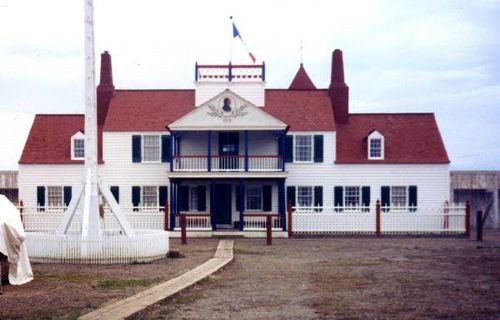
Reenactment group in front of Custer's house at Fort Abraham Lincoln, photo courtesy Fort Abraham Lincoln State Park.

Fort Abraham Lincoln (1872-1891) - As the Northern Pacific Railroad pushed westward across Dakota Territory, the US military kept pace, protecting the railroad and the workers, primarily from Indian attacks. When the railroad reached the Missouri River in 1872, a new city called Bismarck sprouted up and Fort McKeen was established on the west bank of the Missouri River as a small infantry post. Construction began in June, 1872 by Companies B and C of the 6th U.S. Infantry. In November, 1872, the post was renamed renamed in honor of the fallen President, Abraham Lincoln.  The following year, Congress authorized the addition of a Cavalry Post, of which Lieutenant Colonel George Armstrong Custer became the first commander.


Custer enlarged the fort and served here from 1873 until the Battle of the Little Big Horn in 1876. By 1874 the fort housed nine companies with about 650 men and had become one of the largest and most important posts on the Northern Plains. At its height, Fort Abraham Lincoln contained 78 separate buildings. Their mission was to further the advancement of the Northern Pacific Railroad and open the westward expansion of the American frontier.

On May 17, 1876 George Custer led the 7th U.S. Cavalry from Fort Lincoln to the valley of the Little Big Horn, where they planned to force non-treaty Indians back to their reservations.  However, they found themselves outnumbered and outgunned, resulting in the deaths of some 260 cavalry troops, including every member of the five companies with Custer.

Fort Abraham Lincoln remained the headquarters of the 7th U.S. Cavalry until June, 1882 when the troops were transferred to Fort Meade in South Dakota. By the following year, the railroad had been completed to Montana and Fort Abraham Lincoln’s importance began to decline. In 1891, it was officially abandoned by order of Congress. Most of the buildings were then dismantled by settlers and used in the construction of other buildings.

The site sat silent for the next several decades until the Civilian Conservation Corps began to develop it into the Fort Abraham Lincoln State Park in 1934, building a Visitor’s center, shelters, and roads, as well as reconstructing the historic military blockhouses and fabricating several Mandan earthen lodges.

Over the years, additional reproductions have been built, creating a full Mandan village called the "On-a-Slant Village."  The reconstructed earth lodges depict the lifestyle of the Mandan Indians, who occupied this site from about 1575-1781. Also reconstructed is the Victorian-style home of  George and Libbie Custer, the commissary storehouse, barracks, granary, and stable.


Also located in the state park are modern campgrounds, picnic sites, and historic trails. Fort Abraham Lincoln State Park is located seven miles south of Mandan, North Dakota on Highway 1806.


Fort Abraham Lincoln State Park
4480 Fort Lincoln Road
Mandan,
North Dakota 58554
701-667-6340


Book a room in Mandan, North Dakota

Legends of America Lodging


Continued Next Page

Mandan Village, Abraham Lincoln State Park

 "On-a-Slant Village" Mandan village, photo courtesy Fort Abraham Lincoln State Park.

<< Previous 1 2 3 Next >> 

From the Rocky Mountain General Store

Camera - Vintage Photos IconPhoto Print Shop - Travel the trails of the American West with our many photographs! Just take a look at our galleries or purchase prints at very reasonable prices! Here you'll see photographs of Route 66, ghost towns, scenic and historic views, and roadside stops.

Scenic Views Photo Gallery       


                                                              Copyright © 2003-2009, www.Legends of America.com