
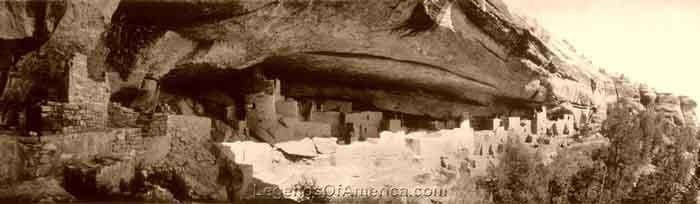
Cliff Palace is the largest cliff dwelling in North America. The structure, built by the Ancient Pueblo Peoples (also called the Anasazi), is located in Mesa Verde National Park in the southwest corner of Colorado. Photo from 1918
Though some Native American tribes lived in the American West for centuries, as the white man pushed westward, always wanting more land and resources, they pushed the American Indians out of their way, further populating the West with various tribes.
When European settlers arrived on the North American continent at the end of the 15th century, they encountered diverse Native American cultures, as many as 900,000 inhabitants with over 300 languages. These people, whose ancestors crossed the land bridge from Asia in what may be considered the first North American immigration, were virtually destroyed by the subsequent immigration that created the United States. This tragedy directly results from treaties written and broken by foreign governments, warfare, and forced assimilation.
In 1786, the United States established its first Indian reservation and approached each tribe as an independent nation. This policy remained intact for more than 100 years.
But, as President James Monroe noted in his second inaugural address in 1821, treating Native Americans this way “flattered their pride, retarded their improvement, and in many instances paved the way to their destruction.” In addition, Monroe observed that America’s westward growth “has constantly driven them back, with almost the total sacrifice of the lands which they have been compelled to abandon.” Despite Monroe’s concern for the plight of Native Americans, his administration successfully removed them from states north of the Ohio River.
In 1823, the Supreme Court made a landmark decision (Johnson v. M’Intosh) that private citizens could not purchase lands from Native Americans because Indians could not hold title to their lands, even if they had occupied them for years. This was because their “right of occupancy” was subordinate to the United States’ “right of discovery.” This decision would become a staple in federal and state cases related to Indian land titles for the next two centuries.
President Andrew Jackson, a long-term proponent of Indian removal, stated in his first inaugural address in 1829 that he wished “to observe toward the Indian tribes within our limits a just and liberal policy, and to give that humane and considerate attention to their rights and their wants which is consistent with the habits of our Government and the feelings of our people.” Fourteen months later, Jackson prompted Congress to pass the Indian Removal Act in May 1830, which forced Native Americans to leave the United States and settle in the Indian Territory west of the Mississippi River.
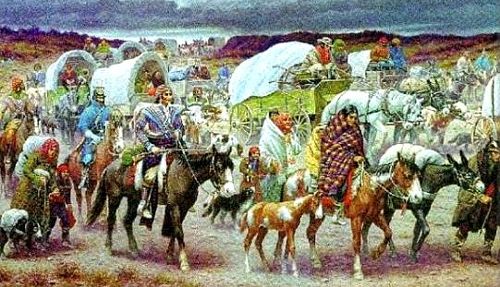
Trail of Tears painting by Robert Lindneux
As a result, many Cherokee tribes banded together as an independent nation and challenged this legislation in U.S. courts. In 1832, the Supreme Court ruled in favor of the Cherokee. However, some tribes still signed treaties giving the federal government the legal authority to “assist” them in their move to the Indian Territory.
In 1838, as the deadline for removal approached, thousands of federal soldiers and Georgia volunteers entered the territory and forcibly relocated the Cherokee, hunting, imprisoning, raping, and murdering many of them. The Cherokee who survived the onslaught were forced on a 1,000-mile march to the established Indian Territory with few provisions. Approximately 4,000 Cherokee members die on this “Trail of Tears.”
The expansion of the United States that encroached upon Native American lands occurred faster than many policymakers had predicted, with events such as the Mexican-American War in 1848, which placed new territories and tribes under federal jurisdiction. A government report in 1852 explained that many Californians believed “destiny had awarded California to the Americans to develop” and that if the Indians “interfered with progress, they should be pushed aside.”
This anti-Native American sentiment was echoed in books of the era, such as Andrew Peabody’s The Hawaiian Islands, published in 1865, which claimed that a “law of the divine Providence” caused some races to submit to those of “superior physical and intellectual vigor.”
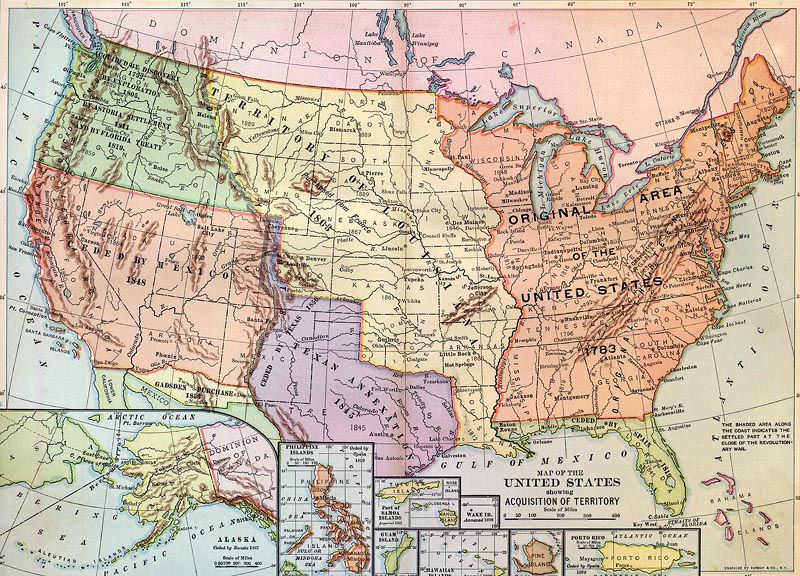
Westward Expansion Map.
He went on to say, “Under this law… the aborigines of North America will ultimately disappear, and the humane policy which ought to have been pursued to them from the first would not have ensured their preservation in the land, though it would have averted the condemnation of blood-guiltiness from the European settlers.”
Despite the prevalence of beliefs such as Andrew Peabody’s, the Union Army welcomed many Native American volunteers to fight in the Civil War. James Blunt’s December 2, 1862, letter to Kansas Citizens requests aid to nearby refugee Indians driven from their homes “by the Rebel for no other reason than adhering in their allegiance to their great Father.”
Ironically, a year later, Kit Carson led the Union Army in an attack on the Navajo tribe in the desert Southwest. Union Soldiers destroyed crops, orchards, livestock, and homes in a campaign to relocate the tribes to a federal reservation. In 1864, thousands of Navajo surrendered to U.S. troops and were forced to walk 300 miles to Fort Sumner, New Mexico. Known as “The Long Walk,” it ended at a small, disease-filled camp that served as a Navajo prison for four years.
Despite their welcome to serve in the Union Army, Native Americans were not recognized as U.S. citizens throughout the nineteenth century. A clause in the Fourteenth Amendment, “excluding Indians not taxed,” prevented Native American men from receiving the right to vote when African-American men gained suffrage in 1868. Instead, tribes remained independent nations expected to sign agreements like the Kit Carson Treaty to establish Native American reservations in U.S. territories.
Ulysses S. Grant acknowledged such disparities in treatment in his first inaugural address in 1869 when he said, “The proper treatment of the original occupants of this land–the Indian is one deserving of careful study. I will favor any course toward them which tends to their civilization and ultimate citizenship.” The theme continued differently during Grant’s second inaugural address in 1873: “Our superiority of strength and advantages of civilization should make us lenient toward the Indian… If the effort is made in good faith, we will stand better before the civilized nations of the earth and in our consciences for having made it.”
Battle of the Little Bighorn by C.M. Russell.
The ongoing conflicts with Native Americans disturbed U.S. military leaders such as General George Armstrong Custer. In his 1874 memoir, My Life on the Plains, Custer said that every American should be willing to avoid these “Indian Wars” at any cost: For let [a soldier] act as he may in… a campaign against the Indians if he survives the campaign he can feel assured… that one-half of his fellow-citizens at home will revile him for his zeal… while the other half,… will cry “Down with him. Down with the regular army, and give us brave volunteers who can serve the Government in other ways besides eating rations and drawing pay.” Custer didn’t deal with military victories and moral failures for long; however, in 1876, he and his 264 men died in an attack on Sioux and Cheyenne warriors during the Battle of the Little Bighorn in the Black Hills of Montana.
The federal government opened the Black Hills to gold mining in 1875, but Native Americans refused to leave the area because of its religious significance. As the U.S. military gathered to relocate them forcibly, Custer’s troops disregarded orders and attacked a village. George Flanders was a soldier in a group arriving in the Black Hills on June 26, 1876, a day after Custer’s charge. Flanders buried his comrades that day, and, years later, he provided an account of Custer’s battlefield actions, as told by the Cheyenne, saying, “Custer had received a wound in the hip and was unable to get up, but continued shooting until he had used all except one of his cartridges and with that last bullet shot himself.”
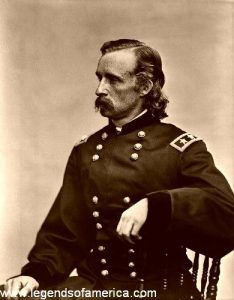
George A. Custer.
Custer’s death galvanized the military. In subsequent months, they tracked down Sioux and Cheyenne warriors and forced them onto reservations. The military pursuit wasn’t the only hunt of concern to Native Americans. Buffalo was a prime resource for its meat and hide. The millions of animals roaming the plains in the 1860s virtually disappeared within two decades as hunters from across the United States and abroad drove the herds to near extinction.
Another account, from a man who grew up during the days of the Old West, recalled the precarious relationship between U.S. soldiers and Native American hunters: “We came upon a smoldering campfire and the remains of a buffalo… and a row of Indians going down the path single file. We opened fire as we were accustomed to doing, killing two of the Indians… and chased them right on into a white camp and found to our dismay that we had been chasing Government Indians… sent out with United States Officers … to show them how to hunt buffalo. We had to go into court over killing the Indians, but it was settled in our favor.”
The killing of buffalo reduced the number of resources available to independent Native Americans, and for most, the federal government’s reservation system became the only means of survival. President Grover Cleveland noted the national obligation in his first inaugural address in 1885: “The conscience of the people demands that the Indians within our boundaries shall be fairly and honestly treated as wards of the Government and their education and civilization promoted with a view to their ultimate citizenship…” Citizenship, however, remained almost 60 years away.
In the meantime, the Dawes Act of 1887 dissolved many Indian reservations. An 1888 report from the Indian Rights Association, The Condition of Affairs in Indian Territory and California, questioned America’s treatment of Native Americans: “The whole management of Indians has been abnormal… Everything is controlled by arbitrary laws and regulations, not moral, social, or economic principles.” The report concluded that opening Oklahoma up to settlers and moving Native Americans farther west “would be unjust, cruel, and disastrous.”
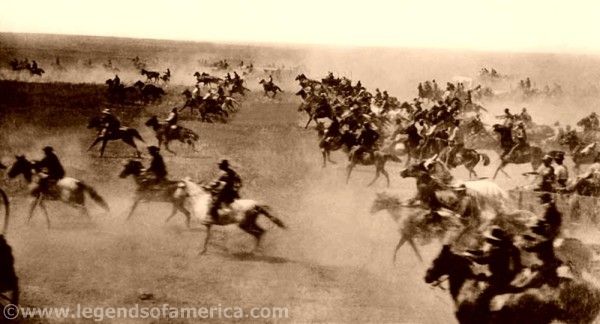
Oklahoma Land Run
Nevertheless, the federal government opened Oklahoma’s unoccupied lands to white settlers in 1889. Four years later, the government purchased more than 6 million acres from tribes to pave the way for the Oklahoma Land Rush. In the years before Oklahoma became a state, violence was rampant between the Native Americans and new white settlers.
Such violent conflicts were common throughout many territories, and it was not long before the last official military action against Native Americans took place on December 29, 1890. That month, the Federal Government banned a growing religion called the Ghost Dance. As part of the crackdown on this dance and other religious ceremonies, the army arrested Chief Big Foot and his Lakota tribesmen and confined them to a camp near Wounded Knee Creek in South Dakota. The day after the arrest, the military attempted to recover the prisoner’s weapons. A gun was accidentally discharged, and soldiers opened fire. When the shooting stopped, more than 300 Lakota Indians were dead.
The massacre exemplified a culture at war with the Native Americans on various fronts. Books such as Recollections of a Virginian in the Mexican, Indians, and Civil Wars, published in 1894, described one such case of the physical and psychological warfare involved in fighting Native Americans in the territories:
“He told me he hanged all of his prisoners because the Indians had a great and superstitious horror of hanging; for they believe that no man’s soul will be received into the happy hunting grounds that does not pass through the throat, which is impossible when that route is closed by a rope; it must seek another road of exit, and all such souls are rejected at the gates of Paradise. He said a fine moral effect was produced upon the Indians by this method of execution.”
By 1900, the Native American population in the United States had dwindled to approximately 250,000. The perceived diminishing of a “Native American threat” to white prosperity sometimes relegated Native Americans to little more than a novelty act. For example, Thomas Edison’s turn-of-the-century films, such as Buffalo Dance, Sioux Ghost Dance, and the Sham Battle at the Pan-American Exposition, documented traditional performances created for the interest and amusement of people attending an ethnic village in a World’s Fair. Meanwhile, materials such as the 1898 film Indian Day School and the 1923 map of Indian Reservations West of the Mississippi River documented the harsh new realities of Native American culture.
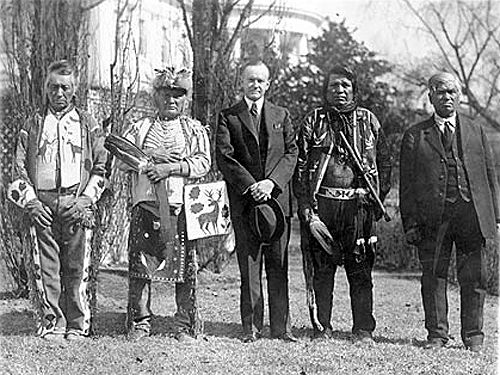
President Calvin Coolidge with four Osage Indians after Coolidge signed the bill granting Indians full citizenship in 1924.
On June 2, 1924, President Calvin Coolidge signed a bill granting Native Americans full citizenship. Coolidge posed with four Osage Indians in front of the White House to commemorate the event. Three years later, the president’s photo opportunities included wearing a suit and a feathered headdress when he was made a Sioux Chief and standing in front of the White House with some veterans of the Indian Wars.
Although Native Americans gained citizenship, they continued to receive federal support for two more decades. In the 1950s, however, the Bureau of Indian Affairs terminated federal services and placed the responsibility for Native Americans on state governments. Between 1952 and 1956, the bureau sold 1.6 million acres of Native American land to developers.
Later, political protests by organizations such as the American Indian Movement (AIM) call attention to the chronic unemployment and political disenfranchisement of Native Americans. For example, 25 Native Americans gathered in Plymouth, Massachusetts, on Thanksgiving Day, 1970. The protesters wore traditional funeral clothes and convened in front of a statue of Massasoit, the Wampanoag Chief who aided colonists in 1621 and then buried Plymouth Rock under mounds of sand.
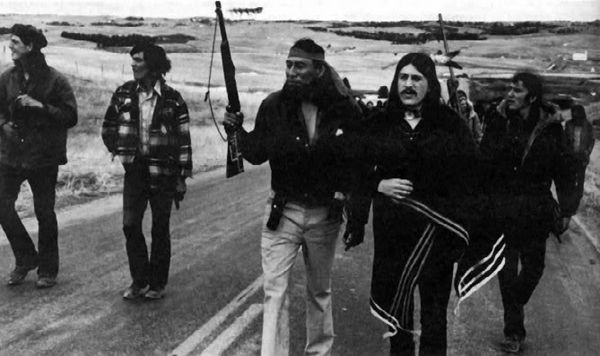
American Indian Movement, 1973.
In a more violent effort, the American Indian Movement took control of South Dakota’s Wounded Knee site in February 1973. The forceful occupation of the reservation to protest local government lasted 71 days and resulted in 2 deaths, 12 injuries, and more than 1,100 arrests. Such protests thrust the plight of Native Americans into the national spotlight. Long-term plans to correct the situation, however, were often nonexistent. During the 1980s, several state governments endowed some reservations with special hunting, fishing, and high-stakes casino gaming rights.
Today, numerous tribes continue to fight for federal recognition and a return of rights and privileges.
Compiled and edited by Kathy Alexander/Legends of America, updated August 2025.
Also See:
Indigenous Americans’ Long Path to U.S. Citizenship
Westward Expansion and Manifest Destiny
Source: Library of Congress.