
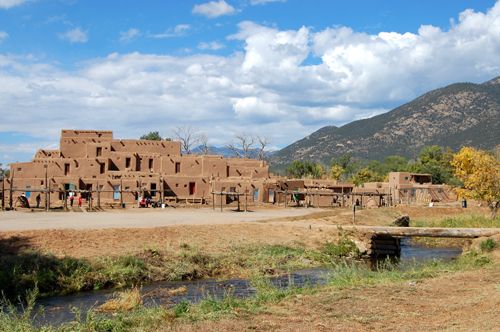
Taos Pueblo, New Mexico, by Kathy Alexander.
The Pueblo Indians, situated in the Southwestern United States, are one of the oldest cultures in the nation. Their name is Spanish for “stone masonry village dweller.” They are believed to be the descendants of three major cultures, including the Mogollon, Hohokam, and Ancient Puebloans (Anasazi), and their history stretches back some 7,000 years.
During their long history, the Ancient Puebloans evolved from a nomadic, hunter-gathering lifestyle to a sedentary culture, primarily making their homes in the Four Corners region of Colorado, New Mexico, Utah, and Arizona. Though they didn’t give up hunting, they adopted an agricultural way of life, growing maize, corn, squash, and beans, raising turkeys, and developing complex irrigation systems.
They also developed excellent skills in basket weaving and pottery making. During this time, they also began building villages, often atop high mesas or in natural caves hollowed out at the bases of canyons. These multi-room dwellings and apartment-like complexes, built of stone or adobe masonry, were the forerunners of later pueblos.
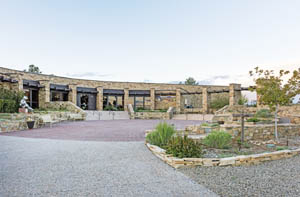
The Anasazi Heritage Center — a museum of the Ancestral Puebloan Culture at the Canyons of the Ancients National Monument. Photo by Carol Highsmith.
Despite their success, the Ancient Puebloans’ way of life declined in the 1300s, probably due to drought and intertribal warfare, and they migrated south, primarily into New Mexico and Arizona, becoming what is today known as the Pueblo people.
These Pueblo descendants lived a similar lifestyle for hundreds of years, surviving by hunting, farming, and building “new” apartment-like structures, sometimes several stories high. These structures were cut from sandstone faced with adobe — a mixture of earth, straw, and water — or the adobe was poured into forms or made into sun-dried bricks to build several-feet-thick walls. The buildings had flat roofs, which served as work and rest areas and as observation points for spotting approaching enemies and viewing ceremonial occasions. For better defense, the outer walls generally had no doors or windows; instead, there were roof openings with ladders leading into the interior.
Each family generally lived in a single room in the building unless it grew too large, in which case side rooms were sometimes added. The houses of the pueblo were usually built around a central, open space or plaza, in the middle of which was a “kiva,” a sunken chamber used for religious purposes.
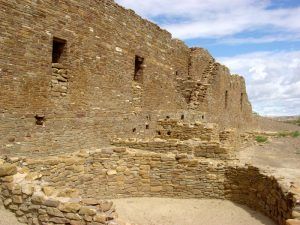
Pueblo del Arroyo at Chaco Canyon, New Mexico, by the National Park Service.
Each pueblo was an independent community, though many shared similar languages and customs. Each pueblo had its chief and sometimes two chiefs, a summer and winter chief, who alternated. However, most important affairs, such as war, hunting, religion, and agriculture, were governed by priesthoods or secret societies.
The Pueblo people continued using irrigation methods to grow corn, beans, pumpkins, cotton, and tobacco. Initially, they hunted with spears rather than bows and arrows, but they were never known to fish. The only domestic animal was the dog, which was used as a beast of burden. They also continued to make elaborate baskets and pottery, becoming expert woodcarvers and decorating ceremonial clothing with shells, turquoise, feathers, and furs.
The vast majority of Pueblo tribes lived in a clan system, with many tribes, including the Hopi, Zuni, Keres, and Jemez, descending matrilineally. Thus, the women owned the house and garden, which earned them more respect than in other northern tribes.
Before Europeans began to inhabit the area, their traditional enemies were the Navajo, Comanche, and Apache tribes.
The Zuni were the first to become known to Europeans in 1539, when Fray Marcos de Niza, a Franciscan, journeyed northward from Mexico in search of the fabled Seven Cities of Cibola. When guides were sent forward, they discovered the Zuni settlement of Hawikuh. Though the Zuni killed them, Fray Marcos continued long enough to plant a cross and declare his “find” part of New Spain. He then returned to Mexico with glowing reports.

Francisco Vásquez de Coronado.
Soon, a new expedition was organized under Francesco Vasquez de Coronado, who was sent into the region, arriving in July 1540 and taking the Zuni community before expanding into other parts of what is now New Mexico and Arizona. The Spaniards first found the Indians friendly, but after wielding their authority and forcing their religion upon the Native Americans, they began to resist, resulting in the Tiguex War during the winter of 1540-41. After putting down the Indians and killing thousands of them, Coronado continued his journey as far as Quivira in central Kansas.
The war with the Indians in New Mexico and the many diseases that the Spanish brought later resulted in the abandonment of many of the pueblos. Afterward, Europeans were no longer welcomed at the pueblos and were often attacked. This, however, did not stop the Spanish missionaries and many new inhabitants who would come later.
By 1617, eleven Franciscan churches had been built, and some 14,000 natives had been baptized. By 1637, 43 missions stood on or near the pueblos. However, in 1680, the Indians rose again against the Spaniards in what is known as the Pueblo Revolt, which successfully expelled the Spanish for 12 years.
However, the Spanish re-conquered the pueblos in 1692 and aggressively began to civilize the Indians by bringing in numerous priests and forcing Christianity upon them.
Though many of the Pueblo Indians were converted, their lifestyle changed little, except for the addition of new animals and crops to their midst, including horses, cattle, sheep, and goats, as well as agricultural products such as peaches, wheat, grapes, and apples.
With the reconquest, most of the tribes settled down. There was only minor intermittent resistance until June 1696, when about half of the pueblos rose again, killing five missionaries and several other Spaniards. The natives were once again forced into submission by the Spanish.
By 1800, only about eleven missions were still in use, and by 1811, only five missionaries were in the nineteen pueblos of New Mexico. In 1821, Mexico became independent of Spain, and though mission support further declined, some Taos Indians attempted another revolution but were soon defeated. The final revolt occurred in January 1847 when Taos Indians once again revolted, this time against the newly established American government, killing Governor Charles Bent and about twenty other Americans. In retaliation, their pueblo was stormed by U.S. Troops who killed some 150 Indians, destroyed the San Geronimo Mission, and afterward executed 16 Indians for their part in the revolt.
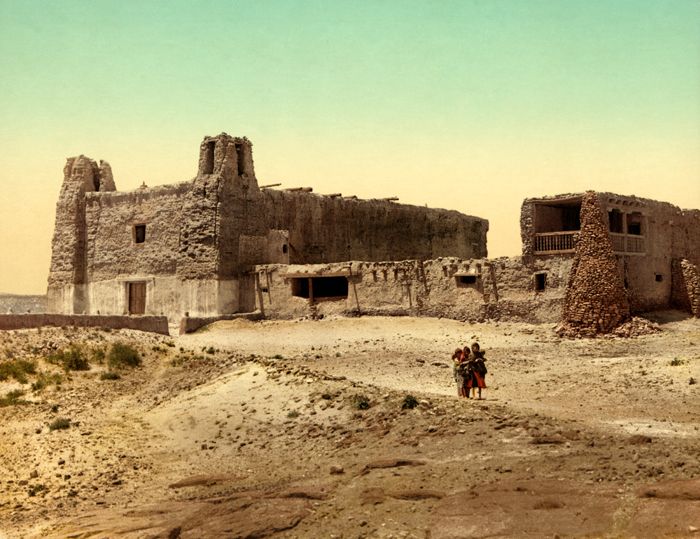
San Estévan del Rey Mission at Acoma Pueblo by Detroit Publishing, 1902.
Today, the inhabited pueblos are governed by their tribes. Though the vast majority, except for the Hopi of Arizona and about half of the Laguna members, remain Catholic, they also adhere to their ancient rites.
Numbering about 35,000 tribal members, today’s Pueblo Indians live primarily in New Mexico and Arizona along the Rio Grande and Colorado River. Most of the pueblos are open to the public, and many of their ceremonies can be attended. Each pueblo has its own rules and etiquette for visitors, which should be reviewed before visiting.
©Kathy Alexander/Legends of America, updated April 2026.
Also See:
Ancient & Modern Pueblos – Oldest Cities in the U.S.
Ancient Cities of Native Americans
Ancient Puebloans of the Southwest
Pueblo and Reservation Etiquette
See Sources.