
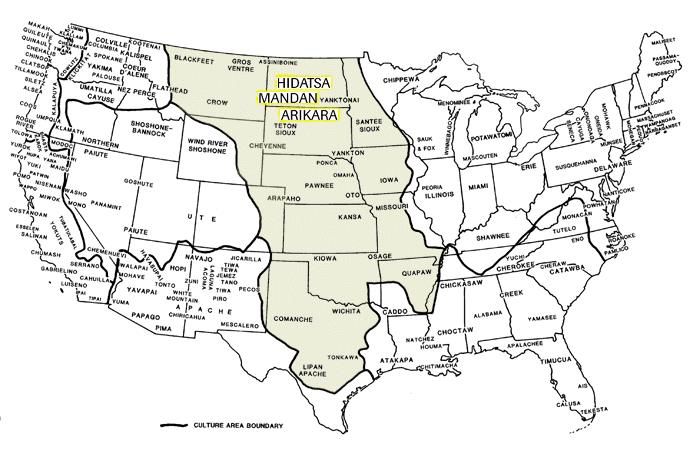
Plains Indians map.
“While the vast herds of buffalo, deer, elk, and antelope remained, they were sure of food and clothing. They were, however, soon to be deprived of their abundant riches. The wave of civilization was moving over the Western horizon. Its onward march was irresistible. No human hand could stay that rolling tide of progress. The pale faces moved over every divide; they cordelled or pushed their boats up every river. They entered every valley and swarmed over every plain. They traveled in wagons and prairie schooners on foot or horseback. Herding their little bands and flocks of domestic stock, they built their homes on every spot of ground that could be made productive. One great cause of disaffection among the Indians was the destruction of their vast herds of buffalo, which seemed like a ruthless sacrifice.”
— Nelson Miles, Personal Recollections and Observations, 1896
The term “Plains Indians” refers to the many Native American tribes that lived on the plains and rolling hills of middle North America between the Mississippi River and the Rocky Mountains and from Canada to Mexico.
The Arapaho, Assiniboine, Blackfeet, Cheyenne, Comanche, Crow, Gros Ventre, Kiowa, Plains Apache, Plains Cree, Plains Ojibwe, Sarsi, Shoshone, Sioux, and Tonkawa. And were all nomadic tribes who followed the buffalo herds and lived in tipis. Though nomadic, some tribes occasionally engaged in agriculture, primarily growing tobacco and corn.
A second group of semi-nomadic tribes, sometimes referred to as Prairie Indians, included the Arikara, Hidatsa, Iowa, Kanza, Kiowa, Mandan, Missouria, Nez Perce, Omaha, Osage, Otoe, Pawnee, Ponca, Quapaw, Santee, Wichita, and Yankton. These groups spent part of every year in fixed villages, where they raised crops, and the rest of the year hunting buffalo and living in tipis.
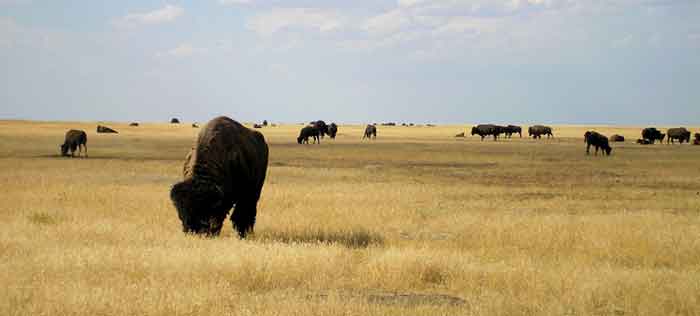
Buffalo in South Dakota, photo by Kathy Alexander.
The nomadic tribes survived by hunting a variety of game, including elk and antelope, but the buffalo was their primary food source. Every part of the buffalo was used. In addition to providing food, the Indians used the skins for tipis and clothing, hides for robes, shields, and ropes; they used dried buffalo dung for fuel, made tools, such as horn spoons, and scrapers from bone; sinew or muscle was used to make bowstrings, moccasins, and bags; and the hoofs were used to make glue. Following the seasonal migration of the buffalo, the tipis the Plains Indians lived in were ideal for their nomadic lifestyle, as they could be quickly put up and taken down.
Before horses were introduced, hunting was far more difficult. Sometimes the hunters would surround the buffalo and try to herd them off cliffs or into places where they could be more easily killed. Another method was to drive them into a corral or a V-shaped funnel made of fallen trees and rocks, where they could be killed. Sometimes the animals could be lured by a hunter who covered himself with a buffalo skin and imitated the animals’ calls. At this time, the Plains Indians hunted with spears, bows and arrows, and various clubs.
The first European to encounter the Plains Indians was Spanish explorer Francisco Vasquez de Coronado in 1541. While searching for the wealth of Quivira, the expedition encountered the Querecho tribe, later known as the Apache, in the Texas Panhandle. According to the Spaniards, the Querechos lived “in tents made of the tanned skins of the cows (buffaloes) and traveled near them, killing them for food. They travel like the Arabs, with their tents and troops of dogs loaded with poles.” At this time, the Plains Indians traveled on foot, not yet having obtained horses.
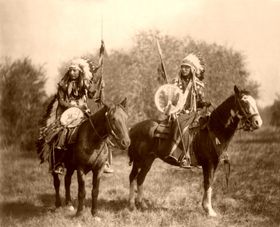
Sioux Indians on Horseback, by Heyn, 1899
The real beginning of the horse culture of the Plains Indians began after the Pueblo Revolt in 1680, when the Pueblo tribes expelled the Spanish from New Mexico and captured thousands of horses and other livestock. The distribution of horses proceeded slowly northward into the Great Plains, as tribes caught and trained wild horses, stole them from white settlers and enemy tribes, and began breeding them.
By the early 18th century, some tribes had fully adopted a horse culture. The Comanche were among the first to adopt a mounted nomadic lifestyle, and before long, all the Plains tribes integrated them into their daily lives. Horses enabled the Indians to travel faster and further in search of buffalo and to transport more goods, making their lives much more accessible. Horses became an item of prestige and utility, and the Indians became very fond of them.
Along with horses, the Spaniards also introduced guns, which simplified the lives of the Plains Indians, though they continued to use bows and arrows because guns were time-consuming to reload and heavy.
The Sioux became the dominant Plains Indian tribe in the mid-19th century. They had relatively small horse herds, which had less impact on their ecosystem, occupied the heart of the prime buffalo range, and were an excellent region for furs, which they sold to traders for goods, including guns.
Religion varied among the Plains Indian tribes. Still, they shared several common beliefs, including the belief that all things possessed spirits and belief in one main god – the Great Spirit, or in the Sioux language – Wakan Tanka.
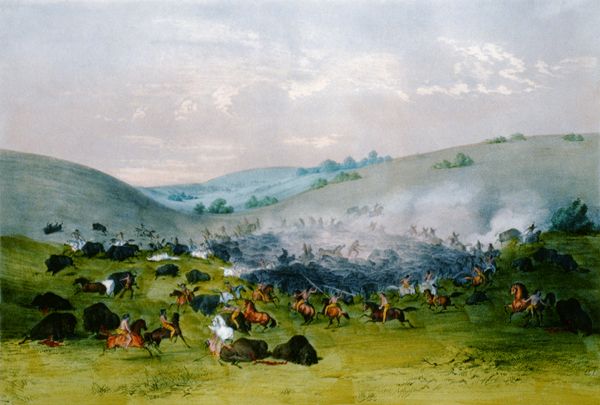
Surrounding the buffalo herd
The Indians believed this Great Spirit had power over all things in nature, including people, animals, vegetation, climate, and the land. The earth was believed to be the mother of all spirits, and the sun also had great power because it gave the earth light and warmth. The spirits were worshiped daily, individually or in groups. They also believed visions in dreams came from the spirits. The Plains Indians had several important ceremonies and rituals, including the Sun Dance, which could last for days, and Vision Quests, in which young boys sought their spirit totem to protect them for the rest of their lives.
Most tribes had a Medicine man or woman that was “blessed,” or “Wakan,” in the Sioux language, who was responsible for helping to interpret visions, utilizing rituals and remedies for healing, taking the lead in certain ceremonies, and was considered so important that they were the ones who decided the time was right to hunt. Most individuals carried their medicine bundle, which held skins, pipes, dried herbs, and tobacco, believing it had special powers.
In 1800, there were around 60 million buffalo in North America; however, that number would drastically decline over the next century, affecting the lives of the Plains Indians. This is partly due to individual hunters looking to make a profit on the buffalo hides, the government starving the population of the Plains Indians by killing off their primary food source, and the coming of the railroads. The buffalo, like the Indian, was in the pathway of civilization.
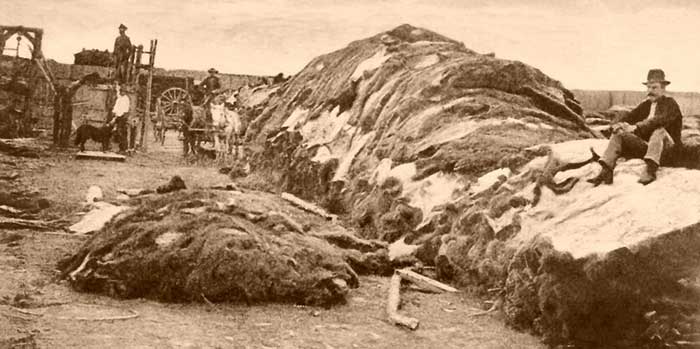
Buffalo Hide Yard in Dodge City, Kansas, 1878
In the second half of the 19th century, buffalo hunters, armed with powerful, long-range rifles, began killing the buffalo in large numbers. Sometimes, an individual hunter could kill as many as 250 buffalo daily.
By the 1880s, over 5,000 hunters and skinners were involved in the trade, leaving the plains littered with carcasses. In the meantime, the government promoted hunting the buffalo for several reasons – so that ranchers could utilize the plains land for raising their cattle without competition, for weakening the Plains Indian population and pressure them to remain on reservations and support the railroad industry, which complained that the buffalo herds damaged tracks and delayed trains.
The killing of buffalo reduced the resources available to independent Native Americans, and for most, the federal government’s reservation system became the only means of survival. By 1890, bison were nearly extinct, with only about 750 left on the plains.
The Plains Indians, by that time, were mostly confined to reservations, and many, to this day, remain dependent upon the Federal Government for sustenance.
 © Kathy Alexander/Legends of America, updated March 2026.
Also See:
See Sources.
“The buffalo supplies the Indians with the necessities of life; with habitations, food, clothing, beds, and fuel, strings for their bows, glue, thread, cordage, trail ropes for their horses, covering for their saddles, vessels to hold water, boats to cross streams, and the means of purchasing all they want from the traders. When the buffalo are extinct, they too must dwindle away.”
— Francis Parkman, 1849