
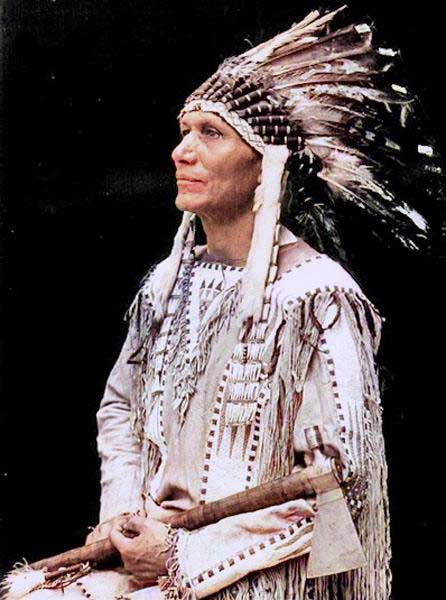
Charles Eastman in traditional Sioux clothing.
Charles Alexander Eastman, aka Ohiyesa, a Santee Sioux Indian, was the first Native American to be certified in Western medicine, a writer, national lecturer, and reformer.
Eastman was born near Redwood Falls, Minnesota, in the winter of 1858 to father, Tawakanhdeota (Face of Many Lightenings), and mother, Wakantakawin, also known as Winona (First-Born Daughter). While his father was full-blood Sioux, his mother was born mixed, her father being Seth Eastman, a well-known army officer who married her mother, Wakantakawin (Stands Sacred), at Fort Snelling. Stands Sacred was the daughter of Santee Dakota chief Cloud Man. She would take on the Christian name of Mary Nancy Eastman.
He would be given the birth name of Hakadah (Pitful Last) because he was the last of three brothers and one sister, and the fact that his mother, Winona, died shortly after his birth. His grandmother, Stands Sacred, would raise Hakadah. In his early youth, he was given the name Ohiye S’a (Always Wins) as part of the Dakota tradition of naming to mark life passages.
When he was 4, the Dakota War of 1862 resulted in Ohiyesa being separated from his siblings and father when Stands Sacred fled with him to North Dakota and Canada, thinking his father and siblings were dead. Over the next decade, Ohiyesa lived a nomadic life with his Uncle, who trained him in the traditional ways of hunting and being a warrior.
At 15, on the cusp of manhood, Ohiyesa was preparing to embark on his first warpath to avenge his father’s death when his father reappeared. At that time, his father, who had accepted Christianity and taken the name Jacob Eastman, came for him and brought the teenage boy to his home in Flandreau, South Dakota. There, several Sioux families had established themselves as farmers and homesteaders. His father sent him to mission day school, but at first, Ohiyesa rebelled, wanting to return to the tribe. After settling in, though, Ohiyesa did well in his education. Two years later, he walked 150 miles to attend a better mission school at Santee, Nebraska, where he made so much progress that he was selected for a more advanced course and sent to Beloit College in Beloit, Wisconsin. During this time, he took the Christian name of Charles Eastman.
Later, he would attend Knox College in Galesburg, Illinois, and Kimball Academy, and Dartmouth College in New Hampshire. He graduated from Dartmouth in 1887 and immediately entered the Boston University School of Medicine, where he received an M.D. degree in 1890.
Dr. Eastman was then appointed as the government physician to the Pine Ridge Agency in South Dakota, a position he held for almost three years. When he returned to the reservation, he became known as the “white doctor who is an Indian.”
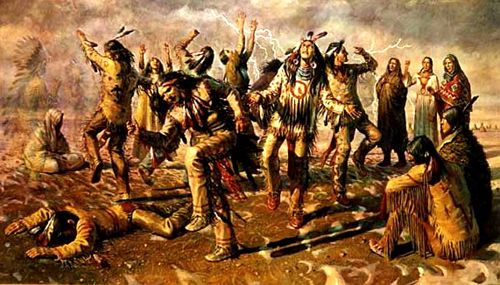
Ghost Dance Painting
In 1890, the Ghost Dance religion was spreading among the Sioux. Following the vision of a Paiute Indian named Wovoka, the spiritual movement gave hope to Native Americans when conditions were terrible on Indian reservations. Wovoka’s vision prophesized that if the Ghost Dance was performed, whites would vanish, the buffalo would return, and Indian land, life, and culture would be restored. When the dance spread to the Lakota, the Indian Agents became alarmed. Attempting to quell the movement, the army massacred approximately 200 men, women, and children at Wounded Knee. Eastman was the only physician to care for those who survived.
In 1891, Charles married Elaine Goodale of Massachusetts, a poet and Indian welfare activist. The couple would eventually have six children. In 1893, he moved his family to St. Paul, Minnesota, where he started a private practice. Unfortunately, the practice was not successful, and, financially struggling, his wife encouraged him to write some of his childhood stories. He published his first two articles in 1893 and 1894 in St. Nicholas Magazine.
Over the next four years, Eastman helped establish 32 Indian groups of the Young Men’s Christian Association (YMCA). In 1899, helped recruit students for the Carlisle Indian Industrial School in Pennsylvania. Continuing to write, Eastman published a memoir, Indian Boyhood, in 1902, which recounted his first fifteen years among the Sioux. Over the next 20 years, he would write 10 more books, most of which were concerned with his Native American culture.
His writings and work with the YMCA prompted the founders of the Boy Scouts of America to request his assistance. With his fame as an author and lecturer, Eastman was instrumental in promoting that group and the Camp Fire Girls. Providing advice to both groups on organizing their summer camps, he directly managed one of the first Boy Scout camps along the shores of the Chesapeake Bay. In 1915, the family organized a summer camp at Granite Lake, New Hampshire, where they worked for several years.
During these years, Eastman was also active in national politics, particularly in matters concerning Indian rights, and often acted as an attorney for the Sioux in Washington. He was also one of the co-founders of the Society of American Indians, which advocated for the freedom and self-determination of Indians. In 1921, he and his wife, Elaine, separated, but were never legally divorced nor publicly acknowledged the separation.
From 1923-25, Eastman served as an appointed U.S. Indian inspector under President Calvin Coolidge. His recommendations would later serve as the basis of the Roosevelt Administration’s New Deal for the Indians, which sought freedom and self-determination.
In later years, Eastman built a cabin on the eastern shore of Lake Huron, where he spent his summers and wintered in Detroit with his only son, Charles, Jr., also called Ohiseya. On January 8, 1939, Charles Eastman, Sr., died in Detroit of a heart attack at 80.
©Kathy Alexander/Legends of America, updated November 2025.
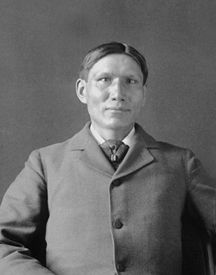
Charles Eastman
Writings by Charles Alexander Eastman
American Horse – A Shrewd Sioux Chief
Chief Gall – An Aggressive Sioux Leader
Chief Joseph – Leader of the Nez Perce and a True American
Dull Knife – Northern Cheyenne Chief
Little Crow – Leader of the Santee Uprising
Little Wolf – Courageous Leader of the Cheyennes
Rain-in-the-Face – Strategic Sioux Warrior
Red Cloud – Lakota Warrior and Statesman
Roman Nose – Cheyenne War Chief
Sitting Bull – Lakota Chief and Holy Man
Spotted Tail – Warrior, Chief & Negotiator
Also See:
Lakota, Dakota, Nakota – The Great Sioux Nation
Ghost Dance – A Promise of Fulfillment
Native American (main page)
Historical Accounts of American History
Sources: