Legends of America

Follow the links to the various pages of Legends of America

The Old West Legends of America Outhouse Madness Ghostly Legends Outlaws Old West Saloons Rocky Mountain General Store Legends Photo Store The Book Store Make your travel reservations here! Route 66 Native Americans The Old States - Back East


Legends Of America's Facebook PageLegends Of America's Twitter Page

Legends Home

Site Map

What's New!!


Content Categories:

American History

Destinations-States

Ghost Towns

Ghostly Legends

Historic People

Native Americans

Old West

Route 66

Travel Center

Treasure Tales

   Search Our Sites

Custom Search

Google

About Us

Advertising

Article/Photo Use

Copyright Information

Blog

Forum

Guestbook

Links

Newsletter

Privacy Policy

Writing Credits


We welcome corrections

and feedback!

Contact Us


Legends Of America's

Rocky Mountain General Store


Old West Mercantile

Route 66 Emporium

TeePee Trading Post

Book Shelf

History Tech
Postcard Rack

Wall Art

and Much More!


  Legends Of America's Rocky Mountain General Store - Cart View


Legends' Photo Prints

Legends Of America's Photo Print Shop
 

Ghost Town Prints

Native American Prints

Old West Prints

Route 66 Prints

and Much More!!
 

Legends Of America's Photo Print Shop - Cart View


Mississippi Civil War Battles - Page 2


Civil War History Collections


<< Previous 1 2 3 4 Next >>


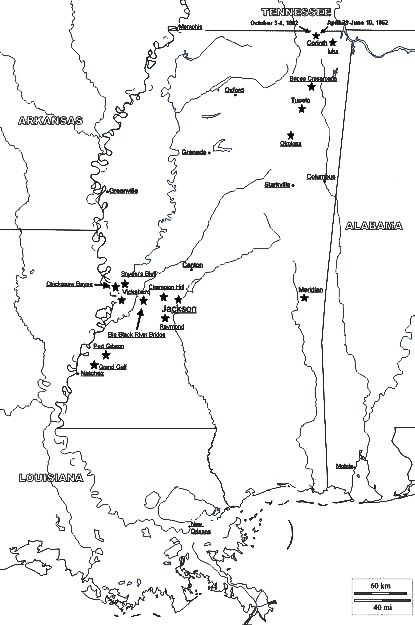
Battle of Corinth (October 3-4, 1862) - Also referred to as the Second Battle of Corinth, this skirmish took place in Alcorn County, Mississippi under
Union commander Major General William S. Rosecrans’ and Confederate Major General Earl Van Dorn.  After the Battle of Iuka, Major General Sterling Price's Confederate Army of the West marched from Baldwyn to Ripley where it joined Major General Earl Van Dorn's Army of West Tennessee. Van Dorn was the senior officer and took command of the combined force numbering about 22,000 men. The Rebels marched to Pocahontas on October 1st, and then moved southeast toward Corinth. They hoped to seize Corinth and then sweep into middle Tennessee. Since the Siege of Corinth, in the spring, Union forces had erected various fortifications, an inner and intermediate line, to protect Corinth, an important transportation center.


Confederate dead at Corinth, Mississippi

The Battle of Corinth was devastating to the Confederates, leaving

 in its wake 4,838 casualties

With the Confederate approach, the Federals, numbering about 23,000, occupied the outer line of fortifications and placed men in front of them. Van Dorn arrived within three miles of Corinth at 10:00 am on October 3rd and moved into some fieldworks that the Confederates had erected for the Siege of Corinth. The fighting began, and the Confederates steadily pushed the Yankees rearward. A gap occurred between two Union brigades which the Confederates exploited around 1:00 pm. The Union troops moved back in a futile effort to close the gap. Price then attacked and drove the Federals back further to their inner line. By evening, Van Dorn was sure that he could finish the Federals off during the next day. This confidence -- combined with the heat, fatigue, and water shortages -- persuaded him to cancel any further operations that day. Rosecrans regrouped his men in the fortifications to be ready for the attack to come the next morning. Van Dorn had planned to attack at daybreak, but Brigadier General Louis Hébert's sickness postponed it until 9:00 am. As the Confederates moved forward, Union artillery swept the field causing heavy casualties, but the Rebels continued on. They stormed Battery Powell and closed on Battery Robinett, where desperate hand-to-hand fighting ensued. A few Rebels fought their way into Corinth, but the Federals quickly drove them out. The Union troops  continued on, recapturing Battery Powell, and forcing Van Dorn into a general retreat. Rosecrans postponed any pursuit until the next day. As a result, Van Dorn was defeated, but not destroyed or captured, at Hatchie Bridge, Tennessee, on October 5th. The Union victory resulted in an estimated 2,359 Union casualties and 4,838 Confederate


Operations Against Vicksburg (December 1862-January 1863) - A series of maneuvers and battles in the Western Theater directed against Vicksburg, Mississippi, a fortress city that dominated the last Confederate controlled section of the Mississippi River. This campaign is divided into two phases by historians: Operations Against Vicksburg (December 1862 – January 1863) and Grant's Operations Against Vicksburg (March–July 1863), which consisted of a number of  important naval operations, troop maneuvers, failed initiatives, and eleven distinct battles from December 26, 1862, to July 4, 1863. Commanded by Major General Ulysses S. Grant, he initially planned a two-pronged approach in which half of his army, under Major General William T. Sherman, would advance to the Yazoo River and attempt to reach Vicksburg from the northeast, while Grant took the remainder of the army down the Mississippi Central Railroad. However, both of these initiatives failed and Grant turned to waterborne expeditions on the Mississippi River south of Vicksburg, which also failed. In the end, a combination of naval and overland assaults would gain control of Vicksburg and the Mississippi River. These events are widely considered the turning point of the Civil War and Grant's Vicksburg Campaign is considered one of the masterpieces of American military history.


Chicasaw Bayou, Mississippi

Chicasaw Bayou, Mississippi, William Redish Pywell,1864.

Battle of Chickasaw Bayou (December 26-29, 1862) - Also called the Battle of Chickasaw Bluffs and  Battle of Walnut Hills, this skirmish took place in Warren County, Mississippi8 under Union Commander Major General William T. Sherman and Confederate Lieutenant General John C. Pemberton  On December 26th, General Sherman led three Union divisions to approach the Vicksburg defenses from the northeast. Sherman and his troops disembarked at Johnson's Plantation on the Yazoo River, while a fourth division landed  farther upstream on the 27th. That same day, the four divisions of Union troops pushed their lines forward through the swamps toward Walnut Hills, which were strongly defended. On the 28th, several futile attempts were made to get around these defenses.


On December 29th, Sherman ordered a frontal assault which was repulsed with heavy casualties. Sherman then withdrew. This Confederate victory frustrated Grant's attempts to take Vicksburg by direct approach. Estimated casualties were 1,776 Union and 207 Confederate.


General Sherman then suggested a combined land and naval movement against the Arkansas Post 50 miles up the Arkansas River from its confluence with the Mississippi River, a base from which Confederate gunboats were attacking Union shipping. The Battle of Arkansas Post occurred on January 9-11, 1863, resulting in a Union Victory.


In the meantime, General Ulysses S. Grant spent the the rest of the winter constructing alternative waterways so that troops could be positioned within striking distance of Vicksburg, without requiring a direct approach on the Mississippi River under  Confederate guns. Termed "Grant's Bayou Operations," these initiatives including canals, dikes, and small dams was unsuccessful and Grant turned his attention to other maneuvers.


Continued Next Page

<< Previous 1 2 3 4 Next >>

From the Rocky Mountain General Store

Camera - Vintage Photos IconVintage Photographs of Railroads & Depots - From our personal Photo Print Shop, you can now order prints that provide dramatic glimpses into the rich heritage of the railroad and its part in the history of the American West.

    vintage railroad prints   vintage railroad prints   vintage railroad prints   vintage railroad photographs   vintage railroad prints


                                                              Copyright © 2003-2012, www.Legends of America.com