
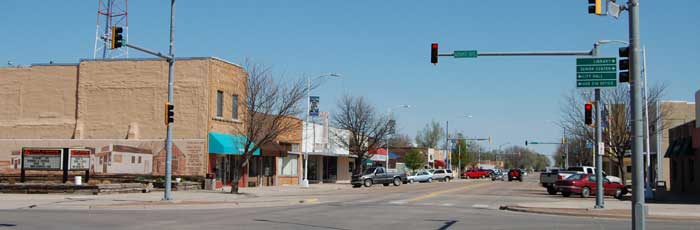
Ulysses, Kansas Main Street by Kathy Alexander.
Ulysses was born twice along the Cimarron Branch of the old Santa Fe Trail in Grant County, Kansas. The first time was in 1885, when it was founded; a second time was when the entire town was loaded onto skids and moved three miles across the prairie.
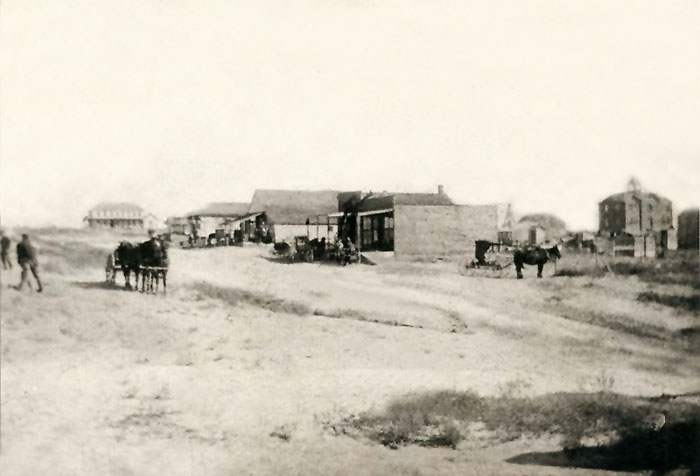
Old Ulysses, 1906
Ulysses was established on March 20, 1873, when Santa Fe Trail traffic was beginning to slow due to the arrival of steam engines in western Kansas. But the steam engine led to several towns springing up in Grant County, including Appomattox, Golden, Shockey, Zionville, and several other now-extinct towns. At one time, there were approximately 20 post offices in Grant County; however, all but Ulysses are now closed. The only other remaining towns are the tiny little unincorporated burgs of Hickok and Ryus.
The town was named for General Ulysses S. Grant, and the settlement was surveyed by George Washington Earp, first cousin to Wyatt Earp of Dodge City and Tombstone fame, in 1885. Earp was one of Ulysses’ first promoters, a businessman, and, like his cousins, the first peace officer. Furthermore, according to legend, he was just as “free with his gun” as Wyatt and his bunch.
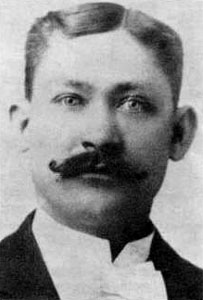
George Washington Earp
By 1886, the town boasted nearly 1,500 people, an opera house, a large hotel, several other businesses, and six saloons, even though Kansas was considered a dry state at the time. Two years later, it had added 500 residents, two more hotels, and supported 12 restaurants.
When Grant County was first established in 1887, there were two candidates for the county seat — Ulysses and Tilden (later called Appomattox.) The governor’s proclamation was not made until June 1888, at which time he named Ulysses as the temporary county seat and appointed County Officers.
A few months later, an election was held to determine the permanent location of the county seat on October 16, 1888. Before and after the election, the two towns were embroiled in a fierce county-seat war.
Constable George Earp would later say that the Ulysses Town Company imported several noted gunmen “to protect the security of the ballot” at the elections. Among them were Bat Masterson, Luke Short, Ed Dlathe, Jim Drury, Bill Wells, and Ed Short. The men built a lumber barricade across the street from the polling place, stationing themselves behind it with their Winchesters and six-shooters in case of trouble or an attempt to steal the ballot box. But no trouble erupted, and in the end, the election resulted in a win for Ulysses.
But, like many other Kansas Counties, the fight wouldn’t end there. Following corruption charges, the case went to the Kansas Supreme Court, where a Tilden partisan submitted evidence, Alvin Campbell. He presented evidence showing that the Ulysses city council had bonded the people for $36,000 to buy votes, claiming that the total votes paid for were 388.
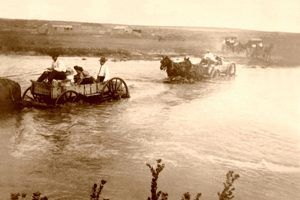
Fording the Cimarron River in Grant County, Kansas
It was an “open secret” that votes were bought, and “professional voters” had been brought in, boarded for the requisite 30 days before the election, and given $10 each upon voting. But it was not known at the time that this had been done at public expense. It was also alleged that “professional toughs” were hired to intimidate the Tilden voters.
The revelation that public funds had been used created excitement among the county’s citizens, who found themselves subject to bond payments, and those responsible for the outrage retaliated against Alvin Campbell by tarring him in August 1889.
It was also shown in court that Tilden had bought votes and engaged in irregular practices, and though Ulysses finally won, it was a dearly bought victory. In addition to the $36,000 spent in the county seat fight, $13,000 in bonds had been voted for a schoolhouse and $8,000 for a courthouse. Ulysses has since retained its county seat status.
At the height of the county seat contest between Ulysses and Appomattox in 1888, Ulysses boasted a population of 2,000. He supported 12 restaurants, four hotels, several other businesses, six gambling houses, and 12 saloons.

New Ulysses, Kansas, 1909.
Although she finally won the honor of county seat, the town went deeply into debt in the process. In 1909, when Ulysses could not extricate itself from its profound financial burden and prevent foreclosure of the entire townsite, the community decided to relocate. Loading every building onto skids, the townspeople relocated three miles across the prairie to the present-day site of Ulysses. All the lots in the old town were deeded back to the East Coast bondholders, and only a masonry school was left behind.
But the troubles weren’t over. In 1898, the county experienced severe crop failure, causing panic and reducing the population of Ulysses from 1,500 to 400, and later to only about 40 souls. Buildings were relocated, banks closed, and merchants allowed their stock of goods to run down.
The “new” town was officially called “New Ulysses,” and the old site was referred to as “Old Ulysses.” The Hotel Edwards had to be cut into three sections for moving. Today, it is the only remaining business building moved from the old town. It now rests on the Grant County Museum grounds, restored to its original appearance.
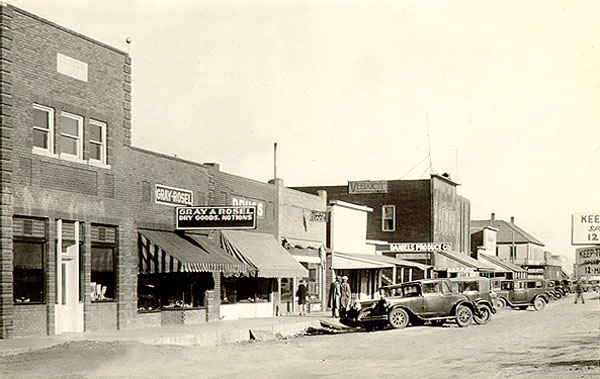
Ulysses, Kansas 1929
“Old Ulysses” was located about three miles east of Ulysses on U.S. Highway 160. The site is now on private property.
In the 1920s, natural gas was discovered in the area surrounding Ulysses. The Hugoton natural gas field, known as “The Gas Capital of the United States,” covers more than 4,800 square miles. This discovery led to a strong area of prosperity.
In 1921, the town name was officially changed to “Ulysses” rather than “New Ulysses.”
Today, a portion of the Ulysses High School grounds is on the old site of Appomattox. Part of the old Hotel Edwards is a feature of the local museum, and history is abundant at nearby Wagon Bed Spring, south of town.
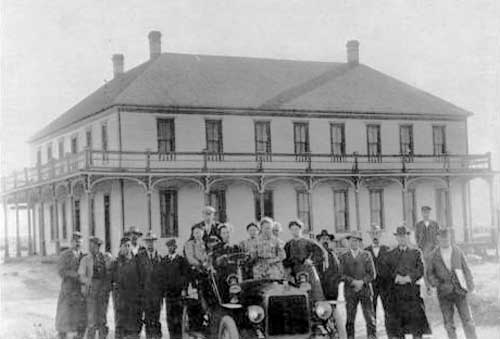
Hotel Edwards in Old Ulysses, Kansas.
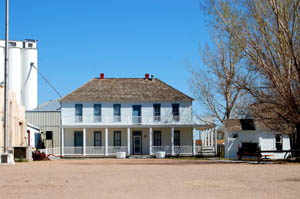
The Hotel Edwards is now part of the Grant County Museum, by Kathy Alexander.
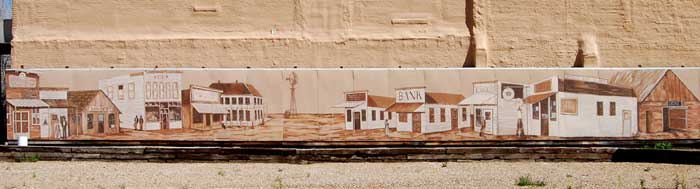
A mural in Ulysses, Kansas, depicts its history by Kathy Alexander.
The vast plains that surround Ulysses afford the most spectacular sunrises and sunsets that one has ever seen. For the hunting enthusiast, the area is renowned for its excellent deer and pheasant hunting.
The Cimarron Cutoff on the Santa Fe Trail passed just east of the current site of Ulysses, turned south, and crossed the path of the current highway US 160 following the Cimarron River.
The famous watering spot along the Santa Fe Trail, Wagon Bed Spring, is located ten miles south of Ulysses. The Cimarron cutoff posed a risk to early travelers, as the journey was perilous due to dry creek beds and frequent Indian attacks. However, many were willing to take the risk to save hundreds of miles of travel rather than take the “safer” trail through Colorado. The “La Jornada,” as the dry crossing between the Cimarron and the Arkansas Rivers became known, was the shortest road from Fort Leavenworth, Kansas, to the Southwest. Near here, noted Western explorer and fur trader Jedediah Smith spent four days without water and was killed by Comanche Indians just as he reached the river.
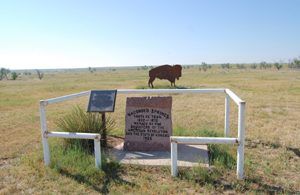
Wagon Bed Spring Marker near Ulysses, Kansas by Kathy Alexander.
Although no military post was ever established at Wagon Bed Spring, hundreds of soldiers rested there from the start of the Mexican-American War in 1846 until the railroads replaced the wagon road.
1864 was the bloodiest year for Indian attacks all along the Santa Fe Trail, and 15 men were killed at Wagon Bed Spring during two weeks. Soon, General James H. Carleton, commanding the Department of New Mexico, sent 100 men to Wagon Bed Spring with rations for sixty days. Today, the site still provides “treasure” hunters with caches of lead balls, empty cartridges, and arrowheads.
In 1961, Wagon Bed Spring was recognized as a National Historic Landmark. However, the spring itself is long and dry, having been irrigated to cultivate the fertile fields of western Kansas.
Ulysses is located in Grant County in southwest Kansas.
© Kathy Weiser-Alexander/Legends of America, updated June 2022.
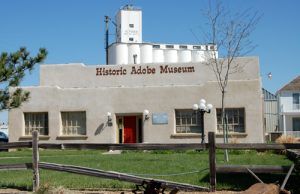
Grant County Museum, Ulysses, Kansas by Kathy Alexander.
P.S. – This is the small Kansas town that I grew up in.
Also See:
Wagon Bed Spring – On the Santa Fe Trail
See Sources.