

Exodusters En Route to Kansas by Harper’s Weekly, 1879
“I am anxious to reach your state … because of the sacredness of her soil washed by the blood of humanitarians for the cause of freedom.”
— S.L. Johnson, black Louisianan, in a letter to Kansas Governor John St John, 1879
Nicodemus, Kansas, is the only remaining western community established by African Americans after the Civil War. As an important part of American History, the town symbolizes the pioneering spirit of these ex-slaves, who fled the war-torn South in search of “real” freedom and a chance to restart their lives. This semi-ghost town has since gained recognition as a National Historic Site.
In the late 1870s, the black population of the South was extremely restless, as the Reconstruction following the Civil War failed to bring long-awaited freedom, equality, and prosperity. Instead, they were racially oppressed, poverty-stricken, debt-ridden, and starving.
At this time, a white man named W.R. Hill came along, who described a “Promised Land” in Kansas to black families in the backwoods of Kentucky and Tennessee. Hill described a sparsely settled territory with abundant wild game and wild horses that could be tamed, and an opportunity to own land through the homesteading process in Nicodemus, Kansas.
The townsite of Nicodemus was planned in 1877 by W.R. Hill, an Indiana land developer, and Reverend W.H. Smith, a Black man, who formed the Nicodemus Town Company. Reverend Smith became the President of the Town Company, and Hill the treasurer. Named for a legendary figure who came to America on a slave ship and later purchased his freedom, Nicodemus was organized with settlers specifically solicited. The Reverend Simon P. Roundtree was the first settler, arriving on June 18, 1877. Zack T. Fletcher and his wife, Jenny Smith Fletcher (the daughter of Reverend W.H. Smith), arrived in July, and Fletcher was named the secretary of the Town Company. Smith, Roundtree, and the Fletchers claimed their property and built temporary homes in dugouts along the prairie.
In the late summer of 1877, 308 railroad tickets were purchased for more families in the South to take them to the closest railroad point in Ellis, Kansas. Still 35 miles away, the families walked to Nicodemus and arrived in September 1877. Within one month, the first black child was born in Graham County to Charles & Emma Williams.
Building homes along the Solomon River in dugouts, the original settlers found more disappointment and privation as they faced adverse weather conditions. In the Promised Land of Kansas, they initially lacked sufficient tools, seeds, and money. Still, they managed to survive the first winter, some by selling buffalo bones, others by working for the Kansas Pacific Railroad at Ellis. Yet, others survived only with the assistance of the Osage Indians, who provided food, firewood, and staples.
Though most stayed, many were disillusioned by the lack of vegetation and the land’s starkness and quickly returned to the green fields of Kentucky and Tennessee. Of those who stayed, the spring of 1878 brought hope and opportunity as the new settlers began to farm the soil.
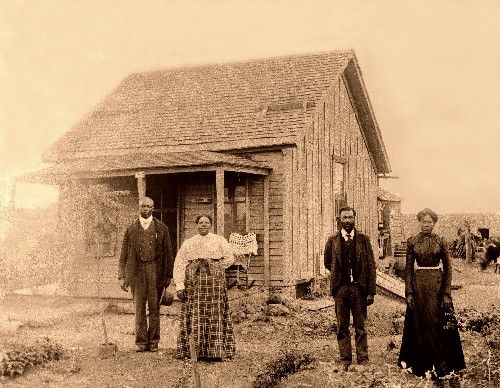
Exodusters in Nicodemus, Kansas.
The spring of 1878 also heralded the arrival of more families from the South, and a local government was established under the leadership of “President Smith.” One woman arriving in the spring, Williana Hickman, said years later of arriving at Nicodemus,
“When we got in sight of Nicodemus, the men shouted, ‘There is Nicodemus!’ Being very sick, I hailed this news with gladness. I looked with all the eyes I had. I said, “Where is Nicodemus? I don’t see it.” My husband pointed out various smokes rising from the ground and said, “That is Nicodemus.” The families lived in dugouts… The scenery was not at all inviting, and I began to cry.”
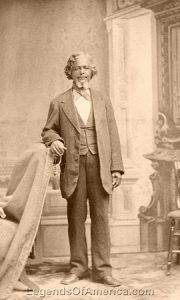
Benjamin “Pap” Singleton.
Despite the living conditions and their longing for the forested hills of Kentucky, Williana and her husband, Reverend Daniel Hickman, stayed, organizing the Mt. Olive Baptist Church four miles West of Nicodemus in a dugout with a sod structure above it. By 1880, a small, one-room stone sanctuary had been erected at the same site.
The Nicodemus Town Company issued numerous circulars to promote the town, inviting “Colored People of the United States” to settle in the “Great Solomon Valley.” The Reverend Roundtree became actively involved in the promotion and worked with Benjamin “Pap” Singleton, a black carpenter from Nashville, who traveled across the country distributing circulars. Singleton, who could not read or write, distributed so many circulars that he was sometimes called the “Moses of the Colored Exodus.” The Blacks who decided to emigrate soon acquired the nickname “Exodusters.”
The black refugees associated Kansas with the Underground Railroad and the fiery abolitionist John Brown and were exceptionally responsive to opportunities to settle there. Handbills and flyers distributed by the Nicodemus Town Company portrayed Nicodemus as a place for African Americans to establish Black self-government. At the same time, railroads, seeking to populate the West and create markets for their services, exaggerated the qualities of the soil and climate in this “Western Eden.”
One of the town’s first settlers, Zachary Fletcher, became the town’s first postmaster and entrepreneur, establishing the St. Francis Hotel and a livery stable in 1880. His wife, Jenny Smith Fletcher, became the first postmistress and schoolteacher, and one of the original charter members of the African Methodist Episcopal Church. The complex Fletcher built, which housed the post office, school, hotel, and stable, later became known as the Fletcher-Switzer House and served as an essential focal point of community activity. The building still stands in Nicodemus today.
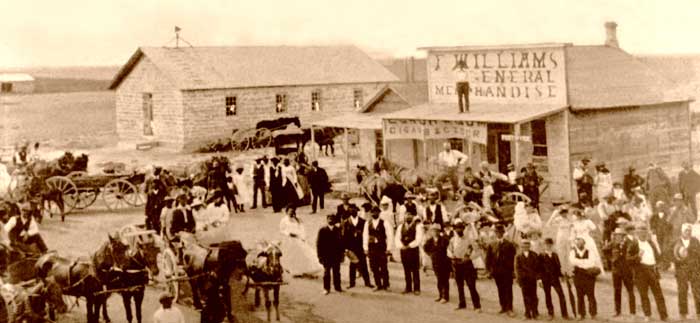
Nicodemus, Kansas, 1885.
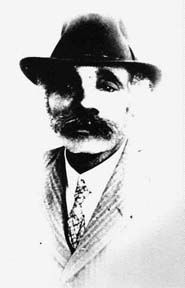
Zachary Fletcher.
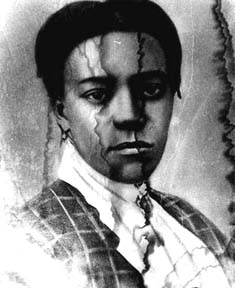
Jenny Smith.
By 1880, Nicodemus had a population of almost 500, boasting a bank, two hotels, three churches, a newspaper, a drugstore, and three general stores, all set within twelve square miles of cultivated land. As the town began, Governor John St. John made a speech welcoming the new arrivals. Then, possibly at the urging of S. J. Gilmore, land commissioner for the Kansas Pacific Railroad, who said of the blacks, “Indications are that we will be overrun with them next year,” Governor St. John began to discourage black immigrants and said that conditions in Kansas were not as promising as they had been led to believe.
Edward P. McCabe, who joined the colony in 1878, served two terms as state auditor from 1883 to 1887, becoming the first African American to hold a major state office.
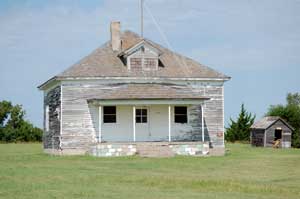
Old School in Nicodemus, Kansas, by Dave Alexander.
By 1887, Nicodemus had gained more churches, stores, a literary society, an ice cream parlor, a lawyer, another newspaper, a baseball team, a benefit society, and a band. Hopes were high in the community when the railroad announced plans to extend from Stockton to Nicodemus. In March of 1887, the voters of the Township approved the issuance of $16,000 in bonds to attract the Union Pacific Railroad to the community. Despite the bond issue, the town and the railroad were unable to agree on financial compensation, and the railroad withdrew its offer. In 1888, the railroad established the extension six miles south of the Solomon River. Leaving Nicodemus a stranded “island village,” businesses fled to the other side of the river to the Union Pacific Railroad camp that later became known as the town of Bogue. With the businesses leaving, Nicodemus began a long, gradual decline.
After the rail service failed to materialize, Zachary Fletcher, the town’s first entrepreneur, sold his town lots to the original promoter, W.R. Hill, but continued to run his businesses. Eventually, the hotel was briefly returned to Graham County, but in the 1920s, Fred Switzer, a great-nephew whom the Fletchers had raised, brought it back into the family. When Switzer married Ora Wellington in 1921, they made the hotel their home.
By 1928, the farmers of Nicodemus were cultivating between 50 and 1,000 acres each. When the seasons were favorable, the lands frequently yielded more wheat than their actual sale value.
But in 1929, the Great Depression brought disaster to Nicodemus as farm prices fell. Most young people began leaving the area during this time.
Further devastation occurred when the area faced severe droughts in 1932, 1933, and 1934, followed by Kansas’s infamous Dust Bowl days in the late winter and early spring of 1935. Entire families then left what had become an unproductive region.
By 1935, the small town had been reduced to just 76 people and supported only a church, a hall, and a store with a meager stock. Most of the marketing and trading were carried out at Bogue, about six miles away.
In 1938, a community center was built from locally quarried limestone. It now hosts a National Park Service ranger, historical displays, and a gift shop. The center was a Works Progress Administration project during the Great Depression.
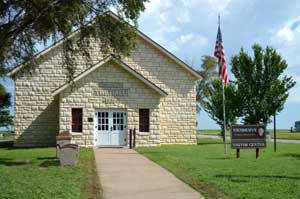
Township Hall in Nicodemus, Kansas, by Kathy Alexander.
By 1950, Nicodemus had been reduced to 16 inhabitants, and the necessities of life had to be purchased in nearby Bogue. The post office closed in 1953.
More than a half-dozen black settlements sprang up in Kansas after the Civil War, but Nicodemus was the only one to survive. Kansas’ first black settlement and Graham County’s first community were designated as a National Historic Landmark in 1976. Twenty years later, on November 12, 1996, Nicodemus was designated as a National Historic Site. This legislation directs the National Park Service to assist the community in preserving historic structures and interpreting the history to benefit present and future generations.
The only remaining business is the Nicodemus Historical Society Museum, which operates on a sporadic schedule. Pamphlets, a walking tour map and guide, and video presentations are available at the Nicodemus Community Center. Today, Nicodemus is home to approximately 20 people.
Every year, on the last weekend in July, Emancipation Day is celebrated, and descendants of original town settlers come home. The town is filled with people who take pride in their heritage. Events include a parade, food, and a celebration of heritage and family.
Nicodemus is located 55 miles northwest of Hays, Kansas, on Highway 24 between Hill City and Stockton. Visitor Information: 785-839-4233
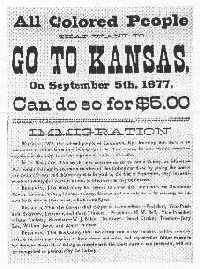
Nicodemus Town Company Circular.
©Kathy Alexander/Legends of America, with input from Angela Bates, executive director- Nicodemus Historical Society, updated June 2026.
Also See:
Chattel Hood to Freedom – Black Pioneers Help Settle California
African American History in the United States
Sources:
Blackmar, Frank W.; Kansas: A Cyclopedia of State History, Standard Publishing Company, Chicago, IL, 1912.
National Park Service – Nicodemus
Nicodemus Historical Society & Museum
Historic Site Brochures and Interactive Boards
Thompson, Isabel, and Clarke, Louise T.; Ghost Town—Almost: The Depression Hits a Negro Town; Opportunity, Journal of Negro Life; September 1925