|
Legends Home
Site
Map
What's New!!

American History
Ghost Towns
Ghostly Legends
Historic People
Native Americans
The Old West
Photo
Galleries
Roadside
Attractions
Rocky Mtn Store
Route 66
Travel
Destinations
Treasure Tales
Legends Blog
Free E-Newsletter
Facebook
Fanpage
Twittering

Contact Us
Please report
broken
links, missing pictures, or
other problems online by
clicking
HERE or send us
an
email. Thanks!
| |
|
|
|
Arizona Forts of the
American West |
|

|
|
<<
Previous
1 2 Next >> |
|
Fort Lowell
(1862-1891) - A part of the system of forts guarding
southern
Arizona during the years of
Apache hostilities, this one served
more as a supply depot and administrative center than as a combat base. It
occupied two sites; the first of which was little more than a tent city,
established in May 1862 just east of Tucson by
California Volunteers who
had captured the town from the Confederates. In March, 1873 the post was
relocated seven miles northeast of town, where permanent adobe
construction began. Its role encompassed escorting wagon trains,
protection of settlers, guarding supplies, patrolling the border and
conducting offensive operations against the Western and Chiricahua
Apache
Indians.
|

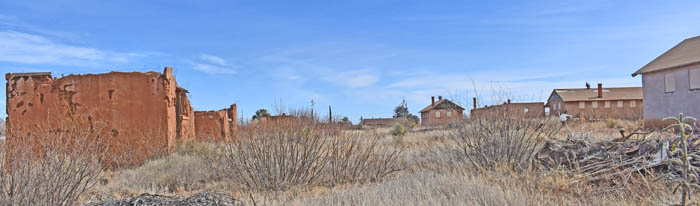
Fort Lowell today, courtesy
Old Fort Lowell
Neighborhood Association |
|
With the end of the
Apache Wars the army
saw no further need for Fort Lowell and in 1891 the post was abandoned.
Today, the Santa Rita Hotel is located on
the first site. However, the second site has been maintained by the
Arizona Historical Society and Pima County. There are several noteworthy
remains including 7 feet high ruins, the hospital and one cavalry and two
infantry barracks. Now called Fort Lowell Park, the commanding officer's
house has been reconstructed and furnished it in period style, now housing
a museum.
Outside the park, about 200 yards to the
west on Fort Lowell Road, is the sutler's store, now a private residence;
and three officers' quarters, in varying condition, on privately owned
land. Immediately to the east are the ruins of the guardhouse. Fort Lowell
Park is located
The park is located at the corner of
Cracroft and Fort Lowell Road in northeastern Tucson.
Contact Information:
Old Fort Lowell Neighborhood Association
5230 E. Fort Lowell Road
Tucson,
Arizona 85712
520-318-0219
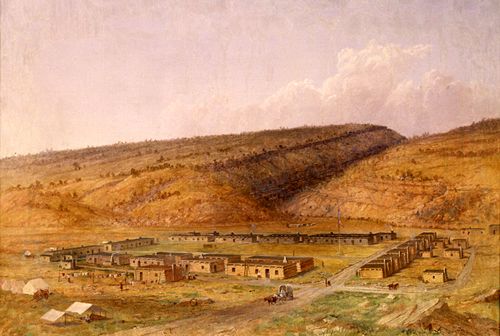
Fort
Mojave (1859-1890) - Originally established as Camp Colorado in
April, 1859, the fort was situated on an eastern bluff overlooking the "Mojave Road"
or "Beale's Road" and the Colorado River crossing that had become popular
with settlers and miners headed for
California.
Established to provide shelter for emigrants and a base of operations
against the sometimes hostile Mojave Indians.
|
|
|
|
By order of Brigadier
General Edwin V. Sumner, the fort buildings were burned down in May, 1861,
so they would not fall into Confederate hands. Just two years later;
however, the fort was rebuilt and re-garrisoned in May, 1863, to once
again protect travelers and to cultivate friendly relations with the
Indians.
On September 29, 1890
the War Department turned the post over to the Bureau of Indian Affairs
and all troops were evacuated to other posts. A military-style boarding
school was then housed in the old fort buildings that schooled various
Indian tribe members from
Arizona,
Nevada,
and
New Mexico.
The school continued until 1935.
The site today displays
just a very few ruins atop the bluff overlooking the Colorado River just
south of present-day Bullhead City. It is now part of the Fort Mojave
Indian Reservation.
|
|
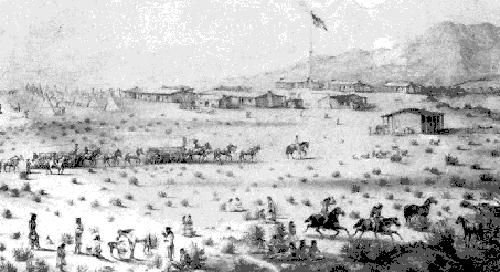
Fort Thomas (1876-1891) - After
Fort Goodwin was
closed, the Gila Valley was still in need of protection and a new post on
the Gila River was established in the summer of 1876, about six miles east
of old Fort Goodwin. The post was initially named Camp Thomas in honor
Adjutant General Lorenzo Thomas, who had died in 1875. Two years after it
was built, the post was moved to the present-day town site of Fort Thomas.
At its peak, 27 buildings were situated at the fort, all constructed of
adobe by the soldiers. Like its predecessor,
Fort Goodwin, the
post was also afflicted with malaria outbreaks throughout its existence.
The post was re-designated as a fort in 1882 and became the regimental
headquarters for the 3rd U.S. Cavalry that same year.
|

Fort Thomas, 1882. |
|
Following
the Battle of Cibecue on
August 30, 1881, right up until the final surrender of Geronimo in 1886,
Fort Thomas was an active military post. However, with the
Apache Wars
over, the troops gradually began to be moved to other posts and the fort
began to decline. It was over to the Department of the Interior in the
spring of 1891.
The town
that grew up around the fort, which took its name, had a poor reputation
in its earliest days – filled with brothels and saloons. The small,
unincorporated community continues to be populated today, but of the fort
there are no remains.
The site of the first Camp Thomas is marked with a bronze plaque reading
"Geronimo." On the north side of U.S. highway 70 between the abandoned
village of Geronimo and the present day town of Fort Thomas. The site of
the second Fort Thomas is about one mile west along U.S. highway 70 on the
across the highway from the Fort Thomas high school. There are no visible
remains except for a few stones with mortar between them on a low hillside
to the southeast of the original site.
Fort Whipple (1863-1913) - Established in
November, 1863 one-mile northeast of Prescott in the Chino Valley, the
U.S. Army post served as
Arizona
Territory's capital prior to the founding of Prescott. It was named for
Lieutenant Amiel W. Whipple, who led a military expedition into the area
in 1853-54 and established the first access routes to nearby gold fields,
but died in 1863 of wounds received during the Civil War. The post was
moved in May, 1864 to Granite Creek, closer to Prescott. Its purpose was
to protect miners and settlers from Indian raids and for years, the
cavalry and infantry soldiers stationed at the fort participated in a
number of Indian skirmishes. By 1869, the quickly erected buildings were
condemned, torn down, and new buildings replaced them.
The next
year, the Whipple Barracks became the Headquarters for the Military
Department of
Arizona
in April, 1870. At the same time, the post was serving as a tactical base
for the United States Cavalry during the Indian Wars of 1864 to 1882. The
post also served as
General George Crook's
District of
Arizona
headquarters in 1882.
Once the
Indians were "under control,” the post lost its importance and was
discontinued in 1898. However, just four years later it was re-garrisoned
in 1902 and new officers’ quarters built in 1904. The post closed for the
last time on February 15, 1913. It was reactivated as a U.S. Army Hospital
in 1918 to treat World War I veterans. It ceased being a military
installation in 1922 and was later made into a Veteran’s Administration
Hospital.
Today,
the fort grounds are much reduced – from 1,700 acres to about 150 acres
and many of the old buildings have been obliterated by modernization.
However, other historic buildings remain and the Fort Whipple Museum
stands out among the buildings, with its colorful painted exterior
beckoning to visitors. Situated in one of the officer quarters buildings
on a hillside south of the hospital, the museum is a joint project between
the hospital and the Sharlot Hall Museum in downtown Prescott. The museum
features exhibits that trace the history of the post and once a month,
local re-enactors stage living-history presentations in and around the
museum, dressing as traders, miners and soldiers.
The
museum is open free of charge Thursday through Saturday from 10:00 am to
4:00 pm. The old fort is one mile east of
Prescott on US 89.
©
Kathy Weiser/Legends
of America, January, 2009.
|
|
<<
Previous
1 2 Next >> |
|
From the Rocky Mountain General Store
Photo
Print Shop - Travel the trails of the
American
West with our many photographs! Just take a look at our
galleries or purchase prints at very reasonable prices! Here you'll
see photographs of
Route 66,
ghost towns,
scenic and historic views, and
roadside stops.
 |
| |
|