
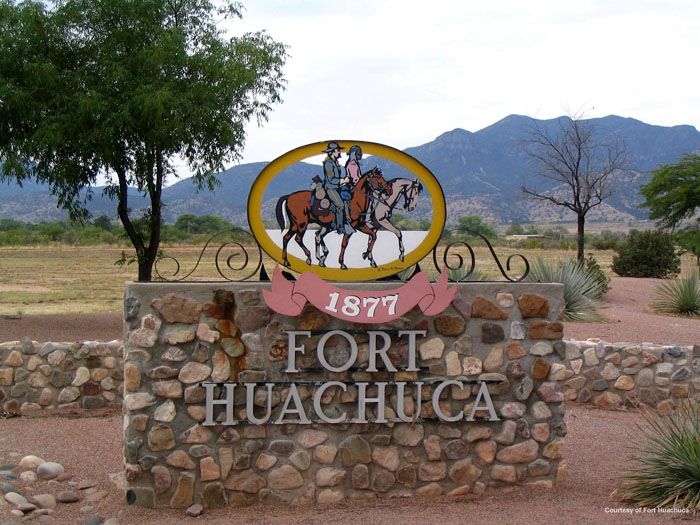
 A product of the Indian Wars of the 1870s and 1880s, Fort Huachuca, Arizona, was established in March 1877 at the base of the Huachuca Mountains. The name “Huachuca” comes from an obscure local American Indian language and loosely translates to a “place of thunder.”
The fort was one of a chain of forts established to guard southern Arizona against the Chiricahua Apache, led by Geronimo. The troops also worked to block the traditional Apache escape routes through the San Pedro and Santa Cruz Valleys to Mexico.
Captain Samuel Marmaduke Whitside and two companies of the 6th Cavalry established a temporary camp at the post’s current location on March 3, 1877. They chose the site for its fresh, running water, abundant trees, excellent observation in three directions, and protective high ground essential for security against Apache tactics. Several years later, in 1882, it was designated as a fort.
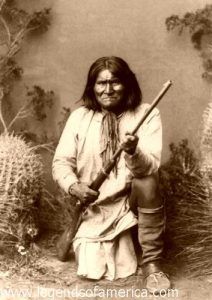
Geronimo, 1886.
In 1886, General Nelson A. Miles designated Fort Huachuca as his advance headquarters and supply base for the Geronimo Campaign. Geronimo’s surrender in August 1886 practically ended the Apache danger in southern Arizona. The Army closed more than 50 camps and forts in the territory. Still, Fort Huachuca was retained because of continuing border troubles involving renegade American Indians, Mexican bandits, American outlaws, and freebooters.
In 1913, the 10th Cavalry “Buffalo Soldiers,” one of the Army’s elite black cavalry corps, arrived and remained for almost 20 years. The 10th Cavalry joined General John J. Pershing in the 1916 expedition into Mexico and, during World War I, was assigned to guard the United States-Mexico border.
By 1933, the 25th Infantry Regiment had replaced the 10th Cavalry as the fort’s primary combat unit. The 25th was later absorbed into the 93rd Infantry Division during World War II. When the 93rd departed for the Pacific in 1943, the 92nd Infantry Division arrived at the fort for training and subsequent assignment to the European Theater. During the war years, the troop strength reached 30,000 men at the fort, which in the 1930s had been described as suitable for a brigade-sized unit of about 10,000 men.
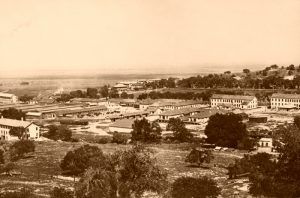
Fort Huachuca, Arizona, 1918.
At the end of the war, the fort was declared surplus and transferred to Arizona. The Army Engineers reactivated it during the Korean War.
A new era began in 1954 when control passed to the chief signal officer, who found the area and climate ideal for testing electronic and communications equipment. From that moment, the fort’s importance in the national defense picture grew steadily. In 1967, Fort Huachuca became the headquarters of the U.S. Army Strategic Communications Command.
Then, in 1971, the post became home to the U.S. Army Intelligence Center and School, bringing with it the School Brigade.
The Strategic Communications Command became the U.S. Army Communications Command in 1973, then the U.S. Army Information Systems Command in 1984, and finally the U.S. Army Signal Command in 1997. On October 1, 2002, the U.S. Army Signal Command was renamed the U.S. Army’s Network Enterprise Technology Command.
In October 1990, the post changed hands when the U.S. Army Training and Doctrine Command became the new host command. Installation Management Command now operates the post. Presently, Fort Huachuca houses the U.S. Army Intelligence Center and the U.S. Army’s Network Enterprise Technology Command.
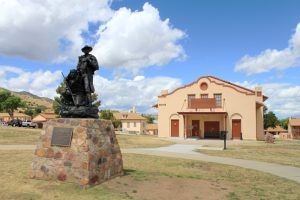
Fort Huachuca, Arizona Museum.
Today, Fort Huachuca is Arizona’s primary military installation and one of the most prominent in the Southwest. The active Army post covers more than 70,000 acres, 110 of which are the “Old Post Area.” The original Fort Huachuca cantonment was declared a National Historic Landmark in March 1977. A rustic wooden sign sits on the northeast corner of Brown Parade Field, the center of post-life during the days of horse soldiers. Surrounding buildings and homes are maintained with the appearance and flavor of the old days. Among its historic buildings are the Pershing House, an adobe structure built in 1884, traditionally the Post Commander’s quarters; the “Old Post” Barracks, built in 1882-1883; Leonard Wood Hall, a large two-storied building used as the hospital; and the Fort Huachuca Historical Museum, an adobe and stone building initially used as the post chapel.
The Fort Huachuca Historical Museum tells the fascinating history of the U.S. Army in the Southwest and the history of the Southwest itself. Opened in 1960, the museum has grown rapidly and now houses one of the state’s most representative collections. The exhibits are instructive and entertaining, and some U.S. Army manuscripts and documents, dating back as far as 1861, tell viewers a great deal about life on a rugged frontier. The museum, in Building 41401, is open to the public without charge. A museum annex across the street from the Fort Huachuca Historical Museum displays more artifacts.
The fort is located about three miles West of Sierra Vista, Arizona, on Arizona Highway 90. The Fort Huachuca Museum is located three miles northwest of the fort’s main gate at Boyd and Grierson Aves.
More Information:
Fort Huachuca
Museum: 520-533-3638
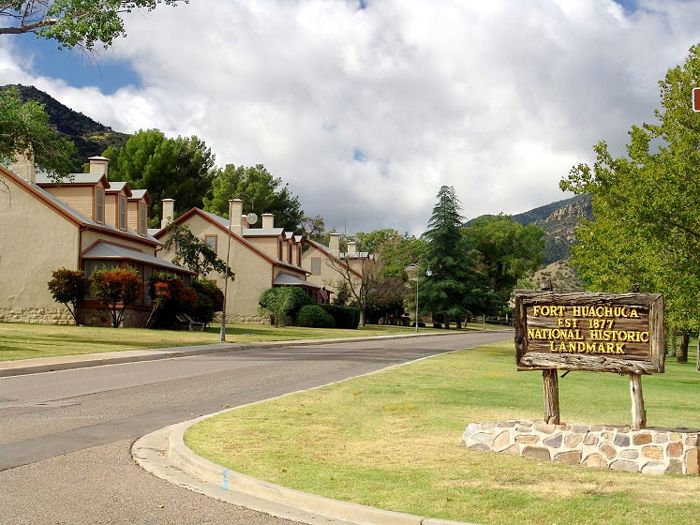
Fort Huachuca, Arizona Historic Officers’ Quarters.
©Kathy Alexander/Legends of America, updated September 2026.
Also See:
Arizona – The Grand Canyon State
Sources: